Complete syllabus of Hajj Moavineen 2026
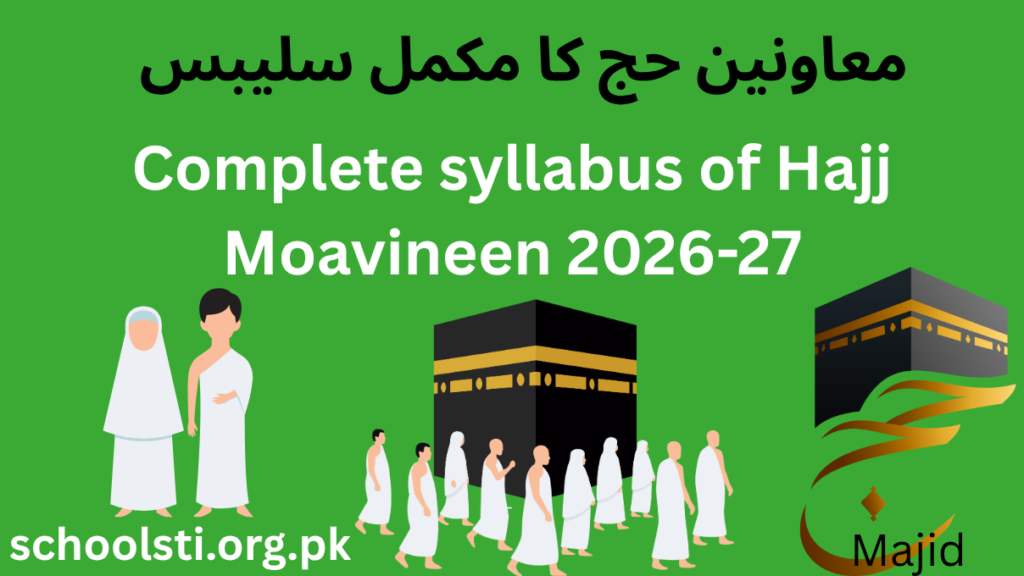
Complete syllabus of Hajj Moavineen 2026-27
Complete Syllabus of Hajj Moavineen 2026-2027: Preparation Guide, Test Pattern & Study Material
- Role & Responsibility: Hajj Moavineen (Welfare Assistants) are authority personnel deployed by Pakistan’s Ministry of Religious Affairs to assist pilgrims in Saudi Arabia across Makkah, Madinah, Mina, Arafat, and Muzdalifah.
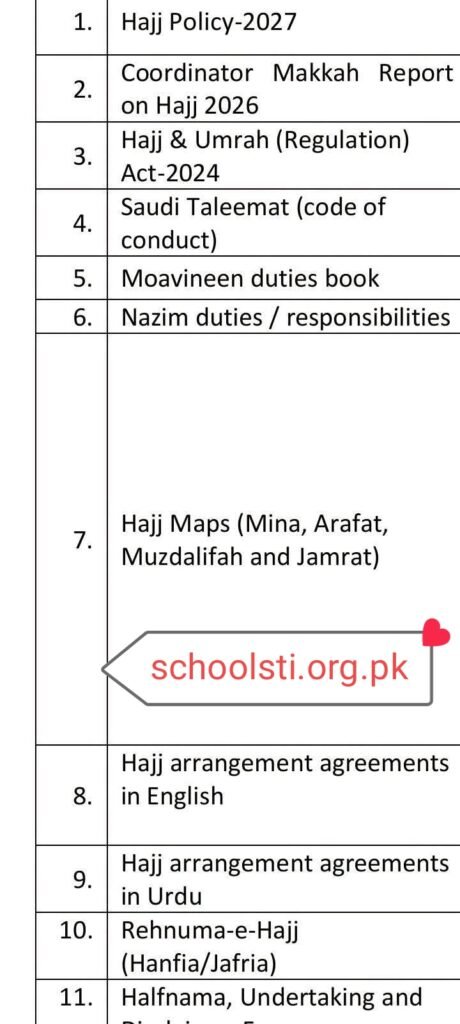
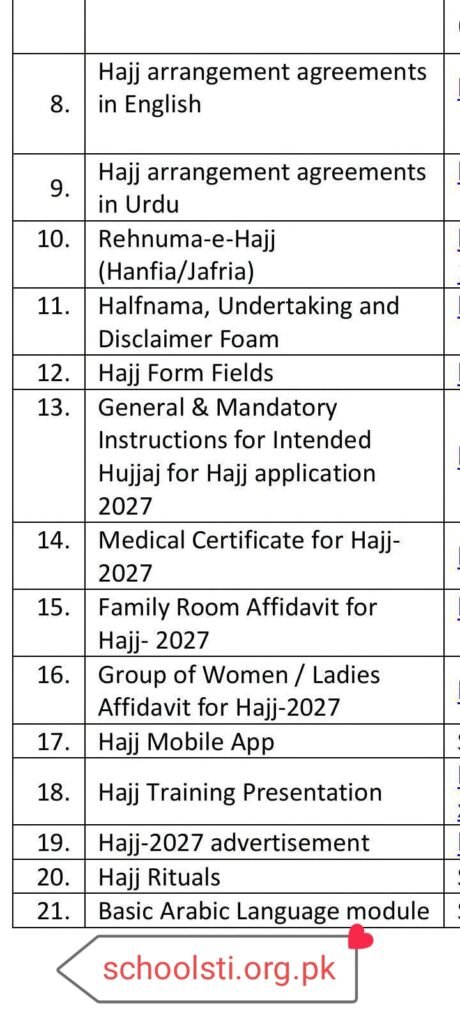
- Official Syllabus Scope: Covers 21 core areas including Hajj Policy 2027, Makkah Coordinator Reports, Hajj Act 2024, Saudi Taleemat, Mashair GIS Maps, Legal Affidavits, Pak Hajj App, and Basic Conversational Arabic.
- Test Structure: Multiple Choice Questions (MCQs) focusing on policy regulations (30%), field duties & lost/found protocols (25%), Hajj rituals & Fiqh (20%), and digital tools/Arabic terminology (25%).
- Key Passing Strategy: Master the 21 official syllabus modules, memorize Mashair sector numbers in Mina, practice digital complaint logging on the Pak Hajj Mobile App, and clear the physical endurance evaluation.
What is the Official Syllabus of Hajj Moavineen 2026-2027?
The official Hajj Moavineen syllabus 2026-2027 consists of 21 mandatory modules covering Hajj Policy 2027, the Hajj & Umrah Regulation Act 2024, Saudi Taleemat, field duties, Mashair navigation maps (Mina, Arafat, Muzdalifah), Hajj rituals (Hanfia and Jafria), Pak Hajj Mobile App operations, legal undertakings, medical requirements, and basic conversational Arabic.
Preparing for the Hajj Moavineen-e-Hujjaj screening test is quite different from studying for typical competitive exams. Several applicants walk into the examination hall assuming they will just face generic universal knowledge and basic Islamic studies questions. Nevertheless, the screening test conducted under the supervision of the Ministry of Religious Affairs and Interfaith Harmony (MORA) evaluates your exact operational readiness for managing high-stress crowds, navigating complex tent sectors under extreme heat, operating digital reporting tools, and resolving pilgrim emergencies under strict Saudi regulations.
Whether you are a government educator, administrative officer, police personnel, or an employee of an attached department applying for the upcoming Hajj season, understanding the entire 21-point syllabus is the single most important step toward securing selection.
Below is an exhaustive breakdown of the official curriculum, test preparation strategies, field insights, and practical guidelines to assist you top the merit set and perform your duties in Saudi Arabia effectively.
What is Hajj Moavineen-e-Hujjaj and Who is Eligible to Apply?
Hajj Moavineen are authority welfare staff selected from federal and provincial departments, armed forces, police, and civil administrations. Their primary mission is to serve as field guides, issue solvers, and administrative assistants for Pakistani pilgrims throughout the Hajj season in the Kingdom of Saudi Arabia (KSA).
+-----------------------------------------------------------------------------------+
|                            CORE ELIGIBILITY CRITERIA                              |
+------------------------------------+----------------------------------------------+
| Parameter                          | Requirement Details                          |
+------------------------------------+----------------------------------------------+
| Employment Status                  | Regular / Permanent Government Employee      |
| Pay Scale Range                    | BPS-01 to BPS-18 (Categorized by role)       |
| Department Clearance               | Valid Departmental NOC signed by Authority   |
| Medical Fitness                    | Medically fit (Certified via Govt Hospital)  |
| Age Bracket                        | Generally 25 to 50 years (Varies by category)|
| Prior Hajj Duty Frequency          | Restrictions apply on repeat deployments     |
+------------------------------------+----------------------------------------------+
Candidates are divided into two chief categories:
- Moavineen-e-Hujjaj (General / Field Duty): Primarily tasked with lost-and-found luggage recovery, guiding stranded pilgrims, wheelchair assistance at Haram Sharif and Jamrat, airport reception, and camp management.
- Moavineen-e-Hujjaj (Supervisory / Medical / Technical): Includes Nazims, sector coordinators, IT operators, and paramedical teams overseeing field sectors and managing communication networks.
For comprehensive educational updates, departmental test past papers, and authority career resources across Pakistan, you can explore the latest guides on Schools STI Educational Portal.
What Are the 21 Modules of the Complete Hajj Moavineen Syllabus 2026-2027?
The Directorate of Hajj divides the testing and training syllabus into 21 distinct modules. Each section addresses a precise legal, administrative, operational, or technical aspect of the Hajj operation.
+----+------------------------------------------------------------------------------+
| #  | OFFICIAL SYLLABUS MODULE TITLE                                               |
+----+------------------------------------------------------------------------------+
| 01 | Hajj Policy 2027                                                             |
| 02 | Coordinator Makkah Report on Hajj 2026                                       |
| 03 | Hajj & Umrah (Regulation) Act-2024                                           |
| 04 | Saudi Taleemat (Code of Conduct & Local Saudi Regulations)                  |
| 05 | Moavineen Duties Book (Field Guide & Standard Operating Procedures)          |
| 06 | Nazim Duties / Responsibilities (Sector & Camp Management)                   |
| 07 | Hajj Maps (Mina, Arafat, Muzdalifah, and Jamrat Sector Layouts)              |
| 08 | Hajj Arrangement Agreements in English (Service Level Agreements - SLAs)     |
| 09 | Hajj Arrangement Agreements in Urdu (Muallim & Service Provider Contracts)   |
| 10 | Rehnuma-e-Hajj (Hanfia & Jafria Fiqh Rituals & Guidelines)                   |
| 11 | Halfnama, Undertaking, and Disclaimer Forms                                  |
| 12 | Hajj Form Fields (Applicant Data Architecture & Verification)                |
| 13 | General & Mandatory Instructions for Intended Hujjaj (Hajj Application 2027) |
| 14 | Medical Certificate Requirements for Hajj 2027                               |
| 15 | Family Room Affidavit Guidelines 2027                                        |
| 16 | Group of Women / Ladies Affidavit Guidelines 2027 (Without Mahram Policy)    |
| 17 | Hajj Mobile App (Pak Hajj App / Field Tracking Architecture)                 |
| 18 | Hajj Training Presentation (Pre-Departure Orientation Modules)               |
| 19 | Hajj 2027 Official Advertisement & Terms of Engagement                       |
| 20 | Hajj Rituals (Step-by-Step Manasik-e-Hajj & Emergency Fiqh Solutions)       |
| 21 | Basic Arabic Language Module (Conversational Phrases for Field Assistance)   |
+----+------------------------------------------------------------------------------+
In-Depth Breakdown: What Does Each Syllabus Module Cover?
To score high on the screening test and avoid confusion during interviews and field deployment, let us break down each of these 21 modules in detail.
                                  HAJJ MOAVINEEN SYLLABUS
                                             │
      ┌──────────────────┬───────────────────┼───────────────────┬──────────────────┐
      ▼                  ▼                   ▼                   ▼                  ▼
[Policy & Law]   [Field Operations]  [Maps & Logistics]  [Rituals & Fiqh]   [Tech & Language]
 (Modules 1-4)      (Modules 5-6)     (Modules 7-9, 11-16) (Modules 10, 18, 20) (Modules 17, 21)
Module 1: Hajj Policy 2027
This module details the official financial, administrative, and quota framework approved by the Federal Cabinet. Key focus areas incorporate:
- Quota split between the Government Hajj Scheme and Private Hajj Tour Operators (normally a 50:50 or 60:40 ratio).
- Sponsorship Scheme vs. Regular Scheme funding structures and foreign exchange allocations.
- Flight schedules, city-wise quota distribution, accommodation tiers (Central Building Category vs. Azizia in Makkah, and Markazia in Madinah).
- Long package vs. short package durations and mandatory baggage allowances.
Module 2: Coordinator Makkah Report on Hajj 2026
Every twelve months, the Chief Coordinator in Makkah compiles a detailed post-Hajj operational evaluation report identifying bottlenecks and solutions from the previous twelve months.
- Key challenges faced during the 5 days of Mashair (8th to 12th/13th Dhul Hijjah).
- Issues regarding Mashair train (Mashaaer Al-Mugaddassah Metro) ticketing, bus transport congestion, and cooling systems in Mina tents.
- Evaluation of catering services, water distribution, and luggage transfer efficiency.
- Statistical analysis of missing pilgrims, hospitalized cases, and emergency repatriations.
Module 3: Hajj & Umrah (Regulation) Act-2024
The statutory law governing Pakistani Hajj operations. Key elements comprise:
- Legal penalties for unauthorized travel agents, fraudulent booking operators, and service agreement violations.
- Powers of the Hajj Inspection Teams, grievance dispute committees, and Consumer Protection tribunals.
- Obligations of designated scheduled banks during the receipt and processing of pilgrim funds.
Module 4: Saudi Taleemat (Code of Conduct & Local KSA Laws)
The Ministry of Hajj and Umrah of Saudi Arabia enforces strict rules for foreign pilgrims and international service missions.
- Strict ban on political rallies, sectarian literature, unapproved banners, and unauthorized fundraising.
- Traffic and road safety regulations in Makkah, Madinah, and highway corridors.
- Laws governing lost Iqamas, Tasreeh (Hajj permits), and penalties for overstaying or unauthorized entry into Mashair holy sites.
- Respect for Saudi cultural norms, local security checkpoints, and interaction with civil defense personnel.
+-----------------------------------------------------------------------------------+
|                        SAUDI TALEEMAT COMPLIANCE SUMMARY                          |
+------------------------------+----------------------------------------------------+
| Area                         | Prohibited Actions & Mandatory Protocols           |
+------------------------------+----------------------------------------------------+
| Public Order                 | No political slogans, unauthorized gatherings      |
| Identification               | Nusuk card / digital QR wristband worn 24/7        |
| Mashair Movement             | Movement strictly as per scheduled Tafweej batches |
| Waste Management             | Strict fines for littering in Haram & Mina streets |
+------------------------------+----------------------------------------------------+
Module 5: Moavineen Duties Book (Field Guide)
This is the core operational handbook for every welfare assistant.
- Airport Reception Duty: Welcoming flights at Jeddah (King Abdulaziz International Airport) and Prince Mohammad bin Abdulaziz Airport Madinah, guiding pilgrims through the “Makkah Route Initiative” (Road to Makkah) terminals, and loading luggage.
- Building Supervision: Monitoring building lifts, drinking water supplies, room cleanliness, and meal distribution in Azizia and Central Makkah.
- Haram Guide Duty: Stationed at major gates (e.g., King Abdulaziz Gate, Bab-e-Fahad, Bab-e-Salam) to assist lost, exhausted, or wheelchair-bound pilgrims returning to their respective building bus stops (Kudai, Mahbas Jin, Ajyad).
- Lost and Found (Baggage & Cash Recovery): Recording serial numbers, cataloging misplaced bags, identifying tags, and dispatching items to respective pilgrim residences.
Module 6: Nazim Duties & Responsibilities
Nazims act as sector heads and operational leaders across Makkah, Madinah, and the holy sites.
- Coordinating between Pakistani building supervisors and Saudi Maktab (Muassasah) officials.
- Managing inventory of emergency medical kits, wheelchairs, SIM cards, and communication walkie-talkies.
- Scheduling shift rotations for field Moavineen (ensuring 24/7 coverage during peak days).
- Managing escalation channels during medical emergencies or fatalities.
Module 7: Hajj Maps (Mina, Arafat, Muzdalifah, Jamrat)
Spatial awareness of the holy sites (Al-Mashaaer Al-Mugaddassah) is heavily tested.
- Mina Tent Layout: Locating Old Mina vs. Fresh Mina, understanding Muassasah Maktab numbers (e.g., Maktab 1 to Maktab 120+), identifying major streets (Street 204, Souk Al-Arab / Street 300, King Faisal Street, King Abdulaziz Street).
- Jamrat Complex: Multi-level Jamrat bridge routing (Basement, Ground, 1st, 2nd, 3rd, and 4th floors), directional pedestrian lanes, one-method exit pathways, and emergency evacuation exits.
- Arafat: Identification of Nimra Mosque (Masjid-e-Nimra), Jabal al-Rahmah, hospital camps, and bus bay parking sectors.
- Muzdalifah: Open-air collection zones, boundary markers (between Mina and Muzdalifah), and pedestrian pathways.
       [ARAFAT] ═══════════► [MUZDALIFAH] ═══════════► [MINA / JAMRAT]
(Wuqoof - 9th Dhul Hijjah)   (Night Stay & Pebbles)      (Ramy & Tent City)
Modules 8 & 9: Hajj Arrangement Agreements (English & Urdu)
These legal documents outline the exact contractual commitments between Pakistan’s Hajj Mission and Saudi service providers:
- Catering specifications: Number of daily meals, menu standards, mineral water quotas, and hygiene audits.
- Transport contracts: Dedicated air-conditioned bus allocations per Maktab, Mashair train boarding cards, and breakdown replacement response times.
- Mina & Arafat tent provisions: Fireproof gypsum/canvas tents, air coolers, sofa-cum-beds, charging ports, and dedicated restroom-to-pilgrim ratios.
Module 10: Rehnuma-e-Hajj (Hanfia & Jafria Fiqh Rulings)
Pilgrims frequently face doubts regarding their rituals. Moavineen must realize the basic fiqh requirements according to both Hanfia and Jafria schools of thought.
- Types of Hajj: Hajj-e-Tamattu (most usual for Pakistani pilgrims), Hajj-e-Qiran, and Hajj-e-Ifrad.
- Core Pillars (Faraidh): Ihram, Wuqoof-e-Arafat, Tawaf-e-Ziyarah.
- Mandatory Rituals (Wajibat): Sa’i between Safa and Marwah, stay at Muzdalifah, Ramy al-Jamarat, Qurbani (Dam-e-Shukr), Halq or Taqsir (shaving or trimming hair), and Tawaf-e-Wida (Farewell Tawaf).
- Fiqh variations: Sunset departure rules from Arafat, stay in Muzdalifah, and night stay timings in Mina.
Module 11: Halfnama, Undertaking, and Disclaimer Forms
- Legal commitment by the applicant to abide by all Saudi and Pakistani administration rules.
- Declarations of non-involvement in commercial trade, political agitation, or unauthorized residency during the Hajj period.
- Recovery liabilities if an appointed official abandons their duty station or breaches discipline.
Module 12: Hajj Form Fields
- Complete familiarity with the online and manual Hajj application form fields.
- CNIC formatting, computerized passport validity requirements (minimum 6 months from travel date), blood group tags, next of kin contact data, and bank branch tracking codes.
Module 13: General & Mandatory Instructions for Intended Hujjaj (2027)
- Bank deposit timelines, installment payment policies, biometric registration via the Saudi Visa Bio app, and mandatory vaccination deadlines.
- Guidelines regarding luggage limits (standard two suitcases weighing up to 30 kg each + 7 kg hand carry, plus 5 liters Zamzam provided at airport departure).
Module 14: Medical Certificate Requirements
Saudi health authorities enforce strict health standards:
- Mandatory vaccinations: Meningococcal Meningitis (ACYW135), Quadrivalent Influenza (Seasonal Flu), Polio (OPV/IPV), and COVID-19 as per prevailing guidelines.
- Disqualifying conditions: Advanced renal failure requiring dialysis, terminal heart failure, advanced liver cirrhosis, severe psychiatric illnesses, advanced pregnancy, and bedridden neurological conditions.
+-----------------------------------------------------------------------------------+
|                     MANDATORY VACCINES & HEALTH PROTOCOLS                         |
+-----------------------------------+-----------------------------------------------+
| Vaccine / Check                   | Validity & Requirement Timeline               |
+-----------------------------------+-----------------------------------------------+
| Meningococcal (ACYW135)           | Administered at least 10 days before arrival  |
| Seasonal Influenza                | Current season shot                           |
| Polio (OPV / IPV)                 | Required from endemic regions                 |
| General Fitness Certificate       | Signed by authorized Medical Board / MS       |
+-----------------------------------+-----------------------------------------------+
Module 15: Family Room Affidavit Guidelines
- Criteria for requesting segregated family accommodation in Makkah and Madinah.
- Additional fee structures and verification of legal marriage / direct blood relationships.
Module 16: Group of Women / Ladies Affidavit Guidelines (Without Mahram)
- Updated Saudi guidelines permitting adult females (above 45 or under exact group regulations) to perform Hajj without a male blood relative (Mahram) under designated group undertakings.
- Verification of consent from guardian/family and designated group leader responsibilities.
Module 17: Hajj Mobile App (Pak Hajj App / Digital Ecosystem)
The Ministry relies heavily on mobile applications for actual-moment field operations.
- Pak Hajj App: Pilgrim registration lookup, lodging building locator, Maktab and bus route maps, automated grievance/complaint submission, and lost pilgrim SOS buttons.
- Nusuk Application (Saudi KSA Platform): Digital Nusuk cards, Rawdah Sharif permit scheduling in Madinah, and digital entry passes.
- Field Moavineen are trained to use GPS tagging and internal grievance escalation dashboards to resolve complaints within specified SLAs.
  [Pilgrim Lodges Complaint]
             │
             ▼
     [Pak Hajj App] ════► [Control Cell] ════► [Nearest Moavin Assigned via GPS]
                                                        │
                                                        ▼
                                             [Issue Resolved & Closed]
Module 18: Hajj Training Presentation (Pre-Departure Orientation)
- Master trainer training slides used at Haji Camps across Islamabad, Lahore, Karachi, Peshawar, Quetta, Multan, Faisalabad, and Sukkur.
- Heat mitigation protocols: Heatstroke prevention, ORS hydration distribution, umbrella usage, and crowd management during peak sun hours.
Module 19: Official Advertisement & Terms of Engagement
- Recruitment eligibility criteria, quota allocations for various departments, selection quotas for repeaters vs. fresh candidates, and financial allowances (TA/DA, daily allowances, no-cost accommodation and transport in KSA).
Module 20: Hajj Rituals & Step-by-Step Manasik
A deep look into the timeline of Hajj days:
- 8th Dhul Hijjah (Yawm at-Tarwiyah): Wearing Ihram, arriving at Mina tents before Zuhr, offering 5 prayers.
- 9th Dhul Hijjah (Yawm Arafat): Departure to Arafat after sunrise, combined Zuhr and Asr prayers behind the Imam, intense Dua during Wuqoof, departure to Muzdalifah at Maghrib without offering prayer.
- Night of 10th Dhul Hijjah (Muzdalifah): Combining Maghrib and Isha prayers with one Adhan and two Iqamahs, sleeping under the open sky, collecting 49 to 70 pebbles for Jamrat.
- 10th Dhul Hijjah (Yawm an-Nahr): Departure to Mina, Ramy of Jamrat al-Aqaba (Big Shaitan) only, performing Qurbani, Halq/Taqsir (exiting primary Ihram), and proceeding to Makkah for Tawaf-e-Ziyarah.
- 11th, 12th, and 13th Dhul Hijjah (Ayyam at-Tashreeq): Pelting all three Jamrats (Sughra, Wusta, Aqaba) in sequence after Zawal, maintaining night stays in Mina tents.
Module 21: Basic Conversational Arabic Language Module
Moavineen must communicate with Saudi police, hospital staff, bus drivers, and Maktab managers. Key functional vocabulary includes:
+--------------------------+----------------------------+---------------------------+
| Arabic Phrase            | Pronunciation / Transliteration | English Meaning       |
+--------------------------+----------------------------+---------------------------+
| أين مكتب رقم... ؟         | Ayna Maktab Raqam...?      | Where is Maktab Number...?|
| هذا الحاج مفقود          | Haaza al-Haaj Mafqood      | This pilgrim is lost      |
| إسعاف / مستشفى           | Is'aaf / Mustashfa         | Ambulance / Hospital      |
| جواز السفر               | Jawaaz as-Safar            | Passport                  |
| بطاقة نسك                | Bitaaqat Nusuk             | Nusuk Card / Permit       |
| توقف هنا من فضلك         | Tawaqqaf huna min fadlik   | Stop here please          |
| حالة طارئة               | Haalah Taari'ah            | Emergency situation       |
| أين حافلة مكة؟           | Ayna Haafilah Makkah?      | Where is the Makkah bus?  |
+--------------------------+----------------------------+---------------------------+
What is the Test Pattern and Marks Distribution for Hajj Moavineen?
The written screening test is typically administered via third-party testing services (such as NTS, PTS, or internal Ministry testing boards). Understanding the weightage allows candidates to focus their study moment strategically.
+-------------------------------------------------------------------+------------+
| EXAMINATION SECTION                                               | WEIGHTAGE  |
+-------------------------------------------------------------------+------------+
| Hajj Policy 2027, Acts, and Saudi Taleemat                        | 30%        |
| Field Duties, Building & Maktab Management, Lost/Found SOPs       | 25%        |
| Hajj Rituals (Manasik-e-Hajj) & Fiqh Rulings                      | 20%        |
| Hajj Maps, Geography of Mashair (Mina/Arafat), & Jamrat Routing   | 15%        |
| Pak Hajj Mobile App, Tech Systems & Basic Conversational Arabic   | 10%        |
+-------------------------------------------------------------------+------------+
| TOTAL MARKS                                                       | 100%       |
+-------------------------------------------------------------------+------------+- Test Format: 100 Multiple Choice Questions (MCQs).
- Time Allowed: 90 to 120 Minutes.
- Negative Marking: Typically no negative marking (verify current test roll number slip instructions).
- Language of Paper: Bilingual (Questions are presented in both English and Urdu).
Comparison Table: Syllabus Modules vs. Field Duty Applications
+----+--------------------------------+----------------------------+-------------------------------------------+
| #  | Module Name                    | Primary Test Focus         | Real-Life Field Application               |
+----+--------------------------------+----------------------------+-------------------------------------------+
| 01 | Hajj Policy 2027               | Quotas, finance, packages  | Verifying pilgrim entitlements & flights  |
| 02 | Makkah Coordinator Report      | Past bottlenecks, stats    | Anticipating heat & transport delays      |
| 03 | Hajj & Umrah Act 2024          | Penalties, legal framework | Handling unauthorized operators / issues  |
| 04 | Saudi Taleemat                 | KSA laws, permits, fines   | Preventing pilgrim violations in Haram    |
| 05 | Moavineen Duties Book          | Airport, luggage, desks    | Daily 8-12 hour field rotation tasks      |
| 06 | Nazim Duties                   | Camp oversight, escalation | Sector-level administrative management    |
| 07 | Mashair Maps (Mina to Jamrat)  | Streets, gates, bridges    | Guiding lost pilgrims back to their tents |
| 08 | Agreements (English)           | SLA contract terms         | Auditing bus & tent facility delivery     |
| 09 | Agreements (Urdu)              | Catering & local transport | Verifying food quality & delivery hours   |
| 10 | Rehnuma-e-Hajj                 | Fiqh essentials & pillars  | Advising pilgrims on missed rituals       |
| 11 | Legal Undertakings             | Disclaimers, liability     | Maintaining discipline & chain of command |
| 12 | Hajj Form Fields               | Data fields & passport     | Re-checking pilgrim credentials & luggage |
| 13 | Instructions for Hujjaj        | Luggage, bank rules        | Answering pilgrim queries at Haji camps   |
| 14 | Medical Requirements           | Mandatory vaccines         | Identifying critical medical cases early  |
| 15 | Family Room Affidavit          | Rooming regulations        | Resolving building rooming disputes       |
| 16 | Ladies Without Mahram Rules    | Group affidavit rules      | Assisting female pilgrim groups           |
| 17 | Pak Hajj Mobile App            | App navigation & features  | Logging GPS complaints & lost luggage     |
| 18 | Training Presentations         | Heatstroke & crowd safety  | Conducting Haji camp briefings in Pak     |
| 19 | Official Advertisement Rules   | Selection criteria         | Completing departmental documentation     |
| 20 | Step-by-Step Manasik           | 5 days of Hajj sequence    | Guiding groups during Jamrat & Tawaf      |
| 21 | Basic Arabic Module            | Essential vocabulary       | Communicating with Saudi police & drivers |
+----+--------------------------------+----------------------------+-------------------------------------------+
What Common Mistakes Cause Applicants to Fail the Screening and Field Duties?
Having observed numerous selection cycles, the difference between selected candidates and rejected applicants commonly comes down to five recurring errors:
                          FREQUENT MISTAKES IN PREPARATION
                                        │
    ┌───────────────────┬───────────────┴───────────────┬───────────────────┐
    ▼                   ▼                               ▼                   ▼
[Generic Study]   [Ignoring Maps]               [Neglecting Arabic]  [Physical Fitness]
Over-focusing on   Treating spatial              Skipping basic KSA   Ignoring running &
Islamic history maps as optional emergency phrases endurance trials- Studying General Islamic History Instead of Operational Policy: Applicants often spend weeks memorizing Ghazwat dates or early Islamic history, which are infrequently asked. The screening test focuses heavily on Hajj Policy, the Hajj Act, and SOPs.
- Treating Mashair Maps as Casual Diagrams: Failing to memorize the street numbers of Mina (e.g., Street 204, Street 300, King Khalid Road) and Jamrat entry/exit levels costs valuable marks in both written tests and interviews.
- Skipping Basic Conversational Arabic: Many candidates neglect Module 21. When interviewers ask basic situational questions in Arabic (e.g., “How will you explain to a Saudi police officer that a pilgrim has lost their passport and Nusuk card?”), unprepared candidates struggle.
- Ignoring Physical Fitness Requirements: The written test is only half the battle. Selected candidates must pass a rigorous physical fitness test (regularly a 1.5 km to 2 km run/walk within 10 to 12 minutes while carrying basic gear, followed by medical screening). Neglecting cardiovascular preparation leads to disqualification.
- Lack of Familiarity with Digital Apps: Questions regarding the Pak Hajj App interface, complaint tracking IDs, and Nusuk permit validation are common in recent test papers.
How Can You Prepare Step-by-Step for the Moavineen Screening Test?
+-----------------------------------------------------------------------------------+
|                        4-WEEK STRUCTURED STUDY PLAN                               |
+-----------+---------------------------------------+-------------------------------+
| Timeline  | Core Focus Modules                    | Actionable Tasks              |
+-----------+---------------------------------------+-------------------------------+
| Week 01   | Modules 01, 02, 03, 04, and 19        | Memorize Hajj Policy & Act    |
| Week 02   | Modules 05, 06, 07, 08, and 09        | Master Mina maps & field SOPs |
| Week 03   | Modules 10, 14, 15, 16, and 20        | Review Hanfia/Jafria Fiqh     |
| Week 04   | Modules 11, 12, 13, 17, 18, and 21    | Practice App & Arabic phrases |
+-----------+---------------------------------------+-------------------------------+- Step 1: Download Official Ministry Publications: Acquire the latest copies of Rehnuma-e-Hajj, Moavineen Duties Handbook, and the Hajj Policy Document directly from the Ministry of Religious Affairs online platform or designated Haji Camps.
- Step 2: Create Visual Map Sketches: Draw the layout of Mina, Jamrat, and Arafat on paper. Label the Maktab clusters, medical camps, train stations, and primary arterial roads by heart.
- Step 3: Practice Daily Functional Arabic: Spend 15 minutes every morning practicing key emergency phrases relating to hospital visits, transport coordination, and crowd guidance.
- Step 4: Begin Daily Walking / Running Exercises: Start brisk walking and light running for 30 minutes daily. In Saudi Arabia, Moavineen commonly walk between 15,000 and 25,000 steps per day under temperatures exceeding 42°C.
- Step 5: Solve Past Papers & Mock Tests: Review past sample MCQs from previous testing cycles to test your speed and accuracy under timed conditions.
How Do You Apply Online for Hajj Moavineen 2026-2027?
Applying for Hajj Moavineen duty requires strict adherence to departmental protocols. Follow these chronological steps:
- Check the Official Advertisement: The Ministry of Religious Affairs releases the official advertisement in national dailies and on the National Information Technology Board (NITB) Portal.
- Obtain Departmental NOC: Submit a formal application through proper channels to your parent department (e.g., School Education Department, Police Department, Civil Secretariat) to get a signed No Objection Certificate (NOC).
- Fill the Online Registration Form: Visit the official online application portal, input your personal CNIC, departmental employee number, basic pay scale (BPS), and blood group, and upload scanned copies of your CNIC, photograph, and service certificate.
- Submit Bank Challan / Fee (if applicable): Pay the nominal test processing fee at designated commercial banks or via digital 1Link channels.
- Physical & Written Test Call Letters: Download your roll number slip from the testing portal and appear for the written test and physical endurance evaluation at your assigned examination center.
Frequently Asked Questions (FAQs)
What is the age limit for Hajj Moavineen candidates?
The general age bracket is between 25 and 50 years at the time of application. Certain supervisory roles (Nazims or Medical Officers) may have relaxed age caps up to 55 years, subject to full medical board fitness certification.
Are female state employees eligible to apply as Moavineen?
Yes. Female administration employees (such as teachers, nurses, and administrative staff) are actively recruited as Lady Moavineen to assist female pilgrims in women-designated tents, building floors, and hospital wards in Makkah and Madinah.
What salary or daily allowance (DA) do Hajj Moavineen obtain in Saudi Arabia?
Moavineen receive their regular monthly salary from their parent department in Pakistan. Additionally, the Ministry of Religious Affairs provides at no charge round-trip airfare, shared accommodation, daily transport in Saudi Arabia, and a designated daily allowance (in Saudi Riyals) to cover food and incidental expenses during the deployment period.
Is passing the physical endurance test mandatory after the written test?
Yes. Candidates who pass the written screening test must apparent a physical test (walking/running evaluation) and undergo a comprehensive medical examination conducted by a administration medical board. Those with chronic ailments or insufficient endurance are dropped from the final merit series.
Which mobile app is used for reporting missing pilgrims and complaints?
The official Pak Hajj Mobile App developed by the Ministry of Religious Affairs and NITB is used by both pilgrims and field Moavineen. It features GPS-based location tracking, Maktab identification, online complaint logging, and direct emergency helplines linked to the central control room in Makkah.
Key Takeaway for Aspiring Moavineen
Serving as a Moavin-e-Hajj is both an official national duty and a spiritual privilege. The selection operation is competitive, requiring thorough preparation across legal policies, field SOPs, spatial maps, and digital tools. By breaking down the 21 official modules systematically, maintaining physical fitness, and mastering the practical logistics of the holy sites, you can maximize your chances of selection and deliver exemplary service to the guests of Allah.
Official Reference Links
- Ministry of Religious Affairs and Interfaith Harmony (MORA), Pakistan: https://mora.gov.pk/
- Ministry of Hajj and Umrah, Kingdom of Saudi Arabia: https://www.haj.gov.sa/
- National Information Technology Board (NITB) Hajj Systems: https://nitb.gov.pk/
- Educational Career & Testing Preparation Portal: Schools STI Educational Platform
- Author: Majid Farooq (Senior Educationist, Web Developer & Departmental Recruitment Analyst)
- Last Updated: August 17, 2026
معاونین حج کا مکمل سلیبس
Complete syllabus of Hajj assistants
معاونین حج کا مکمل سلیبس ا دوستوں کے ساتھ شٸیر کریں اللہ ہم سب کو اپنے گھر بلاۓ آمین👆🏻👆🏻👆🏻👆🏻👆🏻👆🏻👆🏻