Financial Assistance for Husbands of Deceased Punjab Government Employees July 2026
Ultimate Guide: Financial Assistance for Husbands of Deceased Punjab Government Employees (2026 Update)
Losing a living partner is a tragedy that turns your entire society upside down. While the emotional toll is immeasurable, the financial and administrative aftermath can frequently feel like a second, equally heavy burden. Having navigated the administrative corridors of the authority education department since August 2015, I’ve seen firsthand how a single missing document or a misunderstood rule can stall a widower’s financial claim for months.
Recently, a particular administrative query came across my desk that caused quite a bit of confusion: What happens to the financial assistance of a deceased female state employee if her husband had contracted a second marriage during her lifetime?
Historically, ambiguity around marital status has caused delays in processing death claims. Nonetheless, the Finance Department of the Government of Punjab recently issued a obvious, definitive stance on this. In this comprehensive guide, I am going to break down exactly what this means, what you are entitled to, and how to process these claims without losing your mind in the paperwork.
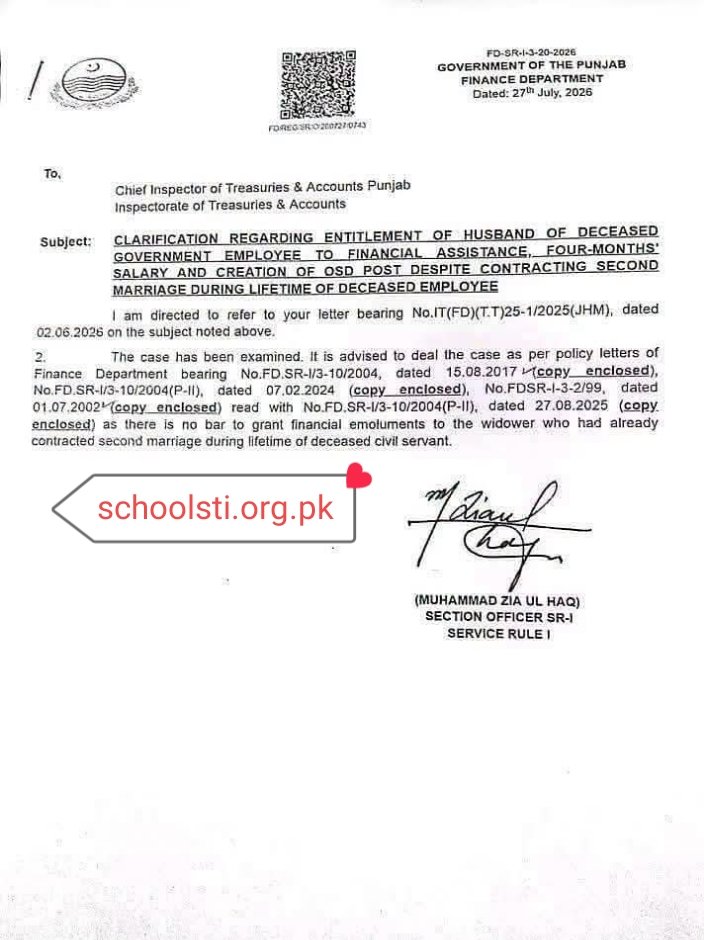
The Core Update: Understanding Notification FD-SR-I-3-20-2026
If you are dealing with a claim right now, you require to be aware of a particular document. As explicitly detailed in the official notification document IMG-20260729-WA0002.jpg, issued by the Finance Department, Government of the Punjab on July 27, 2026, the rules have been clarified to protect the rights of the surviving spouse.
The subject of the notification is the “Clarification Regarding Entitlement of Husband of Deceased Government Employee to Financial Assistance, Four-Months’ Salary and Creation of OSD Post Despite Contracting Second Marriage During Lifetime of Deceased Employee.”
The ruling is straightforward: The case has been examined, and the Finance Department advised that there is absolutely no bar to granting financial emoluments to a widower who had already contracted a second marriage during the lifetime of the deceased civil servant.
This means that a husband’s second marriage, provided it occurred while the earliest wife (the civil servant) was still alive, does not disqualify him from receiving his rightful financial assistance. The administration treats the claim based on his legal status as a surviving spouse, full stop.
Breaking Down the Financial Entitlements
When a authority employee passes away during service, the Punjab state provides a robust assistance package to ensure the family is not left financially stranded. Here is exactly what the widower is entitled to, regardless of a second marriage.
1. The Financial Assistance Package (Lump Sum Grant)
The government provides a substantial lump sum grant to the family of the deceased. This amount varies significantly based on the Basic Pay Scale (BPS) of the deceased employee at the duration of their passing. The goal of this grant is to provide immediate financial relief to cover funeral expenses, evident outstanding debts, and stabilize the family’s financial situation.
2. Four Months’ Salary
As a surviving spouse, you are entitled to accept the deceased employee’s full salary for four months following their death. This is meant to bridge the gap between the stoppage of the regular salary and the commencement of the family pension. You must apply for this immediately through the deceased’s Drawing and Disbursing Officer (DDO).
3. Creation of an OSD Post
This is a critical administrative step that frequently confuses people. When a civil servant dies, the department temporarily creates an Officer on Special Duty (OSD) post in the name of the deceased. Why? Given that the government needs a valid administrative placeholder to legally disburse the remaining salary, leave encashment, and the lump-sum financial assistance. This is an internal accounting mechanism, however it is mandatory. Your application triggers the creation of this OSD post.
Step-by-Step Guide: How to Process the Claim
If you locate yourself in the position of needing to file this claim, do not rely solely on verbal advice from clerks. You need to be proactive. Over the years, I have helped numerous colleagues organize their files, and the key is systematic preparation.
Step 1: Obtain the Official Death Certificate
Immediately secure the computerized death certificate from your local Union Council. Ensure the ID card numbers and names perfectly match the deceased’s service record. Even a minor spelling mistake here will cause your file to be rejected by the District Accounts Office.
Step 2: Apply for the Family Registration Certificate (FRC)
Visit NADRA and get an updated FRC. This document is vital as it proves your legal relationship with the deceased.
Step 3: Secure a Succession Certificate
You will demand a succession certificate from a competent court. This legally authorizes you and other heirs to accept the financial assets of the deceased.
Step 4: Stop the Regular Salary
Notify the head of the department or the Incharge Officer immediately so they can stop the regular salary and issue a Last Pay Certificate (LPC). If the salary continues to be credited after the death, it will effect in recovery notices later, complicating the pension operation.
Step 5: Submit the File to the DDO
Compile all these documents along with the official application for financial assistance and submit them to the DDO. Mention the recent notification (FD-SR-I-3-20-2026) in your application if your second marriage is a known factor, preventing any internal objections before they happen.
Essential Tools to Streamline the Process
Dealing with state paperwork means dealing with physical files. Still, you can manage this efficiently using a few digital tools.
- CamScanner or Adobe Scan: Never submit your only original documents without keeping high-quality digital backups. Use a mobile scanning app to build evident, readable PDFs of every single form, certificate, and CNIC copy.
- HRMIS Punjab: Keep an eye on the Human Resource Management Information System (HRMIS) if you have access through the department. It tracks the service history and helps verify the exact BPS and service length, which dictates the lump sum amount.
- A Reliable Cloud Drive: Store all scanned documents in Google Drive or OneDrive. When a clerk inevitably tells you a paper is missing from the physical file, you can immediately print a recent copy from your phone.
For more detailed guides on managing educational and administrative updates, I frequently distribute resources on my primary portal at schoolsti.org.pk. Keeping yourself updated is half the battle won.
Mistakes to Avoid During the Application
1. Delaying the Process
Time is your worst enemy. The longer you wait to initiate the OSD post creation and financial assistance claim, the harder it gets. Begin the paperwork within the initial two weeks.
2. Hiding the Second Marriage
Transparency is crucial. Because the notification clearly states there is no bar to receiving emoluments if the marriage happened during the employee’s lifetime, hiding it only creates suspicion. Be upfront and attach the Nikah Nama if required.
3. Ignoring the Nominated Counsel
Under administration policy, the department is required to nominate an officer (usually BS-17 or BS-18) as a counsel to assist the family of the deceased. Do not try to do everything alone. Find out who the nominated counsel is and demand their assistance in moving the file through the bureaucracy.
Entitlements Summary Table
To make things easier to digest, here is a quick breakdown of what to expect during the claim procedure.
| Benefit Category | Description | Requirement |
|---|---|---|
| Lump Sum Grant | Direct financial aid based on the deceased’s BPS. | Approved claim file and Succession Certificate. |
| Four Months’ Salary | Continued salary payment for immediate relief. | Immediate intimation of death and LPC generation. |
| OSD Post Creation | Internal mechanism to disburse funds legally. | Formal application submitted through the department head. |
| Family Pension | Monthly pension payments to the legal spouse/heirs. | Completed pension papers and NADRA verification. |
External Resources for Fact-Checking
It is invariably a positive thought to verify rules directly from the source. Here are some authoritative links you should bookmark:
- You can monitor official financial circulars and notifications directly at the Punjab Finance Department.
- For broader provincial service rules and updates, visit the Government of Punjab Official Portal.
- To understand the legal frameworks and rules regarding civil servants, the Punjab Public Service Commission provides excellent contextual guidelines.
[ Apply Online ] (Note: While direct online application for death claims is not fully functional across all departments, always check your specific departmental HRMIS portal for e-filing options).
Frequently Asked Questions (FAQs)
Q: Does contracting a second marriage after the death of the civil servant affect the claim?
A: This exact notification addresses marriages contracted during the lifetime of the deceased. If a widower remarries after the death of his authority-employed wife, family pension rules generally state that the pension stops for the widower and transfers to eligible children. However, the initial financial assistance and four months’ salary earned at the duration of death remain valid.
Q: What if the department objects to the OSD post creation due to the second marriage?
A: You must attach a copy of the official notification (IMG-20260729-WA0002.jpg / FD-SR-I-3-20-2026) to your application. This serves as the definitive legal precedent that the Finance Department has cleared such cases.
Q: How long does it take to receive the financial assistance?
A: If all documents (FRC, Succession Certificate, Death Certificate) are in order, the creation of the OSD post and sanctioning of the amount typically takes 2 to 3 months. Delays are almost invariably due to incomplete paperwork.
Q: Is the lump sum grant taxable?
A: Generally, financial assistance packages granted to the families of deceased administration employees are exempt from standard income tax deductions to maximize the relief provided to the bereaved family.
Q: Can the children from the second marriage claim the deceased employee’s benefits?
A: No. Only the legally recognized heirs of the deceased employee (her husband and her biological/legally adopted children) are entitled to her specific service benefits.
Q: Do I want a lawyer to process this?
A: No, a lawyer is not mandatory for the departmental method. Still, you will require to engage a lawyer or go through the civil courts to obtain the mandatory Succession Certificate.
Q: What happens to the General Provident Fund (GPF)?
A: The GPF is a separate entity from the lump sum grant. The accumulated GPF amount will be disbursed to the family members based on the official nomination made by the deceased during her lifetime, or via the succession certificate if no valid nomination exists.
Final Thoughts
Navigating government procedures is daunting on the best of days, let alone when you are grieving a profound loss. The recent clarification by the Punjab Finance Department is a massive relief for widowers who previously faced unnecessary bureaucratic harassment over their marital status. Remember, the rules are in place to help you, yet you must be meticulous in how you present your case. Gather your documents, secure your digital backups, and do not hesitate to hold the department accountable for processing your rightful claims in a timely manner.
If you found this guide helpful, please spread it with anyone who might be struggling with administration pension or financial assistance claims. Have you faced similar administrative hurdles? Drop a comment below and let’s discuss how to overcome them.
محکمہ: فنانس ڈیپارٹمنٹ، حکومت پنجاب۔
تاریخ: 27 جولائی، 2026۔
موضوع: مرحومہ سرکاری ملازم کے شوہر (بیوہ) کے مالیاتی امداد، چار ماہ کی تنخواہ اور او ایس ڈی (OSD) پوسٹ کی تخلیق کے حق سے متعلق وضاحت۔
اہم فیصلہ: محکمہ نے واضح کیا ہے کہ اگر کسی فوت شدہ سرکاری ملازم کے شوہر (widower) نے ملازمہ کی زندگی میں ہی دوسری شادی کر رکھی ہو، تب بھی اسے مالی مراعات (financial emoluments) دینے پر کوئی پابندی نہیں ہے۔ لہذا، اس کیس کو متعلقہ پالیسی خطوط کے مطابق حل کیا جائے