Prime Minister Medical Invalidation Policy in Federal Government
Prime Minister Medical Invalidation Policy in Federal Government
- Quick Summary
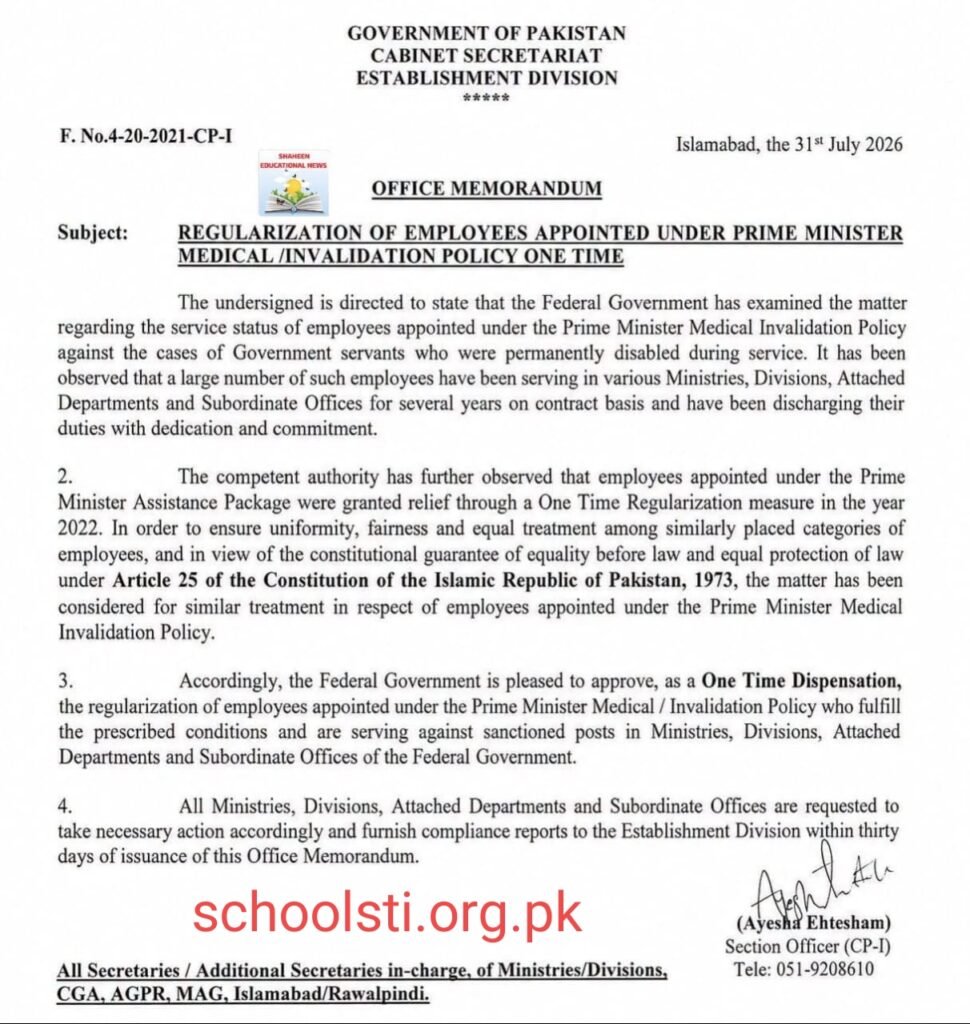
- Key Decision: The Federal Government of Pakistan has officially approved a One-Time Dispensation for the regularization of contract employees appointed under the Prime Minister Medical / Invalidation Policy.
- Official Notification: Issued by the Cabinet Secretariat, Establishment Division, Islamabad via Office Memorandum F. No. 4-20-2021-CP-I dated July 31, 2026, signed by Section Officer Ayesha Ehtesham.
- Legal Basis: Invoked under Article 25 of the Constitution of the Islamic Republic of Pakistan, 1973 (Equality before Law) to maintain parity with the 2022 PM Assistance Package regularization.
- Eligibility Criteria: Contract staff appointed against cases of state servants permanently disabled/invalidated during service who currently fulfill prescribed qualifications and occupy sanctioned posts in federal Ministries, Divisions, Attached Departments, and Subordinate Offices.
- Departmental Deadline: All federal entities must whole internal verification and submit compliance reports to the Establishment Division within 30 days of notification issuance.
The Federal Government of Pakistan issued an official Establishment Division notification (F. No. 4-20-2021-CP-I) on July 31, 2026, granting a one-moment regularization dispensation to contract employees appointed under the Prime Minister Medical Invalidation Policy who occupy sanctioned posts across all federal ministries, departments, and subordinate offices.
Having worked closely with public sector recruitment processes, educational portals, and administrative civil service frameworks in Pakistan, I understand how heavy the weight of contract insecurity can feel. A near acquaintance of mine—working in a federal attached department in Islamabad—was appointed on a temporary contract six years ago after his father was declared permanently incapacitated by a central medical board. Year after year, he carried the anxiety of contract extensions, missing out on basic pension rights, annual increments, and regular promotions. When news broke on July 31, 2026, regarding the Establishment Division’s Office Memorandum, I saw firsthand the sheer relief it brought to hundreds of families across the country.
If you or a family member are currently serving on a contract under the Prime Minister Medical Invalidation Policy against a permanently disabled administration servant’s quota, this notification is the breakthrough you have been waiting for. Nonetheless, navigating departmental paperwork, understanding constitutional justifications, and ensuring your file reaches the Establishment Division within the mandatory 30-day window can be confusing. In this comprehensive guide, I will break down every single aspect of this notification, explain the exact legal grounds behind it, supply a step-by-step action plan, and share crucial document checklists so you don’t face unnecessary delays.
What is the Prime Minister Medical Invalidation Policy in Federal Government?
The Prime Minister Medical Invalidation Policy is a welfare mechanism created by the Government of Pakistan to assist families of civil servants who suffer permanent physical or mental disability while in active service. When a regular state employee is declared medically unfit for further service by a duly constituted Central Medical Board (CMB) or Provincial Standing Medical Board, they are retired prematurely on medical invalidation pension.
To protect such families from sudden financial ruin, the administration policy allowed one child or the spouse of the invalidated employee to secure employment in basic pay scales (typically BS-01 to BS-15) without undergoing accessible open competitive advertising.
For various years, appointments under this medical invalidation quota were executed on a contract basis—commonly renewed annually or semi-annually under Establishment Division OM No. 4/1/2005-CP-I. While this provided immediate financial relief, contract status meant these employees remained deprived of permanent service benefits, pay protection, seniority set placements, and long-term career growth.
What does the Establishment Division Office Memorandum F. No. 4-20-2021-CP-I state?
On July 31, 2026, the Cabinet Secretariat, Establishment Division, Government of Pakistan, issued Office Memorandum F. No. 4-20-2021-CP-I under the subject: “REGULARIZATION OF EMPLOYEES APPOINTED UNDER PRIME MINISTER MEDICAL / INVALIDATION POLICY ONE TIME”.
The central directives contained within the official order comprise:
- Recognition of Service: The Federal Government formally acknowledges that contract employees appointed under the PM Medical Invalidation Policy against permanently disabled state servants have been serving dedicatedly across various Ministries, Divisions, Attached Departments, and Subordinate Offices for several years.
- Approval of One-Time Dispensation: The competent federal authority has approved, as a special one-period measure, the permanent regularization of all eligible contract employees who fulfill the prescribed role qualifications and are currently posted against clear sanctioned posts.
- Mandatory 30-Day Compliance: All Secretaries, Additional Secretaries in-charge of Ministries and Divisions, the Comptroller General of Accounts (CGA), the Accountant General Pakistan Revenues (AGPR), and the Military Accountant General (MAG) are instructed to entire the processing of eligible cases and submit compliance reports to the Establishment Division within 30 days of the OM’s issuance.
Why did the Federal Government issue a One-Time Regularization dispensation in July 2026?
To grasp why this decision was taken in July 2026, we have to look back at the administrative landscape of federal employee welfare policies over the final few years.
In December 2022, the Federal Government granted a similar one-moment regularization relief to contract employees who had been appointed under the Prime Minister Assistance Package for families of state servants who died during service. Still, employees appointed under the Medical Invalidation Policy—who faced nearly identical socio-economic hardships due to the permanent disability of their household breadwinner—were left out of that initial order.
This created a sharp legal and administrative disparity. Contract employees under the invalidation quota approached various administrative forums, departmental representation channels, and service tribunals pointing out that denying them regular status while granting it to deceased employees’ children violated the core principles of administrative fairness.
Recognizing this inequality, the Federal Government examined the matter thoroughly through the Cabinet Secretariat and Establishment Division, ultimately approving this one-moment dispensation to eliminate discrimination and harmonize policy implementation across all federal cadres.
How does Article 25 of the Constitution of Pakistan apply to this regularization?
Paragraph 2 of the Establishment Division’s Office Memorandum explicitly cites Article 25 of the Constitution of the Islamic Republic of Pakistan, 1973.
Article 25 guarantees Equality of Citizens, stating that:
- All citizens are equal before the law and are entitled to equal protection of law.
- There shall be no discrimination on the basis of sex alone.
- Nothing in this Article shall prevent the State from making any special provision for the protection of women and children.
In administrative law, the doctrine of equal protection dictates that “similarly situated individuals must be treated similarly.” Since both categories of employees—those appointed after a parent’s death in service (PM Assistance Package) and those appointed after a parent’s permanent disability in service (PM Medical Invalidation Policy)—were inducted into government departments under compassionate welfare quotas, treating one group as temporary contract workers while regularizing the other was legally unsustainable.
By grounding this decision in Article 25, the Federal Government has provided a rock-solid constitutional basis for this notification, protecting it against arbitrary executive reversals and ensuring equal treatment for disabled civil servants’ families. You can go through the full constitutional context on the Constitution of Pakistan 1973 – Article 25 Official Text.
How does this policy compare with the 2022 PM Assistance Package Regularization?
To assist you see how these two historic government welfare decisions align, here is a detailed breakdown comparing the 2022 PM Assistance Package measure with the fresh 2026 PM Medical Invalidation Policy decision:
| Policy Aspect | PM Assistance Package (Deceased Quota) | PM Medical Invalidation Policy (Disabled Quota) |
|---|---|---|
| Primary Beneficiaries | Widows / Children of civil servants who died in active service | Spouse / One child of civil servants permanently invalidated/disabled during service |
| Original Appointment Basis | Contract basis (BS-01 to BS-15) under PMAP policies | Contract basis (BS-01 to BS-15) under Medical Invalidation OMs |
| Regularization Notification | Office Memorandum F. No. 8/23/2021-E-2 (Dec 23, 2022) | Office Memorandum F. No. 4-20-2021-CP-I (July 31, 2026) |
| Constitutional Grounding | Executive Policy Order & Cabinet Approval | Article 25 of the Constitution (Equality Before Law) |
| Scope of Application | Federal Ministries, Divisions & Attached Departments | Federal Ministries, Divisions, Attached Departments & Subordinate Offices |
| Sanctioned Post Requirement | Mandatory against clear vacant quota | Mandatory against clear sanctioned posts |
| Departmental Action Window | Departmental Scrutiny Committees (DSC) | Compliance reporting to Establishment Division within 30 days |
If you frequently keep track of open sector occupation notifications, educational contracts, and recruitment updates across Pakistan, staying connected with dedicated updates on the School STI Portal helps you track actual-moment administrative movements, quota allocations, and departmental recruitment procedures smoothly.
Who is eligible for one-time regularization under the PM Medical Invalidation Policy?
Not every contract employee in a federal ministry automatically qualifies for this dispensation. The notification establishes specific eligibility criteria that must be verified by departmental scrutiny committees.
To qualify for regular appointment under this Office Memorandum, an employee must satisfy the following condition criteria:
- Valid Medical Invalidation Origin: You must have been initially appointed under the Prime Minister Medical / Invalidation Policy against the quota of a government servant who was declared permanently disabled/incapacitated during active service by an authorized medical board.
- Current Contract Status: You must be actively serving on a contract basis in a federal Ministry, Division, Attached Department, or Subordinate Office at the time of the issuance of this Office Memorandum (July 31, 2026).
- Sanctioned Post Occupancy: You must be working against a obvious, regular sanctioned post. If your contract was drawn against a temporary project or non-sanctioned budget line, your department will initial need to route a case for post-sanctioning or vacant post allocation.
- Prescribed Qualification & Age Eligibility: You must possess the requisite educational qualifications, technical skills, and age profile prescribed in the official Recruitment Rules (APT Rules, 1973) for the particular post you occupy.
- Satisfactory Service Record: Your departmental performance records, character verification, and annual performance evaluation reports (PERs/ACRs) must be free from adverse remarks, severe disciplinary penalties, or ongoing inquiry proceedings under Efficiency & Discipline (E&D) rules.
How to apply for regularization under Establishment Division OM F. No. 4-20-2021-CP-I?
While the Establishment Division has directed departments to take proactive action, contract employees should actively follow up on their personal files to prevent administrative delays. Here is the step-by-step process you should follow immediately:
Step 1: Draft a Departmental Representation / Application
Prepare a formal application addressed to the Head of Department (HOD) or Secretary of your parent Ministry/Division. Reference Establishment Division OM F. No. 4-20-2021-CP-I dated 31st July 2026 in the subject line, requesting the initiation of your regularization method.
Step 2: Compile Your Service & Invalidation Dossier
Gather all historical documentation connecting your initial contract appointment back to the medical invalidation of your parent or spouse. Ensure every document is certified by your drawing and disbursing officer (DDO).
Step 3: Departmental Scrutiny Committee (DSC) Evaluation
Your Ministry or Department will convene a Departmental Scrutiny Committee (DSC) or Departmental Selection Committee (DSC) to check:
- Availability of a sanctioned post.
- Fulfillment of basic qualification criteria.
- Medical fitness certificate from an authorized civil surgeon.
- Clear security/police verification reports.
Step 4: Issuance of Regularization Letter & AGPR Service Book Entry
Upon approval by the Competent Authority (Secretary or Head of Department), an official Regularization Letter will be issued. Your service book will be updated from “Contract” to “Regular”, and your file will be sent to the Accountant General Pakistan Revenues (AGPR) or Military Accountant General (MAG) for issuance of a regular pay slip, vendor number generation, and regular fund deductions (GP Fund, Benevolent Fund, Group Insurance).
Step 5: Submission of Compliance Report to Establishment Division
Your department will forward your verified name, post details, scale, and copy of the regularization order to Section Officer (CP-I), Establishment Division, Islamabad, to satisfy the mandatory 30-day compliance clause.
You can verify official administrative procedures and track federal authority notifications directly through the official portal of the Establishment Division Pakistan.
What documents are required for departmental scrutiny?
To ensure your regularization file moves smoothly through your department’s HR wing without being returned with objections, organize your dossier in the following exact order:
- Written Application: Formal request referencing OM F. No. 4-20-2021-CP-I.
- Copy of Establishment Division OM: Printed copy of the July 31, 2026 Office Memorandum.
- Medical Board Invalidation Certificate: Certified copy of the Central/Standing Medical Board order declaring the original authority employee permanently disabled.
- Parent’s / Spouse’s Retirement Order: Official notification confirming premature retirement on medical grounds.
- Initial Contract Appointment Order: First contract offer letter and joining report issued under the invalidation policy.
- Contract Extension Orders: Copies of all subsequent contract extension letters showing continuous unbroken service up to July 2026.
- Educational Certificates & Degrees: Verified copies of matriculation, intermediate, graduation, or technical diplomas.
- Computerized National Identity Card (CNIC): Valid CNIC copy of the candidate and disabled retiree.
- No-Objection Certificate (NOC) / Affidavit from Family: Sworn affidavit on stamp paper from other legal heirs confirming no objection to the applicant benefiting from the invalidation quota.
- Attested Copies of ACRs/PERs: Annual Performance Evaluation Reports for the preceding years of contract service.
- Clearance Certificates: Character verification from police/special branch and departmental inquiry clearance certificate.
What is the 30-day compliance timeline for Ministries and Subordinate Offices?
The fourth paragraph of the Office Memorandum places a strict deadline on all administrative heads:
“All Ministries, Divisions, Attached Departments and Subordinate Offices are requested to take necessary action accordingly and furnish compliance reports to the Establishment Division within thirty days of issuance of this Office Memorandum.”
Because the notification was officially signed on July 31, 2026, the 30-day compliance window officially ends on August 30, 2026.
Why is this 30-day timeline critical?
- Budgetary Alignment: Departments need to submit regular salary budget demands to the Finance Division for the upcoming quarterly release.
- Sanctioned Post Allocation: Identifying filled versus vacant sanctioned posts ensures that no contract worker is left out due to administrative oversight.
- Audit Protection: Timely compliance reports prevent upcoming audit objections by the Auditor General of Pakistan (AGP) regarding temporary appointments maintained beyond executive directives.
If your departmental HR wing has not yet notified a Departmental Scrutiny Committee meeting, take a copy of the notification to your Administration Wing / Section Officer (Establishment) immediately to ensure your file is included in the earliest compliance batch.
Real-Life Case Study: How Contract Insecurity Impacted Federal Employees
To understand why this legal transition matters so deeply, consider the case of a Junior Clerk working in an attached department of the Cabinet Division in Islamabad.
He was inducted on contract in 2019 after his mother, an Assistant in the same department, suffered severe paralytic stroke conditions and was medically invalidated by the Civil Surgeon Office. Over seven years of contract service, he received no annual increments, could not apply for internal departmental promotion examinations, and lived under constant anxiety during every annual contract renewal window.
When the Establishment Division regularized contract employees under the PM Assistance Package in 2022, he applied for equal treatment yet was turned down given that his file fell under “Medical Invalidation” rather than “Death in Service”.
With the issuance of OM F. No. 4-20-2021-CP-I on July 31, 2026, his contract service is now formally converted into regular service. His past contract period will now count toward his pay protection and pension eligibility, providing his family with long-term financial stability.
Cases like this highlight why administrative policies grounded in constitutional equity (Article 25) are essential for communal service efficiency and worker morale.
What common mistakes should contract employees avoid during document submission?
During my years analyzing administrative workflows and civil service recruitment frameworks, I have seen many valid regularization cases delayed due to basic, avoidable errors. Here are the leading mistakes you must avoid:
- Delaying Document Submission: Waiting until the final week of August 2026 to submit your file can cause your department to miss the 30-day compliance deadline. Submit your complete file immediately.
- Submitting Uncertified Documents: Ensure all educational degrees, CNIC copies, and medical board orders are properly attested by a Gazette Officer (BS-17 or above).
- Mismatched Names or CNIC Details: Double-check that your name, father’s name, and date of birth match exactly across your educational certificates, initial appointment letter, and CNIC. Any discrepancy requires a court decree or NADRA correction before AGPR will operation regular pay slips.
- Ignoring Sanctioned Post Status: Check with your department’s Admin wing whether your post is formally listed in the Schedule of Posts / Budget Book. If you are serving on an ad-hoc or temporary project post, request an immediate transfer to a vacant regular sanctioned post.
- Overlooking Break in Service Records: If your contract had an administrative gap between extensions, request your department to formalize or condone the break period so your continuity of service remains unblemished.
Frequently Asked Questions (FAQs) regarding Federal Employee Regularization 2026
What is the official letter number and date of the regularization notification?
The official notification number is F. No. 4-20-2021-CP-I, issued by the Government of Pakistan, Cabinet Secretariat, Establishment Division, Islamabad on July 31, 2026.
Who signed the Establishment Division Office Memorandum?
The Office Memorandum was signed by Ayesha Ehtesham, Section Officer (CP-I), Establishment Division, Islamabad (Telephone: 051-9208610).
This particular Office Memorandum directly covers contract employees serving in Federal Ministries, Divisions, Attached Departments, and Subordinate Offices of the Federal Government. Nonetheless, provincial governments usually adopt federal Establishment Division dispensations through matching provincial cabinet notifications shortly thereafter.
Will past contract service count toward senior pay scale increments and pension?
Yes. Under standard civil service rules and pay protection guidelines, once a contract employee occupying a sanctioned post is regularized, their continuous contract service period is protected for pay fixation in AGPR, allowing them to draw regular annual increments.
What happens if a contract employee is working against a non-sanctioned post?
The notification specifies that regularization applies to employees serving against sanctioned posts. If a post is not sanctioned, the parent department must approach the Finance Division (Expenditure Wing) for post sanctioning before formal regularization orders can be finalized.
Is there any age relaxation granted for this one-time regularization?
Since candidates were already within the prescribed age limit at the period of their initial contract appointment under the invalidation policy, upper age limits are relaxed for the period served on contract, as per standard federal authority regularization guidelines.
Where can federal employees track payroll updates after regularization?
After receiving your regular appointment letter, your department will submit your case to the Accountant General Pakistan Revenues (AGPR) or Military Accountant General (MAG). You can monitor pay slips and service records through official channels or reference the Federal Board of Revenue HRMS Portal.
Key Takeaways & Action Plan for Federal Employees
To ensure you successfully secure your regular service status under this modern policy, keep these core action steps in mind:
- Act Fast: The 30-day departmental reporting deadline ends on August 30, 2026. Submit your formal representation to your Admin wing without delay.
- Verify Post Sanctioning: Confirm that your post is a clear, regular sanctioned post in your department’s sanctioned strength register.
- Ensure Complete Legal Documentation: Keep certified copies of your medical board invalidation certificate, initial contract letter, extension orders, and educational degrees organized.
- Follow Up with Admin Wing: Track the progress of your file as it moves through the Departmental Scrutiny Committee (DSC) toward final Establishment Division compliance reporting.
This one-period dispensation is a landmark decision that restores dignity, career growth, and social protection to deserving families who have dedicated years of hard work to the federal general service.
Reference Links & Official Gazette Resources
- Establishment Division Pakistan Official Portal
- Constitution of the Islamic Republic of Pakistan 1973 – Article 25 Text
- Federal Board of Revenue (FBR) HRMS Portal & Notifications
- School STI Portal & Public Recruitment Updates
About the Author:
Majid Farooq is an experienced substance writer, web developer, and public sector administrative analyst based in Pakistan. With over seven years of hands-on experience examining civil service rules, educational portal frameworks, and federal recruitment policies, he provides detailed, practical, and authentic guidance to aid public sector workers navigate complex administrative procedures with confidence.
Last updated: August 1, 2026
وفاقی حکومت کا بڑا فیصلہ!
وزیراعظم میڈیکل/انویلڈییشن پالیسی کے تحت کنٹریکٹ ملازمین کو ون ٹائم ریگولرائزیشن کی منظوری دے دی گئی۔
متعلقہ وزارتوں اور اداروں کو 30 دن میں کارروائی مکمل کرکے رپورٹ اسٹیبلشمنٹ ڈویژن کو ارسال کرنے کی ہدایت۔
تمام مستفید ملازمین کو دل کی گہرائیوں سے مبارک ہو!