HEC Overseas Scholarship Phase-IV for MS and PhD Studies Abroad August 2026
HEC Overseas Scholarship Phase-IV for MS and PhD Studies Abroad August 2026
Swift Summary
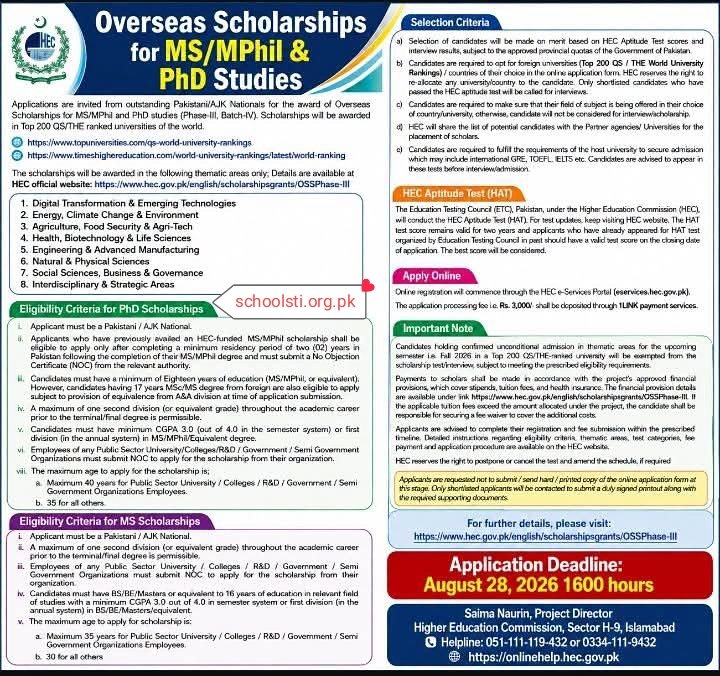
- Scholarship Scope: Fully funded HEC Overseas Scholarships for MS/MPhil and PhD studies in Top 200 QS/THE ranked global universities.
- Eligible Disciplines: 8 key thematic areas including Digital Transformation, Energy & Climate Transform, Agri-Tech, Biotech, Engineering, Physical Sciences, Social Sciences, and Interdisciplinary Studies (including Islamic Studies).
- PhD Eligibility: Minimum 18 years education, CGPA 3.0/4.0 or 1st Division, max 1 second division in career. Age limit is 40 years for public sector employees and 35 years for others.
- MS/MPhil Eligibility: Minimum 16 years education (BS/BE/MA), CGPA 3.0/4.0 or 1st Division, max 1 second division. Age limit is 35 years for public sector employees and 30 years for others.
- Selection & Waiver: Selection is based on the ETC HAT test score and interview. Applicants holding an unconditional admission provide for Fall 2026 from a Top 200 ranked university are exempted from the test and interview.
- Application Details: Online registration via HEC eServices portal (
[https://eservices.hec.gov.pk/](https://eservices.hec.gov.pk/)) with a Rs. 3,000 application fee paid through 1LINK. - Closing Date: August 28, 2026, at 4:00 PM PST.
How to Secure the HEC Overseas Scholarship Phase-IV for MS and PhD Studies Abroad?
To secure the fully funded HEC Overseas Scholarship Phase-IV, eligible Pakistani and AJK citizens must apply online through the HEC eServices portal before August 28, 2026. Applicants demand a minimum 3.0 CGPA (or 1st Division) in their latest 16-annum (MS) or 18-annum (PhD) degree, pass the Education Testing Council HAT test, or secure an unconditional admission letter from a Top 200 QS/THE ranked foreign university for Fall 2026 to receive a test exemption.
How My Search for a Overseas Fully Funded Scholarship Led Me to the HEC Phase-IV Scheme?
Back in 2022, I remember sitting at my workstation in Lahore at 2:15 AM, staring at three open browser tabs containing tuition fee structures for foreign universities. A PhD program in the UK or Australia was going to cost over £25,000 per annum just for tuition, not to mention housing, food, and health insurance. Convert that into Pakistani Rupees, and it felt wholly out of reach for a middle-class researcher working on a government scale salary.
I spent weeks looking for fully funded options, filtering through departmental assistantships, Commonwealth grants, and university-specific stipends. That was when a senior colleague in my department pointed me toward the Higher Education Commission (HEC) Overseas Scholarship project. When Phase-III Batch-IV (Phase-IV) was formally announced by the Higher Education Commission Islamabad, it felt like the exact bridge Pakistani scholars needed to break into the world’s top research laboratories without taking on crippling debt.
Over the years, working with educational platforms, testing portals, and public sector colleagues, I have seen hundreds of candidates apply for these awards. A few won total rides to prestigious universities in Australia, Europe, and the UK, while others with 3.8 CGPAs got rejected simply since they messed up their 1LINK fee voucher, picked an unranked department, or submitted an incomplete NOC from their government department.
If you are serious about pursuing an MS/MPhil or PhD abroad, I am going to walk you through every single step of this announcement. From subject selection to bypassing the HAT test, here is your finished, battle-tested playbook for the HEC Overseas Scholarship Phase-IV.
What is the HEC Overseas Scholarship Phase-IV Program?
The HEC Overseas Scholarship scheme is the flagship human capital development initiative managed by the Higher Education Commission in Islamabad. Under Phase-III Batch-IV (frequently referred to as Phase-IV), the Government of Pakistan funds selected Pakistani and Azad Jammu & Kashmir (AJK) nationals to pursue advanced post-graduate education (MS/MPhil and PhD) at foreign institutions ranked among the Top 200 in the QS Globe University Rankings or the Times Higher Education International community University Rankings.
The purpose of this program is not just to hand out degrees. It is designed to fill critical national skills gaps by training scholars in cutting-edge, high-impact research domains. Upon graduation, scholars return to Pakistan to serve in local universities, research institutes, and public sector organizations, raising the standard of local higher education.
For detailed scholarship policies, updates on provincial merit lists, and public sector educational notices, you can likewise cross-reference updates on the SchoolSTI Educational Portal, which tracks Pakistani merit grants and administrative guidelines closely.
The scholarship is fully funded, meaning it takes care of your key academic and living expenses. Here is what the financial package covers:
- Tuition Fees: Paid directly to the host foreign university up to the project’s approved financial allocation.
- Living Stipend: A fixed monthly allowance paid in local foreign currency to cover housing, food, and daily transportation.
- Health Insurance: Standard medical insurance as mandated by the host nation or university.
- Airfare: Return economy class air ticket at the begin and completion of the study program.
Note on Tuition Expenses: If your target university’s tuition fee exceeds the maximum financial ceiling allocated under the HEC project, the candidate is personally responsible for securing a partial fee waiver or tuition discount from the host institution to cover the difference.
Which Academic Disciplines and Research Areas are Eligible for Funding?
HEC does not award these scholarships for every general academic subject. To align with national economic priorities, the funding is strictly restricted to eight designated thematic research areas. If your research proposal does not fit into one of these buckets, your application will not be entertained.
1. Digital Transformation & Emerging Technologies
This area covers Artificial Intelligence, Machine Learning, Cybersecurity, Quantum Computing, Data Science, Cloud Infrastructure, Robotics, Internet of Things (IoT), and Blockchain Architecture. If you have a background in Computer Science, Software Engineering, or Details Technology, this is your target field.
2. Energy, Climate Alter & Environment
Focuses on Renewable Energy Systems (Solar, Wind, Hydro), Battery Storage, Sharp Grids, Environmental Engineering, Carbon Sequestration, Climate Modeling, Water Resource Management, and Circular Economy studies.
3. Agriculture, Food Security & Agri-Tech
Covers Precision Farming, Crop Genetics, Clever Irrigation Systems, Post-Harvest Technology, Soil Health, Veterinary Biotechnology, Food Supply Chain Logistics, and Sustainable Livestock Production.
4. Health, Biotechnology & Life Sciences
Includes Genomics, Molecular Medicine, Bioinformatics, Vaccine Development, Pharmacology, Cancer Research, Epidemiology, Biomedical Engineering, and Public Health Systems.
5. Engineering & Advanced Manufacturing
Covers Aerospace Engineering, Nanotechnology, Mechatronics, Advanced Materials Science, Structural Health Monitoring, Chemical Process Engineering, and Semiconductor Manufacturing.
6. Natural & Physical Sciences
Focuses on Fundamental Physics, Synthetic Chemistry, Applied Mathematics, Actuarial Sciences, Geophysics, Space Sciences, and Marine Sciences.
7. Social Sciences, Business & Governance
Covers Public Policy, Development Economics, Econometrics, Digital Governance, International Law, Behavioral Sciences, Supply Chain Management, and Applied Psychology.
8. Interdisciplinary & Strategic Areas
Covers cross-cutting domains like Defense & National Security Studies, Complex Systems Engineering, Disaster Management, Science & Technology Policy, and Multidisciplinary Studies.
How Islamic Studies Students Can Qualify for the Overseas Scholarship?
A common point of confusion among Pakistani students is whether religious studies, Arabic, or Islamic Studies graduates are eligible. HEC has explicitly clarified that students of Islamic Studies and related disciplines can qualify for these scholarships.
To do thus, your research proposal must adopt an interdisciplinary approach. Rather than applying with traditional classical literature topics, frame your thesis under Social Sciences, Venture & Governance, Interdisciplinary & Strategic Areas, or Multidisciplinary Research. For instance, research projects focusing on Islamic Banking & Financial Governance, Islamic Jurisprudence and Up-to-date International Bioethics, or Comparative Legal Systems in Digital Governance fit naturally into the eligible thematic areas.
Who is Eligible for the HEC PhD Scholarship Abroad?
The eligibility requirements for the PhD track are strict. HEC enforces these core parameters at the initial screening stage before sending your application for technical evaluation.
Key PhD Requirements:
- Nationality: You must be a citizen of Pakistan or Azad Jammu & Kashmir (AJK). Dual nationals are not eligible.
- Educational Background: Minimum of 18 years of education (MS, MPhil, BE/BS 4-annum followed by 2-annum MS, or equivalent). If you completed a 17-annum foreign MS/MSc degree, you are eligible provided you obtain an equivalence certificate from HEC’s Academics & Attestation (A&A) Division at the moment of application.
- Academic Marks Threshold: Minimum CGPA of 3.0 out of 4.0 in the semester system, or First Division in the annual system, in your terminal degree (MS/MPhil/Equivalent).
- Second Division Limit: A maximum of one second division (or equivalent grade) is allowed throughout your entire academic career prior to your final degree. If you have two second divisions (e.g., in Matric and FSC), you are automatically disqualified.
- Age Limit (as of August 28, 2026):
- Government / Public Sector Employees: Maximum 40 years. (Applies to regular employees of public universities, government colleges, R&D institutes, and government/semi-government bodies).
- General Candidates: Maximum 35 years.
- NOC Requirement: Regular employees of public sector institutions must upload a No Objection Certificate (NOC) from their parent appointing authority.
- Two-Year Residency Rule for Past HEC Awardees: If you previously availed an HEC-funded scholarship for your MS/MPhil degree, you can only apply for this PhD scholarship if you have completed a minimum residency period of two (02) years in Pakistan post-graduation and submit an official NOC.
What are the Eligibility Criteria for M.Phil and MS Scholarships?
If you hold a 16-annum bachelor’s or master’s degree and wish to enroll directly in a foreign MS/MPhil leading to advanced research, the criteria are as follows:
Key MS/MPhil Requirements:
- Nationality: Must be a citizen of Pakistan or AJK.
- Educational Background: BS, BE, MA, MSc, or equivalent 16 years of education in a relevant field of study.
- Academic Marks Threshold: Minimum CGPA of 3.0 out of 4.0 in the semester system, or First Division in the annual system, in your 16-twelve-month period degree.
- Second Division Limit: Maximum of one second division across your entire previous academic record prior to the terminal degree.
- Age Limit (as of August 28, 2026):
- Government / Public Sector Employees: Maximum 35 years.
- General Candidates: Maximum 30 years.
- NOC Requirement: Government and public sector employees must obtain and upload an official NOC from their department.
Summary Table: MS/MPhil vs. PhD Overseas Scholarship Criteria
| Criteria / Parameter | MS / MPhil Scholarship Track | PhD Scholarship Track |
|---|---|---|
| Required Education | 16 Years (BS / BE / MA / MSc) | 18 Years (MS / MPhil / Equivalent) |
| Minimum CGPA / Marks | CGPA 3.0 / 4.0 or First Division | CGPA 3.0 / 4.0 or First Division |
| Academic Career Rules | Max one 2nd Division before final degree | Max one 2nd Division before final degree |
| Age Limit (Public Sector) | Max 35 Years | Max 40 Years |
| Age Limit (General Public) | Max 30 Years | Max 35 Years |
| Prior HEC Grant Rule | N/A | Must full 2-twelve-month period residency in Pakistan |
| Application Processing Fee | Rs. 3,000 via 1LINK | Rs. 3,000 via 1LINK |
| Target University Rank | Top 200 QS / THE Rankings | Top 200 QS / THE Rankings |
| Application Deadline | August 28, 2026 (4:00 PM) | August 28, 2026 (4:00 PM) |
How Does the HEC Selection Procedure Function for Shortlisted Candidates?
Understanding how HEC grades and filters candidates will support you focus your energy on the proper preparations.
Step 1: Merit List Preparation & Provincial Quotas
Selection is made strictly on merit, calculated through a combined score of your Higher Education Aptitude Test (HAT) result and your performance in the HEC panel interview.
Since this is a Federal Government initiative, awards are distributed according to the approved Provincial and Regional Quota policies of the Government of Pakistan (allocating specific percentages for Punjab, Sindh Urban/Rural, Khyber Pakhtunkhwa, Balochistan, Gilgit-Baltistan, FATA, and AJK).
Step 2: Selecting University Choices
During your online portal application, you must select preferred foreign universities and countries from the Top 200 QS or THE rankings. Build sure that your specific field of study is actively offered by the department in your chosen university. If you pick a university that does not propose your specialized subject, you will be dropped from interview consideration.
Note: HEC reserves the final right to reallocate any selected candidate to a alternative university or nation based on bilateral government agreements, placement availability, or budget constraints.
Step 3: Foreign University Requirements (GRE, IELTS, TOEFL)
Shortlisted candidates must independently meet each admission requirements set by their chosen host university. This normally includes passing language proficiency exams like IELTS Academic (normally minimum 6.5 or 7.0 overall) or TOEFL iBT (88–100), as well as subject-specific tests like the GRE or GMAT where applicable.
The Unconditional Admission Exemption Rule
There is an exemption rule in the official announcement that can save you weeks of stress:
Vital Exemption Clause: Candidates who already hold a confirmed, unconditional admission propose in one of the approved thematic areas for the upcoming Fall 2026 semester from a Top 200 QS or THE ranked university are EXEMPTED from appearing in the scholarship test (HAT) and panel interview, provided they fulfill the entire range of basic eligibility criteria.
If you have already spent the past six months contacting foreign professors and secured a formal unconditional acceptance letter for Fall 2026 from a top-ranked university, you skip the testing queue and move straight toward scholarship award processing.
What is the HEC Aptitude Test (HAT) and How to Score High?
Unless you qualify for the unconditional admission exemption, your gateway to the scholarship is the HEC Aptitude Test (HAT), conducted by the Education Testing Council (ETC) Pakistan.
HAT Test Structure and Categories:
The HAT test is similar in structure to the international GRE General test. It is divided into test categories based on your academic background:
- HAT-I: Engineering, IT, Computer Science, Technology, Mathematics, Physical Sciences.
- HAT-II: Social Sciences, Arts, Humanities, Management Sciences, Enterprise.
- HAT-III: Agriculture, Veterinary Sciences, Biological Sciences, Medical Sciences.
- HAT-IV: Religious Studies, Islamic Studies, Law, Allied fields.
Each test paper consists of 100 Multiple Choice Questions (MCQs) to be solved in 120 minutes, split across three core sections:
- Quantitative Reasoning (Math/Problem Solving): 30–40% weightage.
- Verbal Reasoning (English Comprehension/Vocabulary/Grammar): 30–40% weightage.
- Analytical Reasoning (Logical Deduction/Pattern Analysis): 20–30% weightage.
Key Rule on Score Validity:
HAT test scores remain valid for two (02) years. If you have already appeared in a HAT test conducted by ETC Pakistan within the last two years, your valid score can be considered for this batch. If you have taken it multiple times, HEC will automatically count your leading score.
Personal Preparation Tips for HAT:
- Focus Heavy on Analytical Reasoning: Pakistani candidates generally perform well in Quantitative math nevertheless lose critical marks on analytical analytical sequence puzzles. Practice NTS/ETC analytical reasoning modules daily.
- Era Management: You have less than 1.2 minutes per inquiry. If a logical puzzle takes longer than 90 seconds, mark a tentative response, flag it, and move forward.
- Study Resources: Don’t waste finances on outdated local industry guidebooks. Practice directly from GRE General Quantitative Reasoning reviews and Analytical Reasoning practice sheets obtainable online.
Step-by-Step Guide: How to Apply Online via HEC eServices Portal?
Applying for the HEC Overseas Scholarship is done entirely online. Do not send demanding copies, printed forms, or physical documents to the HEC office in Islamabad at this stage. Physical documentation is only requested from candidates who are shortlisted after the test and interviews.
Step 1: Generate or Access Your Account
Go to the official HEC portal at [https://eservices.hec.gov.pk/](https://eservices.hec.gov.pk/). If you already have an account from degree attestation or a past scholarship, log in with your existing CNIC and password. If you are latest, click Register and verify your email and phone figure via OTP.
[HEC eServices Portal] ──► [Fill Personal & Academic Details] ──► [Generate 1LINK Fee Voucher] ──► [Pay Rs. 3,000 via Banking App] ──► [Submit Online Application]Step 2: Full Your Profile
Before opening the scholarship form, make certain your personal profile is 100% finished:
- Fill in your complete name matching your CNIC and passport.
- Input every educational qualifications from Matric/SSC up to your final MS/BS degree. Secure your CGPA, total marks, percentage, and passing twelve-month period match your official transcripts.
- If your degree is from a private or foreign institute, build sure your HEC Equivalence details are attached.
Step 3: Launch the Scholarship Application
- On the left dashboard, navigate to Scholarships and Grants -> Overseas Scholarships Phase-III (Batch-IV).
- Select your application category: MS/MPhil or PhD.
- Choose your specific Thematic Area from the 8 on hand choices.
- Select your top choices for foreign universities/countries from the QS/THE Top 200 list.
Step 4: Pay the Application Processing Fee via 1LINK
The application fee is Rs. 3,000 (non-refundable).
- Once you fill out the application draft, the portal will generate a unique 1LINK Consumer ID or Challan/Invoice Count.
- Open your mobile banking app (Meezan, HBL, Bank Alfalah, Allied Bank, etc.) or digital wallet app (JazzCash, EasyPaisa, Nayapay).
- Go to Bill Payments -> Select 1LINK / 1Bill Invoice or 1Bill Consumer Payment.
- Enter your unique 1LINK Consumer ID count generated by the HEC portal.
- The system will auto-fetch your name and the amount (Rs. 3,000). Confirm and pay.
- Save the digital PDF receipt and transaction ID. The HEC portal automatically syncs 1LINK payments within 1 to 2 hours of payment.
Step 5: Final Review and Submission
Inspect every fields thoroughly. Create sure your uploaded photo is formal with a white background, your NOC is attached if you are a government worker, and your degree scores are accurate. Hit Submit.
Apply Online Portal: You can access the official registration page directly at the HEC eServices Portal.
How to Receive an NOC for Government Employees Without Delays?
If you are a regular teacher, lecturer, engineer, researcher, or officer working in a public sector college, university, or government department, the No Objection Certificate (NOC) is mandatory.
Usual Hurdles in the Public Sector:
In public institutions, NOC files commonly move slowly through administrative channels. A typical issue is that departmental secretaries or principals hold the file until the application deadline passes.
How to Handle the NOC Process:
- Apply Immediately: Draft an official application addressed to your appointing authority (e.g., Secretary Higher Education Department, Vice-Chancellor, or Director General) with the subject line: “Request for Issuance of NOC for HEC Overseas Scholarship Phase-IV Application.”
- Submit Through Proper Channel: Submit the application to your immediate reporting officer (Principal, Head of Department) and obtain a stamped Diary Quantity / Receipt Copy.
- Upload the Receipt if Delayed: If your formal signed NOC is stuck in administrative processing as the August 28 deadline approaches, upload the stamped application copy with the official Diary/Receiving Quantity onto the eServices portal to avoid your application from being rejected at the submission stage. Continue following up to obtain the original NOC before your interview date.
What Typical Mistakes Cause Application Rejections?
Having reviewed application issues with candidates over several scholarship cycles, I have noticed five recurring errors that lead to rejections:
- Incorrect Division Calculations: Candidates assume that having a 2nd division in Matric and another 2nd division in FSc is acceptable. The advertisement states a maximum of ONE 2nd division across your entire academic history.
- Applying to Unranked Universities: Selecting a foreign university that ranks 215 on the QS list disqualifies you. Verify that your university is strictly in the Top 200 overall or subject ranking on the official QS Rankings or THE Rankings websites.
- Incorrect Fee Deposit Methods: Depositing Rs. 3,000 directly via manual bank counter transfers or OTC branch drafts without using the 1LINK Consumer ID system causes system sync failures, leaving your application marked as “Unpaid.”
- Mismatched Thematic Disciplines: Selecting “Digital Transformation” while applying for a PhD in Pure Organic Chemistry will consequence in immediate rejection during technical review. Your thesis project must match the chosen thematic field.
- Waiting Until the Final Hours: The HEC eServices server experiences heavy traffic spikes during the final 6 hours before the deadline. Waiting until 3:00 PM on August 28 often leads to timeout errors, failed file uploads, and missed deadlines.
Frequently Asked Questions (FAQs)
Can final semester students apply without a final transcript?
No. You must possess a completed terminal degree (BS/BE/MA for MS track, or MS/MPhil for PhD track) with a final transcript showing your official CGPA/Division on or before the closing date of August 28, 2026. Hope certificates are not accepted.
Is IELTS or TOEFL mandatory when filling out the online HEC form?
No, IELTS or TOEFL test scores are not mandatory at the initial online application stage for HEC. Nevertheless, once you are shortlisted, you must take these language tests to secure formal admission to your chosen foreign university.
What happens if the host university tuition fee exceeds HEC limits?
HEC pays tuition fees up to a specified maximum budget allocated under the project. If your host university’s tuition fee is higher than this limit, you must secure a tuition fee waiver or partial scholarship from the host university to cover the remaining balance.
Can candidates holding foreign degrees apply?
Yes. Candidates holding a 17-annum foreign MSc/MS or 16-annum foreign degree can apply, provided they obtain an official Equivalence Certificate from the Equivalence Division of HEC Islamabad at the era of application submission.
How do I verify if my target university is in the Top 200?
You can search your target university directly on the official QS Globe University Rankings portal or the Times Higher Education Rankings portal. Secure you appear at the latest overall international community rankings.
Is there any challenging copy document submission required right presently?
No. Applicants should not send printed forms, transcripts, or challenging copies to the HEC head office in Islamabad at this stage. Only shortlisted candidates selected for interviews will be asked to bring signed printouts along with verified original documents.
Final Preparation Checklist Before You Submit
Before you hit the final submit button on the HEC eServices portal, go through this swift checklist:
- [ ] Verified that your academic history contains no extra than one 2nd division.
- [ ] Confirmed your CGPA is 3.0/4.0 or First Division in your terminal degree.
- [ ] Checked that your age is within limits as of August 28, 2026 (30/35 for MS, 35/40 for PhD).
- [ ] Selected a discipline under one of the 8 approved thematic areas.
- [ ] Deposited Rs. 3,000 via 1LINK using your unique portal-generated Consumer ID.
- [ ] Uploaded a clear, scanned copy of your departmental NOC (for public sector workers).
- [ ] Selected foreign universities strictly within the Top 200 QS/THE planet rankings.
Don’t leave your registration for the final afternoon. Full your profile, pay the 1LINK voucher, double-check your uploaded documents, and submit your application early.
Official Resources & Reference Links
- HEC Official Scholarship Details: HEC Overseas Scholarship Portal
- Online Application Portal: HEC eServices Registration System
- HEC Online Helpdesk: HEC Online Support System
- QS Planet University Rankings: QS Planet Rankings Portal
- Times Higher Education Rankings: THE Globe University Rankings Portal
- Educational & Merit Updates: SchoolSTI Educational Portal
- HEC Islamabad Helpline Numbers:
051-111-119-432|0334-111-9432 - Project Directorate Address: Saima Naurin, Project Director, Higher Education Commission, Sector H-9, Islamabad, Pakistan.
Author Profile
Majid Farooq is an English material content creator, web developer, and public sector educator who has been working with the government education department since 2015. He specializes in educational policy analysis, higher education scholarship guidance, and digital web development for educational portals across Pakistan.
Last updated: August 10, 2026
HEC Overseas Schoships Phase-IV:
بیرونِ ملک ایم فل اور پی ایچ ڈی میں HEC Fully Funded اسکالرشپس.
ہائر ایجوکیشن کمیشن اسلام آباد (HEC) نے اہل پاکستانی/آزاد جموں و کشمیر کے شہریوں سے MS/MPhil اور PhD کی تعلیم کے لیے بیرونِ ملک اسکالرشپس کے لیے درخواستیں طلب کی ہیں۔ یہ اسکالرشپس دنیا کی Top 200 QS/THE رینکنگ والی جامعات میں دیے جائیں گے۔
سکالر شپس کے لیے تعلیمی میدان یا تحقیقی ڈیسپلنز :
ڈیجیٹل ٹرانسفارمیشن اور ابھرتی ہوئی ٹیکنالوجیز, توانائی، موسمیاتی تبدیلی اور ماحولیات، زراعت، غذائی تحفظ اور ایگری ٹیک، صحت، بائیوٹیکنالوجی اور لائف سائنسز، انجینئرنگ اور ایڈوانسڈ مینوفیکچرنگ ، قدرتی اور طبیعاتی علوم، سماجی علوم، بزنس اور گورننس، بین الشعبہ جاتی اور اسٹریٹجک شعبے وغیرہ۔
پی ایچ ڈی اسکالرشپ کے لیے اہلیت:
- درخواست گزار پاکستانی یا آزاد جموں و کشمیر کا شہری ہو۔
- کم از کم 18 سالہ تعلیم (MS/MPhil یا مساوی) مکمل ہو۔
- تعلیمی کیریئر میں زیادہ سے زیادہ ایک سیکنڈ ڈویژن قابلِ قبول ہے۔
- ایم فل/ایم۔ایس یا مساوی ڈگری میں کم از کم CGPA 3.0/4.0 یا سالانہ نظام میں فرسٹ ڈویژن ضروری ہے۔
- سرکاری یونیورسٹیوں، کالجز، R&D، حکومتی اور نیم سرکاری اداروں کے ملازمین کو اپنے ادارے سے NOC جمع کرانا ہوگا۔
- عمر کی زیادہ سے زیادہ حد سرکاری شعبے کے ملازمین کے لیے 40 سال اور دیگر امیدواروں کے لیے 35 سال ہے۔
ایم۔فل/ ایم ایس اسکالرشپ کے لیے اہلیت:
- پاکستانی یا آزاد جموں و کشمیر کا شہری ہونا ضروری ہے۔
- تعلیمی کیریئر میں زیادہ سے زیادہ ایک سیکنڈ ڈویژن قابلِ قبول ہے۔
- بی ایس، ایم اے یا مساوی 16 سالہ تعلیم متعلقہ شعبے میں مکمل ہو اور کم از کم CGPA 3.0/4.0 یا فرسٹ ڈویژن ہو۔
- سرکاری اداروں کے ملازمین کے لیے NOC لازمی ہے۔
- عمر کی زیادہ سے زیادہ حد سرکاری شعبے کے ملازمین کے لیے 35 سال اور دیگر امیدواروں کے لیے 30 سال ہے۔
اہل امیدواروں کے انتخاب کا طریقۂ کار:
- امیدواروں کا انتخاب HEC Aptitude Test (HAT) کے اسکور اور انٹرویو کے نتائج کی بنیاد پر میرٹ پر کیا جائے گا۔
- امیدواروں کو آن لائن درخواست میں اپنی پسند کی Top 200 QS/THE رینکنگ والی غیر ملکی جامعات/ممالک کا انتخاب کرنا ہوگا۔ HEC ضرورت کے مطابق امیدوار کو کسی دوسری یونیورسٹی یا ملک میں بھی ری الاٹ کر سکتا ہے۔
- منتخب امیدواروں کو متعلقہ یونیورسٹی کے داخلے کے لیے GRE، TOEFL، IELTS وغیرہ جیسے ٹیسٹ بھی دینا پڑ سکتے ہیں۔
- ایچ ای سی HEC Education Testing Council (ETC) پاکستان HAT ٹیسٹ منعقد کرے گا۔ ٹیسٹ کے بارے میں تازہ ترین معلومات کے لیے HEC کی ویب سائٹ دیکھتے رہیں۔
اپلائی کر نے کا طریقہ:
درخواست کی پروسیسنگ فیس 3,000 روپے ہے، جو 1LINK کے ذریعے جمع کرائی جائے گی۔
درخواست آنلائن پورٹل کے ذریعے جنلمع کروائیں ۔
🔗 Apply Online:
https://eservices.hec.gov.pk/
🔗 مکمل معلومات، اہلیت کے ایچ ای سی کی ویب سائٹ وزٹ کریں : https://www.hec.gov.pk/english/scholarshipsgrants/OSSPhase-III
علومِ اسلامیہ کے طلبہ کے لیے اہم ہدایات:
علومِ اسلامیہ اور متعلقہ شعبوں کے طلبہ بھی اپنی تحقیق اور ڈگری کی نوعیت کے مطابق ان اسکالرشپس کے لیے مواقع حاصل کرسکتے ہیں بالخصوص Social Sciences, Business & Governance اور Interdisciplinary & Strategic Areas کے تحت یا Multidecseplinary
بین الشعبہ جاتی ریسرچ کو سیلیکٹ کریں۔
درخواست دینے سے پہلے HEC کی ویب سائٹ پر موجود مکمل اہلیت، تھیمیٹک ایریاز، HAT، یونیورسٹی رینکنگ اور انتخاب کے طریقۂ کار کو ضرور پڑھیں۔
آخری تاریخ
📅 28 اگست 2026, شام 4:00 بجے