CM Maryam Nawaz Electric Bike Scheme September 2026
CM Maryam Nawaz Electric Bike Scheme 2026: Zero Down Payment, Rs 3,000 Installment, and Complete Application Guide
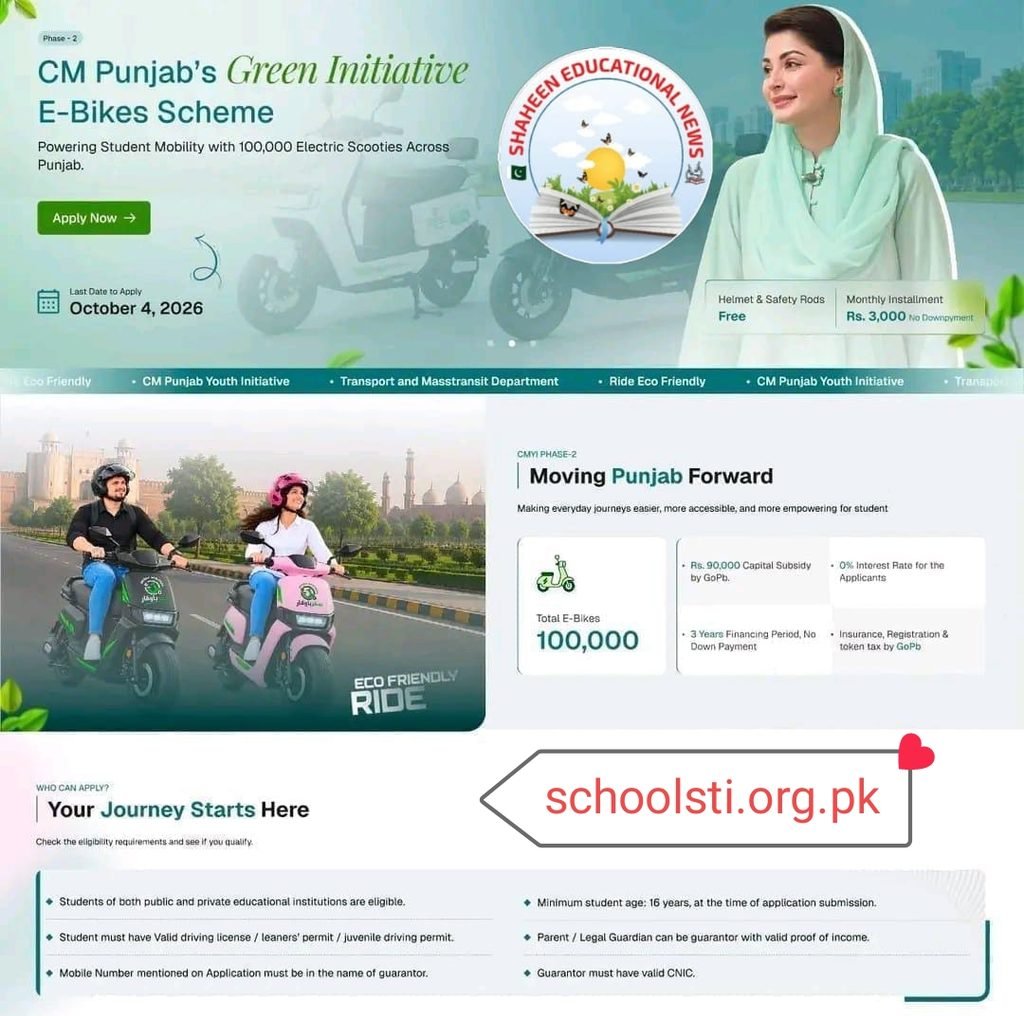
CM Punjab E-Bike Scheme
CM Punjab E-Bikes Scheme 2026 Expanded 100,000 Electric Bikes to be provided to eligible students across Punjab for affordable and eco-friendly mobility.
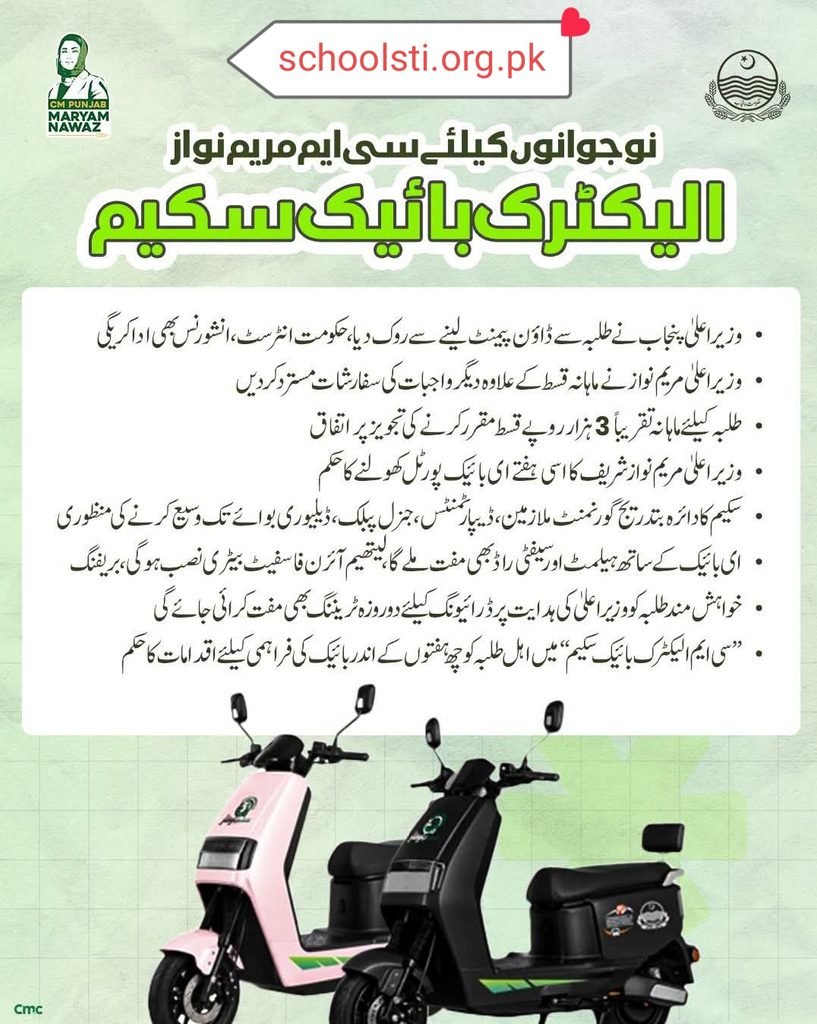
وزیراعلیٰ پنجاب ای بائیک اسکیم
پنجاب کے طلباء کو الیکٹرک بائیک دینے کے لیے رجسٹریشن کا آغاز کردیا گیا
◀️الیکٹرک بائیک کی قیمت 1 لاکھ 99 ہزار روپے کی بجائے صرف 1 لاکھ 9 ہزار روپے ہوگی
◀️بائیک کی قیمت 3 سال کی قسطوں میں ادا کی جائے گی، ماہانہ قسط صرف 3 ہزار 28 روپے ہوگی
◀️سرکاری و نجی کالجز اور یونیورسٹیز کے طلبہ اہل ہیں
◀️مدارس کے طلبہ بھی اس سکیم کے لیے اپلائی کرسکتے ہیں
◀️عمر کم از کم 16 سال ہونی چاہیے
◀️ ڈرائیونگ لائسنس یا لرنر پرمٹ ہونا ضروری ہوگا
وزیراعلیٰ پنجاب ای بائیکس سکیم 2026 نے پنجاب بھر کے اہل طلباء کو سستی اور ماحول دوست نقل و حرکت کے لیے 100,000 الیکٹرک بائیکس فراہم کی ہیں۔
اہم خصوصیات:
• مرد اور خواتین طلباء کے لیے 100,000 الیکٹرک بائک
• سرکاری سبسڈی کے ساتھ بلا سود فنانسنگ
• آسان ماہانہ اقساط
مفت ہیلمٹ اور حفاظتی سامان
• جدید ای بائک: 72V، 30Ah بیٹری | 1000W موٹر | رفتار: 50-55 کلومیٹر فی گھنٹہ
• اہل سرکاری اور نجی اداروں کے طلباء درخواست دے سکتے ہیں۔
اہلیت:
• کم از کم عمر: 16 سال
• درست ڈرائیونگ لائسنس / لرنر کا پرمٹ
• درست CNIC
• والدین/قانونی سرپرست بطور ضامن
• موبائل نمبر گارنٹر کے نام پر ہونا چاہیے۔
درخواست دینے کی آخری تاریخ: 4 اکتوبر 2026
آن لائن اپلائی کریں
📢 ای بائیک سکیم — کون اہل ہے اور کون نہیں؟
اب تک سامنے آنے والی تمام معلومات کے مطابق اس سکیم میں صرف اور صرف طلبہ و طالبات اہل ہیں۔
✅ کون اپلائی کر سکتا ہے؟
- 16 سال یا اس سے زائد عمر کے طلبہ و طالبات
- سکول، کالج اور یونیورسٹی کے طلبہ
- گورنمنٹ اور پرائیویٹ یونیورسٹیز کے طلبہ
- میڈیکل یونیورسٹیز/کالجز کے طلبہ
- یونیورسٹی اور کالج کے تمام اہل طلبہ
📌 اہم شرط:
سمارٹ کارڈ / شناختی کارڈ لازمی ہے۔
ب فارم پر اپلائی نہیں ہوگا، کیونکہ شناختی کارڈ کی فرنٹ اور بیک سائیڈ اپلوڈ کرنا ضروری ہے۔
🪪 ڈرائیونگ لائسنس:
- لرنر پرمٹ / لرنر لائسنس یا
- ریگولر ڈرائیونگ لائسنس
لازمی ہوگا۔
🎓 کالج/یونیورسٹی طلبہ کے لیے:
اپنے ادارے کا Student ID Card ہونا لازمی ہے۔
🏫 سکول جانے والے بچوں کے لیے:
سکول سے جاری کردہ Character Certificate یا Hope Certificate لازمی ہوگا۔
👨🏫 سکول طلبہ کے لیے ٹیچرز کا ریفرنس:
اپنے سکول کے دو ٹیچرز کا:
- نام
- شناختی کارڈ نمبر
- موبائل نمبر
- ای میل ایڈریس
- ریفرنس کی تفصیل
درکار ہوگی۔
👤 گارنٹر کے حوالے سے:
- 18 سال سے کم عمر طالب علم کے لیے فیملی ممبر گارنٹر ہوگا۔
- 18 سال یا اس سے زائد عمر کا طالب علم خود بھی گارنٹر بن سکتا ہے۔
❌ کون اپلائی نہیں کر سکتا؟
اس وقت دستیاب معلومات کے مطابق:
- سرکاری ملازمین
- سرکاری ٹیچرز
اس سکیم کے لیے اہل نہیں ہیں۔
Key Features:
- 100,000 Electric Bikes for Male & Female Students
- Interest-free financing with Govt subsidy
- Easy monthly instalments
- Free helmet & safety equipment
- Modern E-Bike: 72V, 30Ah Battery | 1000W Motor | Speed: 50-55 km/h
- Students from eligible Public & Private institutions can apply
Eligibility:
- Minimum Age: 16 years
- Valid Driving Licence / Learner’s Permit
- Valid CNIC
- Parent/Legal Guardian as Guarantor
- Mobile number should be in Guarantor’s name
Last Date to Apply: 4th October, 2026
Apply Online: http://bikes.punjab.gov.pk
- Program Name: Chief Minister Youth Initiative — Punjab Electric Bike Scheme 2026
- Key Update: 100% Zero Down Payment, zero interest/markup, and free insurance covered by the Punjab Government
- Monthly Installment: Approximately Rs. 3,000 per period of weeks with no additional hidden fees
- Battery Specification: Heavy-duty Lithium Iron Phosphate (LiFePO4) battery pack designed for local temperature resilience
- Safety & Training Perks: Free safety helmet, protective crash/safety rod, and 2 days of complimentary certified driving training
- Target Beneficiaries: Regular college and university students across Punjab (expanding phase-wise to state employees and delivery riders)
- Delivery Window: Distribution within 6 weeks for verified and balloted candidates
- Official Application Portal: Punjab E-Bikes Official Portal

The CM Maryam Nawaz Electric Bike Scheme 2026 provides zero-down-payment electric motorbikes to enrolled college and university students across Punjab, featuring an interest-no-cost installment plan of roughly Rs. 3,000 per period of weeks. Eligible students apply online through the official portal at bikes.punjab.gov.pk by submitting their CNIC/B-Form, pupil verification, and valid driving license or learner permit.
What Sparked the Urgency for Punjab’s New Student E-Bike Push?
If you have stepped out of a college gate in Lahore, Multan, Faisalabad, or Rawalpindi around 1:30 PM lately, you already understand the daily struggle. The scorching afternoon heat hits like a furnace, general buses are packed past the doorsteps with students clinging to railings, and local ride-hailing fares eat through an entire week’s pocket cash in two days.
A few months ago, while visiting a local degree college campus in Punjab to meet faculty colleagues, I watched students waiting nearly forty-five minutes under the sun just to squeeze into an overcrowded private wagon. One third-year student showed me his monthly transport ledger: between feeder bus tokens, shared motorcycle-rickshaws, and emergency bike rides, he was spending over Rs. 9,500 every single period of weeks just getting to class and back. For a middle-class family supporting two or three college-going children, that expense equals grocery finances.
When the earliest phase of the Punjab E-Bike initiative rolled out earlier, it proved the massive appetite among youth for clean mobility, yet it also surfaced practical barriers. The upfront deposit, ancillary bank processing charges, and insurance co-pays placed the bikes just beyond the reach of the students who needed them most.
The latest September 2026 policy directive announced by Chief Minister Maryam Nawaz alongside Provincial Education Minister Rana Sikandar Hayat tackles those hurdles directly. By eliminating the down payment entirely, capping monthly installments at roughly Rs. 3,000, and covering insurance and interest out of provincial funds, the administration has reworked this project into a genuinely accessible pupil utility.
What Is the CM Maryam Nawaz Electric Bike Scheme 2026?
The CM Punjab Electric Bike Scheme is a flagship green-mobility project developed under the Chief Minister Youth Initiative, executed jointly by the Punjab Higher Education Department, the Punjab Information Technology Board (PITB), and the Bank of Punjab (BOP).
The program provides brand-modern electric motorbikes and scooters to bonafide male and female students enrolled in degree colleges and universities across Punjab. Unlike commercial auto financing that burdens applicants with double-digit interest rates, heavy processing fees, and mandatory security deposits, this scheme operates on a social-subsidy model. The Government of Punjab pays the financial markup directly to the lending institution, while also underwriting comprehensive bike insurance so that enrolled youngsters pay only the base asset cost spread across affordable monthly repayments.
+-----------------------------------------------------------------------------+
|                     OFFICIAL E-BIKE SCHEME 2026 SNAPSHOT                    |
+--------------------------+--------------------------------------------------+
| Sponsoring Authority     | Government of the Punjab (Chief Minister Office) |
| Implementing Agency      | Higher Education Department & PITB               |
| Financial Partner        | The Bank of Punjab (BOP)                         |
| Down Payment Requirement | 0% (Completely Waived for Eligible Students)     |
| Monthly Installment      | ~Rs. 3,000 / month                               |
| Mark-up & Financing Cost | 100% Subsidized by Punjab Government             |
| Insurance Premium        | 100% Covered by Punjab Government                |
| Battery Chemistry        | Lithium Iron Phosphate (LiFePO4)                 |
| Mandatory Safety Extras  | Free Helmet + Steel Safety Protection Rod        |
| Free Driver Education    | 2-Day Driving Training Course                    |
| Expected Delivery Time   | Within 6 weeks post-scrutiny & balloting         |
| Primary Online Portal    | bikes.punjab.gov.pk                              |
+--------------------------+--------------------------------------------------+
What Are the Big Policy Upgrades in This Latest Announcement?
The newly released ministerial directive introduces five practical adjustments designed to fix friction points that students encountered during initial pilot distributions.
1. Total Elimination of the Down Payment
In conventional auto leasing, paying 15% to 30% upfront forms the hardest hurdle. For a pupil without independent income, pulling together Rs. 35,000 to Rs. 50,000 for a down payment meant turning to parents who were already stretched thin by tuition fees. Chief Minister Maryam Nawaz strictly directed authorities to waive the initial equity contribution, ensuring financial status does not prevent a hardworking student from getting wheels.
2. Rejection of Incidental Bank Charges
Proposals from financial consultants suggested adding auxiliary administrative overheads, documentation stamps, and ledger-maintenance surcharges on leading of student payments. The Chief Minister firmly rejected these proposals. The monthly installment of approximately Rs. 3,000 represents the flat, all-inclusive maximum out-of-pocket figure for the recipient.
3. Administration-Funded Interest and Insurance
Commercial bank leasing in Pakistan carries commercial KIBOR-linked financing rates that make vehicle purchases prohibitive for students. Under this initiative, the provincial exchequer absorbs both the profit margin and third-party asset insurance. If an unforeseen collision or electrical breakdown occurs, the pupil is not left facing catastrophic out-of-pocket bills.
4. Mandated Lithium Iron Phosphate (LiFePO4) Battery Chemistry
One of the most consequential technical decisions in the new policy is the mandatory integration of Lithium Iron Phosphate (LiFePO4) battery technology. In Pakistan’s harsh summer climate, where road asphalt temperatures frequently top 48°C, generic Lithium Nickel Cobalt (NMC) batteries can degrade rapidly or pose thermal runaway risks if mishandled. LiFePO4 cells provide superior thermal stability, safer operating thresholds, and roughly three to four times the cycle lifespan of basic lead-acid or standard lithium variants.
5. At no charge Safety Gear and Certified Driver Training
Riding in city traffic demands both defensive driving awareness and proper protective gear. Every approved bike delivery comes equipped with an impact-tested safety helmet and a reinforced structural safety rod (leg guard). Furthermore, applicants who lack two-wheeler road experience obtain a mandatory, at no charge two-day driving instruction clinic organized in collaboration with local traffic licensing authorities.
Who Is Eligible to Apply for the Punjab Electric Bike Scheme?
The initial tranche focuses strictly on students who bear the heaviest commuting burdens, with subsequent phases designated for broader social sectors.
+-----------------------------------------------------------------------------+
|                           ELIGIBILITY SCORECARD                             |
+------------------------------------+----------------------------------------+
| Criteria                           | Requirement Status                     |
+------------------------------------+----------------------------------------+
| Domicile                           | Must hold valid Punjab Province domicile|
| Enrollment Status                  | Regular learner of recognized college   |
|                                    | or public/private sector university    |
| Age Verification                   | 18+ years with valid CNIC               |
| Driving Credential                 | Valid Motorcycle Driving License OR    |
|                                    | Traffic Police Learner Driving Permit  |
| Dual Scheme Benefit                | Must not have defaulted on prior state |
|                                    | student transport or laptop programs   |
+------------------------------------+----------------------------------------+
Can Intermediate, University, and College Students Apply?
Yes. Regular students registered in accredited higher secondary colleges, degree awarding institutions, postgraduate colleges, and recognized universities across all administrative divisions of Punjab qualify. Confidential candidates who are not enrolled through institutional attendance rolls are currently ineligible as institutional verification forms the primary validation baseline for banking partners.
Students balancing coursework alongside civil test preparation, career exams, or local education updates can explore dedicated academic resources on Schools STI Educational Portal, which tracks administrative notifications, study materials, and student opportunity guidelines across Punjab.
What Are the Dedicated Quotas for Female Students?
Recognizing that transport scarcity impacts female mobility disproportionately, the Punjab administration established dedicated female quotas within the e-bike division. Specially engineered step-through electric scooters featuring lighter frames, automatic twist-and-go throttles, and wide footboards are prioritized for female candidates to ensure hassle-complimentary daily commuting in traditional attire.
How Will the Scheme Expand to Government Employees and Delivery Workers?
According to the briefing sanctioned by the provincial cabinet, this scheme will systematically open candidate windows for:
- Grade-1 to Grade-14 provincial authority employees who travel long distances between rural residences and district administrative complexes.
- Field-standard staff members in administrative departments.
- Registered gig-economy couriers and food delivery professionals, offering low-cost transport options that reduce operating overheads and help sustainable livelihoods.
What Documents Must You Prepare Before Opening the Portal?
Nothing stalls an online application faster than scrambled paperwork or illegible mobile phone scans. Have these scanned documents organized in a clean folder on your phone or laptop before launching the registration page:
- Original Computerized National Identity Card (CNIC): Clear, uncropped scans of both front and back. If your CNIC has expired, renew it through NADRA before applying, as automated database handshakes instantly flag expired identity numbers.
- Institutional Enrollment Verification: Current learner identity card alongside your latest semester fee challan, official enrollment slip, or a signed bona-fide learner certificate from your college principal or registrar office.
- Motorcycle Driving License or Learner’s Driving Slip: A permanent motorcycle driving license issued by Punjab Police Traffic Licensing branches, or an active Learner Driving Permit. If your learner permit was generated online through the DLIMS framework, ensure the document has not passed its validity date.
- Active Personal Mobile SIM Card: The SIM card must be officially registered against your own CNIC. Verification One-Time Passwords (OTPs) and banking alerts are dispatched solely through cellular SMS, not WhatsApp.
- Parental / Co-Signer Guarantee Details: While the down payment is zero, the financing institution requires basic co-borrower facts (parent, guardian, or immediate family member) who acts as a secondary contact for installment verification.
How Do You Apply Step-by-Step on bikes.punjab.gov.pk?
Applying on the official portal takes less than fifteen minutes when your documents are organized properly. Walk through these exact steps to ensure your application passes automated screening:
[ STEP 1: PORTAL SIGNUP ]
         │
         ▼
[ STEP 2: PROFILE & ACADEMIC INPUT ]
         │
         ▼
[ STEP 3: SELECT E-BIKE MODEL & SPECS ]
         │
         ▼
[ STEP 4: BOP BANKING VERIFICATION ]
         │
         ▼
[ STEP 5: FINAL REVIEW & FORM SUBMISSION ]
Step 1: Account Creation and Phone Validation
Navigate directly to Punjab E-Bikes Portal. Tap on the Register / Apply Now section. You will be prompted to enter your Full Legal Name (matching your CNIC character for character), your 13-digit CNIC number without hyphens, your active email address, and your personal mobile phone number. Hit submit to receive a 6-digit OTP code on your handset, and enter it to verify your account credentials.
Step 2: Educational Profiling and College Selection
Once inside the portal dashboard, select your administrative district (e.g., Lahore, Sahiwal, Rawalpindi, Bahawalpur) and your institutional tier (Public College, Private College, or Chartered University). Apply the searchable dropdown menu to locate your particular institution. Enter your ongoing degree program (e.g., BS Computer Science, BA, B.Com, MBBS), current semester, and roll/registration number. The PITB software verifies these records directly against departmental university databases.
Step 3: Vehicle Type and Battery Specification Selection
Choose the Electric Bike category. You can browse certified models offered by verified domestic manufacturers under the provincial contract. You will notice the updated 2026 specifications highlighting the mandatory Lithium Iron Phosphate battery pack, onboard charging unit, motor wattage ratings, and safety accessories.
Step 4: Driver License & Guardian Verification
Upload a high-resolution photograph of your permanent driving license or your DLIMS digital learner driving slip. Enter the unique tracking code from your license. In the subsequent tab, deliver your parent’s or guardian’s CNIC number, residential address, and active mobile contact for the formal banking agreement.
Step 5: Final Submission and E-Challan Generation
Double-check every single field. A spelling discrepancy between your portal entry and your NADRA record can disqualify your application during automated scrutiny. Click the final declaration checkbox and submit your form. The system will generate a unique Application Tracking ID and a downloadable confirmation receipt with an e-challan slip for record purposes.
[CLICK HERE TO APPLY ONLINE AT BIKES.PUNJAB.GOV.PK]
Keep your tracking ID saved in a secure note on your smartphone. You will want this string to monitor verification steps, physical inspection dates, and e-balloting results.
Why Does the Lithium Iron Phosphate (LiFePO4) Battery Matter?
For the everyday commuter, battery chemistry may sound like dry engineering jargon. In reality, it represents the single biggest factor dictating whether your electric bike remains a reliable workhorse or becomes an expensive paperweight after twelve months.
+-----------------------------------------------------------------------------+
|               BATTERY COMPARISON: LiFePO4 VS STANDARD PACKS                 |
+--------------------------+---------------------+----------------------------+
| Parameter                | Standard Lithium /  | Lithium Iron Phosphate     |
|                          | Lead-Acid Batteries | (LiFePO4) 2026 Standard    |
+--------------------------+---------------------+----------------------------+
| Full Charge Cycles       | 300 - 800 cycles    | 2,500 - 3,500+ cycles      |
| Estimated Life Expectancy| 1 to 2 Years        | 5 to 7 Years               |
| High Heat Degradation    | Rapid (>40°C degrades| Extremely Resistant        |
|                          | capacity quickly)   | up to 55°C operating temps |
| Thermal Runaway Risk     | Moderate to High    | Virtually Non-Existent     |
| Charging Heat Build-up   | Pronounced          | Minimal & Well-Regulated   |
| Depth of Discharge (DoD) | 50% - 70% usable    | 90% - 95% fully usable     |
+--------------------------+---------------------+----------------------------+
In standard lead-acid electric scooters, the battery pack loses substantial charging storage within 10 to 14 months of daily employ, forcing owners to replace expensive cells out of pocket. Standard ternary lithium batteries (NMC) offer lighter weight, but their chemical structure can become volatile when subjected to high ambient temperatures and aggressive charging.
LiFePO4 batteries feature an inherently robust chemical composition that resists thermal breakdown, even when charged immediately following an intense afternoon commute under blazing sunshine. Furthermore, an average lifespan exceeding 3,000 full recharge cycles means that a college student can ride the bike through four full years of undergraduate studies without facing severe battery capacity loss.
What Does the Real-World Cost Breakdown Look Like?
To comprehend why this scheme is economically transformative for students, look at the actual operational math comparing a traditional 70cc petrol motorcycle against a subsidized LiFePO4 electric bike over a typical 30-day college period of weeks.
Assume an average daily round-trip commute of 32 kilometers between home, campus, and library sessions (roughly 960 kilometers traveled each period of weeks):
+-----------------------------------------------------------------------------+
|                 MONTHLY COMMUTE RUNNING COST COMPARISON                     |
+-------------------------------+---------------------+-----------------------+
| Expense Category              | 70cc Petrol Bike    | CM Scheme E-Bike      |
+-------------------------------+---------------------+-----------------------+
| Fuel / Energy Input           | ~22 Liters Petrol   | ~26 Electric Units    |
| Average Rate (Est. 2026)      | ~Rs. 275 per Liter  | ~Rs. 50 per kWh Unit  |
| Monthly Energy Cost           | Rs. 6,050           | Rs. 1,300             |
| Engine Oil & Filter Changes   | Rs. 1,200 (Monthly) | Rs. 0 (Not Required)  |
| Mechanical Tuning & Chains    | Rs. 600             | Rs. 150 (Brake check) |
| Monthly Financing Payment     | Rs. 0 (If owned)    | Rs. 3,000             |
| Total Monthly Expenditure     | Rs. 7,850           | Rs. 4,450             |
+-------------------------------+---------------------+-----------------------+
Even after adding the Rs. 3,000 monthly bike installment, riding the electric bike costs significantly less than simply putting fuel and engine oil into a petrol bike you already own. Once the installment duration concludes, your monthly commuting expenditure drops down to roughly Rs. 1,300 to Rs. 1,500 in home electricity usage. That represents financial breathing room for students funding their own books, semester exam forms, and certification courses.
Comparison: Punjab E-Bike Scheme vs Commercial Vehicle Leasing
To appreciate the scale of the provincial subsidy, consider what happens when an individual walks into a commercial financial institution to lease an entry-level two-wheeler on their own:
+-----------------------------------------------------------------------------+
|             GOVERNMENT SUBSIDY VS COMMERCIAL BANK LEASING                   |
+-------------------------------+--------------------+------------------------+
| Financing Parameter           | Commercial Lease   | CM Maryam Nawaz Scheme |
+-------------------------------+--------------------+------------------------+
| Mandatory Upfront Deposit     | 20% to 30% Cash    | 0% (Completely Zero)   |
| Bank Processing Charges       | Rs. 4,000 - 8,000  | Waived / Non-Existent  |
| Annual Mark-up Rate           | 18% to 26% KIBOR   | 0% (Paid by Government)|
| Annual Asset Insurance        | 3.5% to 5.0% Added | 0% (Paid by Government)|
| Repayment Period Flexibility  | Rigid Default Terms| Student-Centric Grace  |
| Free Accessories Included     | None               | Free Helmet + Rod      |
| Certified Safety Training     | Not Offered        | Free 2-Day Practical   |
+-------------------------------+--------------------+------------------------+
What Common Mistakes Disqualify Students During Registration?
Every semester, thousands of applicants obtain stuck in administrative review queues due to small, avoidable mistakes. Here are the missteps to avoid:
1. Entering Inaccurate CNIC Credentials
A surprisingly common blunder is submitting an older B-Form identity number or having a typo in a single digit. The PITB portal relies on an automated application programming interface (API) that validates your CNIC against both NADRA and your college’s enrollment records. If the name spelling on your portal application differs from the registered spelling on your matriculation or CNIC records, the server will trigger an automatic document hold.
2. Using an Expired or Unverified Driving Permit
Uploading an unreadable, blurry picture of a paper learner slip or submitting a permit that has expired will cause an immediate rejection during manual scrutiny. If your learner permit is near its renewal date, log onto the official Punjab Police DLIMS web page and renew it before attaching the digital file to your application.
3. Providing a Non-Biometric Mobile Contact
Never register using a SIM card that belongs to your friend, roommate, or landlord. The Bank of Punjab and PITB dispatch crucial balloting alerts, account creation prompts, and physical inspection schedules via encrypted SMS channels. If your contact number is not registered against your own personal CNIC, verifying your identity at the bank branch during physical file handovers becomes unnecessarily complicated.
4. Applying as an Irregular or Private Candidate
If you are enrolled in distance learning programs or taking private degree exams without registered attendance rolls at an affiliated college, your application cannot pass institutional verification. The current tranche is reserved strictly for active campus attendees.
What Happens After Application Submission: Scrutiny, Balloting, and Delivery
Knowing what occurs behind the scenes keeps you prepared for every stage of verification once you hit submit.
[ ONLINE APPLICATION ]
         │
         ▼
[ AUTOMATED SCRUTINY ] ──> NADRA, DLIMS & Institutional Verification
         │
         ▼
[ E-BALLOTING (IF OVERSUBSCRIBED) ] ──> PITB Transparent Public Draw
         │
         ▼
[ BANK OF PUNJAB VERIFICATION ] ──> Simple Guarantee & Account Setup
         │
         ▼
[ 2-DAY PRACTICAL SAFETY CLINIC ] ──> Certified Driving Experience
         │
         ▼
[ BIKE HANDOVER WITHIN 6 WEEKS ] ──> Free Helmet, Safety Rod & Keys
Phase 1: Automated Data Scrutiny
During this 7- to 10-day window, structure servers cross-reference your submitted academic roll credentials with the Higher Education Department database. Concurrently, your identity is verified through NADRA, and your driving credential is confirmed via traffic police licensing servers.
Phase 2: Transparent E-Balloting by PITB
If total verified applications in any given district exceed the allocated regional vehicle quota, an automated, computer-generated e-balloting draw takes spot under general media oversight. Balloting algorithms operate with hardcoded geographic and gender quotas to ensure equitable distribution across all 36 districts of Punjab.
Phase 3: Banking Document Execution at BOP
Shortlisted students receive an official SMS notification advising them to visit their designated local Bank of Punjab branch. Since the down payment is zero and interest is covered, you simply sign standard vehicle custody terms, show your original CNIC and college card, provide your guardian’s co-signing signature, and set up your monthly Rs. 3,000 installment channel.
Phase 4: Two-Day Driver Instruction Course
Before collecting your vehicle, you participate in a comprehensive two-day certified motorcycle handling and road safety clinic conducted by traffic training instructors. The curriculum covers low-speed balance, regenerative brake management, throttle modulation on slick surfaces, lane discipline, and regional traffic sign comprehension.
Phase 5: Distribution and Delivery Within 6 Weeks
Following the Chief Minister’s direct instruction, all physical handovers must wrap up within six weeks of balloting completion. Successful candidates get their e-bike along with its onboard charger, factory manual, a certified safety helmet, an installed steel leg protection rod, and the official registration document.
How to Maintain Your Electric Bike for Maximum Longevity?
Operating an electric vehicle is straightforward compared to an internal combustion engine, however keeping the battery healthy requires following a few basic charging habits:
- Avoid Complete Depletion: Try not to run your LiFePO4 battery all the manner down to 0%. While the chemical structure handles deep discharges improved than older battery types, plugging the vehicle in when the display gauge hits 15% to 20% preserves the internal cells.
- Observe the 30-Minute Cool Down Rule: In high summer temperatures, do not plug the bike into the wall outlet the exact second you park after a long commute. Let the battery casing cool down for twenty to thirty minutes before initiating a full recharge.
- Use Only the Factory-Issued Charger: Never borrow a friend’s generic third-party electric scooter charger simply given that the plug fits into the port. Distinct battery packs call for specific charging current and voltage profiles.
- Check Tire Pressure Bi-Weekly: Low tire pressure creates rolling resistance that drains the battery faster. Keeping your tires inflated to factory specifications protects your per-charge range.
- Inspect the Safety Rod Bolts: Vibrations from rough roads can gradually loosen accessory fittings. Check the mounting bolts on your safety leg rod every few weeks to build sure they remain tight.
Frequently Asked Questions (FAQs)
What is the official online platform to apply for the CM Maryam Nawaz Electric Bike Scheme 2026?
The only official portal for learner registrations is Punjab E-Bikes Portal. At no time distribute your personal credentials, pupil records, or identity details with third-party social media pages or unofficial blogs claiming to register students for cash fees.
Is there any initial down payment required under the modern update?
No. Chief Minister Maryam Nawaz has completely eliminated the down payment requirement for students. You do not have to deposit any upfront equity to qualify for or obtain the bike.
Can students with a Learner Driving Permit apply, or is a full license mandatory?
Students holding an active, unexpired Traffic Police Learner Driving Permit issued through the DLIMS framework are fully eligible to apply. However, students are encouraged to convert their learner permits into regular driving licenses as soon as their designated waiting period concludes.
What happens if the monthly installment of Rs. 3,000 is delayed?
Installment schedules are coordinated through the Bank of Punjab. If an unexpected emergency delays payment, the bank provides a standard grace window. However, consecutive defaults without formal communication can lead to vehicle repossession and negative credit reporting, so notify your branch immediately if you face an unavoidable emergency.
How many kilometers can the bike cover on a single full charge?
Equipped with a certified Lithium Iron Phosphate battery pack, these electric motorbikes generally offer a genuine-world riding range between 65 and 85 kilometers per full charge, depending on rider weight, terrain incline, and average throttle speed.
Can female students pick between regular bikes and scooters?
Yes. Female applicants can select either a standard electric motorbike or a specially designed lightweight electric scooter with a step-through frame, making daily campus travel comfortable and convenient.
The project operates under direct provincial oversight via the Government of the Punjab Official Portal, technological execution and transparent balloting management by the Punjab Information Technology Board, and financial processing through The Bank of Punjab.
What Should Punjab Students Do Next?
The revised CM Maryam Nawaz Electric Bike Scheme represents a well-designed, practical policy shift. By removing the upfront financial barrier, keeping monthly installments at roughly Rs. 3,000, and building the vehicles around risk-free LiFePO4 battery technology, the Punjab government has addressed the authentic transport challenges that college students face every single day.
If you are an enrolled college or university pupil in Punjab, do not wait until the final deadline when internet traffic slows the registration servers down. Verify your learner enrollment credentials, renew your learner driving permit on the DLIMS portal, gather your scanned documents, and head straight over to Punjab E-Bikes Official Registration to submit your application currently.
Official Resources & Reference Links
- Official Student Application Portal: Punjab E-Bikes Management Portal
- Provincial Administration: Government of the Punjab Official Website
- Technological Systems & Balloting: Punjab Information Technology Board (PITB)
- Financing & Banking Partner: The Bank of Punjab (BOP)
- Academic Updates & Educational Guides: Schools STI Educational Portal
Author Bio & Editorial Review
Majid Farooq is a seasoned educationist, technology writer, and web publisher based in Punjab, Pakistan. Serving within the open education sector in scale BPS-14 since 2015 and managing regional educational platforms including Schools STI, he specializes in translating complex state policies, digital portals, educational notifications, and academic initiatives into practical, step-by-step guidance for students, teachers, and young professionals.
- Publication Date: September 4, 2026
- Last Updated: September 4, 2026
- Topic Category: Student Welfare, Green Mobility, Education Initiatives Punjab