LAT Registration July 2026
- Quick Summary
- What is the LAT?: The Law Admission Test is a mandatory entry exam by the HEC for students pursuing a 5-year LLB degree in Pakistan.
- Total Marks: 100 (75 MCQs and 25 Subjective).
- Passing Criteria: You must score at least 50 marks to qualify.
- Last Date to Apply: 10 August 2026.
- Official Test Date: 6 September 2026.
- Application Fee: Rs. 1,800, payable via 1Link.
- Official Application Portal: etc.hec.gov.pk.
LAT Registration Open! Last Date: 10 August 2026 | Complete Guide & Test Pattern
The Law Admission Test (LAT) 2026 is a mandatory exam conducted by the Higher Education Commission (HEC) for LLB degree admissions in Pakistan. The total paper comprises 100 marks, requiring a minimum of 50 to pass. Registration is officially open until 10 August 2026, and the written test will be held on 6 September 2026.
Just last week, a panicked student reached out to me. He had spent hours filling out his entire LAT application, generated the fee challan, paid the money through his banking app, and thought he was good to go. A few weeks later, his friends received their roll number slips, but his inbox was empty. The problem? He never clicked the “Verify Online Payment” button on the HEC portal. His application was sitting dead in the “Saved” folder instead of “Submitted,” and he completely missed his chance to sit for the exam.
Working in the government education department since 2015, I’ve noticed this exact technical glitch trip up hundreds of brilliant students every single testing cycle. Whether you are aiming for Punjab University, Quaid-e-Azam University, or any private law college, passing the LAT is your absolute first step. You cannot bypass this legal requirement. Over on my primary educational platform, School STI, I am constantly bombarded with questions about the syllabus, the confusing ETC portal UI, and how to actually secure those 50 passing marks.
I know how web applications work under the hood. When I deploy custom PHP standalone snippets via the WPCode plugin on Astra Pro themes, I see exactly how server requests and API calls behave. The HEC portal relies on a third-party 1Link API to fetch your payment status. If you don’t actively trigger that verification link, the system assumes you haven’t paid. I’m writing this comprehensive guide to ensure you don’t fall victim to these common portal traps, while also providing a complete breakdown of the 2026 syllabus so you can clear the exam on your first attempt.
What is the Law Admission Test (LAT) and Why is it Mandatory?
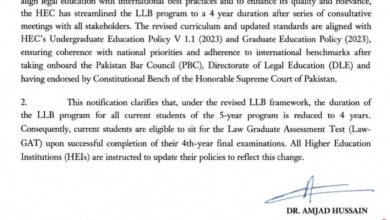
Before we get into the heavy technical details of the application process, let’s establish exactly what this test is. The Law Admission Test (LAT) is an evaluation metric designed by the Education Testing Council (ETC). Following regulations set forth to standardize legal education, the HEC made it compulsory for any student seeking enrollment in an undergraduate 5-year LLB degree program across any public or private university in Pakistan.
If an institution offers you an LLB admission without requiring an LAT score, run the other way. That degree will not be recognized by the Pakistan Bar Council, and you will not be legally permitted to practice law. To be eligible to apply, you simply need to have passed your Intermediate (FA/FSc) or equivalent. Even students who have appeared for their final exams and are awaiting results are entirely eligible to sit for the LAT.
What is the Official LAT Schedule for 2026?
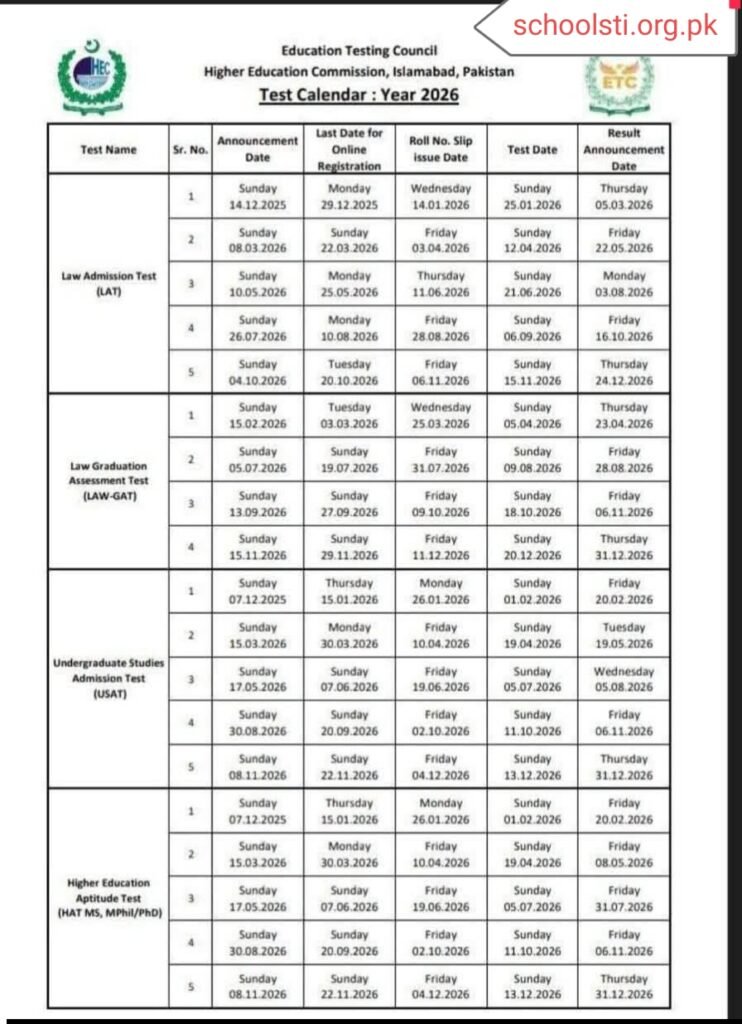
Timing is everything. The ETC servers are notorious for lagging and timing out during the final 48 hours of the registration window due to heavy traffic. You need to plan ahead. Based on the official test calendar, specifically referenced in the document IMG-20260726-WA0040.jpg, here is the exact operational timeline for the upcoming session:
- Announcement Date: Sunday, 26 July 2026
- Last Date for Online Registration: Monday, 10 August 2026
- Roll No. Slip Issue Date: Friday, 28 August 2026
- Test Date: Sunday, 6 September 2026
- Result Announcement Date: Friday, 16 October 2026
Do yourself a favor and complete your registration by the first week of August.
What is the Complete Syllabus and Paper Pattern for LAT 2026?
The biggest mistake candidates make is studying blindly without analyzing the weightage of the paper. You only have 140 minutes to complete the entire exam. The paper is split into an Objective section (MCQs) worth 75 marks, and a Subjective section worth 25 marks.
Here is the exact structural breakdown of the paper:
| Subject / Section | Category | Marks | Syllabus Details |
| English | Objective (MCQs) | 20 | Synonyms, Antonyms, Prepositions |
| General Knowledge | Objective (MCQs) | 20 | Geography, World Capitals, Current Affairs |
| Islamic Studies | Objective (MCQs) | 10 | Basic Beliefs, Islamic History, Quranic Info |
| Pakistan Studies | Objective (MCQs) | 10 | Pre & Post Partition Events, Constitution |
| Urdu | Objective (MCQs) | 10 | Vocabulary, Basic Grammar |
| Mathematics | Objective (MCQs) | 5 | Arithmetic, Percentages, Algebra |
| Essay Writing | Subjective | 15 | Max 200 words (English or Urdu) |
| Personal Statement | Subjective | 10 | Max 200 words (English or Urdu) |
| Total Marks | 100 | Passing Marks: 50 |
How to Master the Objective Section (75 Marks)?
The multiple-choice portion is where you build your safety net. If you score well here, the subjective portion just acts as a bonus to boost your aggregate.
- English (20 Marks): The English section does not test heavy literature. It strictly tests your functional grammar. You will face questions on fixed prepositions (e.g., knowing when to use “accused of” versus “agree with“). It also heavily features synonyms and antonyms. As an English content writer, my advice is to read the editorial sections of major newspapers. It naturally builds your contextual vocabulary faster than rote memorizing word lists.
- General Knowledge (20 Marks): This is vast, but predictable. Focus heavily on international organizations (UN, SAARC, OIC), country capitals, global currencies, and major geographic features like straits and oceans.
- Islamic and Pakistan Studies (20 Marks): Treat these two as a combined storytelling subject. For Pakistan Studies, you need a firm grip on the timeline from the War of Independence (1857) to the creation of Pakistan (1947), along with basic knowledge of the subsequent constitutions. Islamic Studies focuses heavily on the pillars of Islam, Ghazawat (battles), and the life of the Holy Prophet (PBUH).
- Urdu and Mathematics (15 Marks): Urdu grammar covers Alfaz Mutradif (synonyms), Zarb-ul-Amsal (proverbs), and basic sentence structures. Mathematics is only worth 5 marks and tests very basic arithmetic—think BODMAS rules, basic fractions, and simple percentage calculations. If you are terrible at math, do not waste 30 minutes stuck on this section. Leave it for the absolute end.
How to Secure Maximum Marks in the Subjective Section (25 Marks)?
You have the choice to write both the Essay and the Personal Statement in either English or Urdu. Pick the language you can write flawlessly in without grammatical errors.
The Essay (15 Marks): You will generally be given a choice of three topics revolving around education, technology, social issues, or law and justice. You must write a maximum of 200 words. Keep it structured: a clear introductory paragraph, a body paragraph presenting your arguments, and a strong concluding paragraph.
The Personal Statement (10 Marks): This is where you explain your internal motivations. The prompt is usually “Why do you want to become a lawyer?” or a situational question. Don’t write generic, robotic sentences. Tell a brief, 200-word story about a real observation or a specific drive that pushed you toward the legal profession.
How to Apply for the HEC LAT 2026 Online?
The registration process is entirely digital. No paper forms need to be mailed to the HEC headquarters. However, the online portal can be tricky. Here is the exact, step-by-step technical process to ensure your application goes through smoothly.
Step 1: Accessing the ETC Portal
Navigate to the official Higher Education Commission testing portal at http://etc.hec.gov.pk. I highly recommend doing this on a desktop or a laptop rather than a mobile phone. As someone who builds web applications on Hostinger Business servers, I can tell you that complex multi-step forms often suffer from layout shifts on mobile browsers, which can cause you to accidentally click the wrong dropdown options.
Step 2: Creating Your Account
If you are a first-time user, click on the Sign-Up button. You will need to enter your Nationality, CNIC number (or B-Form number), a valid email address, and an active mobile number. Make sure you have access to your phone and email right then, as the system will send a One-Time Password (OTP) for verification.
Step 3: Completing Your Profile
Once logged in, click on “My Profile.” You must fill out all personal details and upload a recent passport-sized photograph. In the education section, meticulously add your academic history starting from your Matriculation (or O-Levels) and then your Intermediate (or A-Levels).
Step 4: Applying for the Test and Selecting a Center
Go back to the main dashboard and locate the active link for the “Law Admission Test (LAT)”. Click apply. You will be prompted to select your preferred test center. The ETC conducts exams in major cities across the country. Choose wisely, because once you lock this in, you cannot change the test center later.
Step 5: Generating and Paying the Fee Challan
Upon selecting your center, the portal will generate a 1Link Consumer ID/Challan Number. The application fee is Rs. 1,800, which is non-refundable.
You no longer have to stand in long bank lines. You can pay this easily using a banking app or mobile wallets like JazzCash and EasyPaisa.
If you are using JazzCash:
- Open the app and navigate to “Corporate / 1Link”.
- Select “1Bill (Invoice / Voucher)”.
- Enter your unique Consumer ID generated by the portal.
- Confirm the Rs. 1,800 payment and take a screenshot of the digital receipt.
Step 6: The Critical Verification Step
As I mentioned at the start, this is where it all goes wrong. After you pay via your phone, you must return to the active HEC portal in your web browser. Click the “Verify Online Payment” button. This forces the portal to ping the 1Link servers to confirm your transaction. Only when this is successful will your application status change from “Saved” to “Submitted”.
What are the Essential Tools and Resources for LAT Preparation?
You don’t need to spend thousands on expensive academies. The internet provides everything you need to cross the 50-mark threshold.
- Past Papers: Practicing past exams is the absolute best way to understand the pattern and identify recurring vocabulary and general knowledge trends. Treat them like actual mock tests and time yourself for 140 minutes.
- Daily Newspapers: For the essay section and the General Knowledge current affairs, reading English dailies like Dawn News is invaluable. It builds your reading comprehension speed.
- Official Syllabus Guidelines: Always cross-reference your preparation with the official mandates found on the HEC Official Website.
What Common Mistakes Should You Avoid During LAT Registration?
Beyond the payment verification issue, here are a few other technical and practical mistakes candidates routinely make:
- Using a Network-Ported Mobile Number: The ETC portal often fails to deliver OTP SMS messages to numbers that have been ported from one network to another (e.g., a Jazz number shifted to Zong). Use a standard, non-ported number for account registration.
- Ignoring the Essay Practice: Many students spend 90% of their time memorizing GK MCQs and completely ignore the subjective portion. The essay and personal statement account for 25% of your grade. Practice writing them out by hand to build your speed.
- Weak English Fundamentals: Neglecting grammar and vocabulary is a fast track to a low score. The English section alone carries 20 marks.
- Poor Time Management: Getting stuck on the 5-mark mathematics section and leaving no time for the 15-mark essay is a massive tactical error.
Frequently Asked Questions (FAQs) About LAT 2026
Can I retake the LAT if I fail?
Yes, there is no restriction on the number of attempts. You can take the LAT test multiple times if you fail to secure the required 50 marks.
How many times a year is the LAT conducted?
The ETC generally conducts the Law Admission Test on a quarterly basis throughout the calendar year.
What documents do I need to bring to the test center?
On the day of the exam, you must bring a printed copy of your Roll Number Slip, your original CNIC (or original B-Form), and the original paid fee challan. If you are missing any of these, the ETC staff will not allow you into the examination hall.
Is there any age limit to apply for the LAT?
No, there is absolutely no upper or lower age limit specified for appearing in the Law Admission Test.
Can overseas Pakistanis apply for the test?
Yes, nationality requirements state that any Pakistani or overseas Pakistani is fully eligible to apply and sit for the exam.
Final Thoughts Before You Apply
Clearing the LAT is less about possessing an encyclopedic knowledge of world events and more about strategic preparation. Secure your technical registration first, verify that application status, and then build a study timetable that heavily prioritizes English vocabulary, structured essay writing, and core Pakistan Studies concepts.
Don’t wait until August 9th to start clicking through the ETC portal. Get it done today. I manage multiple platforms, including toolpk.com and toolkot.com, and I see server analytics every day. When thousands of students rush a portal in the final 24 hours, databases crash. Register early, clear your browser cache if the page hangs, and start tackling those past papers. Good luck!
References
- Education Testing Council (ETC) Portal
- Higher Education Commission (HEC) Official Site
- 1Link Payment Gateway Information
Author Bio:
Majid Farooq is a professional web developer, English content writer, and public sector education employee serving in BPS-14 since 2015. He specializes in designing custom utility tools, managing educational platforms, and simplifying complex government procedures for students across Pakistan. You can reach him directly at majidfarooq295@gmail.com or via phone at +923146685547.
Last Updated: July 26, 2026