BISE Sahiwal Matric Date Sheet 2026
BISE Sahiwal Matric Date Sheet 2026: 9th & 10th Class 2nd Annual Exam Schedule, Guidelines, and Analysis
The Board of Intermediate and Secondary Education (BISE) Sahiwal has officially released the full schedule for the Matric (9th and 10th Class) 2nd Annual Examination 2026 (Theory). For thousands of personal and regular candidates across the Sahiwal division—including Okara, Pakpattan, and Sahiwal districts—the 2nd Annual Examination serves as a crucial opportunity to apparent failed subjects, boost overall marks, or complete unfinished academic records without wasting an academic twelve months.
Navigating the exam timetable, group distributions, shifting schedules, and board regulations is essential to ensure a stress-free examination experience. This guide provides the complete date sheet breakdown, official reporting rules, preparation strategies, a comparative analysis between 1st and 2nd annual exam systems, and expert insights for candidates appearing under BISE Sahiwal.
Key Examination Timings and Shift Details
BISE Sahiwal conducts the matriculation examinations in two dedicated shifts across all designated testing centers:
- Morning Shift (First Group):
- Paper Start Time: 9:00 AM
- Mandatory Candidate Arrival Time: 8:30 AM
- Evening Shift (Second Group):
- Monday to Thursday & Saturday: Starts at 2:00 PM (Mandatory candidate arrival by 1:30 PM)
- Friday Afternoon Session: Starts at 2:30 PM (Mandatory candidate arrival by 2:00 PM)
Major compulsory and science subjects—specifically English (Compulsory), Physics, Chemistry, and Mathematics (Science)—are divided into two distinct groups (Morning and Evening). Candidates must appear strictly according to the group and center assigned on their official roll number slip.
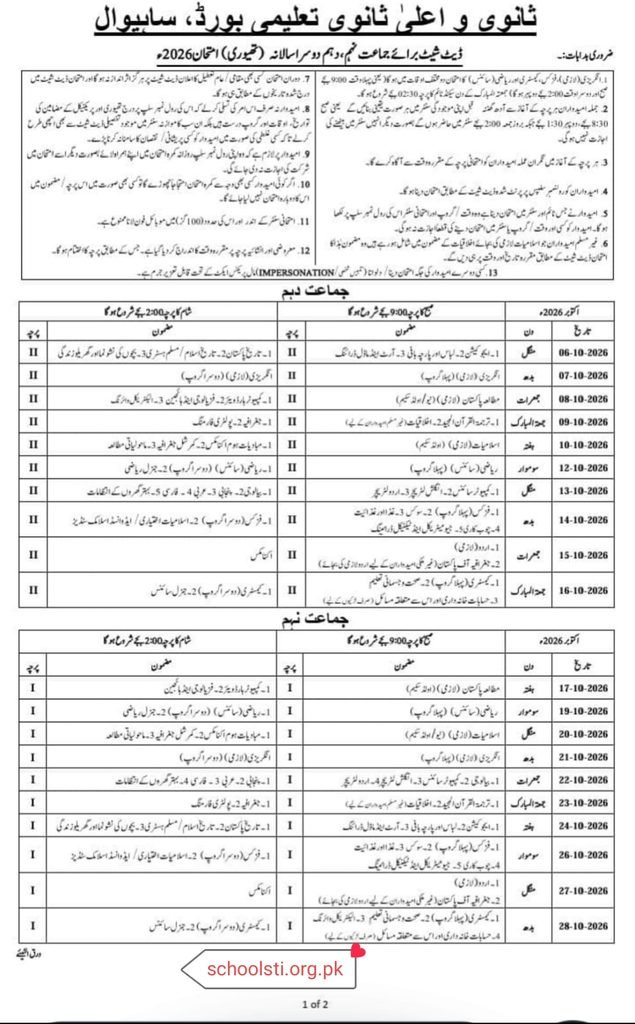
BISE Sahiwal 10th Class 2nd Annual Date Sheet 2026 (Theory)
The 10th Class (Matric Part-II) theory examinations commence on Tuesday, October 6, 2026, and conclude on Friday, October 16, 2026.
| Date | Day | Morning Session (09:00 AM) | Evening Session (02:00 PM / Friday 02:30 PM) |
|---|---|---|---|
| 06-10-2026 | Tuesday | 1. Education |
2. Clothing & Textile
3. Art & Model Drawing | 1. History of Pakistan
2. Islamic History / Muslim History
3. Child Development & Home Living |
| 07-10-2026 | Wednesday | English (Compulsory) — Group I | English (Compulsory) — Group II |
| 08-10-2026 | Thursday | Pakistan Studies (Compulsory) (New & Old Scheme) | 1. Computer Hardware
2. Physiology & Hygiene
3. Electrical Wiring |
| 09-10-2026 | Friday | 1. Translation of the Holy Quran (Tarjuma-tul-Quran)
2. Ethics (For Non-Muslim Candidates) | 1. Geography
2. Poultry Farming (Starts 02:30 PM) |
| 10-10-2026 | Saturday | Islamiat (Compulsory) (Old Scheme) | 1. Elements of Home Economics
2. Commercial Geography
3. Environmental Studies |
| 12-10-2026 | Monday | Mathematics (Science) — Group I | 1. Mathematics (Science) — Group II
2. Overall Mathematics |
| 13-10-2026 | Tuesday | 1. Computer Science
2. English Literature
3. Urdu Literature | 1. Biology
2. Punjabi
3. Arabic
4. Persian
5. Management for Better Homes |
| 14-10-2026 | Wednesday | 1. Physics — Group I
2. Civics
3. Food & Nutrition
4. Wood Work
5. Geometrical & Technical Drawing | 1. Physics — Group II
2. Islamic Studies (Elective) / Advanced Islamic Studies |
| 15-10-2026 | Thursday | 1. Urdu (Compulsory)
2. Geography of Pakistan (For Foreign Candidates) | Economics |
| 16-10-2026 | Friday | 1. Chemistry — Group I
2. Health & Physical Education
3. Household Accounts & Related Problems (For Girls) | 1. Chemistry — Group II
2. Universal Science (Starts 02:30 PM) |
BISE Sahiwal 9th Class 2nd Annual Date Sheet 2026 (Theory)
The 9th Class (Matric Part-I) theory examinations run consecutively after the 10th-grade papers, starting on Saturday, October 17, 2026, and concluding on Wednesday, October 28, 2026.
| Date | Day | Morning Session (09:00 AM) | Evening Session (02:00 PM / Friday 02:30 PM) |
|---|---|---|---|
| 17-10-2026 | Saturday | Pakistan Studies (Compulsory) (Old Scheme) | 1. Computer Hardware |
2. Physiology & Hygiene |
| 19-10-2026 | Monday | Mathematics (Science) — Group I | 1. Mathematics (Science) — Group II
2. General Mathematics |
| 20-10-2026 | Tuesday | Islamiat (Compulsory) (New & Old Scheme) | 1. Elements of Home Economics
2. Commercial Geography
3. Environmental Studies |
| 21-10-2026 | Wednesday | English (Compulsory) — Group I | English (Compulsory) — Group II |
| 22-10-2026 | Thursday | 1. Biology
2. Computer Science
3. English Literature
4. Urdu Literature | 1. Punjabi
2. Arabic
3. Persian
4. Management for Better Homes |
| 23-10-2026 | Friday | 1. Translation of the Holy Quran (Tarjuma-tul-Quran)
2. Ethics (For Non-Muslim Candidates) | 1. Geography
2. Poultry Farming (Starts 02:30 PM) |
| 24-10-2026 | Saturday | 1. Education
2. Clothing & Textile
3. Art & Model Drawing | 1. History of Pakistan
2. Islamic History / Muslim History
3. Child Development & Home Living |
| 26-10-2026 | Monday | 1. Physics — Group I
2. Civics
3. Food & Nutrition
4. Wood Work
5. Geometrical & Technical Drawing | 1. Physics — Group II
2. Islamic Studies (Elective) / Advanced Islamic Studies |
| 27-10-2026 | Tuesday | 1. Urdu (Compulsory)
2. Geography of Pakistan (For Foreign Candidates) | Economics |
| 28-10-2026 | Wednesday | 1. Chemistry — Group I
2. Health & Physical Education
3. Electrical Wiring
4. Household Accounts & Related Problems (For Girls) | 1. Chemistry — Group II
2. General Science |
Students can review comprehensive Matric date sheet updates and model papers to align their revision schedules with the exact testing order.
Mandatory Examination Center Instructions and Regulations
The BISE Sahiwal administration strictly enforces standardized protocols set under provincial testing guidelines overseen by the Punjab School Education Department and the Higher Education Department, Punjab. Candidates must comply with the following instructions:
- Punctuality & Arrival Window: Candidates must report inside their exam centers at least 30 minutes prior to the paper (8:30 AM for morning shifts, 1:30 PM for weekday evening shifts, and 2:00 PM for Friday afternoon shifts). Late arrivals are barred from entry.
- Roll Number Slip Verification: Candidates must carry their original, printed roll number slip every day. Before entering the hall, candidates should verify that the subjects, paper codes, theory/practical designations, and assigned groups match both their slip and the center notice board.
- Strict Prohibition of Mobile Phones: Bringing mobile phones, smartwatches, calculators with programmable storage, or unauthorized electronic gadgets inside the center premises or within a 100-yard perimeter is prohibited.
- No Unscheduled Holidays: If an unexpected local holiday is declared by local administration during the exam cycle, the examination schedule remains completely unchanged unless explicitly notified by the board.
- Impersonation Penalties: Taking an examination on behalf of another candidate constitutes illegal impersonation and attracts immediate legal prosecution and disqualification under the Punjab Prevention of Malpractices Act.
- No Retake Policy: If an examinee misses a paper due to absence, illness, or transport delays, no second opportunity or special re-examination is provided under any circumstances.
Comparison: 1st Annual vs. 2nd Annual Examination Framework
The Punjab examination boards transitioned from the traditional “Supplementary” exam terminology to the standardized “1st Annual” and “2nd Annual” framework. Here is how they compare:
| Feature | 1st Annual Examination | 2nd Annual Examination |
|---|---|---|
| Usual Timing | March – April | October – November |
| Primary Target Audience | Fresh regular and confidential candidates completing their academic twelve months | Improvement seekers, compartment/failure cases, and supplementary candidates |
| Transcript Indication | Indicates regular pass in 1st Annual | Removes the stigma of “Supplementary” on modern outcome cards |
| Time for Preparation | Complete academic session (9–10 months) | Compressed timeline (approx. 2–3 months following 1st annual results) |
| Subject Flexibility | Full composite or single-part registration | Can register for individual failed papers, full-group improvement, or specific subjects |
| Syllabus & Standard | Regular board curriculum | Identical curriculum, standardized marking criteria, and equivalent grading schemes |
Effective Revision Strategies for the 2nd Annual Exams
Achieving solid results during the 2nd Annual exam requires a focused strategy due to the short gap between papers:
- Prioritize High-Weightage Topics: Review the board’s paired schemes and past five-year objective papers to secure easy baseline marks in MCQs and structured short questions.
- Master the Time Allocation: With theoretical subjects like Urdu and Pakistan Studies, allocate fixed minutes per query during practice tests to avoid leaving long answers incomplete.
- Solve Subject-Specific Model Papers: Candidates looking for curated practice tests can access structured educational resources and pupil guides to review expected query patterns and solved numerical problems.
- Clarify Group Specifics: Confirm whether your paper is morning or evening. Science students in Group II should factor in afternoon concentration levels and Friday timing changes (2:30 PM).
Frequently Asked Questions (FAQs)
What happens if a local holiday is announced on an exam date?
According to Clause 7 of the official BISE Sahiwal notification, local holidays declared during the examination period do not alter the date sheet. Papers proceed on the scheduled date and time.
Can a candidate switch their assigned shift from Morning to Evening?
No. Candidates are strictly required to take the examination only at the center, shift, and group printed on their roll number slip. Center superintendents have no authority to accommodate cross-group attendance.
Are practical exams included in this date sheet?
This date sheet covers theory examinations only. The practical examination schedule for science subjects and vocational trades is issued separately on candidates’ roll number slips.
What should I do if there is a discrepancy on my roll number slip?
Cross-examine the printed subjects with the master date sheet immediately upon receiving the slip. In case of conflicting groups or missing subjects, visit the BISE Sahiwal facilitation center before the exams commence.
Analysis
The BISE Sahiwal Matric 2nd Annual Date Sheet 2026 is logically sequenced to balance high-demand core disciplines and elective papers. Scheduling 10th Class from October 6 to October 16 and 9th Class from October 17 to October 28 ensures that examination centers avoid overcrowding and logistical strain.
Allocating English, Mathematics, Physics, and Chemistry into dual morning and evening shifts maintains manageable seating capacities across testing halls. Furthermore, placing challenging science disciplines (Mathematics, Physics, Chemistry) with reasonable intervening intervals provides candidates with necessary revision time, supporting students attempting score improvements.
Opinion
The transition to the “2nd Annual” framework represents a positive, learner-centric reform in Punjab’s educational structure. By replacing the outdated supplementary label, it encourages students to boost their scores without academic stigma.
Candidates appearing in this cycle should treat the 2nd Annual Examination not merely as a second chance to pass, yet as a strategic path to upgrade their grade tiers. Given that morning entry closes strictly at 8:30 AM and mobile phones are banned within a 100-yard perimeter, punctuality and adherence to board rules are just as vital as academic preparation. Candidates should print their verified roll number slips well in advance and focus their efforts on targeted past-paper analysis.