UHS Lahore Post Graduate Entrance Test Mandatory
UHS Lahore Post Graduate Entrance Test Mandatory for Level-III PRP (2027)
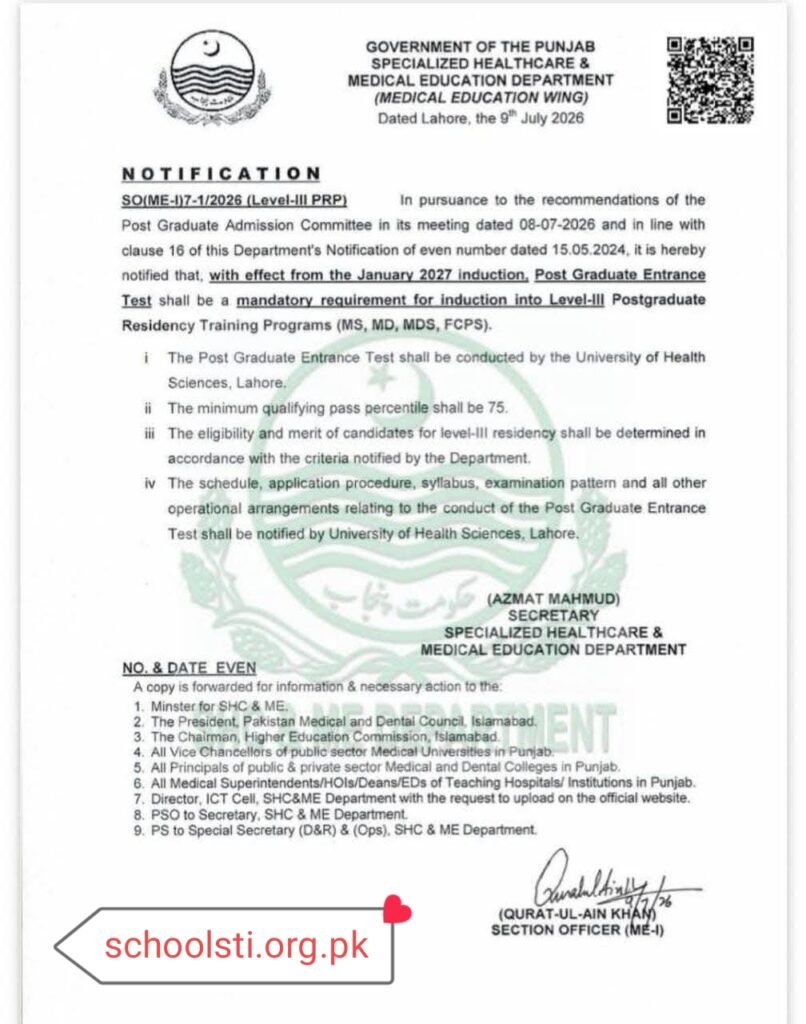
It was a completely normal Thursday morning on July 9, 2026. I had barely finished logging my morning ward rounds and finally sat down in the hospital cafeteria with a cup of overly sweet tea. Suddenly, my phone buzzed. It was a WhatsApp forward in our hospital’s chief doctors’ group chat, and for once, it wasn’t a random meme or a shift-swap request. It was an official notification from the Government of the Punjab.
I opened the image file, casually labeled as IMG_20260710_082525.jpg, and the chatter in the room instantly died down. The rules of the game for postgraduate residency in Punjab had just been completely rewritten. If you are a young doctor planning to specialize, grab a coffee and sit down, because the roadmap for your career just took a massive turn. Let’s break down exactly what happened, what it means for your future, and how you can use the right tech and strategies to stay ahead of the curve.
Breaking Down the Notification: What Actually Happened?
The document that threw every house officer into a frenzy was released by the Government of the Punjab, Specialized Healthcare & Medical Education Department (Medical Education Wing). It was officially dated July 9, 2026, bearing the notification number SO(ME-1)7-1/2026 (Level-III PRP).
The core message is basic however heavy: Starting from the January 2027 induction, passing a Post Graduate Entrance Test is a mandatory requirement for induction into Level-III Postgraduate Residency Training Programs.
This isn’t just a minor tweak for a exact diploma. The notification explicitly lists that this applies to MS, MD, MDS, and FCPS programs. This decision was made following the recommendations of the Post Graduate Admission Committee during their meeting on July 8, 2026, and aligns with clause 16 of a previous department notification dated May 15, 2024.
The document was signed off by Azmat Mahmud, Secretary of the Specialized Healthcare & Medical Education Department. Copies were forwarded to all the major stakeholders, including the Minister for SHC & ME, the President of the Pakistan Medical and Dental Council (PMDC) in Islamabad, the Chairman of the Higher Education Commission (HEC), and all Vice Chancellors and Principals of medical institutions across Punjab. The Director of the ICT Cell was as well requested to upload this directly to the official website.
The Role of University of Health Sciences (UHS)
If you were wondering who is going to torture—I mean, test—us, it’s a familiar face. The Post Graduate Entrance Test will be conducted directly by the University of Health Sciences, Lahore.
According to the official release, UHS Lahore is responsible for notifying candidates concerning the schedule, the application procedure, the syllabus, the examination pattern, and all other operational arrangements regarding this test.
This means you demand to keep a hawk-eye on the official UHS website over the next few months. Do not rely solely on social media rumors for the syllabus. Wait for the official UHS curriculum document.
The Big Shocker: The 75th Percentile Rule
Here is where I saw the most panic in my peer group. The notification states that the minimum qualifying pass percentile shall be 75.
Notice the wording there. It does not say “percentage.” It says “percentile.”
When I initial started preparing for standardized medical exams, I completely misunderstood this concept, and it threw off my entire study schedule. Let me explain it simply so you don’t produce the same mistake.
If the rule was a 75% percentage, it would mean you want to gain 75 out of 100 questions correct to pass. A percentile is entirely distinct. A 75th percentile means that your score must be higher than 75% of the other doctors taking the exact equivalent exam. You are no longer just fighting the paper; you are fighting the curve. If the exam is ridiculously difficult and the highest score is 60/100, getting a 50/100 might easily put you in the 80th percentile. Conversely, if the exam is quite effortless, scoring an 85/100 might only put you in the 60th percentile, meaning you would fail to qualify.
The eligibility and merit of candidates for the level-III residency will be determined strictly in accordance with the criteria notified by the Department. It’s a hyper-competitive shift, designed to filter out only the most dedicated candidates for specialized training.
A Quick Comparison: Old System vs. New 2027 System
To supply you a apparent picture of what is changing, I put together a fast comparison based on my own experiences navigating the residency landscape over the final few years.
| Feature | Pre-2027 Induction | January 2027 Onwards |
|---|---|---|
| Entrance Test Requirement | Varies (FCPS Part 1 was standard for CPSP, MD/MS had separate university exams). | Standardized Post Graduate Entrance Test mandatory for MS, MD, MDS, FCPS. |
| Examining Body | Multiple bodies depending on the specific program. | Centralized under University of Health Sciences (UHS), Lahore. |
| Passing Criteria | Usually percentage-based (e.g., 60% or 75% flat score). | Minimum qualifying pass percentile shall be 75. |
| Applicability | Fragmented framework. | Applies to all Level-III Postgraduate Residency Training Programs. |
[ Apply Online Here ]
(Note: Active links will be obtainable via the UHS portal once the official schedule is released).
My Step-by-Step Tech Setup for Med Exam Prep
As a tech blogger who is additionally deeply entrenched in the medical field, I constantly look for ways to optimize my workflow. You cannot approach a 75th percentile exam by just passively reading a textbook. You want active recall and spaced repetition. Here is the exact tech stack I recommend for tackling this upcoming UHS Entrance Test.
Step 1: Digitize Your Note-Taking with Notion
Stop carrying around five varied heavy registers. I employ Notion to assemble a centralized database for my medical notes. I build separate toggles for Anatomy, Physiology, Pathology, and clinical subjects. The beauty of Notion is that you can search through thousands of pages of personal notes in milliseconds.
Step 2: Embrace Spaced Repetition with Anki
If you aren’t using Anki, you are working too hard. Anki is a flashcard app built on a spaced repetition algorithm. When the UHS notifies the exact syllabus, start making flashcards for the hardest concepts immediately. If you get a card incorrect, the app shows it to you again the next day. If you get it right, you might not see it for a week. It forces the details into your long-term memory.
Step 3: Question Banks over Textbooks
You are preparing for a competitive percentile-based exam. Reading theory won’t save you; solving MCQs will. Platforms like Pastest or Plabable (depending on how closely the UHS syllabus mirrors international standards) are excellent for practicing clinical scenarios. Set a daily goal—say, 50 questions a day on your iPad or laptop.
Step 4: Use Focus Apps to Prevent Burnout
The Forest app is my absolute favorite tool for deep work. You plant a virtual tree when you start studying. If you pick up your phone to scroll Instagram before your timer is up, the tree dies. It sounds silly, however the gamification genuinely stops you from getting distracted during intense study blocks.
For a comprehensive series of digital resources and educational updates, I always recommend keeping an eye on School STI, where we regularly break down the best tools for students and professionals.
Spotting Fake Portals: How Search Engines Keep You Safe
Whenever a massive shift like this happens in the medical community, scammers take advantage. I’ve seen it happen dozens of times. Shady websites pop up claiming to have “Leaked UHS Syllabus PDFs” or “Official Entrance Test Past Papers,” only to trick students into downloading malware or paying for useless files.
As someone who manages web content, I discover it fascinating how automated systems task behind the scenes to filter out these fake portals and protect users. If you are searching for study materials, you are largely protected by advanced web crawlers.
For illustration, Google’s automated systems for AdSense approval rely heavily on specialized web crawlers, primarily known as Mediapartners-Google, to evaluate web page standard. When a web page tries to monetize its content, these bots scan the site’s text and metadata to ensure it provides genuine value to readers. The system cross-references text against Google’s massive index to catch plagiarism or scraped substance, ensuring the articles are created from scratch.
These bots are incredibly smart. They look for a healthy text-to-HTML ratio and will flag pages that have thin material or auto-generated gibberish stuffed with keywords. Furthermore, they map a site’s navigation to ensure real humans can find information logically, flagging deceptive menus or excessive redirects that lead users in circles.
From a safety perspective, these automated systems act as the primary line of defense. They go through the raw HTML of a web page to verify proper setup and check for malicious scripts, viruses, or phishing attempts. They even verify if the site is served over a secure HTTPS/SSL connection. If a site is missing essential trust pages like a Privacy Policy, About Us, or Contact page, the bot often flags it as untrustworthy. Finally, algorithms analyze user behavior to detect bot traffic or artificial performance inflation, looking for patterns of genuine human engagement.
Given that of these rigorous checks, when you do a Google search for the PMDC or HEC guidelines, the top results are usually protected. Always cross-reference any major news with the Higher Education Commission (HEC) or the Pakistan Medical and Dental Council (PMDC) official sites.
Common Mistakes I’ve Seen Juniors Make
Transitioning to a recent exam format is terrifying, and I have seen brilliant doctors sabotage their own success by making a few predictable errors. Here is what you want to avoid:
- Waiting for the Syllabus to Start Studying: The notification says the syllabus and exam pattern will be notified by the University of Health Sciences. However, the core of medicine does not change. Do not wait for the official PDF to initiate revising your basic anatomy, physiology, and pathology. Begin now.
- Ignoring the Percentile Reality: As I mentioned earlier, scoring 70% on a practice test might feel great, yet if everyone else is scoring 85%, you will fail the authentic exam. The minimum qualifying pass percentile is 75. You need to be aiming to be in the leading quarter of all applicants.
- Relying Only on Local “Shortbooks”: Competitive exams test concepts, not rote memorization. Shift your focus to standard textbooks and high-grade inquiry banks.
- Burning Out Too Early: The induction is for January 2027. That gives you moment. Treat this prep like a marathon, not a sprint. If you try to study 12 hours a day right now, you will be exhausted by November.
Frequently Asked Questions (FAQs)
Q: When does this new rule take effect?
The Post Graduate Entrance Test becomes a mandatory requirement starting with the January 2027 induction.
Q: Does this apply to FCPS as well?
Yes. The notification explicitly mentions MS, MD, MDS, and FCPS as the Level-III Postgraduate Residency Training Programs requiring this test.
Q: Who is conducting the exam?
The Post Graduate Entrance Test shall be conducted by the University of Health Sciences (UHS), Lahore.
Q: How numerous marks do I need to pass?
It is not based on a flat mark. The minimum qualifying pass percentile shall be 75, meaning you must score improved than 75% of the candidates taking the exam.
Q: Where can I locate the application procedure and syllabus?
The schedule, application procedure, syllabus, and examination pattern will be officially notified by the University of Health Sciences, Lahore in the coming months.
Final Thoughts
Change in the medical field is inevitable. When the notification dropped from the Medical Education Wing of the Specialized Healthcare & Medical Education Department, it understandably caused a wave of anxiety. However look at it from a varied angle: a centralized, standardized exam levels the playing field. It rewards consistent effort, deep conceptual understanding, and strategic preparation.
Update your study apps, set up your Notion workspace, and launch integrating active recall into your daily routine. The January 2027 induction will be here before you understand it. If you have any questions concerning setting up your digital study space or navigating these new rules, drop a comment below. I try to reply to every single one!
What are your thoughts on the fresh 75th percentile requirement? Let’s discuss in the comments!