10th Class All Subjects Pairing Scheme 2027
10th Class All Subjects Pairing Scheme 2027 for All BISE Boards Punjab, Pakistan
Preparing for the Matriculation Part-II annual examinations requires a strategic roadmap rather than blind rote memorization. The 10th class all subjects pairing scheme 2027 for all BISE boards in Punjab, Pakistan, introduces updated chapter weightages aligned with the revised PECTAA Student Learning Outcomes (SLO) framework. Whether you are appearing under BISE Lahore, Rawalpindi, Multan, Gujranwala, Faisalabad, Sargodha, Bahawalpur, DG Khan, or Sahiwal, this comprehensive assessment guide breaks down exact paper patterns, mark distributions, and high-yield chapter combinations across science, humanities, and compulsory subjects.
Introduction to the 2027 Punjab Boards Assessment Policy
The Punjab Boards Committee of Chairmen (PBCC), in coordination with the Punjab Curriculum and Textbook Board (PCTB), has finalized a standardized examination blueprint for the 2026–2027 academic session. The 2027 matriculation papers emphasize conceptual clarity, analytical thinking, and application-based questions alongside core curriculum knowledge.
Students preparing for their final exams can access verified 10th class study notes and model papers to align their daily revision with the modern SLO-based board criteria. Across all nine Boards of Intermediate and Secondary Education (BISE), the paper structure divides cognitive domains into Knowledge (50%), Understanding (35%), and Application (15%).
- standardized Across 9 Boards: Valid for Lahore, Gujranwala, Multan, Faisalabad, Sargodha, Rawalpindi, Bahawalpur, DG Khan, and Sahiwal boards.
- SLO-Based Framework: Direct textbook exercises are supplemented by unseen conceptual questions testing analytical understanding.
- Balanced Marks Weightage: Science subjects carry 60 theory marks each (plus practicals), while Mathematics, English, and Urdu carry 75 marks each.
Master Reference: 10th Class Marks Distribution (2027)
Before diving into individual chapter combinations, review the overarching structure across all major 10th-grade subjects.
| Subject Name | Total Marks | Objective (MCQs) | Short Questions | Long / Subjective |
|---|---|---|---|---|
| English | 75 | 19 Marks | 10 Marks | 46 Marks |
|
| Chemistry | 60 | 12 Marks | 30 Marks | 18 Marks
|
| Biology | 60 | 12 Marks | 30 Marks | 18 Marks
|
| Physics | 60 | 12 Marks | 30 Marks | 18 Marks
|
| Mathematics | 75 | 15 Marks | 36 Marks | 24 Marks |
| Computer Science | 50 | 10 Marks | 24 Marks | 16 Marks |
| Urdu | 75 | 15 Marks | 10 Marks | 50 Marks |
| Pakistan Studies | 50 | 10 Marks | 24 Marks | 16 Marks |
| Tarjuma-tul-Quran | 50 | 10 Marks | 20 Marks | 20 Marks |
The science subjects (Physics, Chemistry, Biology, and Computer Science) allocate an additional 30 marks during the combined Part-I and Part-II practical examinations.
Science Group Pairing Schemes 2027 (Chapter-Wise Breakdown)
Science students face the highest pressure due to numerical problems, chemical equations, and biological diagrams. The verified 2027 chapter-wise schemes below reflect the updated numbering and unit divisions.
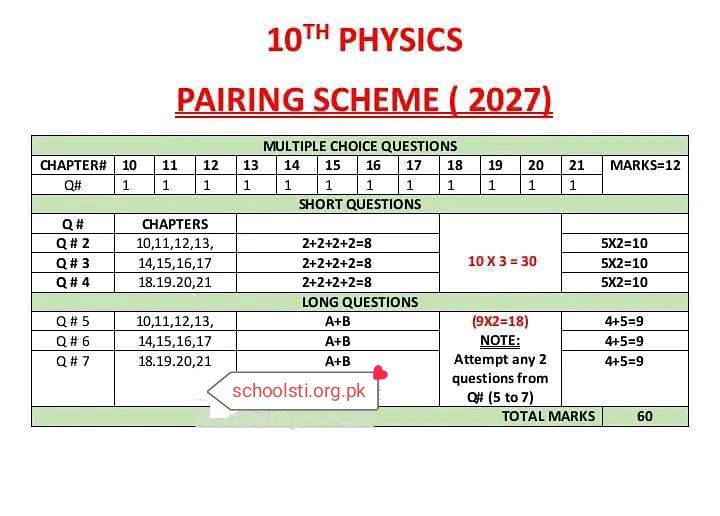
1. 10th Class Physics Pairing Scheme 2027 (60 Marks)
The 10th Class Physics paper covers Chapters 10 through 21. Every single chapter contributes exactly one MCQ to the objective paper, while the short and long questions are grouped into three distinct four-chapter blocks.
- Q.1 Multiple Choice Questions (12 Marks): 1 MCQ each from Chapters 10, 11, 12, 13, 14, 15, 16, 17, 18, 19, 20, and 21.
- Q.2 Short Questions (10 Marks): Attempt any 5 out of 8 questions from Chapters 10, 11, 12, and 13 (2 questions from each chapter).
- Q.3 Short Questions (10 Marks): Attempt any 5 out of 8 questions from Chapters 14, 15, 16, and 17 (2 questions from each chapter).
- Q.4 Short Questions (10 Marks): Attempt any 5 out of 8 questions from Chapters 18, 19, 20, and 21 (2 questions from each chapter).
- Long Questions (18 Marks – Attempt any 2 out of 3): Each question carries 9 marks, divided into Part A (4 marks) and Part B (5 marks).
- Q.5: Part A & Part B drawn from the Chapter 10, 11, 12, 13 group.
- Q.6: Part A & Part B drawn from the Chapter 14, 15, 16, 17 group.
- Q.7: Part A & Part B drawn from the Chapter 18, 19, 20, 21 group.
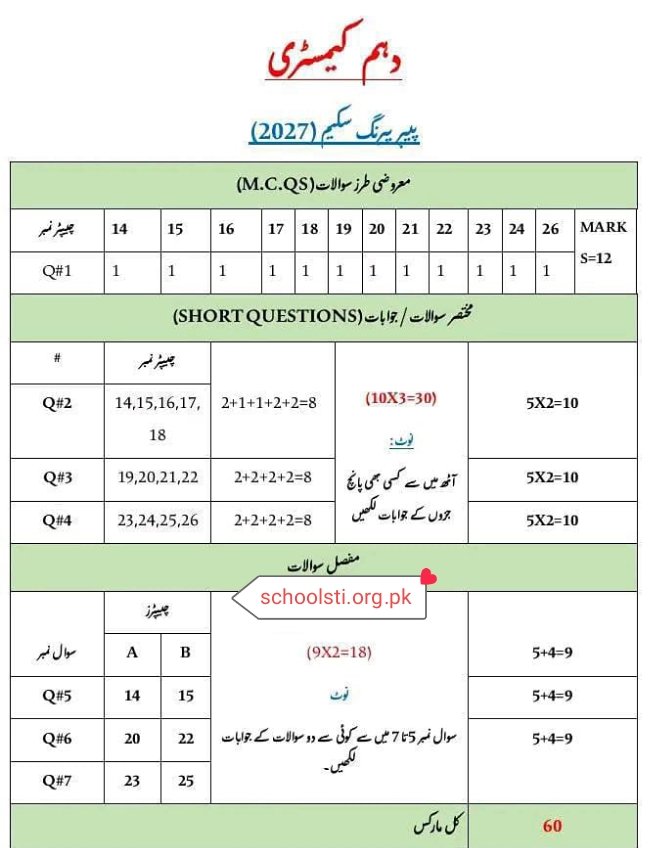
2. 10th Class Chemistry Pairing Scheme 2027 (60 Marks)
Under the updated 2027 syllabus numbering, 10th-grade Chemistry spans Chapters 14 to 26. Long questions are divided into a 5-mark Part A and a 4-mark Part B.
| Paper Section | Question Number | Chapters Included | Question Split / Distribution | Marks |
|---|---|---|---|---|
| MCQs | Q.1 | Ch 14 to 24, Ch 26 | 1 MCQ from each listed chapter | 12 |
| Short Questions | Q.2 (5 of 8) | Ch 14, 15, 16, 17, 18 | 2 + 1 + 1 + 2 + 2 = 8 | 10 |
| Short Questions | Q.3 (5 of 8) | Ch 19, 20, 21, 22 | 2 + 2 + 2 + 2 = 8 | 10 |
| Short Questions | Q.4 (5 of 8) | Ch 23, 24, 25, 26 | 2 + 2 + 2 + 2 = 8 | 10 |
| Long Question 1 | Q.5 (A + B) | Ch 14 (A) + Ch 15 (B) | Part A (5M) + Part B (4M) | 9 |
| Long Question 2 | Q.6 (A + B) | Ch 20 (A) + Ch 22 (B) | Part A (5M) + Part B (4M) | 9 |
| Long Question 3 | Q.7 (A + B) | Ch 23 (A) + Ch 25 (B) | Part A (5M) + Part B (4M) | 9 |
|
Students must attempt any two long questions out of Q.5, Q.6, and Q.7 (9 x 2 = 18 marks).
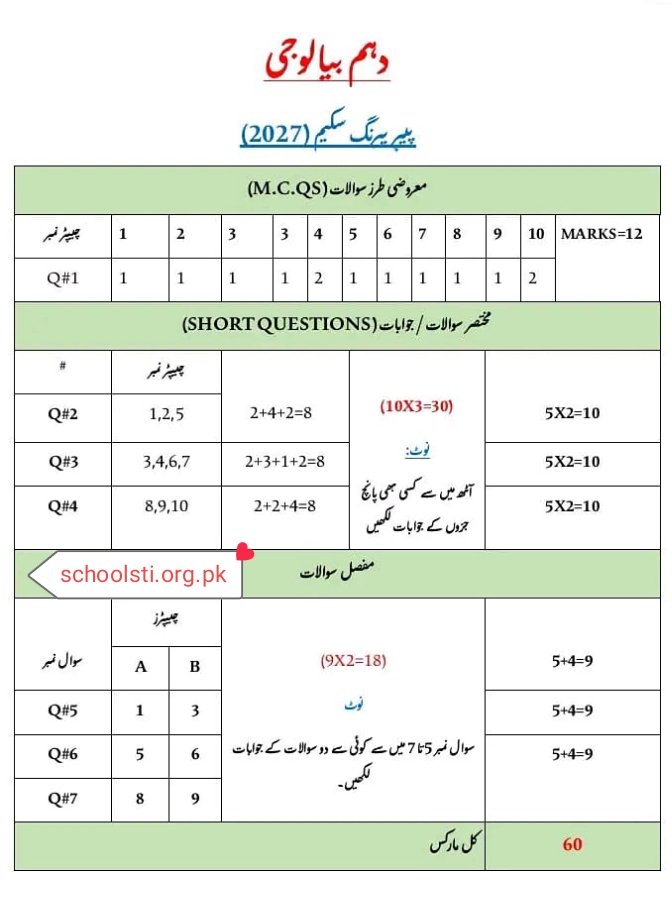
3. 10th Class Biology Pairing Scheme 2027 (60 Marks)
The 2027 Biology scheme covers Chapters 1 through 10 of the updated 10th-class textbook. Like Chemistry, each long inquiry consists of a 5-mark Part A and a 4-mark Part B.
- Q.1 Multiple Choice Questions (12 Marks): 1 MCQ each from Chapters 1, 2, 3, 5, 6, 7, 8, and 9; 2 MCQs each from Chapters 4 and 10.
- Q.2 Short Questions (10 Marks – Attempt 5 of 8): Chapter 1 (2 Qs), Chapter 2 (4 Qs), Chapter 5 (2 Qs).
- Q.3 Short Questions (10 Marks – Attempt 5 of 8): Chapter 3 (2 Qs), Chapter 4 (3 Qs), Chapter 6 (1 Q), Chapter 7 (2 Qs).
- Q.4 Short Questions (10 Marks – Attempt 5 of 8): Chapter 8 (2 Qs), Chapter 9 (2 Qs), Chapter 10 (4 Qs).
- Long Questions (18 Marks – Attempt any 2 of 3):
- Q.5: Part A from Chapter 1 (5 marks) + Part B from Chapter 3 (4 marks).
- Q.6: Part A from Chapter 5 (5 marks) + Part B from Chapter 6 (4 marks).
- Q.7: Part A from Chapter 8 (5 marks) + Part B from Chapter 9 (4 marks).
4. 10th Class Mathematics Pairing Scheme 2027 (75 Marks)
The 2027 Mathematics syllabus features a notable structural update: there is no compulsory standalone theorem query, and long questions are bifurcated into two sub-sections (Part-II and Part-III). You can additionally download the official 10th class pairing scheme PDF cards for offline printing and classroom reference.
- Q.1 Multiple Choice Questions (15 Marks): 1 MCQ each from Chapters 1, 2, 3, 4, 5, 6, 7, 8, and 10; 2 MCQs each from Chapters 9, 11, and 12.
- Q.2 Short Questions (12 Marks – Attempt 6 of 9): Drawn from Chapters 1, 2, 3, and 4 (at least 2 questions per chapter).
- Q.3 Short Questions (12 Marks – Attempt 6 of 9): Drawn from Chapters 5, 6, 7, and 8 (at least 2 questions per chapter).
- Q.4 Short Questions (12 Marks – Attempt 6 of 9): Drawn from Chapters 9, 10, 11, and 12 (at least 2 questions per chapter).
- Long Questions Section I (16 Marks – Attempt any 2 out of Q.5, Q.6, Q.7):
- Q.5 (8 Marks): Part (a) from Chapter 1 (4M) + Part (b) from Chapter 2 (4M).
- Q.6 (8 Marks): Part (a) from Chapter 3 (4M) + Part (b) from Chapter 4 (4M).
- Q.7 (8 Marks): Part (a) from Chapter 5 (4M) + Part (b) from Chapter 7 (4M).
- Long Questions Section II (8 Marks – Attempt any 1 out of Q.8, Q.9):
- Q.8 (8 Marks): Part (a) from Chapter 6 (4M) + Part (b) from Chapter 8 or Chapter 11 (4M).
- Q.9 (8 Marks): Part (a) from Chapter 10 (4M) + Part (b) from Chapter 9 or Chapter 12 (4M).
5. 10th Class Computer Science Pairing Scheme 2027 (50 Marks)
Computer Science focuses heavily on C-language programming logic, flowcharts, and loop structures across 9 chapters.
- Q.1 MCQs (10 Marks): 1 MCQ from each chapter (Chapters 1 to 9), plus 1 additional conceptual MCQ from programming syntax.
- Short Questions (24 Marks Total): Divided into three sections (Q.2, Q.3, Q.4) where students attempt 4 out of 6 questions in each section (8 marks per section).
- Long Questions (16 Marks – Attempt any 2 of 3): Each query carries 8 marks, selected primarily from Chapters 1, 4, 6, and 8.
Compulsory & Humanities Subjects Pairing Scheme 2027
Scoring high in compulsory subjects is the secret to pushing your total aggregate above 90%. Below is the exact breakdown for English and allied compulsory papers.
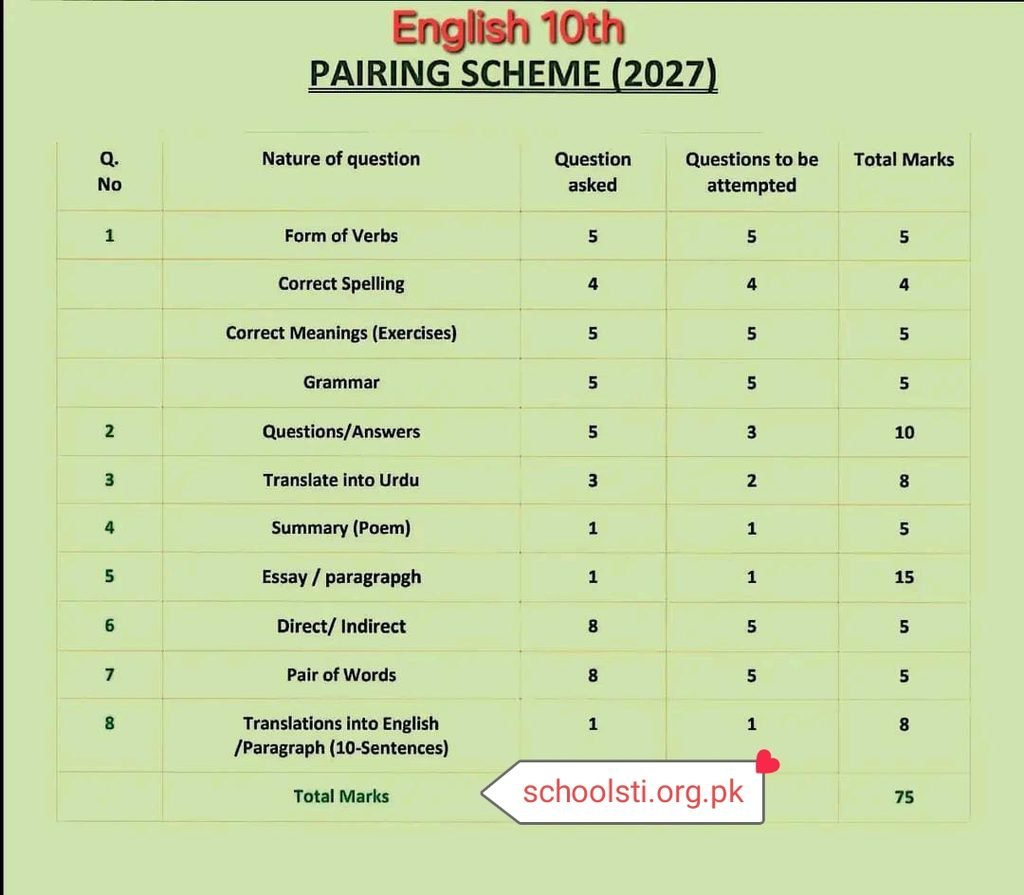
1. 10th Class English Pairing Scheme 2027 (75 Marks)
The English paper tests vocabulary, grammar, translation accuracy, and creative composition across 8 distinct questions.
| Q. No | Nature of Question | Questions Asked | Questions to Attempt | Total Marks |
|---|---|---|---|---|
| Q.1 (a) | Correct Form of Verbs (MCQs) | 5 | 5 | 5 |
| Q.1 (b) | Words with Correct Spellings (MCQs) | 4 | 4 | 4 |
| Q.1 (c) | Correct Meanings / Synonyms (Exercises) | 5 | 5 | 5 |
| Q.1 (d) | Correct Option According to Grammar | 5 | 5 | 5 |
| Q.2 | Short Questions / Answers (Text Units) | 8 | 5 | 10 |
| Q.3 | Translate Paragraph into Urdu | 3 | 2 | 8 |
| Q.4 | Summary of the Poem / Stanza Paraphrase | 1 | 1 | 5 |
| Q.5 | Essay Writing OR Paragraph Writing | 1 (of 3 choices) | 1 | 15 |
| Q.6 | Change Direct into Indirect Speech | 8 | 5 | 5 |
| Q.7 | Use Pair of Words in Sentences | 8 | 5 | 5 |
| Q.8 | Translate Urdu Paragraph into English | 1 | 1 | 8 |
|
Note that on the question paper, Q.2 provides 8 short questions (5 from text exercises and 3 from lesson boxes) out of which students attempt 5 for 10 marks.
2. Urdu, Pak Studies, Islamiat & Tarjuma-tul-Quran (2027 Overview)
- Urdu (75 Marks): 15 Marks MCQs (7 from Nazam/Ghazal, 5 from Grammar, 3 from Prose). The 60-mark subjective paper includes Tashreeh of Ashaar (10 marks), Iqtibas Ki Tashreeh (10 marks), Lesson Summary (5 marks), Central Idea/Summary of Nazam (5 marks), Essay Writing (15 marks), and Comprehension/Lafzi Tardeed (10 marks).
- Pakistan Studies (50 Marks): 10 MCQs from Chapters 5 to 8. Two short question sections totaling 24 marks, and 2 out of 3 long questions carrying 8 marks each (16 marks total).
- Tarjuma-tul-Quran (50 Marks): 10 Marks MCQs, 5 out of 8 short questions (10 marks), Quranic vocabulary meanings (10 marks), verse translations (10 marks), and 1 long detailed note on a prescribed Surah (10 marks).
Comparison: 2027 PECTAA Scheme vs. Previous Board Schemes
Understanding how the 2027 examination pattern differs from older board trends prevents students from relying on outdated preparation methods. Official updates and schedule circulars are routinely published by boards such as BISE Lahore and the Higher Education Department (HED) Punjab.
| Feature / Criterion | Previous Board Schemes (Pre-2026) | New 2027 PECTAA / BISE Scheme |
|---|---|---|
| Syllabus Alignment | Old 2006 National Curriculum | Revised 2026–2027 New Syllabus Units |
| Math Theorems | Compulsory 8-mark standalone theorem | Replaced by bifurcated analytical problems (Q.8/Q.9) |
| Science Long Marks | Fixed 4 + 5 split (Theory + Numerical) | 5 + 4 split in Bio/Chem; 4 + 5 split in Physics |
|
| Question Style | 80% direct textbook exercise questions | 50% Knowledge, 35% Understanding, 15% Application |
| Chapter Numbering | Old sequential chapter numbers | Updated unit numbering (e.g., Chem Ch 14–26)
|
Analysis
An examination of the 2027 pairing schemes across all Punjab boards reveals three actionable insights for matriculation candidates:
- Block-Based Modularity in Physics and Math: Both Physics and Mathematics group their chapters into chronological four-chapter blocks for short and long questions. Mastering two out of the three blocks guarantees 100% coverage of the long-inquiry portion while securing two-thirds of the short-query marks.
- Selective High-Yield Pairing in Biology and Chemistry: Unlike Physics, where long questions can be drawn from any chapter within a four-chapter block, Chemistry (Ch 14+15, 20+22, 23+25) and Biology (Ch 1+3, 5+6, 8+9) specify exact two-chapter pairs for Q.5, Q.6, and Q.7. Students can safely leave out three entire chapters for long questions while still attempting 18 out of 18 marks, provided they prepare those skipped chapters thoroughly for MCQs and short questions.
- Shift Toward Grammar & Composition in Languages: In the 10th Class English paper, 42 out of 75 marks (Essay: 15, Urdu-to-English Translation: 8, Direct/Indirect: 5, Pair of Words: 5, Grammar/Verb MCQs: 10) depend purely on English grammar rules and writing mechanics rather than textbook story memorization.
Opinion
From an educational assessment perspective, the 2027 Punjab Board pairing scheme represents one of the most balanced examination blueprints introduced in recent years. Removing the predictable, rote-memorized compulsory theorem in 10th Class Mathematics forces students to engage with practical geometry and trigonometry problems rather than memorizing two pages of text without understanding the underlying proofs.
Still, students must exercise caution when using pairing schemes for “selective study.” While the scheme allows you to target precise chapter pairs for the 18-mark or 24-mark long sections, skipping chapters entirely is a costly mistake under the 2027 SLO regime. Every chapter contributes to the MCQ and short-inquiry pools, which collectively account for 70% to 76% of the total paper marks. The smartest strategy is 100% syllabus coverage for MCQs and short definitions, paired with selective, deep-dive mastery of four to six paired chapters for long questions.
Frequently Asked Questions (FAQs)
Is the 10th class pairing scheme 2027 the equivalent for all 9 BISE boards in Punjab?
Yes, all nine boards in Punjab (Lahore, Rawalpindi, Multan, Gujranwala, Faisalabad, Sargodha, Bahawalpur, Sahiwal, and DG Khan) follow the unified PBCC and PECTAA assessment scheme for the 2027 annual examinations.
Are theorems still compulsory in the 10th Class Math 2027 paper?
Under the modern 2027 Mathematics syllabus, the traditional standalone 8-mark compulsory theorem inquiry has been replaced. Instead, long questions are split into two sections: students attempt 2 out of 3 questions from Q.5–Q.7 (Chapters 1, 2, 3, 4, 5, 7) and 1 out of 2 questions from Q.8–Q.9 (Chapters 6, 8, 9, 10, 11, 12).
Can the board examiner violate the pairing scheme in 2027?
While the MCQ and short-question distributions strictly adhere to the official assessment rubric, long-inquiry chapter combinations are guidelines with a 95% consistency rate. Occasionally, a board paper setter may swap a Part (a) and Part (b) within the identical chapter block, which is why preparing entire chapter blocks is safer than relying on isolated topics.
How many marks are required to pass the 10th class board exams in 2027?
Under the updated inter-board grading regulations, students should aim for at least 40% passing marks in each individual theory and practical component to secure a apparent pass status.
Conclusion
Mastering the 10th class all subjects pairing scheme 2027 gives you a decisive edge in the upcoming Punjab BISE board examinations. By aligning your daily study timetable with the exact chapter weightages for Physics, Chemistry, Biology, Mathematics, and English, you can eliminate exam anxiety and focus your energy where it yields the highest marks. Print out these tables, map out your four-chapter priority blocks, and combine them with daily past-paper practice to turn your 2027 matriculation goals into top-tier results.
10th Class All Subjects Pairing Scheme 2027 pdf file