PECTAA Smart Syllabus ALP 9th, 10th, 11th, 12th Class 2026–27 PDF
PECTAA Smart Syllabus ALP 9th, 10th, 11th, 12th Class 2026–27 PDF: The Complete Official Guide
The Punjab Education, Curriculum, Training and Assessment Authority (PECTAA) has officially released the Smart Syllabus / Accelerated Learning Program (ALP) for the 2026–27 academic session, establishing the definitive roadmap for the Annual Board Examinations 2027 across all nine Boards of Intermediate and Secondary Education (BISE) in Punjab. Under Notification No. PECTAA/C&C Unit/2026/1238 (dated November 6, 2026), PECTAA formally notified the revised Smart Syllabus, deleted topics, excluded exercise questions, pairing schemes, and model papers for 9th Class (Matric Part 1) and 11th Class (1st Year / HSSC Part 1).
Meanwhile, 10th Class and 12th Class have transitioned from the previous curriculum to a newly introduced revised curriculum for the 2026–27 cycle, where students must distinguish between standard modern textbook frameworks and official exam-particular topic exclusions. Whether you are a pupil aiming for top board marks, a parent tracking exam preparation, or a instructor aligning classroom lesson plans, understanding the exact scope of the PECTAA Smart Syllabus 2026–27 PDF is critical to avoiding wasted effort on excluded material while protecting core conceptual foundations.
Understanding the PECTAA Smart Syllabus (ALP) 2026–27 Framework
The transformation of the Punjab Curriculum and Textbook Board (PCTB) and Punjab Examination Commission (PEC) into the unified Punjab Education, Curriculum, Training and Assessment Authority (PECTAA) has centralized curriculum plan, textbook publishing, and board assessment policies across the province. The Accelerated Learning Program (ALP)—popularly known as the Smart Syllabus—is an assessment rationalization initiative designed to streamline board exam preparation without compromising Student Learning Outcomes (SLOs).
Why PECTAA Introduced the 2026–27 Smart Syllabus
- Transition to Revised Textbooks: With new curriculum editions rolling out across Matric and Intermediate levels, students and educators faced compressed academic timelines due to delayed book distribution and updated SLO frameworks.
- Focus on Core Competencies: Rather than testing rote memorization across sprawling, repetitive chapters, the ALP isolates essential theoretical concepts, numerical problems, and high-value analytical exercises.
- Standardization Across All Punjab Boards: The PECTAA notification binds all nine BISE boards in Punjab—Lahore, Rawalpindi, Multan, Gujranwala, Faisalabad, Bahawalpur, Sargodha, Sahiwal, and Dera Ghazi Khan—ensuring uniform paper setting and marking criteria for the 2027 annual exams.
Crucial Rule: Classroom Teaching vs. Board Examination Scope
A critical directive highlighted in PECTAA’s official documentation is the distinction between instructional coverage and examination coverage:
- For Teachers (Instructional Scope): Educators are advised to train foundational concepts across the full curriculum in the classroom, particularly topics in 9th and 11th grades that serve as prerequisites for 10th and 12th-grade chapters. Educators and School Teaching Interns looking for classroom pacing guides and academic updates can review the latest Punjab institution education updates and teaching guidelines to align daily lesson plans with provincial standards.
- For Paper Setters & Students (Assessment Scope): Board examination papers for the Annual 2027 cycle will be constructed strictly from the retained topics and exercises specified in the official PECTAA ALP notification. Deleted topics will not appear in either the objective (MCQs) or subjective sections of the board paper.
Class-Wise Breakdown: PECTAA Smart Syllabus 2026–27 Status & Details
To prevent confusion caused by outdated 2025–26 PDFs circulating on social media, it is essential to look at the verified status for each grade level for the 2026–27 academic session (Annual Exams 2027).
1. PECTAA 9th Class Smart Syllabus 2026–27 PDF (Matric Part 1)
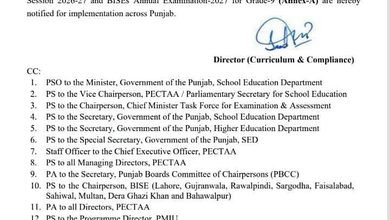
On November 6, 2026, PECTAA officially issued Notification No. PECTAA/C&C Unit/2026/1238, announcing the revised Smart Syllabus, pairing schemes, and model papers for Grade 9.
- Document Specifications: The official consolidated PDF spans 58 pages (approx. 12.4 MB) and details chapter-by-chapter retained topics, excluded sub-topics, and particular exercise questions to skip.
- Subjects Covered: Physics, Chemistry, Biology, Mathematics (Science & General), English Compulsory, Urdu Compulsory, Islamiat Compulsory, and Tarjuma-tul-Quran.
- Computer Science Note: While the primary science and compulsory booklet was released on November 6, the updated 9th Class Computer Science Smart Syllabus is scheduled for separate notification in mid-November 2026.
- Key Takeaway: Students must not rely on the November 7, 2025 notification endlessly recycled online, as that applied strictly to the 2026 exams. Only the November 6, 2026 booklet governs the 2027 annual examination.
2. PECTAA 10th Class Syllabus 2026–27 PDF (Matric Part 2)
The situation for 10th Class (Matric Part 2) is structurally different from 9th Class and requires careful attention:
- Transition to the New Syllabus: During the 2026 board exams, 10th-grade students were examined on the former (full) curriculum. For the 2026–27 academic twelve months (2027 Annual Exams), PECTAA has introduced the New Revised Syllabus and Textbooks for Class 10 across all compulsory and science subjects (Mathematics, Physics, Chemistry, Biology, Computer Science, English, Urdu, Pakistan Studies, and Tarjuma-tul-Quran).
- ALP Reduction Status: Because the 10th-grade textbooks have just been modernized for the 2026–27 session to match the updated curriculum cohort, PECTAA has not issued a separate reduced-topic “Smart Syllabus” notification on foremost of the modern 10th-grade books. Students must prepare from the newly introduced 2026–27 textbooks and follow the official 2027 BISE pairing schemes.
3. PECTAA 11th Class Smart Syllabus 2026–27 PDF (1st Year / HSSC Part 1)
Alongside the 9th-grade release, PECTAA published the official 11th Class (1st Year) Smart Syllabus 2026–27 PDF on November 6, 2026.
- Document Specifications: The official HSSC Part 1 ALP booklet consists of 71 pages (approx. 8.45 MB) covering FSc (Pre-Medical & Pre-Engineering), ICS, I.Com, and FA streams.
- Subject Scope: Includes detailed topic exclusions and retained exercise mappings for 1st Year Physics, Chemistry, Biology, Mathematics, Computer Science, English, Urdu, and Islamiat.
- Strategic Impact for MDCAT & ECAT: While FSc Part 1 students should skip deleted topics for their May/June 2027 board exams to maximize their HSSC marks, pre-medical and pre-engineering aspirants should still study excluded conceptual sections during self-study so they do not face knowledge gaps in upcoming entry tests.
4. PECTAA 12th Class Smart Syllabus 2026–27 PDF (2nd Year / HSSC Part 2)
For 12th Class (HSSC Part 2) students appearing in the 2027 annual examinations:
- Curriculum & Pattern Updates: Class 12 students must align their preparation with the updated 2026–27 syllabus guidelines and subject-precise paper patterns issued by PECTAA and the Punjab Boards Committee of Chairmen (PBCC).
- Verification Rule: Before skipping any chapter or exercise in 2nd Year Physics, Chemistry, Calculus (Math), or Biology, students should verify the exact examination year printed on the cover notification of their syllabus PDF to ensure they are not using an expired circular.
Comprehensive Data Overview: PECTAA 2026–27 Syllabus Matrix
The following table summarizes the official document specifications, notification status, and preparation mandates across all four secondary and higher secondary classes in Punjab.
| Class / Level | Academic Session | Official ALP / Syllabus Status | Notification / Release Date | Official PDF Specs | Applicable Exam Cycle | Core Action for Students |
|---|---|---|---|---|---|---|
| 9th Class (SSC Part 1) | 2026–27 | Smart Syllabus (ALP) Officially Announced | Nov 6, 2026 (PECTAA/C&C Unit/2026/1238) | 58 Pages / 12.4 MB | Annual Exam 2027 | Prepare retained topics; skip officially deleted exercises. |
| 10th Class (SSC Part 2) | 2026–27 | New Revised Syllabus Introduced (No separate ALP reduction) | Oct–Nov 2026 Cycle | Subject-wise New Textbooks | Annual Exam 2027 | Study the new 2026–27 syllabus in full alongside 2027 pairing schemes. |
| 11th Class (HSSC Part 1) | 2026–27 | Smart Syllabus (ALP) Officially Announced | Nov 6, 2026 | 71 Pages / 8.45 MB | Annual Exam 2027 | Follow the 71-page ALP booklet and updated 1st Year model papers. |
| 12th Class (HSSC Part 2) | 2026–27 | Updated Syllabus & Paper Pattern Framework | Nov 2026 Updates | Subject-wise Notifications | Annual Exam 2027 | Cross-check subject pairing schemes and official PECTAA circulars. |
Comparison: Full Curriculum vs. PECTAA Smart Syllabus (ALP) 2026–27
How does studying from the PECTAA Smart Syllabus (ALP) compare to following the traditional Full Textbook Curriculum? Moreover, how has the 2026–27 cycle evolved compared to the 2025–26 cycle? The comparison matrix below breaks down the operational differences.
| Comparison Parameter | Full Textbook Curriculum | PECTAA Smart Syllabus (ALP) 2026–27 | Impact on 2027 Exam Preparation |
|---|---|---|---|
| Content Volume | 100% of chapters, sub-topics, practicals, and end-of-chapter exercises. | Reduced by ~20% to 30% via targeted exclusion of redundant sub-topics and repetitive questions. | Saves 6–8 weeks of instructional and revision duration before board exams. |
| Pairing Scheme Alignment | General chapter weightage based on full textbook scope. | Custom-bound Pairing Schemes & Model Papers issued alongside the ALP notification. | High predictability of Long Question (LQ) and Short Question (SQ) chapter combinations. |
| Assessment Approach | Broad coverage across all cognitive domains and descriptive topics. | SLO-focused & Analytical: Retains high-yield conceptual topics while trimming low-priority rote sections. | Students must focus on conceptual clarity rather than selective chapter skipping. |
| 2025–26 vs. 2026–27 Cycle | In 2025–26, 9th & 11th transitioned to fresh books while 10th & 12th used aged books. | In 2026–27, 9th & 11th receive newly calibrated ALP notifications (06.11.2026), while 10th moves to the fresh syllabus. | Using 2025–26 PDFs for 2027 exams will outcome in studying incorrect exercise subsets. |
| Long-Term Entry Test Utility | Provides 100% baseline coverage for MDCAT, ECAT, and NUMS. | Covers ~75% of entry test syllabi; excluded board topics may still appear in national aptitude tests. | Board exam toppers should still review deleted science concepts after annual exams. |
Subject-Wise Highlights & Preparation Strategy for Science & Arts
To extract maximum marks using the PECTAA Smart Syllabus 2026–27, students demand to adapt their study techniques according to how PECTAA has structured exclusions across different subject groups:
- Mathematics (9th, 10th, 11th, 12th):
- In the ALP documents, PECTAA seldom deletes an entire chapter in Mathematics. Instead, specific exercises or individual query numbers (e.g., complex word problems or redundant proofs) are excluded.
- Pro Tip: Take a highlighter and physically mark the retained questions and deleted questions directly on your textbook index and exercise pages using the official 58-page (Class 9) or 71-page (Class 11) PDF.
- Physics, Chemistry, and Biology:
- Science subjects aspect a mix of deleted theoretical articles, excluded numerical problems, and trimmed multiple-choice questions.
- Because PECTAA’s Notification
1238also includes Model Papers and Pairing Schemes, cross-reference the retained topics with the pairing scheme to see which chapters carry the highest weightage for Long Questions.
- English, Urdu, and Compulsory Subjects:
- Exclusions in language subjects typically involve exact textbook lessons, poems, or grammar composition items (such as selected letters, applications, or essays).
- For Tarjuma-tul-Quran and Islamiat, only prepare the Surahs, Ahadith, and thematic topics explicitly listed in the 2026–27 syllabus breakdown.
For educators and academic coordinators implementing these subject breakdowns in open and private schools, checking resource portals for Punjab educators and STI staff helps ensure that weekly test series and mid-term assessments mirror the updated PECTAA weightage.
How to Verify and Download the Authentic PECTAA Smart Syllabus 2026–27 PDF
Every year, thousands of students lose marks because they download re-titled PDFs from unverified blogs or WhatsApp groups that simply slap “2027” onto an old 2021 COVID-era ALP booklet or a 2025 circular. Follow this verification checklist before trusting any PDF:
- Step 1: Check the Official Notification Number and Date: For 9th Class (and corresponding 2026–27 updates), verify that the cover letter carries Notification No. PECTAA/C&C Unit/2026/1238, dated 06.11.2026, explicitly mentioning Academic Session 2026–27 and Annual Examination 2027.
- Step 2: Visit Primary Official Portals: Always cross-check circulars on the official PECTAA Curriculum & Compliance portal or verify exam implementation circulars through the Board of Intermediate and Secondary Education (BISE) Lahore and your regional board site.
- Step 3: Use Trusted Educational Repositories: If the primary government server experiences high-traffic downtime following the November 6 release, you can access mirrored copies of the official 58-page Class 9 PDF and 71-page Class 11 PDF on established educational archives like Taleem360’s Official Smart Syllabus Portal.
Analysis: Key Takeaways for the 2026–27 Academic Cycle
- Timely Clarity for 2027 Examinees: By issuing the formal notification on November 6, 2026, PECTAA has given 9th and 11th-grade students roughly four to five months of focused revision duration ahead of the Spring 2027 board examinations.
- Three-In-One Assessment Alignment: Unlike piecemeal announcements in the past, the 2026–27 notification integrates the Smart Syllabus (Deleted Topics), Pairing Schemes, and Model Papers into a single cohesive package, eliminating guesswork regarding paper patterns.
- Distinct Paths for Part 1 vs. Part 2: The 2026–27 cycle is not a blanket reduction across all grades. While 9th and 11th classes operate under dedicated ALP booklets (58 pages and 71 pages respectively), 10th class is navigating a brand-modern full syllabus introduced for the 2027 exams without an additional topic-reduction overlay.
- Bridging the Instructional Gap: PECTAA’s explicit instruction in Urdu and English within the notification—that teachers should still introduce core foundational concepts in class even if excluded from the board paper—shows an awareness of vertical curriculum continuity between Matric and Intermediate levels.
Opinion: Final Expert Verdict
From an educational policy and exam-strategy standpoint, the PECTAA Smart Syllabus (ALP) 2026–27 is a pragmatic and a great deal of-needed intervention, but it carries a hidden trap for complacent students. On the positive side, trimming 20% to 30% of repetitive exercises in dense newly introduced textbooks prevents cognitive overload and allows teachers to focus on conceptual depth and SLO mastery rather than racing blindly to finish the book by February. Coupling the syllabus reduction directly with official model papers and pairing schemes is a masterstroke by PECTAA that curbs the predatory “guess paper” market across Punjab.
Nevertheless, my final verdict for students is one of disciplined caution: treat the Smart Syllabus as an examination filter, not a license to ignore foundational science and math principles. In subjects like Physics, Chemistry, and Mathematics, chapters are interconnected; skipping a “deleted” introductory concept completely can create the retained exercise right after it nearly impossible to solve conceptually. Furthermore, for 11th and 12th-grade students aiming for MDCAT, ECAT, or NUST entry tests, competitive exam bodies test the broader curriculum framework. The winning strategy for 2027: Read the full conceptual flow of every chapter once for understanding, but dedicate 100% of your memorization, written practice, and test-series revision strictly to the retained topics and pairing schemes in the official November 6, 2026 PECTAA PDF.
Frequently Asked Questions (FAQs)
1. Has PECTAA officially announced the Smart Syllabus for 2026–27 (Annual Exams 2027)?
Yes. On November 6, 2026, PECTAA officially issued Notification No. PECTAA/C&C Unit/2026/1238, announcing the Smart Syllabus (ALP), deleted topics, pairing schemes, and model papers for the 2026–27 academic session (Annual Examinations 2027) for 9th and 11th classes.
2. Does the 2025–26 Smart Syllabus automatically apply to the 2027 board exams?
No. The November 7, 2025 notification applied solely to the Annual Examination 2026. For the 2027 board exams, students must strictly follow the newly issued November 6, 2026 notification and its accompanying 2026–27 PDF booklets.
3. Is there a Smart Syllabus for 10th Class in 2026–27?
For the 2027 exams, 10th Class has transitioned from the former syllabus to a newly introduced revised syllabus. PECTAA has not issued a separate reduced-topic Smart Syllabus on highest of the modern 10th-class textbooks. Thus, 10th-grade students must prepare the modern 2026–27 syllabus in full alongside the official 2027 pairing schemes.
4. Why is 9th Class Computer Science missing from the initial November 6, 2026 PDF?
While the 58-page 9th Class ALP booklet released on November 6, 2026 covers all major science and compulsory subjects, the Computer Science Smart Syllabus was held back for final curriculum vetting and is scheduled for release between November 15 and November 20, 2026.
5. Will board exam questions come from the deleted topics in the PECTAA ALP?
No. According to PECTAA guidelines, paper setters across all nine Punjab BISE boards are bound to construct the Annual 2027 examination papers (both MCQs and subjective questions) strictly from the retained portions of the syllabus.
6. Is the PECTAA Smart Syllabus 2026–27 valid for all boards in Punjab?
Yes. The PECTAA Smart Syllabus applies uniformly across all nine educational boards in Punjab: BISE Lahore, Gujranwala, Rawalpindi, Faisalabad, Multan, Bahawalpur, Sargodha, Sahiwal, and D.G. Khan.
For a visual walkthrough on navigating the newly released syllabus booklets and checking subject-wise reductions, you can watch the PECTAA Smart Syllabus 2026-27 Announced video, which explains the latest updates and PDF download steps for 8th to 12th class students across Punjab.

Download 1st year smart syllabus 2026 of all subjects here