English All 12 Tenses with Examples
English All 12 Tenses with Examples and Solved, Unsolved Worksheet for 10th Class Students
Introduction: Why Mastering the 12 English Tenses is Your Ultimate Matric Score Booster
Understanding English all 12 tenses is the foundational skill required to secure an A+ grade in 10th Class (Matric Part 2 / SSC-II) board examinations. In English grammar, tenses are verb-based structures used to indicate the time an action occurs (Present, Past, or Future) and the aspect or state of that action (Indefinite/Simple, Continuous/Progressive, Perfect, or Perfect Continuous).
For 10th-grade students appearing across BISE boards, grammar is not tested in isolation. Out of a standard 75-mark English paper, tenses directly govern at least 23 to 28 marks. When you sit in the examination hall, your grasp of verb conjugations dictates your accuracy across four major sections:
- Objective MCQs (5 Marks): “Choose the correct form of the verb” is the extremely primary section of the objective paper, testing duration-marker recognition and conditional syntax.
- Urdu-to-English Paragraph Translation (8 Marks): Converting unseen or prescribed Urdu passages from the textbook into accurate English requires instant recognition of Urdu sentence endings (ta hai, raha tha, chuka hoga) and mapping them to the exact English formula.
- Direct and Indirect Narration (5 Marks): Backshifting tenses (such as converting Present Indefinite into Past Indefinite) is impossible if you cannot identify the tense of the reported speech.
- Essays and Short Question Answers (15+ Marks): Examiners heavily penalize students who compose historical accounts in the present tense or shift tenses erratically mid-paragraph.
By moving away from blind cramming (ratta) and learning the structural logic of auxiliary verbs, main verb forms ($V_1, V_2, V_3, V_1\text{+ing}$), and signal words, you can turn the grammar portion of your Matric English paper into guaranteed full marks.
The Master 12 English Tenses Formula Chart (Quick Reference Table)
Before diving into individual rules, use this master structural matrix to visualize how duration and aspect intersect to design the 12 tenses in English.
| Tense Name | Affirmative Formula | Negative Formula | Interrogative Formula | Signal Words (Board Exam Clues) |
|---|---|---|---|---|
| Present Indefinite | $\text{S} + V_1\text{(s/es)} + \text{O}$ | $\text{S} + \text{do/does not} + V_1 + \text{O}$ | $\text{Do/Does} + \text{S} + V_1 + \text{O?}$ | Daily, invariably, usually, commonly, every day, universal truths |
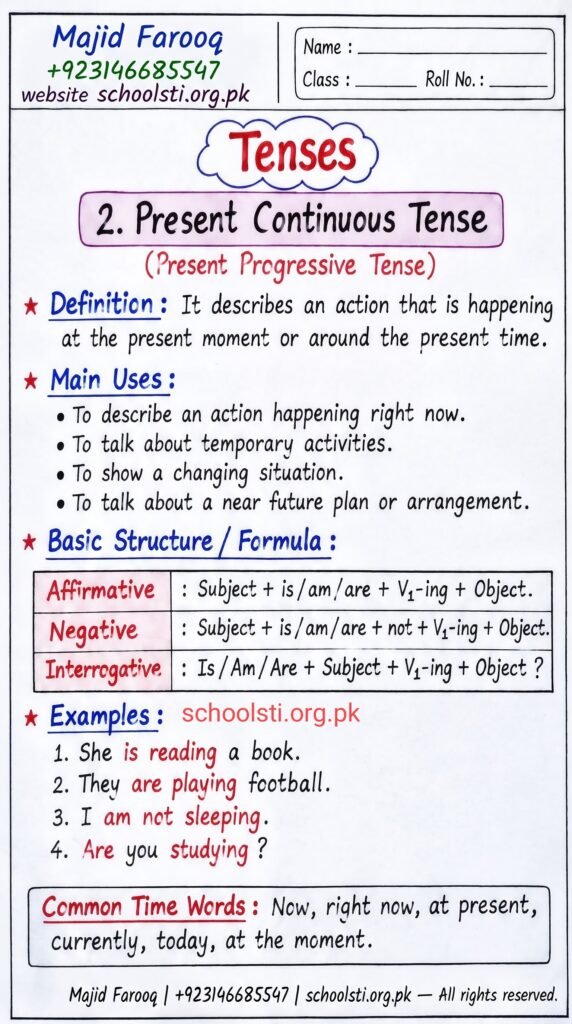
| Present Continuous | $\text{S} + \text{is/am/are} + V_1\text{-ing} + \text{O}$ | $\text{S} + \text{is/am/are not} + V_1\text{-ing} + \text{O}$ | $\text{Is/Am/Are} + \text{S} + V_1\text{-ing} + \text{O?}$ | Now, right now, at present, at this moment, look!, listen! |
| Present Perfect | $\text{S} + \text{has/have} + V_3 + \text{O}$ | $\text{S} + \text{has/have not} + V_3 + \text{O}$ | $\text{Has/Have} + \text{S} + V_3 + \text{O?}$ | Just, already, yet, recently, so far, ever, never |
| Present Perfect Continuous | $\text{S} + \text{has/have been} + V_1\text{-ing} + \text{O} + \text{since/for}$ | $\text{S} + \text{has/have not been} + V_1\text{-ing} + \text{O} + \text{since/for}$ | $\text{Has/Have} + \text{S} + \text{been} + V_1\text{-ing} + \text{O} + \text{since/for?}$ | Since + point in time, For + period of duration |
| Past Indefinite | $\text{S} + V_2 + \text{O}$ | $\text{S} + \text{did not} + V_1 + \text{O}$ | $\text{Did} + \text{S} + V_1 + \text{O?}$ | Yesterday, ago, last night, final twelve months, in 2020 |
| Past Continuous | $\text{S} + \text{was/were} + V_1\text{-ing} + \text{O}$ | $\text{S} + \text{was/were not} + V_1\text{-ing} + \text{O}$ | $\text{Was/Were} + \text{S} + V_1\text{-ing} + \text{O?}$ | While, when, at that time, all yesterday |
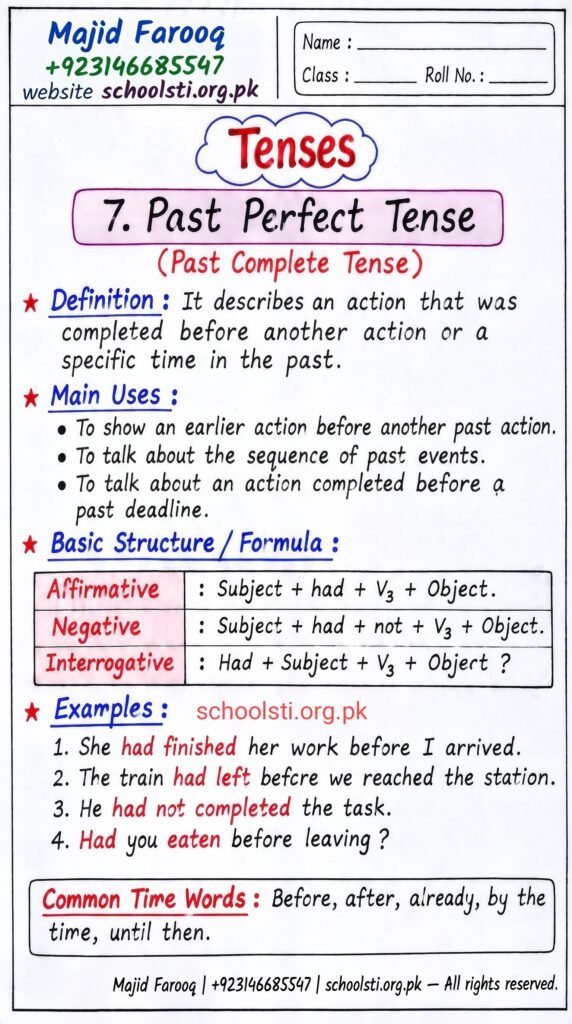
| Past Perfect | $\text{S} + \text{had} + V_3 + \text{O}$ | $\text{S} + \text{had not} + V_3 + \text{O}$ | $\text{Had} + \text{S} + V_3 + \text{O?}$ | Before, after, already, by the duration, when |
| Past Perfect Continuous | $\text{S} + \text{had been} + V_1\text{-ing} + \text{O} + \text{since/for}$ | $\text{S} + \text{had not been} + V_1\text{-ing} + \text{O} + \text{since/for}$ | $\text{Had} + \text{S} + \text{been} + V_1\text{-ing} + \text{O} + \text{since/for?}$ | Since/for + past reference clause (e.g., before he came) |
| Future Indefinite | $\text{S} + \text{will/shall} + V_1 + \text{O}$ | $\text{S} + \text{will/shall not} + V_1 + \text{O}$ | $\text{Will/Shall} + \text{S} + V_1 + \text{O?}$ | Tomorrow, next week, next month, soon, shortly |
| Future Continuous | $\text{S} + \text{will/shall be} + V_1\text{-ing} + \text{O}$ | $\text{S} + \text{will/shall not be} + V_1\text{-ing} + \text{O}$ | $\text{Will/Shall} + \text{S} + \text{be} + V_1\text{-ing} + \text{O?}$ | At this moment tomorrow, next week at 5 PM |
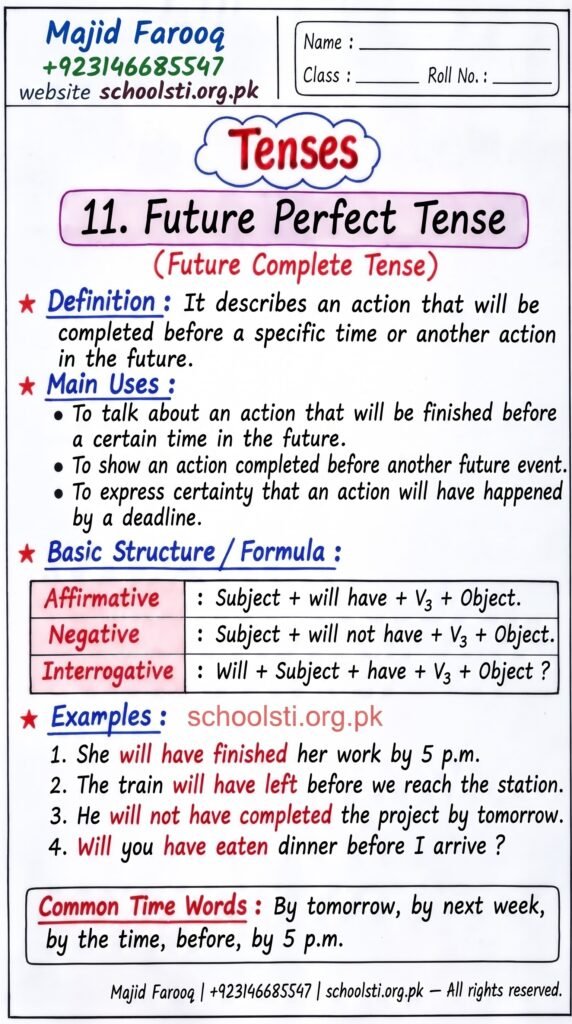
| Future Perfect | $\text{S} + \text{will/shall have} + V_3 + \text{O}$ | $\text{S} + \text{will/shall not have} + V_3 + \text{O}$ | $\text{Will/Shall} + \text{S} + \text{have} + V_3 + \text{O?}$ | By tomorrow, by next twelve months, by the complete of this month |
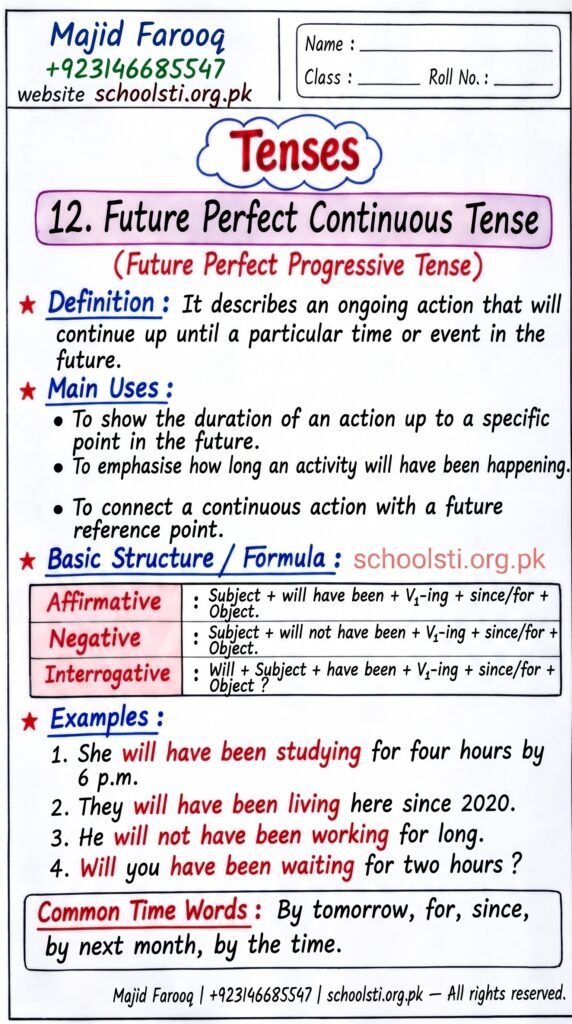
| Future Perfect Continuous | $\text{S} + \text{will/shall have been} + V_1\text{-ing} + \text{O} + \text{since/for}$ | $\text{S} + \text{will/shall not have been} + V_1\text{-ing} + \text{O} + \text{since/for}$ | $\text{Will/Shall} + \text{S} + \text{have been} + V_1\text{-ing} + \text{O} + \text{since/for?}$ | For + duration + by forthcoming moment (e.g., for two hours by 6 PM) |
Present Tenses: Rules, Formulas, and 10th Class Examples
According to the British Council’s English Grammar Reference, present tense forms anchor actions in the current timeframe, express permanent realities, or connect past events to the present moment.
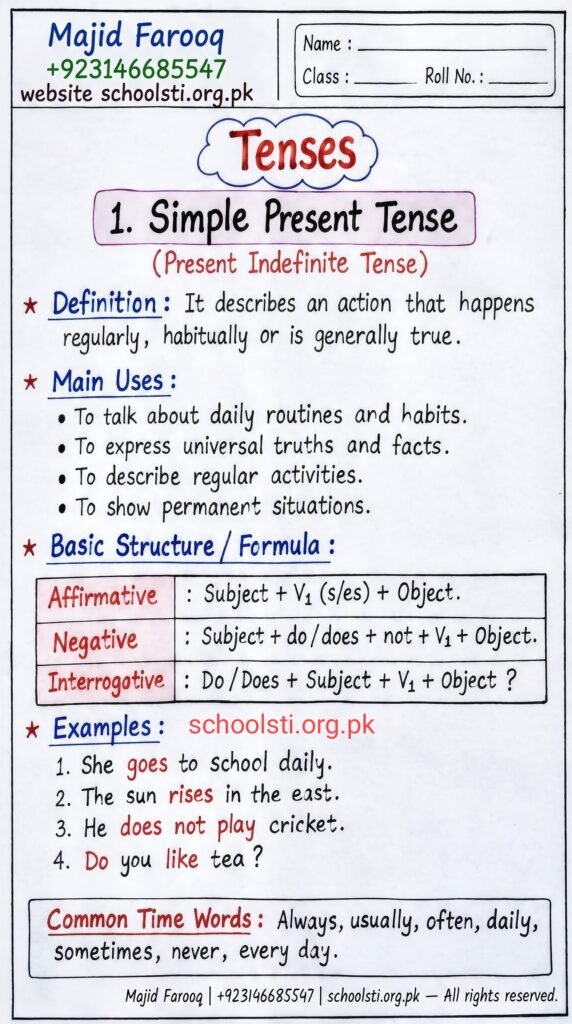
1. Present Indefinite Tense (Simple Present)
The Present Indefinite tense describes habitual actions, daily routines, general truths, and permanent situations.
- Urdu Identification: Sentences conclude with ta hai, ti hai, tay hain, ta hoon (تا ہے، تی ہے، تے ہیں).
- Helping Verbs: Do (with I, We, You, They, and plural nouns) and Does (with He, She, It, and singular nouns).
- Main Verb Rule: Use the first form of the verb ($V_1$). In affirmative sentences with third-person singular subjects (He, She, It, or a single name), add -s or -es to $V_1$. Once does or does not enters the sentence, drop the -s/-es from the central verb.
- Examples:
- Affirmative: She recites the Holy Quran every morning. (Universal truth: The Earth revolves around the Sun.)
- Negative: He does not waste his period before the board exams.
- Interrogative: Do they revise their lessons daily?
2. Present Continuous Tense (Present Progressive)
This tense indicates an action that is actively in progress at the exact moment of speaking or a temporary ongoing action around the present period.
- Urdu Identification: Sentences end with raha hai, rahi hai, rahay hain, raha hoon (رہا ہے، رہی ہے، رہے ہیں).
- Helping Verbs: Is (He, She, It, singular), Am (I), Are (We, You, They, plural).
- Main Verb Rule: Always utilize the present participle ($V_1 + \text{ing}$).
- Examples:
- Affirmative: The educator is explaining the rules of direct and indirect speech right now.
- Negative: The students are not making a noise in the classroom.
- Interrogative: Am I improving my English handwriting?
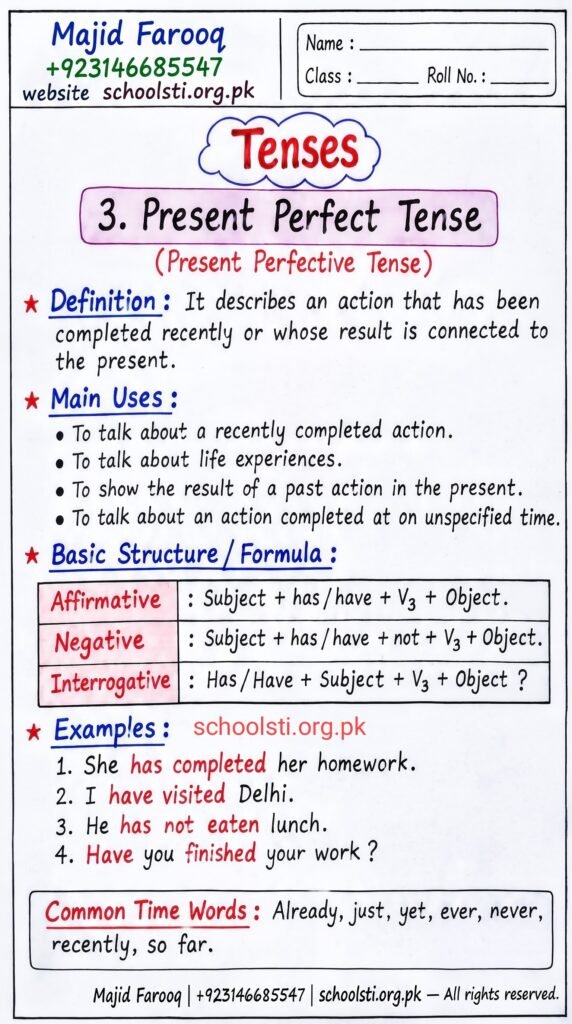
3. Present Perfect Tense
The Present Perfect tense expresses an action that occurred at an unspecified moment in the past however retains a powerful outcome or relevance in the present, or an action that just finished.
- Urdu Identification: Sentences end with chuka hai, chuki hai, chukay hain or liya hai, diya hai, ki hai (چکا ہے، چکی ہے، لیا ہے).
- Helping Verbs: Has (He, She, It, singular) and Have (I, We, You, They, plural).
- Main Verb Rule: Always utilize the past participle—the third form of the verb ($V_3$).
- Examples:
- Affirmative: We have already solved the past five years’ board papers.
- Negative: The Principal has not announced the summer vacation dates yet.
- Interrogative: Have you ever visited the Badshahi Mosque in Lahore?
4. Present Perfect Continuous Tense
This tense is used for an action that began in the past, has continued uninterrupted up to the present moment, and is still in progress.
- Urdu Identification: Sentences end with raha hai, rahi hai, rahay hain combined with an explicit mention of time/duration (waqt ka zikr).
- Helping Verbs: Has been and Have been.
- Main Verb Rule: $V_1 + \text{ing}$, followed by Since (for an exact starting point: since morning, since 2022, since Monday, since 8 o’clock) or For (for a calculated duration: for two hours, for five days, for many years).
- Examples:
- Affirmative: It has been raining heavily in Murree since morning.
- Negative: They have not been living in this house for ten years.
- Interrogative: Has the gardener been watering the plants for two hours?
Past Tenses: Rules, Formulas, and 10th Class Examples
Past tenses are the backbone of story writing, historical essays (like Quaid-e-Azam Muhammad Ali Jinnah), and textbook comprehension questions. To master all grammar formulas required for the Punjab Board examinations, students can download the 10th Class English Master Formula and Grammar Rules Handbook, which compiles high-weightage exam rules in a prompt-revision format.
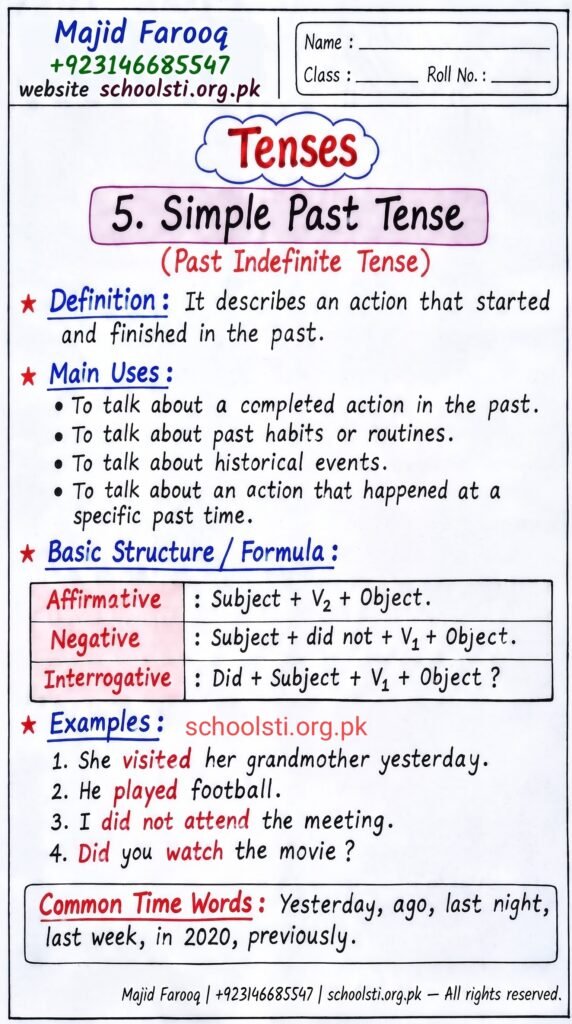
5. Past Indefinite Tense (Simple Past)
The Past Indefinite tense describes an action that started and finished at a exact, definite moment in the past, or a past habit.
- Urdu Identification: Sentences finish with tha, thi, thay paired with an action, or aa, ee, ay sounds (gaya, aaya, parha, likha — الف، چھوٹی ی، بڑی ے).
- Helping Verbs: No helping verb is used in affirmative sentences. Did is used in negative and interrogative sentences for all subjects.
- Main Verb Rule: Use the second form of the verb ($V_2$) in affirmative sentences. Crucial Exam Trap: As soon as you apply did or did not, revert the verb back to the primary form ($V_1$). At no time author did not went—consistently write did not go.
- Examples:
- Affirmative: Pakistan won the Cricket World Cup in 1992.
- Negative: He did not attend the extra coaching classes yesterday.
- Interrogative: Did the police catch the thief last night?
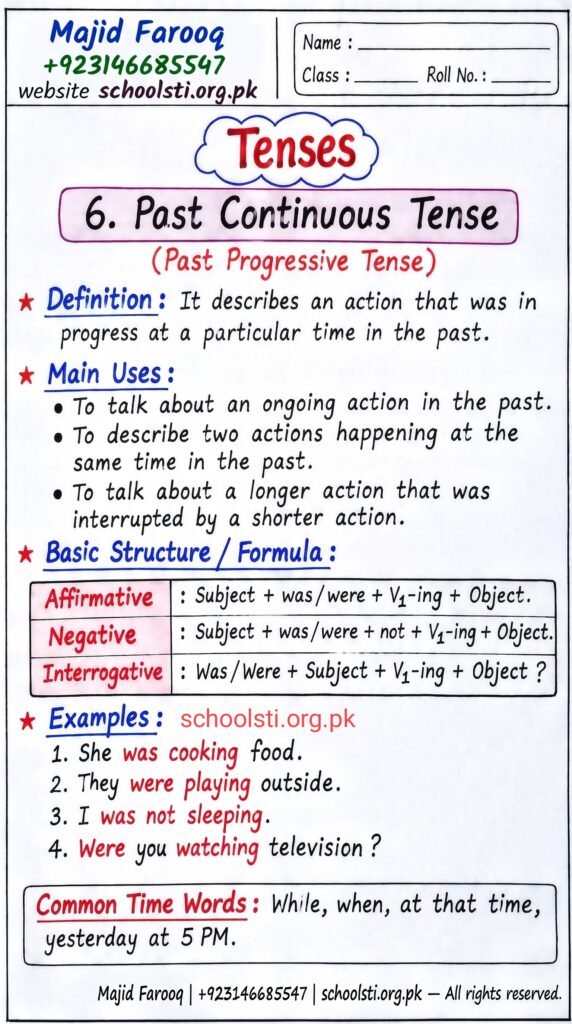
6. Past Continuous Tense (Past Progressive)
This tense refers to an ongoing action that was happening at a precise moment in the past, commonly interrupted by a shorter past action.
- Urdu Identification: Sentences complete with raha tha, rahi thi, rahay thay (رہا تھا، رہی تھی، رہے تھے).
- Helping Verbs: Was (I, He, She, It, singular nouns) and Were (We, You, They, plural nouns).
- Main Verb Rule: $V_1 + \text{ing}$.
- Examples:
- Affirmative: I was preparing for my physics test when the lights went out.
- Negative: The birds were not chirping in the trees at noon.
- Interrogative: Was she weeping over her low marks?
7. Past Perfect Tense
Often called the “past of the past,” the Past Perfect tense describes an action that was completed before another action took site in the past. As detailed in the Purdue Online Writing Lab (OWL) guide to verb tenses, establishing this sequence of events is vital when two past actions occur in the identical sentence.
- Urdu Identification: Sentences complete with chuka tha, chuki thi, chukay thay or liya tha, diya tha (چکا تھا، چکی تھی، لیا تھا).
- Helping Verbs: Had (used universally with all singular and plural subjects).
- Main Verb Rule: Third form of the verb ($V_3$). In two-clause board exam sentences using before or after, pair Past Perfect ($\text{had} + V_3$) for the earliest completed action with Past Indefinite ($V_2$) for the second action.
- Examples:
- Affirmative: The patient had died before the doctor arrived.
- Negative: We had not seen such a terrifying storm before.
- Interrogative: Had the train left the station before you reached there?
8. Past Perfect Continuous Tense
This tense indicates an action that began in the past, continued for a period of time, and was still ongoing when another past event occurred.
- Urdu Identification: Sentences finish with raha tha, rahi thi, rahay thay accompanied by a precise time reference (waqt ka zikr).
- Helping Verbs: Had been (for all subjects).
- Main Verb Rule: $V_1 + \text{ing}$, accompanied by since or for.
- Examples:
- Affirmative: He had been trying to solve the math puzzle for two hours before his brother helped him.
- Negative: The farmers had not been ploughing the fields since morning.
- Interrogative: Had they been waiting for the bus since 9 o’clock?
Future Tenses: Rules, Formulas, and 10th Class Examples
Future tenses express predictions, promises, plans, and scheduled projections. While modern conversational English frequently uses will for all subjects, 10th-grade board examiners still test the traditional distinction between Shall (used with primary-person pronouns I and We) and Will (used with You, He, She, It, They, and all nouns) unless determination or a promise is implied (where they reverse).
9. Forthcoming Indefinite Tense (Simple Future)
Used to predict a future event or state an action that will happen in the moment to come.
- Urdu Identification: Sentences conclude with ga, gi, gay (گا، گی، گے).
- Helping Verbs: Will and Shall.
- Main Verb Rule: First form of the verb ($V_1$).
- Examples:
- Affirmative: We shall appear in the Matric annual examinations next month.
- Negative: They will not forgive him for his rude behavior.
- Interrogative: Will the administration announce a communal holiday tomorrow?
10. Forthcoming Continuous Tense (Future Progressive)
This tense projects an ongoing action that will be taking location at a particular duration in the forthcoming.
- Urdu Identification: Sentences conclude with raha hoga, rahi hogi, rahay hongay (رہا ہوگا، رہی ہوگی، رہے ہوں گے).
- Helping Verbs: Will be and Shall be.
- Main Verb Rule: $V_1 + \text{ing}$.
- Examples:
- Affirmative: At this period tomorrow, I shall be flying to Karachi.
- Negative: The children will not be playing outside during the afternoon heat.
- Interrogative: Will the guests be arriving late in the evening?
11. Future Perfect Tense
The Future Perfect tense describes an action that will be completed before a specified deadline or before another event happens in the future.
- Urdu Identification: Sentences conclude with chuka hoga, chuki hogi, chukay hongay or liya hoga (چکا ہوگا، چکی ہوگی).
- Helping Verbs: Will have and Shall have.
- Main Verb Rule: Third form of the verb ($V_3$).
- Examples:
- Affirmative: The mason will have finished the construction job by the conclude of this week.
- Negative: She will not have locked the doors before the sun sets.
- Interrogative: Shall we have revised the entire syllabus by March?
12. Future Perfect Continuous Tense
This tense projects an ongoing action that will continue up until a particular milestone in the forthcoming, emphasizing the total duration of the activity.
- Urdu Identification: Sentences conclude with raha hoga, rahi hogi, rahay hongay paired with a duration or time reference.
- Helping Verbs: Will have been and Shall have been.
- Main Verb Rule: $V_1 + \text{ing}$, followed by for (or since / from in textbook translations).
- Examples:
- Affirmative: By next month, he will have been teaching at this high institution for twenty years.
- Negative: They will not have been taking exercise since morning.
- Interrogative: Will the girls have been weaving carpets for three hours?
Comparison Section: Confusing Tense Pairs Decoded for Board Exams
A major cause 10th-class students lose marks in the “Correct Form of the Verb” MCQ section is confusion between overlapping tenses. As outlined in the Cambridge Dictionary of English Grammar, distinguishing between aspectual boundaries—such as uncomplicated past versus perfective aspect—depends entirely on how the speaker frames the timeframe. Examine the four most heavily tested comparisons below:
| Confusing Tense Pair | Core Grammatical Difference | Board Exam Trap to Avoid | Side-by-Side Comparison |
|---|---|---|---|
| Past Indefinite vs. Present Perfect | Past Indefinite locks an action into a finished past duration (yesterday, in 2019). Present Perfect links a past action to the present with no finished past timestamp. | Never utilize has/have + $V_3$ if the sentence contains yesterday, ago, or last night. | Wrong: I have met him yesterday. |
Right (Past Ind.): I met him yesterday.
Right (Pres. Perf.): I have already met him. |
| Past Indefinite vs. Past Perfect | Past Indefinite states a single past event ($V_2$). Past Perfect highlights the earlier of two past events ($\text{had} + V_3$). | Using $\text{had} + V_3$ in both clauses of a before/after sentence. | Right: The bus had left (1st action) before I reached (2nd action) the stand. |
| Present Continuous vs. Present Perfect Continuous | Present Continuous states what is happening now without duration. Present Perfect Continuous states what started in the past and is still happening with a moment duration. | Using is/am/are when since or for is present at the finish of the sentence. | Wrong: It is raining since morning.
Right (Pres. Cont.): It is raining right now.
Right (Pres. Perf. Cont.): It has been raining since morning. |
| Conditional Type 1 vs. Conditional Type 3 | Type 1 deals with genuine upcoming possibilities ($\text{If} + V_1 \rightarrow \text{will} + V_1$). Type 3 deals with impossible past regrets ($\text{If} + \text{had} + V_3 \rightarrow \text{would have} + V_3$). | Putting will or would inside the If-clause. | Type 1: If he works difficult, he will pass.
Type 3: If he had worked hard, he would have passed. |
Solved Worksheet on All 12 Tenses for 10th Class Students
Practice how board examiners test your tense recognition. For a comprehensive collection of past board objective questions, review the 10th Class English Solved Objective MCQs Mega Bank to test yourself against actual BISE questions.
Part A: Solved Board-Style Verb Form Exercises (With Explanations)
- She ______ (go) to school an hour ago.
- Answer: went
- Rule Explanation: The period marker “an hour ago” indicates a completed action in the past, requiring the Past Indefinite tense ($V_2$).
- It ______ (rain) outside at present.
- Answer: is raining
- Rule Explanation: The phrase “at present” shows the action is occurring right now, which requires the Present Continuous tense ($\text{is} + V_1\text{-ing}$).
- They ______ (live) in this house since 1995.
- Answer: have been living
- Rule Explanation: The presence of “since 1995” denotes an action that began in the past and continues into the present, requiring the Present Perfect Continuous tense ($\text{have been} + V_1\text{-ing}$).
- The patient ______ (die) before the doctor arrived.
- Answer: had died
- Rule Explanation: Two past actions are linked by “before”. The second action (arrived) is in Past Indefinite ($V_2$), so the earlier action must take the Past Perfect tense ($\text{had} + V_3$).
- Good students consistently ______ (labor) hard.
- Answer: work
- Rule Explanation: The adverb “always” signals a habitual truth in the Present Indefinite tense. Because “Good students” is plural, we use the base form $V_1$ without -s.
- I ______ (read) a novel when my father entered the room.
- Answer: was reading
- Rule Explanation: An ongoing past action was interrupted by a shorter past event (entered), requiring the Past Continuous tense ($\text{was} + V_1\text{-ing}$).
- He ______ (not whole) his homework yet.
- Answer: has not completed
- Rule Explanation: The adverb “yet” in a negative sentence is a classic marker for the Present Perfect tense ($\text{has not} + V_3$).
- They ______ (finish) their project by next Monday.
- Answer: will have finished
- Rule Explanation: The deadline marker “by next Monday” points to an action that will be completed before a particular future duration, requiring the Future Perfect tense ($\text{will have} + V_3$).
- If you ______ (labor) difficult, you will win the scholarship.
- Answer: work
- Rule Explanation: This is a Type 1 Conditional sentence. When the chief clause uses Future Indefinite (will win), the If-clause must use the Present Indefinite tense ($V_1$).
- The sun ______ (rise) in the east.
- Answer: rises
- Rule Explanation: Universal truths are consistently expressed in the Present Indefinite tense. Since “The sun” is singular, we add -s to the base verb.
Part B: Solved Sentence Transformation & Urdu-to-English Translation
- Transform into Past Perfect Interrogative: She writes a letter to her friend.
- Answer: Had she written a letter to her friend?
- Rule Explanation: Past Perfect Interrogative places Had before the subject and converts $V_1$ (writes) to $V_3$ (written).
- Transform into Present Indefinite Negative: He told a lie.
- Answer: He does not tell a lie.
- Rule Explanation: Present Indefinite negative with a singular subject (He) uses does not + $V_1$ (tell).
- Translate into English: وہ دو گھنٹے سے اپنا سبق یاد کر رہا ہے۔
- Answer: He has been learning his lesson for two hours.
- Rule Explanation: Ending in raha hai with a two-hour duration (for two hours) requires the Present Perfect Continuous tense.
- Translate into English: سورج غروب ہونے سے پہلے ہم گھر پہنچ چکے ہوں گے۔
- Answer: We shall have reached home before the sun sets.
- Rule Explanation: Two upcoming actions where one finishes before the other: the earliest clause takes Future Perfect (shall have reached) and the subordinate time clause takes Present Indefinite (sets).
- Translate into English: کیا مالی صبح سے پودوں کو پانی دے رہا تھا؟
- Answer: Had the gardener been watering the plants since morning?
- Rule Explanation: Past ongoing action with a point in moment (since morning) in a query format requires Past Perfect Continuous Interrogative (Had + Subject + been + $V_1$-ing).
Unsolved Practice Worksheet for 10th Class Students (Self-Assessment)
Test your readiness for the board exam without looking at the rules above. Draft your answers in a notebook and period yourself (15 minutes).
Section 1: Fill in the Blanks with the Correct Form of the Verb (Board MCQs Style)
- She ______ (sleep) since morning. (sleeps / is sleeping / has been sleeping / slept)
- Quaid-e-Azam ______ (labor) extremely hard to achieve Pakistan. (works / worked / has worked / will labor)
- Wait here until the sun ______ (set). (sets / will set / set / is setting)
- I ______ (not see) him since final Monday. (did not see / do not see / have not seen / had not seen)
- Look! The bus ______ (come). (comes / came / is coming / has come)
- If he had walked quick, he ______ (catch) the train. (caught / would catch / would have caught / will catch)
- They ______ (take) tea every morning. (take / takes / took / are taking)
- By next December, I ______ (author) my second book. (will write / shall be writing / shall have written / wrote)
- Why ______ you ______ (produce) a noise yesterday? (do…build / did…build / were…making / had…made)
- The peon ______ (ring) the bell before I reached the academy. (rang / has rung / had rung / will ring)
Section 2: Transform the Following Sentences as Directed
- They played hockey in the evening. (Change into Future Continuous Tense)
- He teaches us English grammar. (Change into Past Indefinite Negative)
- We have been waiting for the effect since morning. (Change into Interrogative)
- She will have cooked the food. (Change into Negative)
- Did the boy converse the truth? (Change into Present Perfect Affirmative)
Section 3: Translate the Following Urdu Sentences into English
- پرندے صبح سے چہچہا رہے ہوں گے۔
- کیا تم نے اپنا کام ختم کر لیا ہے؟
- وہ ہر روز ورزش نہیں کرتا ہے۔
- جب میں وہاں پہنچا تو بارش ہو رہی تھی۔
- پاکستان دن دگنی رات چوگنی ترقی کر رہا ہے۔
Frequently Asked Questions (FAQs)
How can a 10th class pupil memorize all 12 tenses easily?
Instead of memorizing 12 separate chapters, master the 4 Aspect Rules that apply across all three times:
- All 3 Continuous tenses and all 3 Perfect Continuous tenses (6 tenses total) consistently utilize the $V_1 + \text{ing}$ form of the verb.
- All 3 Perfect tenses (Present Perfect, Past Perfect, Future Perfect) invariably utilize the 3rd form of the verb ($V_3$).
- Future Indefinite and Negative/Interrogative sentences of Present and Past Indefinite invariably utilize the 1st form of the verb ($V_1$).
- The 2nd form of the verb ($V_2$) is used in only one spot in the entire English language: the Affirmative sentence of the Past Indefinite Tense.
What is the golden rule for using “Since” and “For” in Perfect Continuous tenses?
Employ Since when you are given the exact starting point of an action on a calendar or clock (e.g., since 8 AM, since Monday, since January, since 2010, since childhood, since morning). Employ For when you are given a counted duration or length of time (e.g., for two hours, for ten days, for three months, for a long time).
Which tenses are most critical for the 10th class Urdu-to-English paragraph translation?
Over 75% of the 40 prescribed Urdu-to-English paragraphs in the 10th class English Grammar and Composition book rely on four tenses: Present Indefinite (for moral and descriptive passages), Past Indefinite (for historical narratives and stories), Past Continuous, and Past Perfect. Mastering the interplay between Past Indefinite and Past Perfect alone will secure most of your 8 translation marks.
Why do we adjust the verb to the first form after “did not” in Past Indefinite?
In English grammar, a single clause can only mark the past tense once. The auxiliary verb did is already the second (past) form of the verb do. Consequently, adding did absorbs the past tense marker, forcing the main verb back into its base form ($V_1$).
Analysis
An examination of the latest five years of BISE board papers (2021–2026) reveals that the 10th-class English assessment has shifted away from rote definitions toward applied grammatical context (in line with the Student Learning Outcomes / SLO policy). Key takeaways from our breakdown incorporate:
- Signal Words Dictate Objective Marks: In the 5-mark verb-correction MCQ section, 90% of sentences contain an explicit moment marker (ago, since, before, by next month, daily). Students who train themselves to underline the duration marker before looking at the options infrequently lose marks.
- The “Two-Clause” Dominance: Board examiners strongly favor complex sentences over basic ones. Expect at least two MCQs testing paired clauses—specifically Past Perfect + Past Indefinite (before/after) and Type 1, 2, and 3 Conditionals.
- Cross-Sectional Multiplier Effect: Because tenses directly control Direct/Indirect narration backshifting (5 marks) and Urdu-to-English translation (8 marks), a single conceptual flaw in Past Indefinite or Past Perfect cascades across multiple questions in the paper.
Opinion
From an academic instruction and curriculum layout standpoint, the biggest mistake 10th-grade students create is treating English tenses as an exercise in Urdu-to-English word swapping rather than understanding timeline logic. Relying strictly on Urdu suffixes (ta hai, chuka tha) works for basic sentences, but it breaks down during complex board paragraphs where an Urdu sentence ending in aa/ee/ay might actually call for the Present Perfect tense depending on context.
Our expert verdict for 10th-class students aiming for 70+ out of 75 marks is to adopt a three-step daily drill for two weeks:
- Memorize the verb conjugations ($V_1, V_2, V_3$) of the 100 most common irregular verbs so you never write buyed or ringed.
- Practice identifying the Signal Words in the unsolved worksheet above until matching since/for to has/have/had been becomes an automatic reflex.
- Translate one Urdu paragraph daily from your grammar book and immediately cross-check every single verb against the Master Formula Chart. When you treat grammar like mathematics—applying fixed formulas to clear clues—scoring 100% in the grammar section becomes completely predictable.