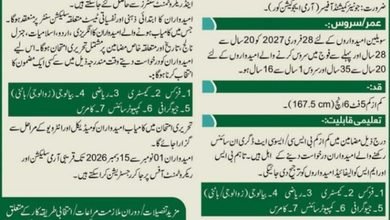
PPSC Combined Competitive Examination (CCE) 2026
PPSC Combined Competitive Examination (CCE) 2026: Complete Guide to Advertisement No. 12/2026, Revised Syllabus, and Eligibility
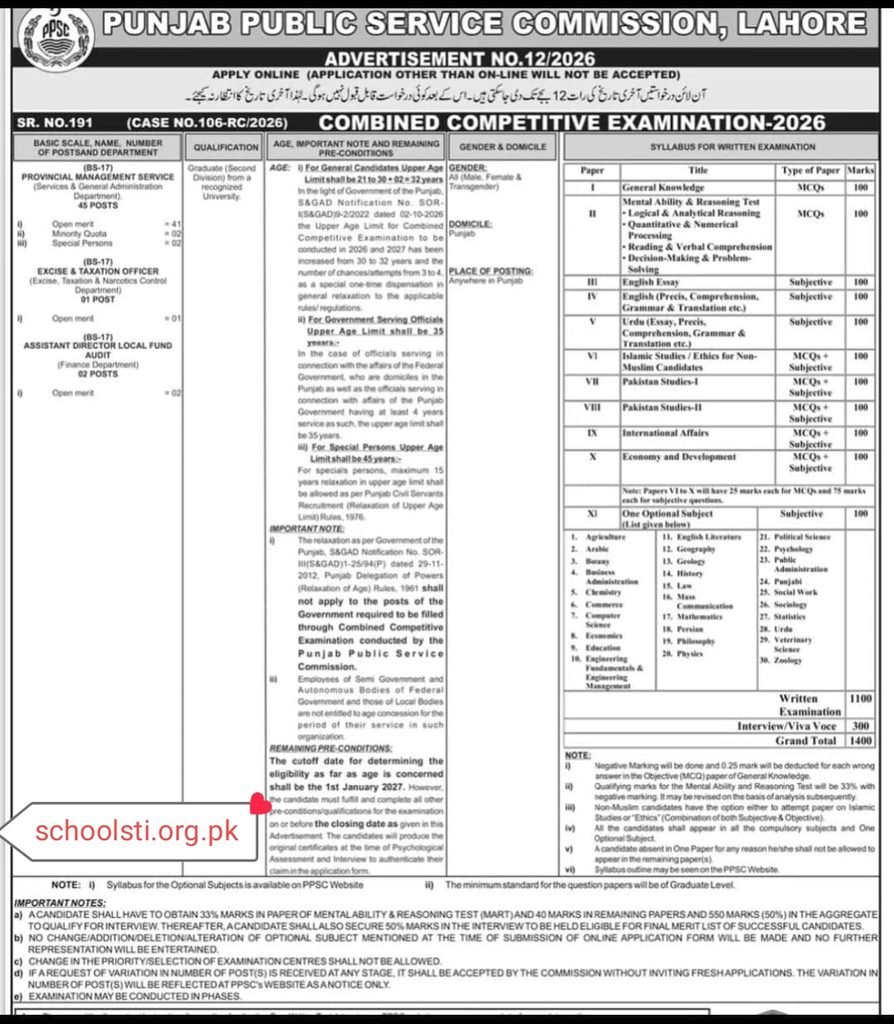
The Punjab Public Service Commission (PPSC) has officially released Advertisement No. 12/2026 (Case No. 106-RC/2026), announcing 48 BS-17 vacancies for the Combined Competitive Examination (CCE) 2026—commonly known as the Provincial Management Service (PMS) exam. Unlike previous exam cycles, the 2026 notification introduces a historic structural overhaul: total marks have shifted from 1,200 to 1,400 (1,100 written + 300 interview), compulsory subjects have expanded to 10 papers including a mandatory Mental Ability & Reasoning Test (MART), optional subjects have been reduced to a single 100-mark paper, and the upper age limit has been raised to 32 years with 4 permissible attempts.
For civil service aspirants across Punjab, understanding every clause of this notification is critical before submitting an online application or locking in an optional subject. Below is the complete, authoritative breakdown of Advertisement No. 12/2026, covering post allocations, age relaxations, the revamped exam syllabus, and passing thresholds.
Breakdown of Announced BS-17 Vacancies (Case No. 106-RC/2026)
Under Serial No. 191 of Advertisement No. 12/2026, PPSC has invited online applications from male, female, and transgender domicile holders of Punjab for 48 permanent BS-17 posts across three key provincial departments. Selected candidates can be posted anywhere in Punjab.
| Post Title (Basic Scale) | Parent Department | Total Posts | Open Merit | Minority Quota | Special Persons Quota |
|---|---|---|---|---|---|
| Provincial Management Service (BS-17) | Services & General Administration Department (S&GAD) | 45 | 41 | 02 | 02 |
| Excise & Taxation Officer (BS-17) | Excise, Taxation & Narcotics Control Department | 01 | 01 | — | — |
| Assistant Director Local Fund Audit (BS-17) | Finance Department | 02 | 02 | — | — |
| Total Announced Vacancies | All Participating Departments | 48 | 44 | 02 | 02 |
|
Eligibility Criteria, Age Limit Dispensation, and Pre-Conditions
Academic Qualification and Domicile
- Minimum Qualification: Candidates must hold at least a Graduate degree (Second Division) from a university recognized by the Higher Education Commission (HEC). The minimum academic standard for all query papers will be of Graduate Level.
- Gender & Domicile: Open to all (Male, Female, and Transgender) holding a valid domicile of any district in Punjab.
Upper Age Limit and the 2026–2027 Special Dispensation
The cutoff date for determining age eligibility is January 1, 2027. However, candidates must whole and fulfill all other academic pre-conditions and qualifications on or before the closing date of the advertisement.
- General Candidates (21 to 32 Years): In light of the Services and General Administration Department (S&GAD) Government of the Punjab Notification No. SOR-I(S&GAD)9-2/2022 dated 02-10-2026, the upper age limit for the Combined Competitive Examination conducted in 2026 and 2027 has been increased from 30 to 32 years (21 to 30 + 02 years). Furthermore, the maximum number of attempts/chances has been raised from 3 to 4 as a special one-period dispensation in overall relaxation of the applicable rules.
- Government Serving Officials (Up to 35 Years): Officials serving in connection with the affairs of the Federal Government who hold a Punjab domicile, as well as officials serving in connection with the affairs of the Punjab Government with at least 4 years of service as such, are granted an upper age limit of 35 years.
- Special Persons (Up to 45 Years): For differently-abled candidates, a maximum 15-twelve months relaxation in the upper age limit is allowed under the Punjab Civil Servants Recruitment (Relaxation of Upper Age Limit) Rules, 1976.
Important Exclusions on Age Relaxation
- No General Delegation Relaxation: The standard age relaxation under Government of the Punjab, S&GAD Notification No. SOR-I(S&GAD)1-25/94(P) dated 29-11-2012 (Punjab Delegation of Powers Relaxation of Age Rules, 1961) does not apply to posts filled through the Combined Competitive Examination conducted by PPSC.
- Semi-Government & Autonomous Bodies Excluded: Employees of Semi-Government organizations, Autonomous Bodies of the Federal or Provincial Government, and Local Bodies are not entitled to age concession for the period of their service in such organizations.
For candidates keeping track of broader provincial hiring updates alongside civil service exams, you can explore the latest government jobs and recruitment notifications in Punjab to ensure you not ever miss an active departmental deadline.
Complete CCE 2026 Examination Syllabus (1,400 Marks Structure)
The most transformative element of Advertisement No. 12/2026 is the completely restructured syllabus. PPSC has aligned the provincial exam toward analytical assessment and core governance subjects—similar to reforms debated by the Federal Public Service Commission (FPSC)—by introducing 10 compulsory papers (1,000 marks) and restricting optional subjects to just one paper (100 marks).
Compulsory Subjects (Papers I to X — 1,000 Marks)
| Paper | Subject Title | Paper Format & Breakdown | Marks |
|---|---|---|---|
| Paper I | General Knowledge | MCQs (Objective — 0.25 negative marking applies) | 100 |
| Paper II | Mental Ability & Reasoning Test (MART) |
• Logical & Analytical Reasoning
• Quantitative & Numerical Processing
• Reading & Verbal Comprehension
• Decision-Making & Problem-Solving | MCQs (Objective — 0.25 negative marking; 33% qualifying threshold) | 100 |
| Paper III | English Essay | Subjective | 100 |
| Paper IV | English (Precis, Comprehension, Grammar & Translation etc.) | Subjective | 100 |
| Paper V | Urdu (Essay, Precis, Comprehension, Grammar & Translation etc.) | Subjective | 100 |
| Paper VI | Islamic Studies / Ethics (for Non-Muslim Candidates) | MCQs (25 Marks) + Subjective (75 Marks) | 100 |
| Paper VII | Pakistan Studies-I | MCQs (25 Marks) + Subjective (75 Marks) | 100 |
| Paper VIII | Pakistan Studies-II | MCQs (25 Marks) + Subjective (75 Marks) | 100 |
| Paper IX | International Affairs | MCQs (25 Marks) + Subjective (75 Marks) | 100 |
| Paper X | Economy and Development | MCQs (25 Marks) + Subjective (75 Marks) | 100
|
Crucial Hybrid Paper Rule: In Papers VI through X, each paper carries 25 marks for MCQs (Objective) and 75 marks for Subjective questions. Non-Muslim candidates have the option either to attempt the paper on Islamic Studies or “Ethics” (both follow the combined Objective & Subjective format).
Optional Subject (Paper XI — 100 Marks)
Every candidate must select one (01) Optional Subject of 100 Marks (Subjective) from the 30 approved subjects listed below. Detailed syllabus outlines for optional subjects are hosted on the official Punjab Public Service Commission (PPSC) portal.
- Agriculture
- Arabic
- Botany
- Company Administration
- Chemistry
- Commerce
- Computer Science
- Economics
- Education
- Engineering Fundamentals & Engineering Management
- English Literature
- Geography
- Geology
- History
- Law
- Mass Communication
- Mathematics
- Persian
- Philosophy
- Physics
- Political Science
- Psychology
- General Administration
- Punjabi
- Social Work
- Sociology
- Statistics
- Urdu
- Veterinary Science
- Zoology
To sharpen your command over compulsory language papers and quantitative test components, utilizing structured online test preparation tools and English grammar guides can significantly boost your written score.
Comparison: Old PPSC PMS Pattern vs. New CCE 2026 Framework
To assist aspirants recalibrate their preparation strategy, the table below compares the legacy PPSC PMS examination framework against the newly notified CCE 2026 structure under Advertisement No. 12/2026.
| Feature / Parameter | Legacy PMS Exam Pattern | New CCE 2026 Pattern (Adv. No. 12/2026) |
|---|---|---|
| Compulsory Papers | 6 Papers (600 Marks) | 10 Papers (1,000 Marks) |
| Optional Papers | 3 Subjects / 600 Marks (200 marks each) | 1 Subject / 100 Marks (Subjective) |
| Total Written Marks | 1,200 Marks | 1,100 Marks |
| Interview / Viva Voce | 200 Marks | 300 Marks |
| Grand Total Marks | 1,400 Marks | 1,400 Marks |
| Aptitude / Reasoning Paper | None | Paper II: Mental Ability & Reasoning Test (100 MCQs) |
| Core Governance Additions | Covered briefly in GK/Pak Studies | Dedicated Papers: Pak Studies I & II, International Affairs, Economy & Development |
| Hybrid Papers (MCQ + Subjective) | Only Islamic Studies & Pak Studies | Papers VI, VII, VIII, IX, and X (25 Marks MCQs + 75 Marks Subjective each) |
| Upper Age Limit (General) | 30 Years | 32 Years (Special dispensation for 2026 & 2027) |
| Maximum Allowed Attempts | 3 Attempts | 4 Attempts (Special dispensation for 2026 & 2027) |
|
Qualifying Thresholds, Negative Marking, and Mandatory Rules
PPSC has laid out strict qualifying benchmarks and procedural rules at the lowest of Advertisement No. 12/2026. Missing even a single requirement results in automatic disqualification:
- Qualifying Marks in Written Examination:
- 33% Marks in Paper II: Mental Ability & Reasoning Test (MART) — Note: PPSC specifies that the 33% threshold for MART may be revised subsequently on the basis of post-exam statistical analysis.
- 40% Marks (40 out of 100) in each of the remaining written papers (Papers I and III through XI).
- 50% Aggregate Marks (550 out of 1,100) across all written papers to qualify for the Psychological Assessment and Interview.
- Interview Qualifying Threshold: Candidates must secure at least 50% marks (150 out of 300) in the Interview/Viva Voce to be eligible for the final merit series of successful candidates.
- Negative Marking: Negative marking of 0.25 mark is deducted for each mistaken solution in the Objective (MCQ) paper of General Knowledge (Paper I) and Mental Ability & Reasoning Test (Paper II).
- Compulsory Attendance Rule: All candidates must appear in all compulsory subjects and one optional subject. A candidate absent in any single paper for any motive will not be allowed to appear in the remaining papers.
- Irrevocable Application Selections:
- No modify, addition, deletion, or alteration of the Optional Subject mentioned at the duration of online application submission will be entertained.
- Change in the priority or selection of Examination Centres is strictly prohibited once submitted.
- Phased Execution & Post Variation: The examination may be conducted in phases. Additionally, if the Commission receives a departmental request to vary the number of posts at any stage, it will accept the variation via an official online platform notice without inviting fresh applications.
- Online Application Deadline: Applications must be submitted exclusively online by 12:00 Midnight on the closing date; no tough-copy or late applications are accepted.
Analysis
A deep-dive analysis of PPSC Advertisement No. 12/2026 reveals three major strategic shifts in how Punjab recruits its elite provincial bureaucracy:
- Elimination of the “Optional Subject Lottery”: Under the aged 600-mark optional system, candidates taking high-scoring technical or regional language subjects (such as Punjabi, Arabic, or Mathematics) frequently gained an insurmountable 120–150 mark advantage over candidates picking social sciences. By slashing optional weightage from 600 marks down to a single 100-mark paper, PPSC has leveled the playing field and ensured that core administrative knowledge determines merit.
- Alignment with Modern Governance Realities: Adding standalone 100-mark papers in International Affairs (Paper IX) and Economy and Development (Paper X), alongside splitting Pakistan Studies into Paper I and Paper II, forces every upcoming PMS Officer, ETO, and Audit Officer to master macroeconomic policy, fiscal management, and geopolitical dynamics rather than relying on rote memorization.
- Increased Interview Weightage (300 Marks) & Cognitive Screening: Raising the Viva Voce from 200 to 300 marks (now 21.4% of the 1,400 grand total) gives the PPSC panel significantly greater leverage to assess psychological suitability, leadership temperament, and communication clarity. Meanwhile, introducing the Mental Ability & Reasoning Test (MART) with negative marking acts as an analytical filter against pure cramming.
Opinion
From an expert civil service recruitment standpoint, the CCE 2026 overhaul in Advertisement No. 12/2026 is the most progressive reform PPSC has executed in over two decades. For years, aspirants had to juggle two wildly diverse preparation tracks for CSS and PMS—especially regarding optional subject combinations. By consolidating 91% of the written exam (1,000 out of 1,100 marks) into standardized compulsory subjects that heavily overlap with CSS core papers, PPSC has rewarded well-rounded, analytical readers over selective crammers.
Moreover, the one-period age relaxation to 32 years and 4 attempts for the 2026 and 2027 cycles is a timely, equitable intervention that protects thousands of seasoned aspirants whose preparation timelines were disrupted by administrative delays between exam cycles. To succeed under this recent regime, candidates should immediately stop obsessing over optional subject pairings and instead invest 80% of their study hours into English Essay/Precis, Economy & Development, International Affairs, and daily MCQ practice for the 25-mark objective sections embedded in Papers VI through X.
Frequently Asked Questions (FAQs)
1. What is the fresh upper age limit and attempt limit for PPSC CCE (PMS) 2026?
Under S&GAD Notification No. SOR-I(S&GAD)9-2/2022 dated October 2, 2026, the upper age limit for overall candidates has been increased from 30 to 32 years, and the maximum number of attempts has been increased from 3 to 4 attempts as a special dispensation for the 2026 and 2027 examinations. The age cutoff date is January 1, 2027.
2. How numerous optional subjects do candidates have to select in CCE 2026?
Candidates are now required to pick only one (01) optional subject worth 100 marks (Subjective) from a collection of 30 subjects, replacing the aged requirement of three optional subjects worth 600 marks.
3. Is there negative marking in the PPSC CCE 2026 written exam?
Yes. A deduction of 0.25 mark for each incorrect solution applies to the MCQs in Paper I (General Knowledge) and Paper II (Mental Ability & Reasoning Test).
4. What are the passing marks for the CCE 2026 written exam and interview?
Candidates must secure 33% marks in Paper II (Mental Ability & Reasoning Test), 40% marks in each of the remaining 10 written papers, and at least 50% aggregate marks (550 out of 1,100) to qualify for the interview. In the interview, candidates must score at least 50% (150 out of 300 marks) to be considered for final allocation.
5. Can I alter my optional subject or exam center after submitting the online form?
No. According to PPSC’s mandatory instructions in Advertisement No. 12/2026, no adjust, addition, or alteration of the optional subject or examination center priority will be entertained once the online application is submitted.
Conclusion
PPSC Advertisement No. 12/2026 marks a watershed moment for competitive examinations in Punjab. Although the total tally of 48 BS-17 vacancies makes competition fierce, the revised 1,400-mark syllabus ensures that every candidate is evaluated on a fair, transparent, and uniform academic standard. Verify your documents before the closing date, select your single 100-mark optional subject wisely before submitting your form on the PPSC portal, and focus your preparation on conceptual clarity across the 10 compulsory papers.