9TH CLASS BIOLOGY PAIRING SCHEME ALL PUNJAB BOARDS 2026
9TH CLASS BIOLOGY PAIRING SCHEME ALL PUNJAB BOARDS 2026
Contents
- 1 9th Class Biology Pairing Scheme 2026All Punjab Boards
- 1.1 Introduction: What Is the 9th Class Biology Pairing Scheme?
- 1.2 Which Punjab Boards Does This Scheme Cover?
- 1.3 9th Class Biology Paper Structure 2026 — Overview
- 1.4 Section A: MCQs Division 12 Marks
- 1.5 Section B: Short Questions Division 30 Marks
- 1.6 Section C: Long Questions Division 27 Marks — Attempt Any 2
- 1.7 Why Is the 9th Class Biology Pairing Scheme 2026 Important?
- 1.8 Top 5 Smart Study Tips Using This Pairing Scheme
- 1.9 Complete Marks Summary — 9th Class Biology Paper 2026
- 1.10 Trusted External Resources for 9th Class Biology 2026
- 1.11 Frequently Asked Questions (FAQs)
- 1.12 Conclusion
9th Class Biology Pairing Scheme 2026
All Punjab Boards
Complete chapter-wise MCQs, Short Questions & Long Questions distribution — officially based on PBCC Punjab Board pattern for BISE Lahore, Rawalpindi, Multan, Faisalabad & all other Punjab boards.
Introduction: What Is the 9th Class Biology Pairing Scheme?
The 9th Class Biology Pairing Scheme 2026 is an official chapter-wise paper pattern released by the Punjab Board Committee of Chairmen (PBCC). It tells students exactly how many MCQs, short questions, and long questions will be taken from each chapter of the 9th class Biology textbook in the annual board examination.
This scheme is identical across all nine Punjab boards — meaning whether you appear from Lahore, Rawalpindi, Faisalabad, Multan, Gujranwala, Sargodha, DG Khan, Bahawalpur, or Sahiwal, the paper pattern remains the same.
Instead of preparing all 11 chapters equally, the pairing scheme helps you focus on high-weight chapters, which saves precious revision time and dramatically improves your chances of scoring an A+ grade.
Which Punjab Boards Does This Scheme Cover?
All nine Punjab boards — BISE Lahore, BISE Gujranwala, BISE Sahiwal, BISE Sargodha, BISE Rawalpindi, BISE Faisalabad, BISE DG Khan, BISE Multan, and BISE Bahawalpur — follow the same 9th Biology pairing assessment scheme.
9th Class Biology Paper Structure 2026 — Overview
The Biology paper for 9th class consists of two main parts: Objective (MCQs) and Subjective (Short + Long Questions). Here is a quick summary of the overall marks breakdown:
| Section | Question Type | Total Questions | Attempt | Total Marks |
|---|---|---|---|---|
| Section A | MCQs (Objective) | 12 | All | 12 |
| Section B – Q#2 | Short Questions | 8 (5×2 marks) | Any 5 of 8 | 10 |
| Section B – Q#3 | Short Questions | 8 (5×2 marks) | Any 5 of 8 | 10 |
| Section B – Q#4 | Short Questions | 8 (5×2 marks) | Any 5 of 8 | 10 |
| Section C – Q#5 | Long Question | 1 (a+b) | Attempt | 9 |
| Section C – Q#6 | Long Question | 1 (a+b) | Attempt | 9 |
| Section C – Q#7 | Long Question | 1 (a+b) | Attempt | 9 |
| Grand Total | 75 Marks | |||
Section A: MCQs Division 12 Marks
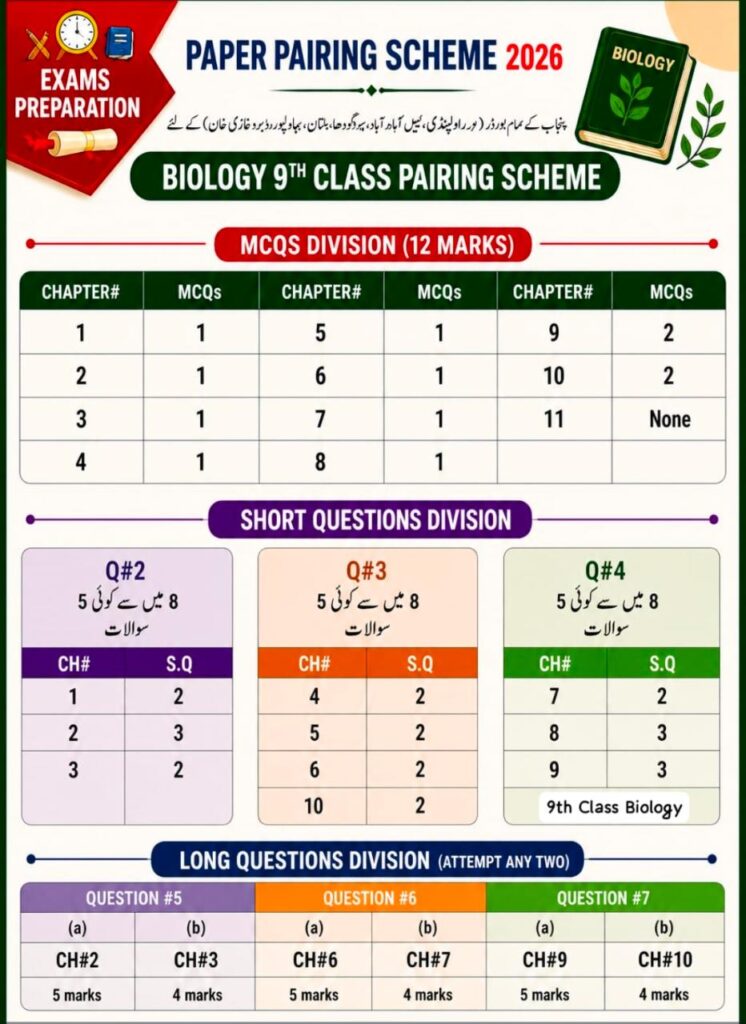
The objective section of the 9th Class Biology paper consists of 12 Multiple Choice Questions (MCQs). These are distributed across all 11 chapters of the textbook. Chapters 9 and 10 carry the highest MCQ weightage with 2 marks each, while Chapter 11 has no MCQ.
| Chapter # | Chapter Name | MCQs |
|---|---|---|
| 1 | Introduction to Biology | 1 |
| 2 | Solving a Biological Problem | 1 |
| 3 | Biodiversity | 1 |
| 4 | Cells and Tissues | 1 |
| 5 | Cell Cycle | 1 |
| 6 | Enzymes | 1 |
| 7 | Bioenergetics | 1 |
| 8 | Nutrition | 1 |
| 9 | Transport | 2 |
| 10 | Gaseous Exchange | 2 |
| 11 | Homeostasis | None |
| Total MCQs | 12 | |
Section B: Short Questions Division 30 Marks
Section B has three groups of short questions (Q#2, Q#3, and Q#4). In each group, 8 short questions are given and students must attempt any 5. Each short question carries 2 marks. Total marks from this section: 30.
Q#2 — Chapters 1, 2, 3
| Chapter # | Short Questions |
|---|---|
| Chapter 1 – Introduction to Biology | 2 |
| Chapter 2 – Solving a Biological Problem | 3 |
| Chapter 3 – Biodiversity | 2 |
| Total in Q#2 | 8 (Attempt 5) |
Q#3 — Chapters 4, 5, 6, 10
| Chapter # | Short Questions |
|---|---|
| Chapter 4 – Cells and Tissues | 2 |
| Chapter 5 – Cell Cycle | 2 |
| Chapter 6 – Enzymes | 2 |
| Chapter 10 – Gaseous Exchange | 2 |
| Total in Q#3 | 8 (Attempt 5) |
Q#4 — Chapters 7, 8, 9
| Chapter # | Short Questions |
|---|---|
| Chapter 7 – Bioenergetics | 2 |
| Chapter 8 – Nutrition | 3 |
| Chapter 9 – Transport | 3 |
| Total in Q#4 | 8 (Attempt 5) |
Section C: Long Questions Division 27 Marks — Attempt Any 2
Section C has three long questions (Q#5, Q#6, Q#7). Students must attempt any two. Each long question has two parts: part (a) for 5 marks and part (b) for 4 marks, totalling 9 marks per question.
| Question | Part (a) — Chapter | Marks | Part (b) — Chapter | Marks |
|---|---|---|---|---|
| Q#5 | Chapter 2 – Solving a Biological Problem | 5 | Chapter 3 – Biodiversity | 4 |
| Q#6 | Chapter 6 – Enzymes | 5 | Chapter 7 – Bioenergetics | 4 |
| Q#7 | Chapter 9 – Transport | 5 | Chapter 10 – Gaseous Exchange | 4 |
Why Is the 9th Class Biology Pairing Scheme 2026 Important?
The pairing scheme gives chapter-wise emphasis rather than full-book questions and helps students focus on important chapters and sections with higher weightage of marks. It also tells students how many questions — MCQs, short, and long — are in each part, saving time during revision before board exams.
- Allows you to identify the most important chapters and focus your revision smartly
- Saves time — no need to prepare every chapter with the same intensity
- Helps you understand the exact number of MCQs, short, and long questions per chapter
- Prevents last-minute panic by giving a clear roadmap before exams
- Valid for all nine Punjab boards — one scheme, all boards
- Directly aligned with the Punjab Board’s official PBCC paper pattern
- Helps both Science and Arts group students structure their preparation
Top 5 Smart Study Tips Using This Pairing Scheme
1. Prioritize High-Weightage Chapters First
Chapters 2, 8, 9, and 10 appear in multiple sections (MCQs + Short Questions + Long Questions). Dedicate more study hours to these chapters as they contribute the most marks.
2. Practice 5-out-of-8 Short Question Strategy
Since you only attempt 5 out of 8 in each short question group, prepare at least 6 questions from each group to have flexibility in the exam hall. Do not skip any chapter from the group entirely.
3. Master Two Long Questions Thoroughly
You only need to attempt two of the three long questions. Strategically choose your strongest two from Q#5, Q#6, Q#7 and practice their part (a) and part (b) separately.
4. Practice MCQs Daily
Since all 12 MCQs are compulsory, review definitions, diagrams, and key concepts from all chapters. Pay extra attention to Chapters 9 and 10 which carry 2 MCQs each. Refer to trusted resources like Punjab School Education Department for official syllabus details.
5. Download Notes and Past Papers
Combine your pairing scheme preparation with chapter notes and past papers from Schools STI to understand the exam pattern and question types over the years.
Complete Marks Summary — 9th Class Biology Paper 2026
| Section | Questions | Chapter Source | Marks |
|---|---|---|---|
| MCQs (Q#1) | 12 MCQs (All) | All 11 Chapters | 12 |
| Short Q#2 | 8, Attempt 5 | Ch. 1, 2, 3 | 10 |
| Short Q#3 | 8, Attempt 5 | Ch. 4, 5, 6, 10 | 10 |
| Short Q#4 | 8, Attempt 5 | Ch. 7, 8, 9 | 10 |
| Long Q#5 | Attempt 1 (a+b) | Ch. 2 + Ch. 3 | 9 |
| Long Q#6 | Attempt 1 (a+b) | Ch. 6 + Ch. 7 | 9 |
| Long Q#7 | Attempt 1 (a+b) | Ch. 9 + Ch. 10 | 9 |
| Grand Total | 75 Marks | ||
Trusted External Resources for 9th Class Biology 2026
- Punjab School Education Department (Official) — For official syllabus, policy updates, and examination notifications from the Government of Punjab.
- Punjab Textbook Board (PTBB) — Download the official 9th class Biology textbook, chapter outlines, and learning objectives from the source.
- BISE Lahore Official Website — Check official date sheets, roll number slips, and result notifications for 9th class annual exams 2026.
Frequently Asked Questions (FAQs)
Conclusion
The 9th Class Biology Pairing Scheme 2026 is one of the most powerful tools a Matric student can use to prepare smartly for board exams. With clear chapter-wise distribution of MCQs, short questions, and long questions, it removes guesswork and gives you a focused revision strategy.
This scheme is valid for all nine Punjab boards and is based on the official PBCC guidelines. By prioritizing high-weight chapters like 2, 6, 9, and 10, and practicing accordingly, you can significantly improve your Biology score in the annual examination 2026.
For more notes, guess papers, and educational resources tailored to Pakistani students, visit schoolsti.org.pk — your trusted partner in exam preparation.