Basic Pay Scale 2026 Annual Increment Rates (BPS-1 to BPS-22)
Basic Pay Scale 2026 Annual Increment Rates (BPS-1 to BPS-22): Official Chart, December 1 Calculation & Salary Impact
Every twelve months as winter approaches in Pakistan, millions of federal and provincial civil servants—from primary institution teachers and clerical staff to senior administrative officers—ask the exact equivalent query: “How much will my salary increase on December 1st?”
Following the introduction of the Revised Basic Pay Scales 2026 (BPS-2026) via Finance Division Office Memorandum No. F.1(2)Imp/2026 dated July 21, 2026 (effective July 1, 2026), the annual increment rates across all 22 grades have been significantly revised upward. Since the government officially merged two previous relief allowances—the Ad-hoc Relief Allowance 2022 (15%) and the Ad-hoc Relief Allowance 2025 (10%)—directly into the running basic pay, the baseline for annual increments jumped by approximately 20.1% to 21.3% across all scales.
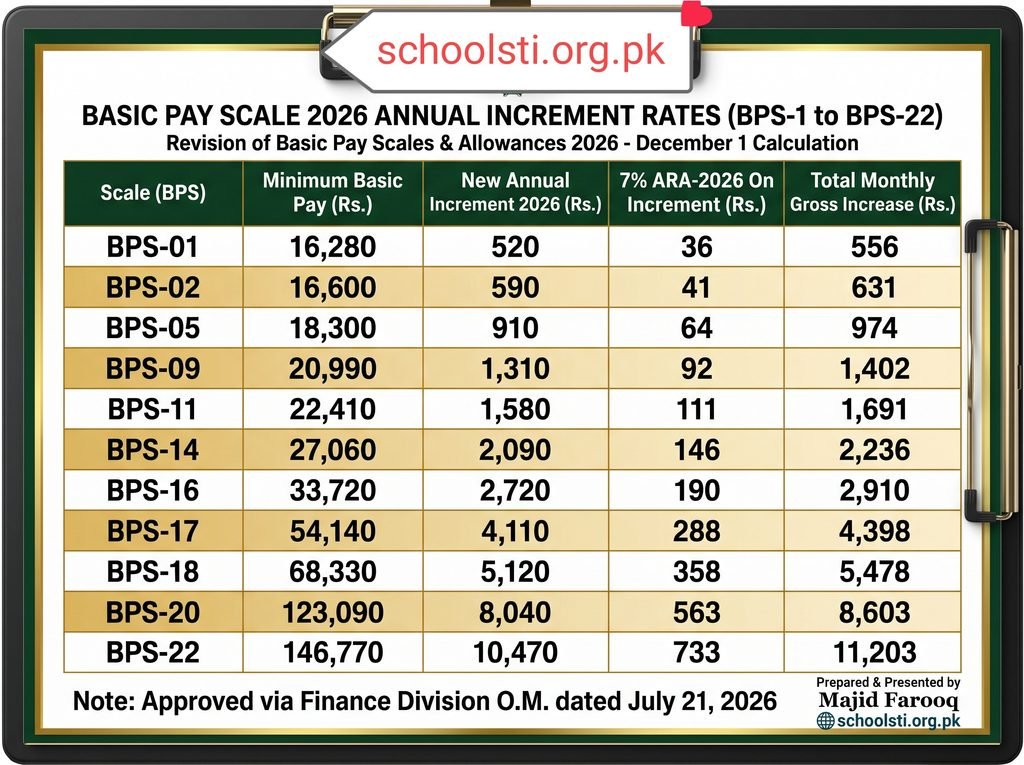
Under the revised Basic Pay Scale 2026, the recent annual increment added on December 1 ranges from Rs. 520 per month for BPS-1 up to Rs. 10,470 per month for BPS-22. Furthermore, as the 7% Ad-hoc Relief Allowance 2026 (ARA-2026) is calculated on your running basic pay, your December 1 annual increment automatically triggers an additional 7% expand on the increment amount itself, giving your net monthly take-home pay an extra compounding boost.
Complete Basic Pay Scale 2026 Annual Increment Chart (BPS-1 to BPS-22)
To aid administration employees, Drawing and Disbursing Officers (DDOs), and accounts personnel verify December salary slips accurately, the table below presents the full, official BPS-2026 Annual Increment Rates alongside the minimum basic pay, maximum ceiling, total stages, and the actual monthly financial gain (including the 7% ARA-2026 effect).
| Scale (BPS) | Minimum Basic Pay (Rs.) | New Annual Increment 2026 (Rs.) | Maximum Basic Pay (Rs.) | Total Stages | 7% ARA-2026 Rise on Increment (Rs.) | Total Monthly Gross Increase on Dec 1 (Rs.) |
|---|---|---|---|---|---|---|
| BPS-01 | 16,280 | 520 |
| 31,880 | 30 | 36 | 556 |
| BPS-02 | 16,600 | 590
| 34,300 | 30 | 41 | 631 |
| BPS-03 | 17,130 | 700
| 38,130 | 30 | 49 | 749 |
| BPS-04 | 17,650 | 800
| 41,650 | 30 | 56 | 856 |
| BPS-05 | 18,300 | 910
| 45,600 | 30 | 64 | 974 |
| BPS-06 | 18,930 | 1,010
| 49,230 | 30 | 71 | 1,081 |
| BPS-07 | 19,590 | 1,100
| 52,590 | 30 | 77 | 1,177 |
| BPS-08 | 20,290 | 1,210
| 56,590 | 30 | 85 | 1,295 |
| BPS-09 | 20,990 | 1,310
| 60,290 | 30 | 92 | 1,402 |
| BPS-10 | 21,680 | 1,430
| 64,580 | 30 | 100 | 1,530 |
| BPS-11 | 22,410 | 1,580
| 69,810 | 30 | 111 | 1,691 |
| BPS-12 | 23,750 | 1,720
| 75,350 | 30 | 120 | 1,840 |
| BPS-13 | 25,420 | 1,880
| 81,820 | 30 | 132 | 2,012 |
| BPS-14 | 27,060 | 2,090
| 89,760 | 30 | 146 | 2,236 |
| BPS-15 | 28,730 | 2,380
| 100,130 | 30 | 167 | 2,547 |
| BPS-16 | 33,720 | 2,720
| 115,320 | 30 | 190 | 2,910 |
| BPS-17 | 54,140 | 4,110
| 136,340 | 20 | 288 | 4,398 |
| BPS-18 | 68,330 | 5,120
| 170,730 | 20 | 358 | 5,478 |
| BPS-19 | 105,510 | 5,450
| 214,510 | 20 | 382 | 5,832 |
| BPS-20 | 123,090 | 8,040
| 235,650 | 14 | 563 | 8,603 |
| BPS-21 | 136,680 | 8,920
| 261,560 | 14 | 624 | 9,544 |
| BPS-22 | 146,770 | 10,470
| 293,350 | 14 | 733 | 11,203 |
Note: If an employee is also eligible for the Disparity Reduction Allowance (DRA-2026 at 15% of BPS-2026 Basic Pay), their monthly gross salary increase on December 1 will be even higher. If you desire to check your exact stage-wise basic salary before adding the December increment, you can review the full Revised Pay Scale 2026 guide for point-to-point stage fixation tables.
Understanding the Mechanics of the BPS-2026 Annual Increment
An Annual Increment is a guaranteed, statutory yearly step-up in a state servant’s basic pay. Rather than leaving annual progression to discretionary performance bonuses, Pakistan’s civil service framework utilizes a structured “Stage” ladder:
- BPS-01 to BPS-16: Consist of 30 incremental stages above the initial minimum basic pay.
- BPS-17 to BPS-19: Consist of 20 incremental stages above the minimum basic pay.
- BPS-20 to BPS-22: Consist of 14 incremental stages above the minimum basic pay.
Why Did the Annual Increment Increase in 2026?
Until December 1, 2025, government employees received their annual increment based on the BPS-2022 chart. Nevertheless, when the Finance Division of Pakistan issued the Revision of Basic Pay Scales & Allowances 2026 on July 21, 2026, it dissolved the standalone Ad-hoc Relief Allowances of 2022 (15%) and 2025 (10%) and folded them into the basic pay structure.
As the core pay scale expanded by roughly 20.1%, the distance between each stage (the annual increment) was proportionally enlarged. This structural revision applies uniformly across federal ministries as well as provincial employees under the Finance Department, Government of the Punjab, Sindh, Khyber Pakhtunkhwa, and Balochistan.
Core Service Rules for the December 1 Increment
Under the Civil Servants Pay Revision Rules, the annual increment is governed by four strict administrative conditions:
- The Date of Accrual: The annual increment accrues exclusively on 1st December each twelve months for all eligible civil servants across Pakistan.
- The 6-Month Qualifying Rule: To earn the increment on December 1, an employee must have completed at least six (6) months of actual service at their current pay scale stage during that calendar year. Any employee newly appointed or promoted on or before June 1 qualifies for the December 1 increment of that equivalent twelve months. Anyone appointed or promoted between June 2 and November 30 must wait until December 1 of the following calendar twelve months for their earliest increment in that scale.
- Personal Pay Beyond Stage Ceiling: If a veteran employee has already reached Stage 30 (the maximum ceiling of their scale, such as Rs. 69,810 for BPS-11), their increments do not stop. They continue to get the exact equivalent annual increment (Rs. 1,580 for BPS-11) every December 1 as Personal Pay, which counts toward pension and running basic pay allowances.
- Effect of Extraordinary Leave (EOL): Periods spent on Extraordinary Leave without pay do not count toward the 6-month qualifying service requirement unless specifically condoned by the competent authority.
Comparison Section: BPS-2022 vs. BPS-2026 Annual Increment Rates
To truly appreciate how considerable the BPS-2026 revision impacts long-term career earnings and retirement benefits, we must compare the newly implemented 2026 increment rates against the previous BPS-2022 rates.
In the table below, you can see the exact rupee difference and percentage jump for every single grade from BPS-1 to BPS-22:
| Grade (BPS) | Old Annual Increment (BPS-2022) | New Annual Increment (BPS-2026) | Net Increment Increase (Rs./Month) | Percentage Growth (%) | Annualized Extra Gain (12 Months) |
|---|---|---|---|---|---|
| BPS-01 | Rs. 430 | Rs. 520 |
| +Rs. 90 | +20.93% | Rs. 1,080 |
| BPS-02 | Rs. 490 | Rs. 590
| +Rs. 100 | +20.41% | Rs. 1,200 |
| BPS-03 | Rs. 580 | Rs. 700
| +Rs. 120 | +20.69% | Rs. 1,440 |
| BPS-04 | Rs. 660 | Rs. 800
| +Rs. 140 | +21.21% | Rs. 1,680 |
| BPS-05 | Rs. 750 | Rs. 910
| +Rs. 160 | +21.33% | Rs. 1,920 |
| BPS-06 | Rs. 840 | Rs. 1,010
| +Rs. 170 | +20.24% | Rs. 2,040 |
| BPS-07 | Rs. 910 | Rs. 1,100
| +Rs. 190 | +20.88% | Rs. 2,280 |
| BPS-08 | Rs. 1,000 | Rs. 1,210
| +Rs. 210 | +21.00% | Rs. 2,520 |
| BPS-09 | Rs. 1,090 | Rs. 1,310
| +Rs. 220 | +20.18% | Rs. 2,640 |
| BPS-10 | Rs. 1,190 | Rs. 1,430
| +Rs. 240 | +20.17% | Rs. 2,880 |
| BPS-11 | Rs. 1,310 | Rs. 1,580
| +Rs. 270 | +20.61% | Rs. 3,240 |
| BPS-12 | Rs. 1,430 | Rs. 1,720
| +Rs. 290 | +20.28% | Rs. 3,480 |
| BPS-13 | Rs. 1,560 | Rs. 1,880
| +Rs. 320 | +20.51% | Rs. 3,840 |
| BPS-14 | Rs. 1,740 | Rs. 2,090
| +Rs. 350 | +20.11% | Rs. 4,200 |
| BPS-15 | Rs. 1,980 | Rs. 2,380
| +Rs. 400 | +20.20% | Rs. 4,800 |
| BPS-16 | Rs. 2,260 | Rs. 2,720
| +Rs. 460 | +20.35% | Rs. 5,520 |
| BPS-17 | Rs. 3,420 | Rs. 4,110
| +Rs. 690 | +20.18% | Rs. 8,280 |
| BPS-18 | Rs. 4,260 | Rs. 5,120
| +Rs. 860 | +20.19% | Rs. 10,320 |
| BPS-19 | Rs. 4,530 | Rs. 5,450
| +Rs. 920 | +20.31% | Rs. 11,040 |
| BPS-20 | Rs. 6,690 | Rs. 8,040
| +Rs. 1,350 | +20.18% | Rs. 16,200 |
| BPS-21 | Rs. 7,420 | Rs. 8,920
| +Rs. 1,500 | +20.22% | Rs. 18,000 |
| BPS-22 | Rs. 8,710 | Rs. 10,470
| +Rs. 1,760 | +20.21% | Rs. 21,120 |
Key Takeaways from the 2022 vs. 2026 Comparison
- Support & Clerical Cadres (BPS-01 to BPS-05): Received the highest proportional percentage boost in annual increments, peaking at +21.33% for BPS-05 (rising from Rs. 750 to Rs. 910) and +21.21% for BPS-04 (rising from Rs. 660 to Rs. 800).
- Teaching & Supervisory Cadres (BPS-14 to BPS-16): Primary, Elementary, and Secondary School Educators (PSTs, ESTs, and SSTs) see substantial relief. A BPS-14 educator now gets Rs. 2,090 instead of Rs. 1,740, while a BPS-16 officer/teacher receives Rs. 2,720 instead of Rs. 2,260. For regular updates on educator service rules, promotions, and departmental announcements, visit the Schools STI Educational Notifications & News portal.
- Gazetted Officers (BPS-17 to BPS-22): The absolute rupee jump widens significantly at the officer degree, with BPS-17 crossing the four-thousand mark (Rs. 4,110) and BPS-22 crossing ten thousand rupees (Rs. 10,470) per single annual increment.
Step-by-Step Worked Examples: How to Calculate Your December 1 Salary
Many state employees mistakenly believe that their monthly salary on December 1 only increases by the exact figure shown on the increment chart. In reality, your Running Basic Pay drives dynamic allowances. Let’s walk through two actual-world payslip calculations verified through the Controller General of Accounts (CGA) payroll formula.
Worked Example 1: Secondary School Teacher / Superintendent (BPS-16)
Suppose an employee in BPS-16 is currently at Stage 6 of the 2026 pay scale in November 2026.
- Minimum Basic Pay (BPS-16): Rs. 33,720
- Annual Increment Rate (BPS-16): Rs. 2,720
- November 2026 Basic Pay (Stage 6): $\text{Rs. } 33,720 + (6 \times \text{Rs. } 2,720) = \text{Rs. } 50,040$
- November 2026 ARA-2026 (7% of Basic): $7% \text{ of Rs. } 50,040 = \text{Rs. } 3,503$
What Happens on December 1, 2026 (Moving to Stage 7):
- New Basic Pay (Stage 7): $\text{Rs. } 50,040 + \text{Rs. } 2,720 = \mathbf{\text{Rs. } 52,760}$
- Revised ARA-2026 (7% of New Basic): $7% \text{ of Rs. } 52,760 = \mathbf{\text{Rs. } 3,693}$ (an increase of Rs. 190)
- Total Monthly Salary Increase: $\text{Rs. } 2,720 \text{ (Increment)} + \text{Rs. } 190 \text{ (ARA boost)} = \mathbf{\text{Rs. } 2,910\text{/month}}$
- Total Cumulative Gain over 12 Months: $\text{Rs. } 2,910 \times 12 = \mathbf{\text{Rs. } 34,920\text{/year}}$
Worked Example 2:Newly Appointed or Promoted Officer (BPS-17) & The June 1 Cutoff
Suppose two Subject Specialists or Assistant Directors (BPS-17, Minimum Basic Pay Rs. 54,140, Annual Increment Rs. 4,110) join service or obtain promoted in mid-2026:
- Officer A joins on May 28, 2026: By December 1, 2026, Officer A has completed more than 6 months of service. Their Basic Pay jumps from Rs. 54,140 (Stage 0) to Rs. 58,250 (Stage 1) on December 1, 2026, plus a Rs. 288 grow in ARA-2026, yielding Rs. 4,398 extra per month.
- Officer B joins on June 10, 2026: Because June 10 to December 1 is less than the mandatory 6-month threshold, Officer B remains at Rs. 54,140 on December 1, 2026, and will get their earliest annual increment of Rs. 4,110 on December 1, 2027.
Which Allowances Change and Which Stay Frozen on December 1?
- Allowances That Increase Automatically:
- Basic Pay / Personal Pay: Increases by the exact BPS-2026 increment amount.
- Ad-hoc Relief Allowance 2026 (ARA-2026 @ 7%): Increases by 7% of the annual increment since it is tied to running basic pay.
- Disparity Reduction Allowance 2026 (DRA-2026 @ 15%): For eligible civil servants not drawing special departmental allowances, if linked to running basic pay, it adjusts accordingly; otherwise, check your department’s particular DDO fixation.
- Allowances That Remain Unchanged:
- House Rent Allowance (HRA): Remains frozen at the pre-existing degree.
- Conveyance Allowance: Fixed according to BPS slabs (revised by +50% in July 2026, e.g., Rs. 2,550 for BPS 1–4; Rs. 2,760 for BPS 5–10; Rs. 4,080 for BPS 11–15; and Rs. 7,500 for BPS 16–22) and does not modify with December increments.
- Medical Allowance: Fixed slab rate; unaffected by stage increments.
Analysis
A shut examination of the Basic Pay Scale 2026 Annual Increment structure reveals four vital financial and administrative takeaways for Pakistan’s open sector workforce:
- Uniform ~20.2% Expansion Across the Board: By merging the 15% ARA-2022 and 10% ARA-2025 into the 2022 basic scales, the authority elevated both the floor (minimum pay) and the step size (annual increment) by a consistent 20.11% to 21.33%. Unlike ad-hoc allowances that remain stagnant or frozen on past scales, a higher annual increment permanently accelerates basic pay growth every December.
- Compounding Effect on Running Allowances: Because the 7% ARA-2026 is levied on running basic pay rather than frozen at initial fixation, every December 1 increment carries a built-in 7% multiplier. For a BPS-16 employee, a Rs. 2,720 increment actually puts Rs. 2,910 into their gross pay; for a BPS-19 officer, a Rs. 5,450 increment translates to Rs. 5,832 per month.
- Major Boost to Pensionable Emoluments: Ad-hoc relief allowances do not directly count toward pension calculation until they are merged into basic pay. By embedding previous ad-hoc reliefs into the BPS-2026 chart, every December increment of Rs. 1,580 (BPS-11), Rs. 2,720 (BPS-16), or Rs. 5,120 (BPS-18) directly enlarges the employee’s last drawn basic pay, significantly increasing gratuity and monthly pension for employees retiring between December 2026 and June 2027.
- Widening Gap Between Lower and Upper Tiers: While the percentage expand is uniform (~20.2%), the absolute rupee gap remains steep. A BPS-01 employee gains Rs. 520 per year in basic pay, whereas a BPS-22 officer gains Rs. 10,470—more than 20 times the rupee value of the lowest tier.
Opinion
From a general finance and human resource perspective, the Revision of Basic Pay Scales 2026 is a welcome and long-overdue structural correction, though it stops short of comprehensive civil service compensation reform.
For four consecutive years (2022–2025), authority employees watched inflation erode their real purchasing power while the state relied on temporary “Ad-hoc Relief Allowances” rather than revising the underlying Basic Pay Scale chart. While ad-hoc allowances supply immediate cash relief in July, they freeze the annual December increment at outdated levels, penalizing long-serving employees and distorting pension calculations. Merging the 2022 and 2025 allowances to develop BPS-2026 restores integrity to the basic pay ladder.
Nonetheless, our expert verdict highlights two areas that still require policy intervention from the Ministry of Finance:
- Unfreezing House Rent & Medical Allowances: Even as basic pay and annual increments rise by 20%+, House Rent Allowance remains tethered to obsolete historical benchmarks. Linking HRA and Medical Allowance to the revised BPS-2026 running basic pay is essential for lower- and middle-grade employees (BPS-01 to BPS-15) struggling with urban housing and healthcare costs.
- Performance-Linked Progression: Currently, the December 1 increment is awarded automatically based on period served (the 6-month rule) rather than classroom outcomes or administrative efficiency. Moving forward, retaining the guaranteed inflation-adjusted annual increment while introducing an additional Merit Increment for top-performing teachers, healthcare workers, and civil servants would modernize Pakistan’s open sector and reward genuine excellence.
Frequently Asked Questions (FAQs)
1. When will the new BPS-2026 annual increment be added to state employees’ salaries?
The new BPS-2026 annual increment accrues officially on December 1, 2026. It will be reflected in the December 2026 salary slip, which is disbursed to federal and provincial government employees at the beginning of January 2027.
2. What is the fresh annual increment for BPS-14, BPS-15, and BPS-16 in 2026?
Under the Revised Basic Pay Scale 2026 chart, the annual increment is Rs. 2,090 for BPS-14, Rs. 2,380 for BPS-15, and Rs. 2,720 for BPS-16. When you incorporate the automatic 7% ARA-2026 increase on the increment, the total monthly rise is Rs. 2,236 (BPS-14), Rs. 2,547 (BPS-15), and Rs. 2,910 (BPS-16).
3. If I was appointed or promoted in July 2026, will I obtain the annual increment on December 1, 2026?
No. Under civil service fixation rules, an employee must whole at least 6 months of service in their current scale before December 1 to qualify for the annual increment. Since July 1 to December 1 is only 5 months, you will receive your initial annual increment in the modern scale on December 1, 2027. Only employees appointed or promoted on or before June 1, 2026, qualify for the December 1, 2026 increment.
4. What happens if an employee has already reached Stage 30 (Maximum Basic Pay) of their scale?
If you have already reached the maximum stage of your pay scale (Stage 30 for BPS 1–16, Stage 20 for BPS 17–19, or Stage 14 for BPS 20–22), you will still obtain your full annual increment on December 1. On your payslip, this amount is recorded under a separate head called “Personal Pay,” which is treated as part of your basic pay for ARA-2026 and pension calculations.
5. Does the BPS-2026 annual increment chart apply to both Federal and Provincial (Punjab, Sindh, KP, Balochistan) employees?
Yes. The Basic Pay Scale 2026 chart—including minimum pay, annual increment rates from BPS-1 (Rs. 520) to BPS-22 (Rs. 10,470), and maximum pay ceilings—is standardized across the Federal Government and all Provincial Governments (Punjab, Sindh, KP, and Balochistan).
Conclusion
The Basic Pay Scale 2026 Annual Increment chart marks a pivotal milestone for administration employees across Pakistan. By replacing the outdated 2022 rates with a ~20.2% higher increment structure—ranging from Rs. 520 for BPS-01 to Rs. 10,470 for BPS-22—the December 1 increment now delivers meaningful, compounding growth in both monthly take-home pay and long-term pensionable emoluments.
As December approaches, take five minutes to inspect your November payslip, note your current BPS Stage, and add your scale’s 2026 Annual Increment plus 7% ARA-2026 using the tables above. Verifying your stage fixation early ensures your December salary slip is 100% accurate and free from accounting anomalies.