Daanish Schools Authority Test Syllabus & Content Weightages
Daanish Schools Authority Test Syllabus & Content Weightages: Comprehensive Guide
Securing a leadership or teaching position under the Daanish Schools Authority—operating under the Ministry of Federal Education & Professional Training, Government of Pakistan—is among the most competitive career milestones for educators in Pakistan. To establish merit-based selection, the testing authority uses a standardized 100 Multiple Choice Questions (MCQs) framework.
Whether applying for the position of School Principal or a specialized Subject Specialist/Teacher role (such as Mathematics, English, Computer Science, or Montessori), mastering the officially approved syllabus distribution is the key to qualifying. This guide breaks down the approved test patterns, weightages, strategic preparation plans, and comparative analysis to streamline exam preparation.
Universal Test Structure: The Core Foundation
Across nearly all teaching disciplines—from STEM to Humanities—the examination maintains a uniform baseline structure:
- Total Questions: 100 MCQs
- Verbal Reasoning (English Comprehension & Grammar): 20%
- Analytical Reasoning (Logical & Critical Thinking): 10%
- Pedagogy & Teaching Methodology: 10%
- Core Subject Specialization: 60%
(Note: Administrative roles like Principal allocate 70% toward institutional governance, leadership, and policy).
Because 40% of the entire paper consists of general cognitive and professional competencies across all teaching posts, candidates who prepare only their subject discipline frequently fall short. A balanced approach across both sections is essential. For the latest employment notices and departmental criteria, visit the official Ministry of Federal Education & Professional Training portal.
Approved Post-Wise Test Weightages & Subject Breakdowns
1. Principal / School Administration
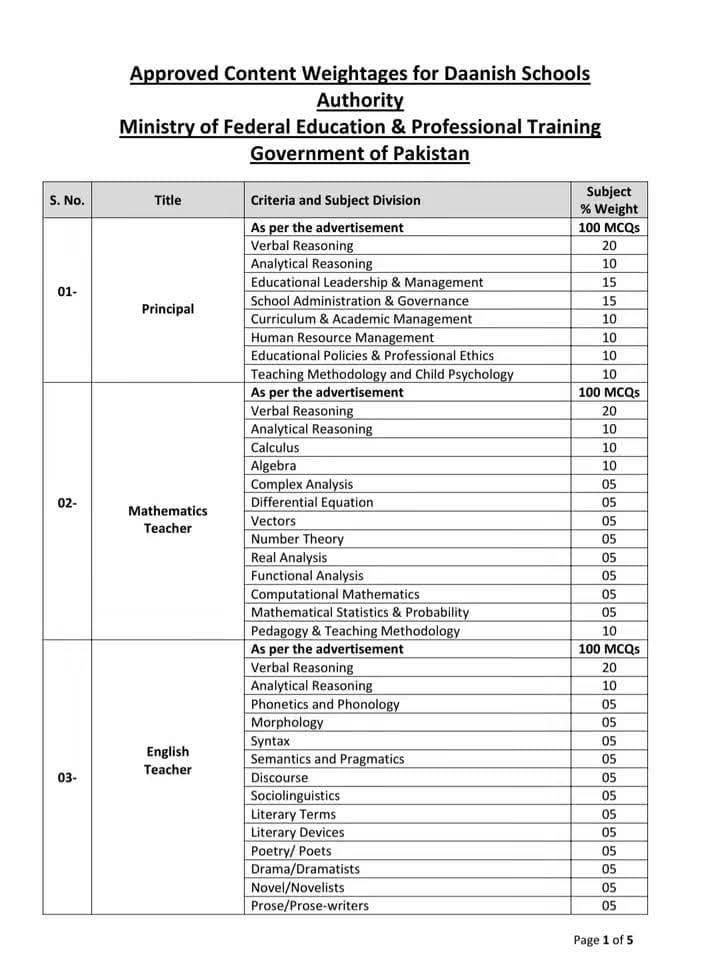
The Principal test evaluates institutional governance, institution leadership, and educational psychology rather than single-subject mastery:
| Criteria & Subject Division | Weightage (%) |
|---|---|
| Verbal Reasoning | 20% |
|
| Analytical Reasoning | 10%
|
| Educational Leadership & Management | 15%
|
| School Administration & Governance | 15%
|
| Curriculum & Academic Management | 10%
|
| Human Resource Management (HRM) | 10%
|
| Educational Policies & Professional Ethics | 10%
|
| Teaching Methodology & Child Psychology | 10%
|
For candidates targeting broader academic leadership positions, explore our comprehensive breakdown on schoolsti.org.pk teacher hiring and administration criteria to grasp institutional expectations.
2. Mathematics Teacher
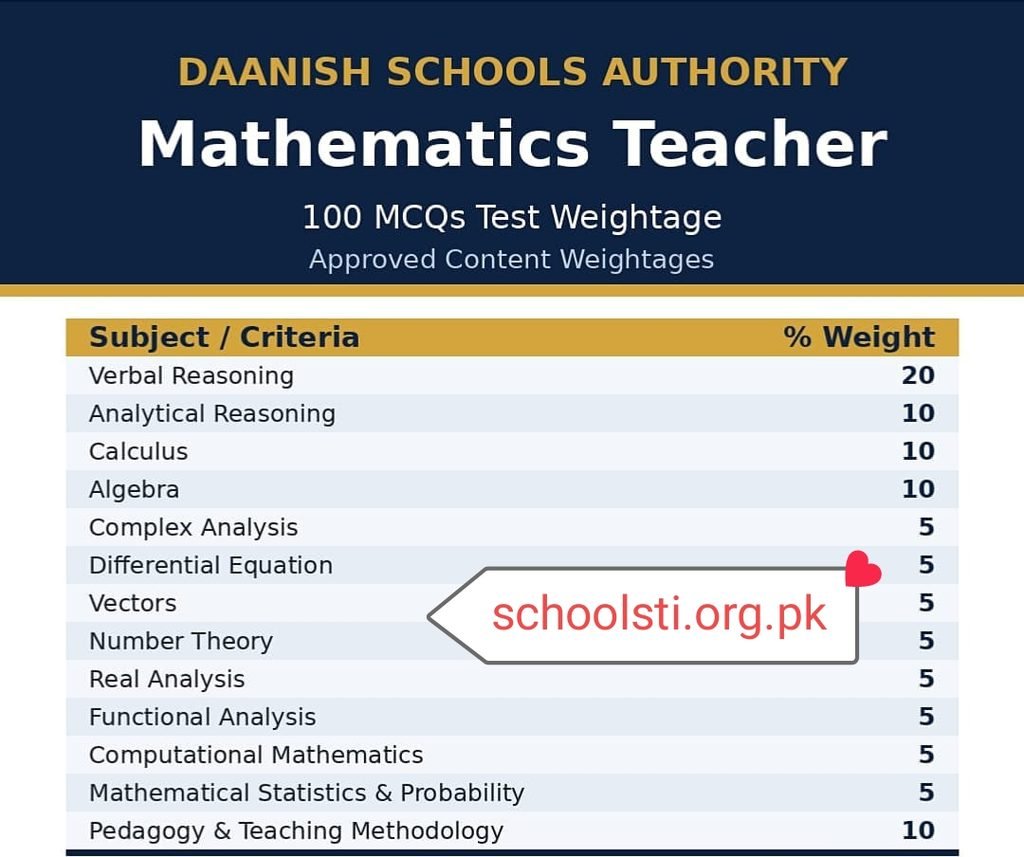
The syllabus requires advanced conceptual proficiency spanning undergraduate and graduate-stage mathematics[cite: 1, 4]:
| Subject / Criteria | Weightage (%) |
|---|---|
| Verbal Reasoning | 20%[cite: 1, 4] |
| Analytical Reasoning | 10%[cite: 1, 4] |
| Calculus | 10%[cite: 1, 4] |
| Algebra (Linear & Abstract) | 10%[cite: 1, 4] |
| Complex Analysis | 5%[cite: 1, 4] |
| Differential Equations | 5%[cite: 1, 4] |
| Vectors | 5%[cite: 1, 4] |
| Number Theory | 5%[cite: 1, 4] |
| Real Analysis | 5%[cite: 1, 4] |
| Functional Analysis | 5%[cite: 1, 4] |
| Computational Mathematics / Numerical Analysis | 5%[cite: 1, 4] |
| Mathematical Statistics & Probability | 5%[cite: 1, 4] |
| Pedagogy & Teaching Methodology | 10%[cite: 1, 4] |
3. English Teacher
The English instructor evaluation balances formal linguistics with classic and modern literature:
- Linguistics Modules (30% total): Phonetics and Phonology (5%), Morphology (5%), Syntax (5%), Semantics & Pragmatics (5%), Discourse Analysis (5%), Sociolinguistics (5%).
- Literature Modules (30% total): Literary Terms (5%), Literary Devices (5%), Poetry & Major Poets (5%), Drama & Dramatists (5%), Novel & Novelists (5%), Prose & Prose-Writers (5%).
- Cognitive & Teaching Framework (40% total): Verbal Reasoning (20%), Analytical Reasoning (10%), Pedagogy (10%).
To verify academic testing standards aligned with national guidelines, consult the curriculum frameworks published by the Higher Education Commission of Pakistan (HEC).
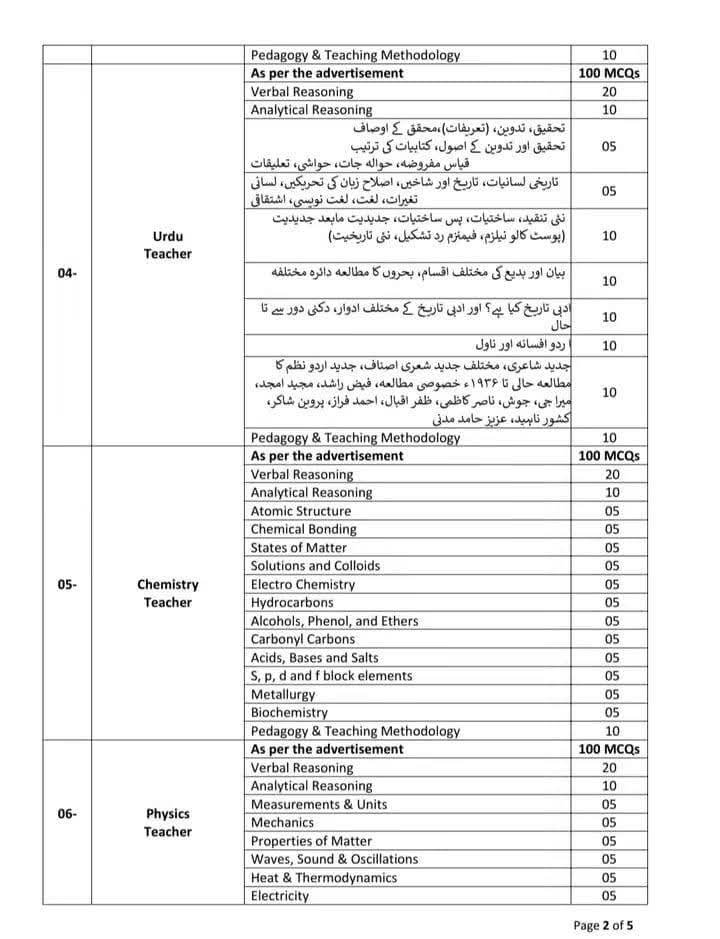
4. Natural Sciences (Physics, Chemistry, Biology)
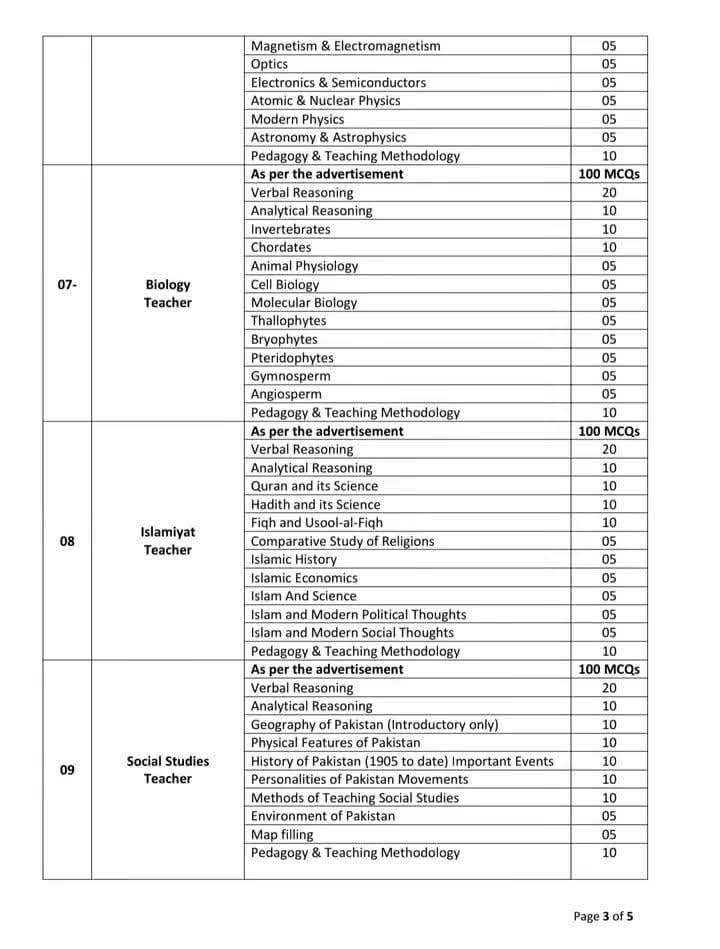
The pure sciences assess core conceptual and applied foundations[cite: 2, 5]:
+---------------------------------------------------------------------------------+
|                       NATURAL SCIENCES BREAKDOWN (60% CORE)                     |
+------------------------------------+--------------------------------------------+
| Physics                            | Measurements & Units (5%), Mechanics (5%), |
|                                    | Properties of Matter (5%), Waves & Sound   |
|                                    | (5%), Heat & Thermodynamics (5%),          |
|                                    | Electricity (5%), Magnetism (5%), Optics   |
|                                    | (5%), Electronics (5%), Modern Physics(5%) |
|                                    | Astronomy & Astrophysics (5%)              |
+------------------------------------+--------------------------------------------+
| Chemistry                          | Atomic Structure, Bonding, States of       |
|                                    | Matter, Solutions & Colloids, Electro-     |
|                                    | chemistry, Hydrocarbons, Alcohols/Phenols, |
|                                    | Carbonyls, Acids & Bases, s/p/d/f Blocks,  |
|                                    | Metallurgy, Biochemistry (5% each)         |
+------------------------------------+--------------------------------------------+
| Biology                            | Invertebrates (10%), Chordates (10%),      |
|                                    | Animal Physiology (5%), Cell Biology (5%), |
|                                    | Molecular Biology (5%), Plant Taxonomies:  |
|                                    | Thallophytes, Bryophytes, Pteridophytes,   |
|                                    | Gymnosperms, Angiosperms (5% each)         |
+------------------------------------+--------------------------------------------+
(All science posts retain the standard 20% Verbal Reasoning, 10% Analytical Reasoning, and 10% Pedagogy framework[cite: 2, 5]).
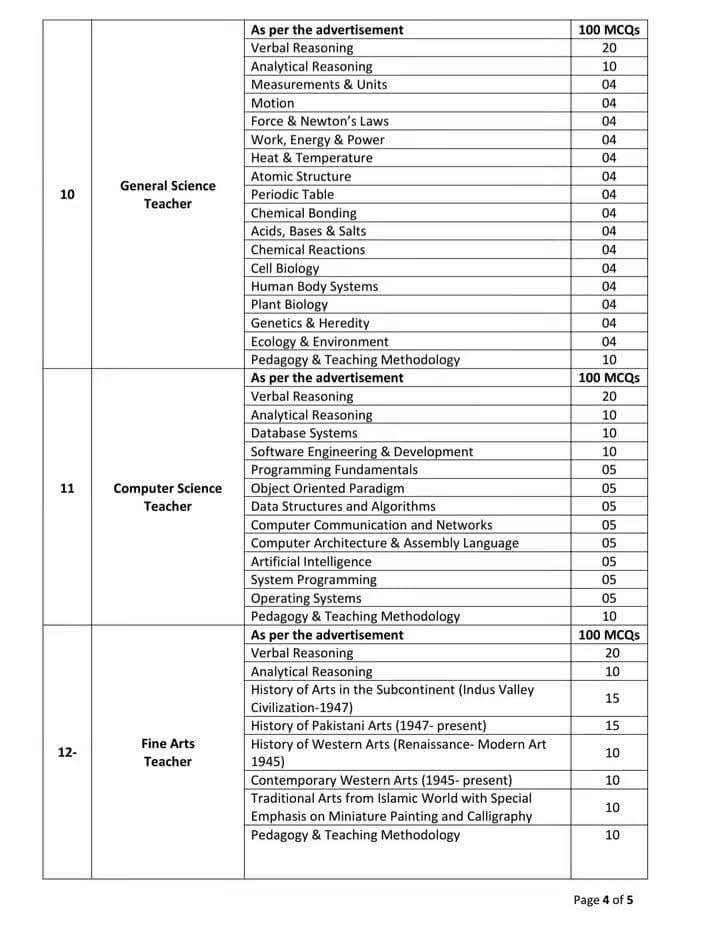
5. Computer Science Teacher
Designed for modern IT and computing curricula, this post focuses heavily on software architecture and system operations[cite: 6]:
- Database Systems: 10%[cite: 6]
- Software Engineering & Development: 10%[cite: 6]
- Core Computing (5% each): Programming Fundamentals, Object-Oriented Paradigm (OOP), Data Structures & Algorithms (DSA), Computer Communication & Networks, Computer Architecture & Assembly Language, Artificial Intelligence (AI), System Programming, Operating Systems[cite: 6].
- General & Pedagogy: Verbal (20%), Analytical (10%), Pedagogy (10%)[cite: 6].
6. Social Sciences, Humanities & Specialized Roles
- Urdu Teacher: Literary research methodology (تحقیق و تدوین), linguistics/lexicography (لسانیات و لغت نویسی), modern critical theory (ساختیات، پس ساختیات، نئی تاریخیت), rhetoric and prosody (بیان و بدیع، بحور), literary history, prose, and classical/modern poetry (10% per module)[cite: 2].
- Islamiyat Teacher: Quranic Sciences (10%), Hadith Sciences (10%), Fiqh & Usool-al-Fiqh (10%), Comparative Religion (5%), Islamic History (5%), Islamic Economics (5%), Islam & Science (5%), Modern Political & Social Thought (10%)[cite: 5].
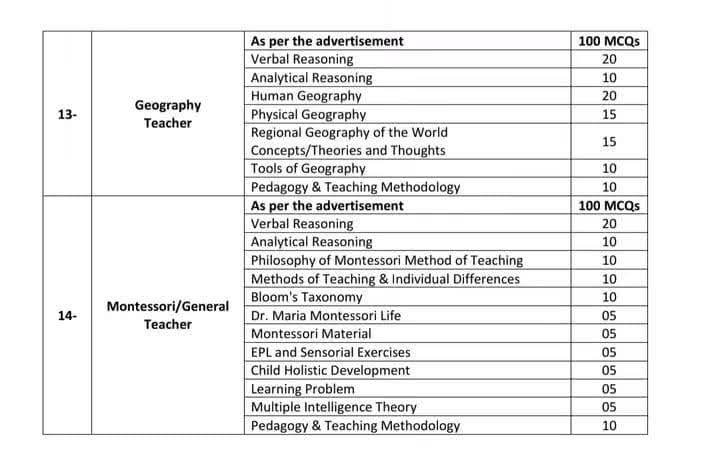
- Social Studies & Geography Teachers: Regional, Physical, and Human Geography, Pakistan Movement milestones (1905–present), and cartography/map-reading[cite: 3, 5].
- Montessori / General Teacher: Practical Life Exercises (EPL) & Sensorial, Child Holistic Development, Bloom’s Taxonomy, Maria Montessori methodology, and Multiple Intelligence Theory[cite: 3].
- Fine Arts Teacher: Indus Valley to modern Subcontinental art history (30%), Western Renaissance to contemporary art (20%), and Islamic Calligraphy/Miniature painting (10%)[cite: 6].
For sample tests, topic-wise practice modules, and past papers, refer to our detailed resource repository on schoolsti.org.pk test preparation materials.
Comparison: STEM vs. Humanities vs. Administrative Profiles
| Evaluation Dimension | Administrative (Principal) | Pure Sciences & STEM | Humanities & Languages |
|---|---|---|---|
| Primary Focus | Policy, HRM & Governance |
| Numerical/Theory & Problem-Solving[cite: 1, 6] | History, Literary Criticism & Syntax[cite: 2, 4] |
| Reasoning Weightage | 30% (Verbal + Analytical)
| 30% (Verbal + Analytical)[cite: 1, 6] | 30% (Verbal + Analytical)[cite: 2, 4] |
| Subject Weightage | 60% Leadership & Academics
| 60% Domain Knowledge[cite: 1, 6] | 60% Specialized Literature/Arts[cite: 2, 4] |
| Pedagogy Weightage | 10% (Psychology Focus)
| 10% (Methodology Focus)[cite: 1, 6] | 10% (Methodology Focus)[cite: 2, 4] |
| Preparation Difficulty | High administrative breadth | Dense calculation & technical depth | Broad memorization & contextual theory |
High-Yield Preparation Strategy
- Target the 30% Cognitive Foundation First: Dedicate daily duration to analytical puzzles (arrangements, blood relations, conditional logic) and verbal sentence completions/analogies. These 30 marks frequently determine the final merit cutoff.
- Master Bloom’s Taxonomy and Assessment Models: The 10% Pedagogy section centers consistently on formative vs. summative assessment, classroom management, learning theories (Piaget, Vygotsky), and Bloom’s cognitive domain[cite: 3, 4]. Consult educational frameworks from international organizations like UNESCO’s Teacher Development Resources to review global top practices in classroom pedagogy.
- Follow the Topic Weightages Strictly: Avoid spending weeks on low-weight topics. In Mathematics, for instance, Calculus and Algebra together represent 20% of the paper, while six separate advanced modules carry only 5% each[cite: 1, 4]. Allocate study hours proportional to published percentages.
- Practice Timed MCQ Drills: With 100 questions to solve in a standard 90 to 120-minute window, pacing is critical—especially for calculation-heavy papers like Physics, Chemistry, and Mathematics[cite: 1, 2].
Frequently Asked Questions (FAQs)
What is the total number of questions and format for Daanish Schools tests?
The written test consists of 100 Multiple Choice Questions (MCQs) with single-top-option formats. The testing agency (such as NTS or internal departmental testing) provides an OMR response sheet.
Is there negative marking in the Daanish School screening test?
Most testing bodies operating under federal guidelines do not enforce negative marking; nevertheless, candidates should verify the precise instructions printed on their test roll number slip.
What is the primary difference between the Montessori Teacher and General Teacher syllabus?
The Montessori syllabus focuses on early childhood development, sensorial exercises, EPL (Exercises of Practical Life), and the philosophy of Dr. Maria Montessori, whereas General Teacher syllabi test broad-spectrum primary-standard subjects[cite: 3].
How should candidates prepare for the Pedagogy section?
Focus on lesson planning, student evaluation, classroom management dynamics, learning taxonomies (Bloom’s Revised Taxonomy), and developmental psychology[cite: 3, 4].
Analysis
The Daanish Schools Authority syllabus balances specialized domain knowledge (60%), general cognitive ability (30%), and pedagogical competence (10%). For the Principal role, the emphasis shifts toward governance, HRM, and school leadership.
By setting explicit percentage weightages for each sub-discipline—such as allocating 5% increments to specific branches of physics, chemistry, and mathematics—the testing authority prevents candidates from relying on universal impressions of their subject[cite: 1, 2]. Candidates who follow this blueprint systematically and drill the high-weight sections can approach the exam with confidence and precision.
Opinion
The Daanish Schools testing blueprint offers a fair, transparent evaluation framework, yet candidates regularly misjudge where the passing margin lies. In competitive open-sector screening tests across Pakistan, most subject specialists score similarly on basic subject knowledge.
The deciding factor that determines selection is almost always the non-core 40%—specifically Analytical Reasoning and Pedagogy. Treating reasoning and teaching methodology as secondary topics is the most usual preparation mistake. Candidates who master basic analytical logic, review standard educational psychology, and follow the exact topic weightages will have a evident advantage on test day.