PEF Revised Fee Schedule (October 2026)
PEF Revised Fee Schedule (October 2026): Complete Per-Student Funding Breakdown & Impact Guide
Introduction
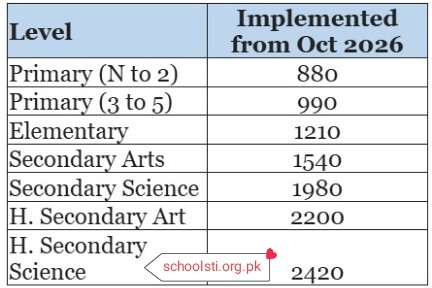
The Punjab Education Foundation (PEF) has officially rolled out a revised monthly per-child fee schedule effective October 2026, delivering a flat 10% funding increase across all academic tiers. Under the updated structure, per-pupil monthly stipends disbursed to partner schools now initiate at PKR 880 for Early Primary (Nursery to Grade 2) and scale up to PKR 2,420 for Higher Secondary Science.
For low-cost private schools operating under the Foundation-Assisted Schools (FAS), Education Voucher Scheme (EVS), and New School Program (NSP) umbrellas, rising utility tariffs, building rents, and inflation have severely compressed operational margins over the past twelve months. This October 2026 revision is designed to stabilize partner institution finances, upgrade classroom resources, and ensure that mandatory increases are passed directly to teaching staff honorariums.
Whether you are a institution licensee calculating your upcoming Q4 disbursements, a teacher tracking salary revisions, or an education policy researcher, understanding the exact breakdown and compliance requirements of the PEF Fee Schedule 2026 is essential for seamless financial planning.
Official PEF Fee Schedule (Implemented from October 2026)
The updated subsidy model categorizes funding into seven distinct academic and subject-particular tiers. Recognizing that higher grades and STEM subjects demand specialized faculty and laboratory infrastructure, the stipend scales progressively from primary to intermediate levels.
| Academic Level | Applicable Grades | Revised Monthly Fee (PKR) – Effective Oct 2026
| Annual Subsidy Per Student (PKR) |
| — | — | — | — |
| Primary (N to 2)
| Nursery, Prep, Grade 1 & Grade 2
| 880
| 10,560 |
| Primary (3 to 5)
| Grade 3, Grade 4 & Grade 5
| 990
| 11,880 |
| Elementary
| Grade 6, Grade 7 & Grade 8 | 1,210
| 14,520 |
| Secondary Arts
| Grade 9 & Grade 10 (Arts/Humanities) | 1,540
| 18,480 |
| Secondary Science
| Grade 9 & Grade 10 (Science Group) | 1,980
| 23,760 |
| H. Secondary Art
| Grade 11 & Grade 12 (FA / I.Com / Arts) | 2,200
| 26,400 |
| H. Secondary Science
| Grade 11 & Grade 12 (FSc / ICS) | 2,420
| 29,040 |
Key Highlights of the New Tariff Structure
- Bifurcated Primary Funding: Unlike older legacy structures that grouped all primary classes under a single flat rate, the schedule maintains a apparent distinction between foundational learners (N to Grade 2 at PKR 880) and upper primary students (Grades 3 to 5 at PKR 990), reflecting the higher textbook and instructional demands of upper primary classes.
- The Science Premium: Secondary Science students accept PKR 440 more per month than Arts students (PKR 1,980 vs. PKR 1,540), a 28.5% premium allocated specifically to cover physics, chemistry, biology, and computer lab consumables.
- Higher Secondary Cap: Intermediate Science classes command the highest per-child allocation at PKR 2,420 per month, helping partner colleges retain M.Phil and B.Ed-qualified subject specialists.
Comparison: Previous (2025) vs. Revised (October 2026) PEF Fee Structure
To appreciate the financial impact on school cash flows, it helps to compare the October 2026 revision against the previous fee schedule implemented in September 2025. Across every single tier, the authorities have applied a uniform 10% upward adjustment.
| Class Level | Previous Fee Schedule (Sept 2025 – Sept 2026) | New Fee Schedule (From Oct 2026)
| Net Monthly Increase (PKR) | Percentage Growth (%) |
| — | — | — | — | — |
| Primary (N to 2)
| PKR 800 | PKR 880
| +80 | +10.0% |
| Primary (3 to 5)
| PKR 900 | PKR 990
| +90 | +10.0% |
| Elementary (6 to 8) | PKR 1,100 | PKR 1,210
| +110 | +10.0% |
| Secondary Arts (9 to 10) | PKR 1,400 | PKR 1,540
| +140 | +10.0% |
| Secondary Science (9 to 10) | PKR 1,800 | PKR 1,980
| +180 | +10.0% |
| H. Secondary Art (11 to 12) | PKR 2,000 | PKR 2,200
| +200 | +10.0% |
| H. Secondary Science (11 to 12) | PKR 2,200 | PKR 2,420
| +220 | +10.0% |
How This Compares to PSRP (Public School Reorganization Program)
While partner schools under FAS, EVS, and NSP now enjoy rates ranging from PKR 880 to PKR 2,420, newly outsourced general schools under the Public School Reorganization Program (PSRP) operate under a separate baseline structure (historically starting around PKR 550 for primary up to PKR 1,500 for higher secondary, primarily because PSRP licensees utilize existing administration school buildings rent-complimentary). Traditional PEF partner schools carry heavy building rental and maintenance overheads, justifying the higher per-child allocation shown in the October 2026 table.
Why the October 2026 Revision Matters for Partner Schools
The public-exclusive partnership model administered by the Punjab Education Foundation (PEF) is one of the largest subsidized education ecosystems in the developing world, educating over 2.6 million underprivileged children across Punjab. Nevertheless, partner academy owners are strictly prohibited from charging any tuition, admission, or examination fees from parents.
As 100% of a partner academy’s revenue is tied to state per-student disbursements, inflation directly threatens academy survival. Here is how the October 2026 revision addresses ground realities:
1. Mandatory Revision in Teacher Honorariums
A core stipulation attached to PEF fee hikes is the trickle-down mandate for teaching staff. Whenever per-child funding increases, partner schools are directed to proportionally raise educator salaries. Retaining qualified Science and Mathematics educators at the Secondary and Higher Secondary levels is notoriously demanding in rural and peri-urban districts; the PKR 1,980 and PKR 2,420 science slabs provide academy principals with the fiscal headroom needed to offer competitive monthly packages. Educators looking to compare exclusive sector stipends with public sector temporary hiring can review the latest Punjab education notifications and STI updates to see how compensation trends are evolving across the province.
2. Absorbing Commercial Utility and Rental Spikes
Partner schools are classified as commercial entities by power distribution companies, meaning their electricity bills include heavy commercial tariffs and fuel price adjustments. For a mid-sized elementary school with 400 students, an grow of PKR 80 to PKR 110 per child generates an additional PKR 35,000 to PKR 40,000 per month—enough to offset soaring summer electricity bills and annual building rent escalations.
3. Preparing for QAT (Quality Assurance Test) Standards
Funding under the foundation is strictly performance-contingent. Schools must pass the annual Quality Assurance Test (QAT) aligned with curriculum benchmarks set by the Punjab School Education Department (SED). Failing two consecutive QATs results in contract termination. The enhanced funding for Secondary Science (PKR 1,980) allows schools to restock laboratory apparatus, purchase updated learning aids, and maintain the pupil-educator ratios required by monitoring teams.
Compliance & Eligibility Requirements to Claim the Revised Rates
The revised rates are not disbursed as a blind lump sum; they are strictly tied to verified headcounts and regulatory compliance. Partner schools must satisfy the following operational checkpoints to receive the October 2026 rates without deductions:
- SIS (Student Information System) Synchronization: All pupil profiles, B-Form (NADRA CRC) verifications, and grade promotions must be accurately updated on the online PEF Student Information System before the monthly cutoff date.
- Minimum 80% Physical Attendance: Field Monitoring Officers (FMOs) conduct unannounced inspections. If physical attendance drops below the mandated threshold compared to SIS enrollment, financial penalties are imposed on that month’s invoice.
- Classroom Infrastructure & Teacher Credentials: To claim the PKR 1,980 (Secondary Science) and PKR 2,420 (Higher Secondary Science) slabs, schools must maintain functional science and computer labs and ensure teacher credentials match the subject requirements logged in the portal.
- Zero-Fee Policy Compliance: Any complaint verified through the monitoring cell showing a partner institution collecting hidden stationery, security, or tuition funds from students results in immediate suspension of the monthly invoice. Stay informed on all regulatory circulars and official school policies and educator guidelines on Schools STI to avoid administrative penalties during surprise inspections.
Analysis
Evaluating the October 2026 PEF fee schedule from an economic and educational policy perspective reveals three critical takeaways for stakeholders:
- Revenue Impact for a Standard 500-Student High School: Consider a typical FAS partner high academy with 500 enrolled students distributed evenly across Primary (N–2: 150 students), Upper Primary (3–5: 150 students), Elementary (6–8: 120 students), and Secondary Science (9–10: 80 students). Under the old 2025 structure, the school received PKR 531,000 per month. Under the modern October 2026 structure, the exact identical enrollment yields PKR 584,100 per month—a net injection of PKR 53,100 monthly or PKR 637,200 annually.
- Incentivizing STEM Enrollment: By widening the absolute monetary gap between Arts and Science groups (a PKR 440/month gap at the Matric degree and PKR 220/month at the Intermediate stage), the foundation actively incentivizes personal institution operators to accessible and promote Science sections rather than defaulting to lower-cost Arts classrooms.
- Parity with Macroeconomic Realities: According to general-personal partnership assessments by the World Bank Education Sector Reports, voucher and per-child subsidy programs in South Asia still deliver education at less than one-third the per-learner cost of traditional government-run schools. Even at the highest slab of PKR 2,420, PEF continues to save the provincial exchequer billions of rupees compared to direct communal schooling costs while maintaining higher learning outcomes.
Opinion
From an industry and policy standpoint, the 10% upward revision implemented in October 2026 is a pragmatic and much-needed lifeline, though it remains a conservative adjustment rather than a transformative leap.
On the positive side, the back-to-back annual revisions (September 2025 followed by October 2026) prove that the Punjab authority has moved away from its historical habit of freezing partner academy stipends for three to four years at a stretch. Annual, predictable 10% adjustments let institution owners to sign multi-twelve months building leases and offer annual increments to their teaching staff with confidence.
Nonetheless, a closer look at the Primary (N to 2) rate of PKR 880 and Primary (3 to 5) rate of PKR 990 shows that standalone primary schools—especially those operating in urban centers like Lahore, Rawalpindi, Faisalabad, and Multan—still face intense financial pressure. Running a grade primary academy on less than PKR 1,000 per pupil per month in an urban genuine estate market is extraordinarily tight. Moving forward, the Punjab Education Foundation should consider introducing a geographic tiering multiplier (offering a 15% urban rental allowance for metropolitan districts) alongside subject-standard tiers. Until then, the most sustainable path for PEF partners is to gradually upgrade their campuses to Elementary and Secondary Science levels, where the PKR 1,210 to PKR 1,980 brackets provide valid operational stability.
Frequently Asked Questions (FAQs)
1. What is the fresh PEF per-learner fee for Primary classes from October 2026?
Effective October 2026, the PEF monthly fee for Primary classes is divided into two tiers: PKR 880 per student for Nursery to Grade 2, and PKR 990 per student for Grades 3 to 5.
2. How considerable does PEF pay per pupil for Matric (Secondary) Science and Arts in 2026?
Under the October 2026 schedule, partner schools receive PKR 1,540 per month for each pupil enrolled in Secondary Arts (Grades 9–10) and PKR 1,980 per month for each pupil in Secondary Science.
3. Does the October 2026 fee schedule apply to FAS, EVS, and NSP schools?
Yes, the revised per-child fee structure applies across the board to partner schools registered under the Foundation-Assisted Schools (FAS), Education Voucher Scheme (EVS), and New School Program (NSP), subject to verified SIS enrollment.
4. What is the maximum per-child stipend paid by the Punjab Education Foundation?
The highest monthly stipend under the October 2026 schedule is PKR 2,420 per student, allocated to Higher Secondary Science (Grades 11 and 12 / FSc & ICS), followed by Higher Secondary Arts at PKR 2,200 per student.
5. Can PEF partner schools charge parents the difference if expenses exceed the state stipend?
No. PEF partner schools are strictly bound by a zero-tuition policy. Schools receive 100% of their per-child fee directly from the Punjab state and are legally barred from charging tuition, admission, or stationery fees from enrolled students.
Conclusion
The PEF Fee Schedule implemented from October 2026 reinforces the Punjab administration’s commitment to sustaining general-exclusive partnerships in education. By raising monthly subsidies to PKR 880–990 for Primary, PKR 1,210 for Elementary, PKR 1,540–1,980 for Secondary, and PKR 2,200–2,420 for Higher Secondary classes, the foundation has provided partner schools with essential breathing room to combat inflation and reward hardworking teachers. To maximize these revised disbursements, academy administrators must prioritize 100% SIS data accuracy, maintain strict physical attendance, and channel the incremental revenue into classroom standard ahead of the upcoming QAT cycle.