Punjab Afternoon Schools Upgradation Guidelines
Punjab Afternoon Schools Upgradation Guidelines: New Retention Criteria for Elementary Classes
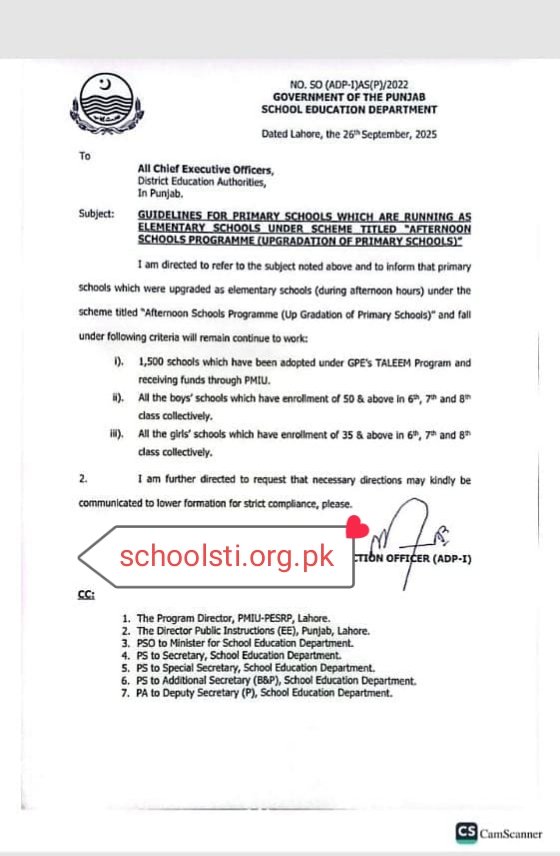
The School Education Department (SED) of Punjab has officially issued fresh directives establishing the continuity criteria for primary schools upgraded to elementary levels under the Afternoon Schools Programme. Promulgated via notification NO. SO (ADP-I)AS(P)/2022, this policy sets definitive benchmarks regarding institution adoption frameworks, international funding linkages, and mandatory collective enrollment thresholds across middle classes (grades 6, 7, and 8).
This guide examines what this official notification entails for academy heads, teachers, District Education Authorities (DEAs), and students across Punjab.
Key Highlights of the Official Notification
According to the official circular issued from Lahore to all Chief Executive Officers (CEOs) of District Education Authorities across Punjab, upgraded primary schools operating during afternoon shifts will continue functioning only if they meet clearly demarcated criteria.
- Issuing Authority: School Education Department (SED), Government of the Punjab.
- Notification Reference: NO. SO (ADP-I)AS(P)/2022.
- Target Institution Types: Primary schools upgraded as elementary schools during afternoon hours.
- Key Focus: Rationalization and continuity based on Global Partnership for Education (GPE) funding and grade 6–8 student headcounts.
Detailed Eligibility & Continuation Criteria
Under the updated guidelines, upgraded afternoon elementary schools must satisfy at least one of the particular operational or enrollment thresholds detailed below to remain operational:
                          ┌──────────────────────────────────────────────┐
                          │   Afternoon Elementary Schools Continuity    │
                          └──────────────────────┬───────────────────────┘
                                                 │
          ┌──────────────────────────────────────┼──────────────────────────────────────┐
          │                                      │                                      │
          ▼                                      ▼                                      ▼
┌───────────────────┐                  ┌───────────────────┐                  ┌───────────────────┐
│ GPE TALEEM Shift  │                  │   Boys' Schools   │                  │  Girls' Schools   │
│   1,500 Schools   │                  │ Minimum Enrollment│                  │ Minimum Enrollment│
│ Funded via PMIU   │                  │   50+ (Grades 6-8)│                  │   35+ (Grades 6-8)│
└───────────────────┘                  └───────────────────┘                  └───────────────────┘
1. GPE’s TALEEM Programme Adopted Schools
A total of 1,500 schools that have been formally adopted under the Global Partnership for Education (GPE) TALEEM Programme and are actively drawing disbursement funds through the Program Monitoring & Implementation Unit (PMIU-PESRP) are fully protected and will continue their academic sessions.
2. Enrollment Threshold for Boys’ Schools
For non-GPE morning-primary institutions operating afternoon elementary shifts:
- The academy must maintain a collective enrollment of 50 students or more across classes 6th, 7th, and 8th.
- Failure to demonstrate 50 cumulative enrolled students in middle grades puts the afternoon shift at risk of closure or merger.
3. Enrollment Threshold for Girls’ Schools
Recognizing lower female mobility and retention challenges in rural areas, the department has designated a lower threshold:
- A collective enrollment of 35 students or more across classes 6th, 7th, and 8th.
- This lower bar ensures female students in remote union councils continue to have access to post-primary education without traveling long distances.
Breakdown of Enrollment & Operational Benchmarks
The table below breaks down the structural thresholds mandated by the School Education Department:
| Category / Institution Type | Target Grades | Mandatory Threshold / Status | Funding & Monitoring Mechanism |
|---|---|---|---|
| GPE TALEEM Adopted Schools | Classes 6, 7 & 8 | 1,500 Schools Adopted | PMIU-PESRP / International Grant |
| Boys’ Afternoon Elementary Shifts | Classes 6, 7 & 8 (Collective) | Minimum 50 Enrolled Students | District Education Authority (DEA) / SED |
| Girls’ Afternoon Elementary Shifts | Classes 6, 7 & 8 (Collective) | Minimum 35 Enrolled Students | District Education Authority (DEA) / SED |
| Below-Threshold Institutions | Classes 6, 7 & 8 | Non-compliant / Review Category | Subject to DEA Rationalization |
Comparison: Regular Elementary Schools vs. Afternoon Elementary Shifts
To improved comprehend why these enrollment thresholds are critical, consider the operational differences between standard elementary schools and afternoon shifts:
| Operational Metric | Regular Morning Elementary School | Afternoon Upgraded Elementary School |
|---|---|---|
| Infrastructure | Dedicated elementary building & labs | Utilizes existing primary school premises |
| Class Timings | Morning hours (approx. 07:45 AM – 01:30 PM) | Afternoon hours (approx. 01:30 PM – 05:00 PM) |
| Teaching Cadre | Permanent EST/PST staff | Contractual teachers, interns, or honorarium staff |
| Financial Overhead | Full regular budget allocation | Stipend/honorarium model & development schemes |
| Closure Risk | Low (established sanctioned posts) | High if enrollment dips below 50 (boys) / 35 (girls) |
For educators monitoring policy updates and hiring frameworks, checking recent Punjab educational circulars on schoolsti.org.pk provides timely visibility into staffing needs and honorarium distributions.
Strategic Significance of the GPE TALEEM Programme
The Transforming Access, Learning, Equity and Education Management (TALEEM) project, funded through the Global Partnership for Education, represents a major multilateral intervention designed to address out-of-school children (OOSC) in Punjab.
By sheltering 1,500 afternoon schools under direct PMIU supervision, the authority guarantees:
- Financial Sustainability: Regular disbursement of running expenses and honoraria to teaching staff.
- Standardized Materials: Delivery of supplementary learning modules and complimentary textbooks.
- Targeted Gender Parity: Focused efforts in districts with wide disparities in female literacy.
Administrative Directives to District Education Authorities
The notification directs all Chief Executive Officers (CEOs) of District Education Authorities to communicate these instructions down to lower administrative formations—including District Education Officers (DEOs), Deputy DEOs, and Assistant Education Officers (AEOs)—for strict compliance.
Administrative steps currently underway in districts incorporate:
- Census Verification: AEOs are cross-checking Student Information System (SIS) data to verify real-time grade 6–8 enrollments.
- Rationalization of Staff: In institutions unable to meet the 50/35 pupil threshold, teaching staff and resources may be reassigned to prevent budgetary waste.
- Community Mobilization: Head teachers are liaising with School Management Councils (SMCs) to run localized enrollment drives and prevent afternoon shifts from falling below minimum thresholds.
Educators and administrative staff tracking daily updates can review educational resources and administrative guidelines at schoolsti.org.pk to keep pace with operational guidelines.
Frequently Asked Questions (FAQs)
What is the Afternoon Schools Programme in Punjab?
The Afternoon Schools Programme (regularly associated with the Insaf Afternoon School initiative) utilizes existing primary academy infrastructure during second-shift afternoon hours to deliver elementary education (grades 6–8), bringing middle-academy access closer to rural and underprivileged students.
Does the enrollment requirement apply to each class separately?
No. The official notification clearly states that the enrollment figure is collective across grades 6th, 7th, and 8th combined (e.g., 50 total for boys and 35 total for girls).
Where can official SED notifications and circulars be verified?
Official notifications can be verified directly through the Punjab School Education Department or through district circulars released by respective District Education Authorities.
What happens if an afternoon school drops below the required enrollment?
Schools falling below the minimum collective cutoff (50 for boys, 35 for girls) and not covered under the GPE TALEEM 1,500-academy cohort are subject to administrative review, shift suspension, or rationalization by their respective DEA.
Analysis
The issuance of notification NO. SO (ADP-I)AS(P)/2022 marks a strategic shift from unrestricted expansion to performance-based rationalization.
- Pragmatic Resource Management: Running second shifts incurs utility expenses, administrative monitoring overhead, and instructor remuneration. Establishing a minimum headcount prevents “ghost” or sub-scale afternoon shifts with single-digit enrollments.
- Gender-Conscious Thresholds: The decision to fix the girls’ threshold at 35 students (versus 50 for boys) directly addresses socioeconomic hurdles, cultural mobility restrictions, and dropout risks among post-primary female students in rural areas.
- Ring-Fencing Donor Commitments: By carving out an explicit continuation clause for the 1,500 GPE TALEEM schools, Punjab ensures compliance with international donor covenants, preserving foreign assistance pipelines managed via PMIU-PESRP.
Opinion
The School Education Department’s policy strikes a sensible balance between fiscal responsibility and equitable educational access. Keeping primary schools accessible in the afternoon is one of the most cost-effective strategies for tackling Pakistan’s out-of-institution children crisis without spending millions on modern brick-and-mortar infrastructure.
Nevertheless, District Education Authorities must avoid abrupt shift closures in marginalized union councils that narrowly miss the enrollment threshold. Instead of simply shutting down classes with 30 girls or 45 boys, DEAs and local AEOs should grant temporary grace periods paired with targeted village-stage enrollment campaigns. Strict compliance must not compromise student retention where an afternoon shift is the only local bridge to post-primary education.
Conclusion
The notification issued under reference NO. SO (ADP-I)AS(P)/2022 provides obvious benchmarks for the continuation of upgraded primary schools operating elementary afternoon shifts. With 1,500 schools shielded under the GPE TALEEM initiative and clear collective minimum thresholds (50 for boys, 35 for girls across grades 6–8), field formations now have an unambiguous mandate to audit and maintain afternoon shifts across Punjab. Head teachers and institution councils must prioritize enrollment drives to retain their upgraded status and serve students in their communities.