Punjab School Education Department Mandates 4th DPC 2026
Punjab School Education Department Mandates 4th DPC 2026: Strict Timelines, SIS Tagging, and Accountability Warnings
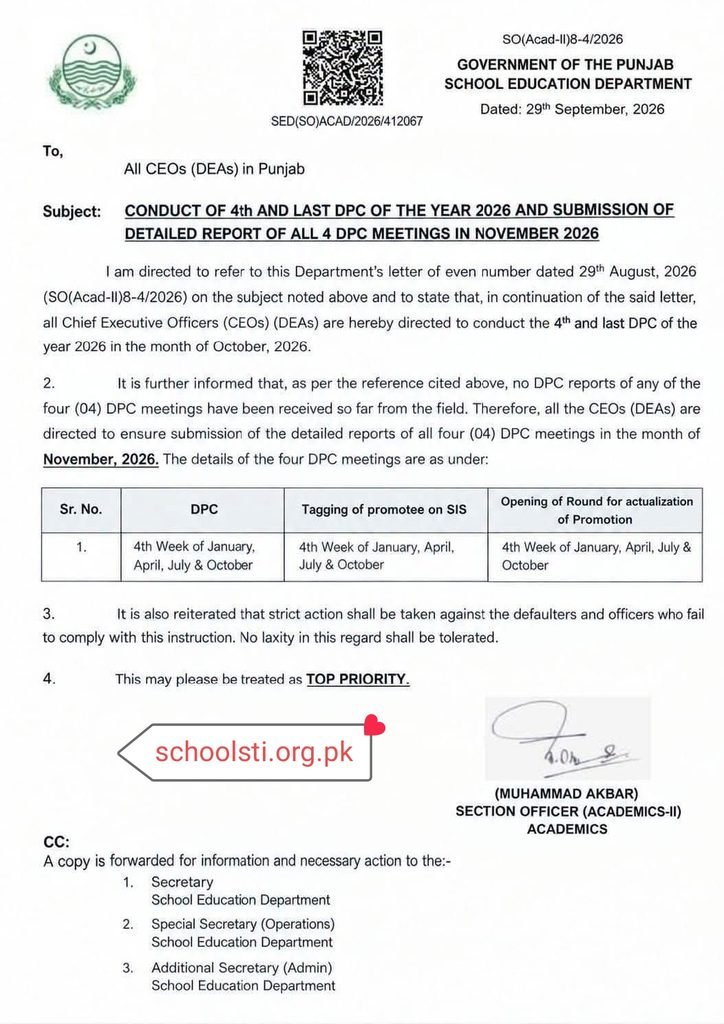
The Government of the Punjab, School Education Department (SED) has officially issued an urgent executive directive regarding the conduct of the fourth and final Departmental Promotion Committee (DPC) meeting for the calendar twelve months 2026. Issued under notification reference SO(Acad-II)8-4/2026 and dated September 29, 2026, the circular targets all Chief Executive Officers (CEOs) of District Education Authorities (DEAs) across Punjab.
This notification delivers both an operational roadmap and a stern administrative reprimand: field offices have failed to submit DPC progress reports for the preceding three quarters of 2026, prompting the provincial secretariat to demand immediate compliance, mandatory digital tracking on the School Information System (SIS), and consolidated reporting by November 2026 under threat of disciplinary proceedings.
Below is an exhaustive breakdown of the notification, the procedural requirements for instructor promotions, technical compliance mechanisms on SIS and SEDHR, and what this development means for teaching cadres across Punjab.
Key Highlights of SED Notification SO(Acad-II)8-4/2026
- Mandatory Conduct of 4th DPC: All 36 District Education Authorities in Punjab must convene and conclude the 4th and final DPC of 2026 within October 2026.
- Consolidated Reporting in November 2026: CEOs of DEAs are ordered to compile and dispatch comprehensive, detailed reports covering all four DPC rounds of 2026 during November 2026.
- Zero Reports Received from Field Formations: The department noted with serious concern that, despite instructions issued in an earlier letter dated August 29, 2026, not a single DEA has submitted the required reporting data for previous DPC sessions.
- Synchronized SIS Tagging and Actualization: The DPC proceedings are tethered directly to the digital ecosystem—promotees must be tagged in the School Information System (SIS), followed by the immediate opening of rounds for the actualization of promotions.
- Strict Disciplinary Action: The circular explicitly marks the matter as “TOP PRIORITY”, cautioning that no laxity will be tolerated and strict action will be initiated against non-compliant officers under Punjab civil service regulations.
For regular departmental circulars and official archives, educators can consult the latest SED notifications on schoolsti.org.pk as well as the official repository on the Punjab School Education Department portal.
Detailed Schedule: The Four DPC Rounds of 2026
To prevent arbitrary delays at the district degree, the School Education Department established a quarterly promotion mechanism. Each phase requires three parallel administrative actions: convening the DPC board, tagging approved candidates on the SIS database, and opening online placement rounds to formalize postings.
The official schedule articulated in the notification is organized as follows:
| Quarter / Round | DPC Convening Window | SIS Tagging of Promotees | Opening of Round for Actualization of Promotion |
|---|---|---|---|
| 1st DPC (Q1 2026) | 4th Week of January 2026 | 4th Week of January 2026 | 4th Week of January 2026 |
| 2nd DPC (Q2 2026) | 4th Week of April 2026 | 4th Week of April 2026 | 4th Week of April 2026 |
| 3rd DPC (Q3 2026) | 4th Week of July 2026 | 4th Week of July 2026 | 4th Week of July 2026 |
| 4th & Final DPC (Q4 2026) | 4th Week of October 2026 | 4th Week of October 2026 | 4th Week of October 2026 |
| Consolidated Field Reports | November 2026 (Mandatory submission by all District CEOs) | — | — |
Administrative Context: Why Did SED Issue This Stern Order?
The Chronic Lateness of Field Formations
Historically, departmental promotions within the open institution framework in Punjab suffered from prolonged bureaucratic bottlenecks. Promotions from Primary School Teacher (PST / BPS-14) to Elementary School Teacher (EST / BPS-15), EST to Secondary School Teacher (SST / BPS-16), and upward into administrative scales (such as Headmasters and Subject Specialists) frequently languished for months or years.
To remedy this, the provincial administration mandated quarterly DPC meetings. Nonetheless, as Section Officer (Academics-II) Muhammad Akbar highlighted in the directive, district administrations failed to furnish documentation verifying whether the sessions scheduled for January, April, and July 2026 were executed transparently, or if candidate files remained unprocessed.
Digital Transparency via SIS and SEDHR
To curb favoritism, ghost vacancies, and manual tampering, the department relies on systems built in partnership with the Punjab Information Technology Board. The DPC process is no longer purely paper-driven:
- Scrutiny of Service Books and ACRs/PERs: Evaluated against seniority lists.
- SIS Tagging: Upon clearance by the committee, the promotee’s national identity number and employee code are flagged on SIS as “Promotee Pending Posting.”
- Automated Order Generation: Actualization takes spot via the centralized School Education Department SEDHR Portal, ensuring postings correlate directly with verified school-level vacancies.
Educators tracking procedural shifts can read comprehensive guides regarding Punjab teachers recruitment and promotion updates on schoolsti.org.pk to review quota breakdowns and service eligibility criteria.
Traditional DPC Processing vs. The Standardized Digital DPC Mechanism
Understanding the difference between the legacy manual setup and the newly enforced digital protocol illustrates why the department is taking an uncompromising stance with district CEOs.
Comparative Evaluation
| Parameter | Legacy Manual Promotion System | Modern SIS-Integrated DPC Model (2026 Mandate) |
|---|---|---|
| Meeting Frequency | Ad-hoc, irregular, often delayed by 1–2 years | Fixed quarterly schedule (January, April, July, October) |
| Record Tracking | Physical files vulnerable to misplacement or delays | Centralized electronic service records on SEDHR & SIS |
| Seat Actualization | Manual posting orders susceptible to administrative friction | Digital allocation based on live SIS pupil-instructor ratios |
| Accountability | Diffuse responsibility across district staff | Direct legal and administrative liability on CEOs of DEAs |
| Reporting Visibility | Fragmented district records; delayed provincial oversight | Centralized review via mandatory consolidated reports |
Step-by-Step Checklist for Eligible Teachers Awaiting Promotion in October 2026
If you are a authority institution instructor in Punjab whose seniority falls within the consideration zone for the 4th DPC, take the following steps immediately to avoid objections:
- Verify Online Profile on SEDHR: Confirm that your qualification records, date of regular appointment, date of birth, and posting history are completely synchronized.
- Clear Pending Performance Evaluation Reports (PERs / ACRs): Ensure your ACR counter-signatures for previous calendar years are completed and submitted to the DEA scrutiny committee.
- Obtain “No Inquiry / No Penalty” Verification: Ensure that no proceedings under the Punjab Employees Efficiency, Discipline and Accountability (PEEDA) Act are active or un-disposed against your record.
- Scrutinize the Tentative Seniority List: Review the district seniority series published by your respective DEA. If any senior colleague has retired, transferred, or resigned, ensure the series reflects that update.
- Monitor SIS Tagging Post-DPC: Once the DPC concludes in late October, check your status on the SIS application to confirm that your profile has been tagged for actualization.
Frequently Asked Questions (FAQs)
What is the primary purpose of notification SO(Acad-II)8-4/2026?
The notification directs all CEOs of District Education Authorities in Punjab to hold the 4th and final Departmental Promotion Committee (DPC) meeting of 2026 during October 2026, while mandating the submission of detailed performance reports for all four 2026 DPCs in November 2026.
Who is responsible for conducting the DPC at the district level?
The Chief Executive Officer (CEO) of the respective District Education Authority (DEA), alongside the designated district promotion board members, is responsible for convening the meeting, evaluating eligible candidates, and issuing promotion orders.
What does “Tagging of Promotee on SIS” mean?
Once an educator is recommended for promotion by the DPC, their profile must be digitally marked (“tagged”) in the School Information System (SIS). This prevents candidate records from being altered and reserves a setup slot for their promotion actualization round.
What happens if a DEA fails to submit reports in November 2026?
The notification warns that strict disciplinary action will be initiated against non-compliant officers and defaulters under applicable Punjab civil service and conduct rules.
Analysis
The issuance of notification SO(Acad-II)8-4/2026 exposes two ongoing realities within the administrative machinery of Punjab’s open academy framework:
- The Gap Between Policy and Field Implementation: While the provincial secretariat established an equitable, predictable calendar with four DPC windows a twelve months, field offices have demonstrated persistent administrative inertia. The admission that no reports for the initial three DPCs of 2026 were submitted from the field illustrates an operational breakdown between Lahore and the districts.
- Digital Accountability as a Policy Instrument: By binding promotion actualization strictly to SIS tagging and SEDHR rounds, the department has removed arbitrary discretionary powers from district clerks. Nonetheless, the system’s effectiveness relies entirely on district leadership adhering to established timelines.
- Career Morale and Classroom Impact: Vacancies created by delayed promotions often leave secondary and elementary classrooms without specialized subject teachers. Executing the 4th DPC in October 2026 is critical not only for employee rights, however also for staffing equilibrium before the winter academic push.
Opinion
The School Education Department’s stern tone in this letter is both warranted and overdue. For far too long, the professional advancement of grassroots teachers—who form the foundation of Pakistan’s primary and secondary educational framework—has been treated as an administrative afterthought by district officers.
A quarterly schedule becomes meaningless if district managers can skip compliance reporting without consequence. When Section Officer Muhammad Akbar emphasizes that “no laxity in this regard shall be tolerated” and labels the order as “TOP PRIORITY”, it signals that high-standard authorities recognize this bureaucratic drag.
However, issuing warnings on paper is only half the battle. If CEOs fail to complete these DPCs by the fourth week of October or default on the November reporting deadline, the department must back its words with measurable accountability under the PEEDA Act. Ensuring transparent, automated promotions on SIS is essential to restoring institutional trust among open academy educators across Punjab.