Punjab Government Launches Revolutionary Teacher Training in Mental Health and AI
Punjab Government Launches Revolutionary Teacher Training in Mental Health, AI, and English Communication
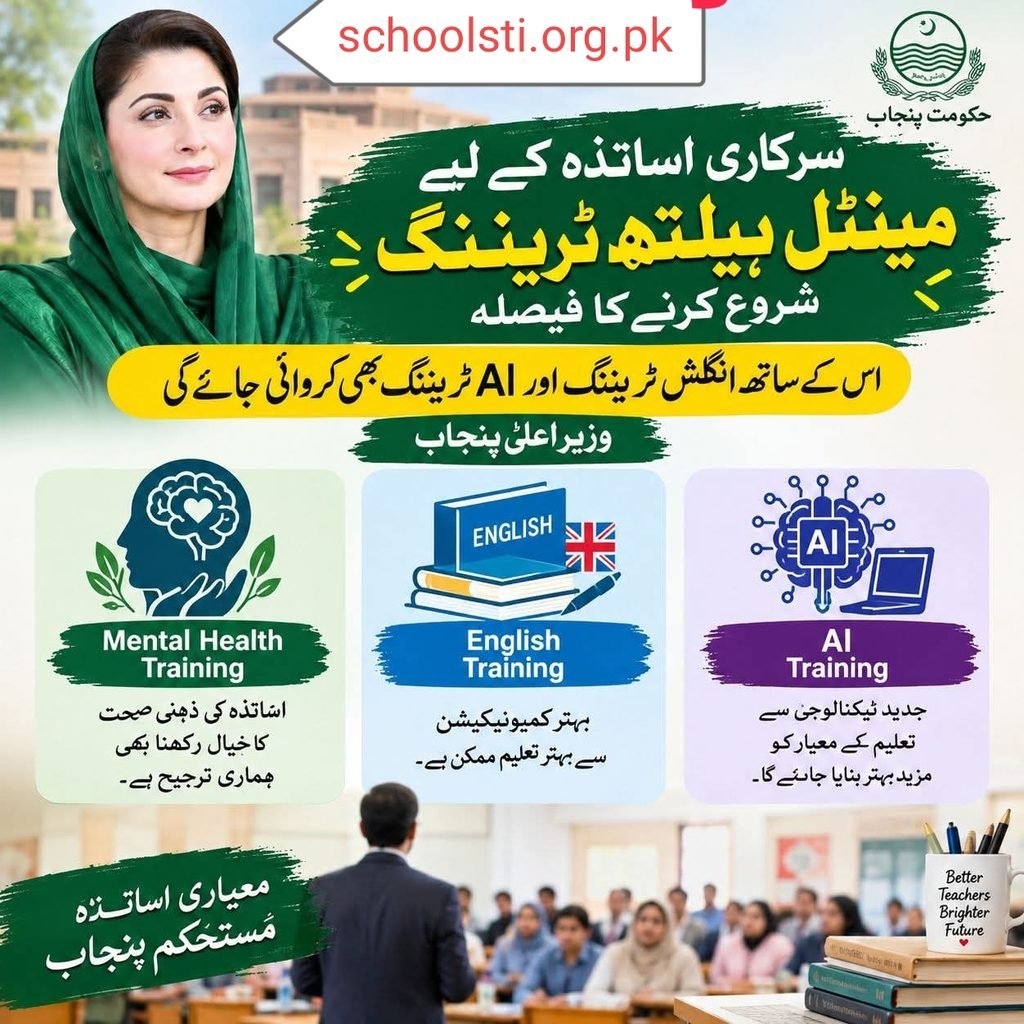
The Government of Punjab, led by Chief Minister Maryam Nawaz Sharif, has officially approved a transformative training framework for public school educators across the province. Under the banner “معیاری اساتذہ، مستحکم پنجاب” (Quality Teachers, Stable Punjab) and the core vision “Better Teachers, Brighter Future,” this initiative targets professional development across three essential pillars: Mental Health Training, English Language & Communication Skills, and Artificial Intelligence (AI) Literacy.
This initiative marks a shift in how educator development is addressed in Pakistan’s public schooling sector. Beyond subject rote-learning, the province is equipping educators with modern digital tools, classroom psychological acumen, and global communication fluency to enhance classroom outcomes.
The Three Pillars of the Punjab Teacher Training Initiative
The curriculum overhaul addresses classroom realities by balancing psychological wellness, language proficiency, and frontier educational technologies.
       ┌────────────────────────────────────────────────────────┐
       │     PUNJAB OPEN ACADEMY EDUCATOR TRAINING PROGRAM      │
       └───────────────────────────┬────────────────────────────┘
                                   │
         ┌─────────────────────────┼─────────────────────────┐
         ▼                         ▼                         ▼
┌──────────────────┐     ┌──────────────────┐     ┌──────────────────┐
│  Mental Health   │     │ English Training │     │   AI Training    │
│     Training     │     │                  │     │                  │
├──────────────────┤     ├──────────────────┤     ├──────────────────┤
│• Teacher Well-   │     │• Communicative   │     │• Smart Classroom │
│  being & Stress  │     │  Fluency         │     │  Integration     │
│• Student Psycho- │     │• Interactive     │     │• GenAI for Lesson│
│  logical Support │     │  Pedagogy        │     │  Planning        │
│• Discipline      │     │• Standardized    │     │• Digital Literacy│
│  Alternatives    │     │  Class Delivery  │     │  Grades 1–12     │
└──────────────────┘     └──────────────────┘     └──────────────────┘
1. Mental Health Training (ذہنی صحت کا فروغ)
“اساتذہ کی ذہنی صحت کا خیال رکھنا بھی ہماری ترجیح ہے۔”
(Taking care of teachers’ mental health is also our priority.)
For the first duration in the province’s educational history, educator psychological help has been elevated to an institutional policy priority. Recognizing workplace stress, administrative burdens, and large pupil-to-educator ratios, this module focuses on:
- Stress Resilience and Burnout Prevention: Introducing coping strategies, mindfulness, and workload management aligned with WHO guidelines on mental health at work.
- Trauma-Informed Classroom Management: Transitioning teachers away from punitive enforcement toward empathetic engagement. This directly ties into the provincial policy eliminating corporal punishment and establishing dedicated classroom “discipline corners.”
- District Psychological Support: Supplemented by the proposed appointment of visiting psychologists in each district and dedicated student-educator tele-counseling help.
2. English Language & Communication Training (انگلش ٹریننگ)
“بہتر کمیونیکیشن سے بہتر تعلیم ممکن ہے۔”
(Better education is possible through stronger communication.)
Language barriers regularly hinder primary and middle-grade instruction in communal institutions. This module aims to transform instructors into confident communicators rather than passive grammar instructors:
- Interactive Classroom Instruction: Shifting away from archaic translation-based teaching methods toward communicative English teaching.
- Scale of Deployment: As officially reported by The Nation’s coverage of the Punjab school reforms, over 35,000 teachers across 31 tehsils and 12 districts have already completed foundational English-language modules, with full provincial scaling underway.
- Curriculum Alignment: Ensuring that English textbooks are actively paired with conversational drills and phonetic accuracy.
3. Artificial Intelligence (AI) Training (مصنوعی ذہانت کی تربیت)
“جدید ٹیکنالوجی سے تعلیم کے معیار کو مزید بہتر بنایا جائے گا۔”
(The standard of education will be further improved with modern technology.)
To bridge the public-exclusive educational divide, the School Education Department is integrating AI skills across schools, aligning with international standards outlined by The UNESCO Courier on artificial intelligence in education. Key aspects incorporate:
- Automated Lesson Preparation: Training instructors to employ generative AI for quizzes, dynamic worksheets, and individualized lesson differentiation.
- Smart Classroom Readiness: Equipping teachers to operate digital boards, recorded lecture repositories, and interactive multimedia systems.
- Foundational AI Literacy for Students: Preparing teachers to guide students through the newly integrated Grades 1–12 digital literacy and AI curriculum.
Detailed Implementation Framework
To prevent disruption to the academic calendar, the School Education Department has designated one full day each week exclusively for teacher training across Punjab, directly involving textbook authors, educational technologists, and clinical psychologists.
| Training Module | Target Core Competencies | Delivery Mechanism | Expected Educational Impact |
|---|---|---|---|
| Mental Health & Well-being | Stress mitigation, child psychology, non-violent discipline | On-site workshops + District psychologist sessions | Reduced instructor attrition, eliminated corporal punishment, positive learning environment |
| English Communication | Spoken fluency, classroom terminology, phonetics | Blended learning modules + cluster center practice | Higher learner engagement, smoother transition to bilingual subjects |
| AI & EdTech Integration | Prompt engineering, automated grading aids, smart classroom software | Lab-based hands-on modules via PITB platforms | 40% reduction in lesson-planning moment, modernized classroom delivery |
Comparative Assessment: Traditional vs. Modernized Training
The current training cycle shifts away from conventional, passive instructor training sessions toward interactive, multidisciplinary development:
+-----------------------------------+------------------------------------+
| Traditional Teacher Training      | New Punjab Government Framework    |
+-----------------------------------+------------------------------------+
| • Heavy focus on rote lecture     | • Multidisciplinary development:   |
|   notes and outdated pedagogy     |   Mental Health + AI + English     |
| • Zero institutional focus on     | • Structured psychological         |
|   educator mental wellness        |   resilience & counselling back |
| • Static English grammar theory   | • Spoken communicative fluency     |
| • Manual lesson preparation and   | • AI-assisted lesson generation &  |
|   administrative workloads        |   smart classroom technologies     |
| • Irregular training cadences     | • Dedicated weekly training day    |
+-----------------------------------+------------------------------------+
For practical guides, schedule circulars, and instructional materials, teachers can reference the latest updates via the SchoolSTI education portal.
Analysis: Key Takeaways
- Teacher-Centric Systems Thinking: Placing educator mental well-being alongside technical training recognizes that student outcomes depend heavily on teacher health and morale.
- Technological Democratization: Introducing generative AI and digital smart classrooms to administration institutions helps narrow the technological gap between elite exclusive academies and open schools.
- Structured Regularity: Dedicating a weekly training day ensures professional development is an ongoing workplace method rather than an irregular, one-off seminar.
- Implementation Safeguards: The collaboration between the School Education Department, PITB, and regional academies provides the digital infrastructure needed to monitor attendance and track competency gains. Educators can monitor district allocation rosters and training schedules through schoolsti.org.pk updates.
Frequently Asked Questions (FAQs)
What are the main components of the modern Punjab teacher training policy?
The program focuses on three main areas:
- Mental Health Training for instructor wellness, stress mitigation, and non-violent classroom management.
- English Language Training to assemble spoken confidence and communicative teaching skills.
- AI Training to equip teachers with digital lesson-planning tools and prepare them for the recent digital literacy curriculum.
Who is eligible to participate in this training?
All open institution teachers across primary, elementary, and secondary levels under the Punjab School Education Department are included under phased rollouts arranged by the Quaid-e-Azam Academy for Educational Development (QAED).
When will the training sessions be conducted?
The provincial state has allocated one day per week dedicated to continuous instructor development and curriculum review, as reported in provincial policy briefings covered by The Public Purview’s education reporting.
Does the initiative include student mental health facilities?
Yes. Alongside educator training, the initiative proposes visiting district psychologists and establishing online pupil counseling services to assist child welfare across the province.
Opinion: Expert Verdict
The Punjab Government’s educator training initiative introduces a forward-looking model for general academy reform in South Asia. Historically, educational interventions in the communal sector focused primarily on physical infrastructure or basic syllabus distribution, while overlooking the emotional well-being and digital modernization of instructors.
By pairing mental wellness with AI literacy and English proficiency, this strategy tackles educator burnout while preparing the workforce for an AI-enabled economy. The actual test will lie in classroom-stage execution: ensuring dependable internet access and equipment in rural schools, avoiding excessive administrative duties on designated training days, and providing genuine counseling support. If implemented consistently across all districts, this program can establish an effective standard for general education modernization in Pakistan.