Punjab School Teacher Interns (STI) District-Wise Allocation
Punjab School Teacher Interns (STI): District-Wise Allocation Breakdown, Quotas, and Strategic Analysis
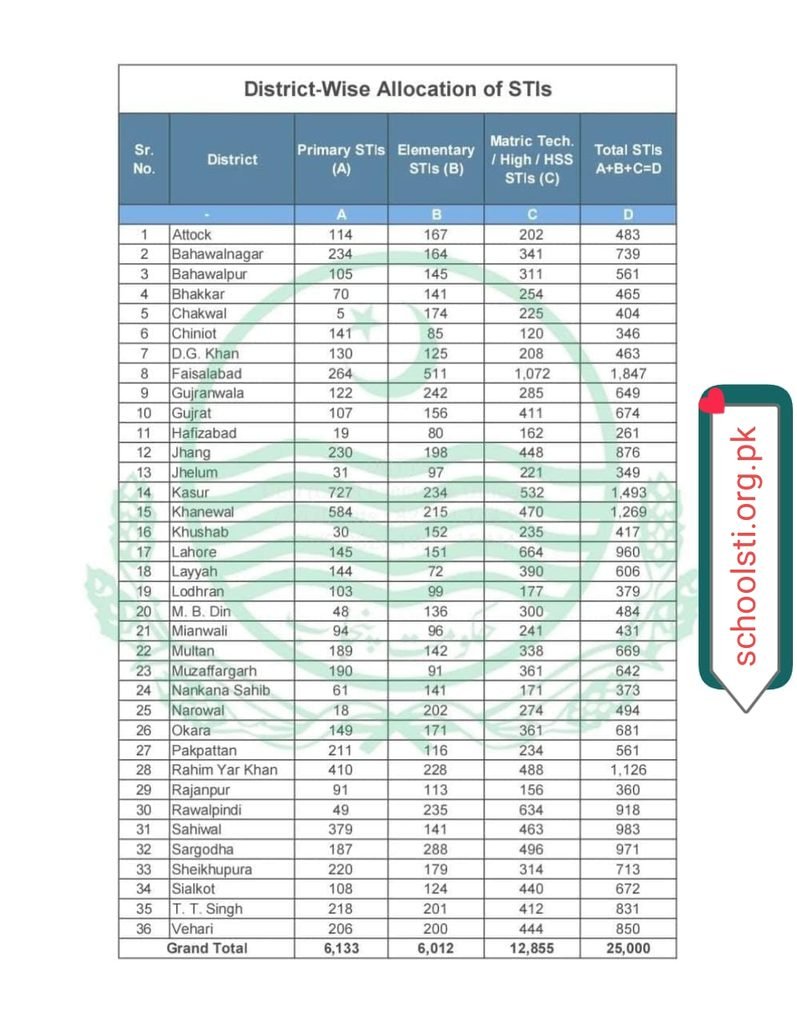
The School Education Department (SED) of Punjab has officially rolled out the district-wise quota and allocation matrix for the recruitment of 25,000 School Teacher Interns (STIs) across all 36 districts of Punjab. Aimed at addressing acute teaching staff shortages, enhancing learner-teacher ratios, and supporting specialized instruction in primary, elementary, and high/higher secondary schools, this induction represents one of the largest academic workforce mobilizations in the province.
For occupation seekers, educationists, and policy analysts tracking these openings through the School STI recruitment portal, understanding how seats are apportioned geographically and across school tiers is critical. Below is the full, official breakdown of STI allocations, categorized by primary, elementary, and matric tech/secondary tiers, accompanied by cross-district comparisons, policy evaluation, and candidate guidelines.
Executive Summary of the STI Allocation Framework
The recruitment drive targets three core academy levels across open educational institutions governed by the School Education Department Punjab:
- Primary Level STIs (Category A): 6,133 posts allocated to foundational learning environments.
- Elementary Level STIs (Category B): 6,012 posts designated for middle academy classes (grades 6 to 8).
- Matric Tech / High / Higher Secondary School STIs (Category C): 12,855 posts dedicated to secondary, higher secondary, and emerging technical education streams.
- Grand Total: 25,000 positions across Punjab.
+-----------------------------------------------------------------------------------+
|                            TOTAL ALLOCATION: 25,000 STIs                         |
+------------------------------------+----------------------------------------------+
| Category A: Primary Level          |  6,133 Seats (24.53%)                        |
| Category B: Elementary Level       |  6,012 Seats (24.05%)                        |
| Category C: Matric Tech / High/HSS | 12,855 Seats (51.42%)                        |
+------------------------------------+----------------------------------------------+
Complete District-Wise Seat Allocation Matrix (36 Districts)
The seat distribution is determined by enrolment pressures, verified educator vacancies reported via the School Information System (SIS), and gender-segregated school requirements managed under infrastructure developed by the Punjab Information Technology Board.
| Sr. No. | District | Primary STIs (A) | Elementary STIs (B) | Matric Tech. / High / HSS STIs (C) | Total STIs (A+B+C=D) |
|---|---|---|---|---|---|
| 1 | Attock | 114 | 167 | 202 | 483 |
| 2 | Bahawalnagar | 234 | 164 | 341 | 739 |
| 3 | Bahawalpur | 105 | 145 | 311 | 561 |
| 4 | Bhakkar | 70 | 141 | 254 | 465 |
| 5 | Chakwal | 5 | 174 | 225 | 404 |
| 6 | Chiniot | 141 | 85 | 120 | 346 |
| 7 | D.G. Khan | 130 | 125 | 208 | 463 |
| 8 | Faisalabad | 264 | 511 | 1,072 | 1,847 |
| 9 | Gujranwala | 122 | 242 | 285 | 649 |
| 10 | Gujrat | 107 | 156 | 411 | 674 |
| 11 | Hafizabad | 19 | 80 | 162 | 261 |
| 12 | Jhang | 230 | 198 | 448 | 876 |
| 13 | Jhelum | 31 | 97 | 221 | 349 |
| 14 | Kasur | 727 | 234 | 532 | 1,493 |
| 15 | Khanewal | 584 | 215 | 470 | 1,269 |
| 16 | Khushab | 30 | 152 | 235 | 417 |
| 17 | Lahore | 145 | 151 | 664 | 960 |
| 18 | Layyah | 144 | 72 | 390 | 606 |
| 19 | Lodhran | 103 | 99 | 177 | 379 |
| 20 | Mandi Bahauddin (M. B. Din) | 48 | 136 | 300 | 484 |
| 21 | Mianwali | 94 | 96 | 241 | 431 |
| 22 | Multan | 189 | 142 | 338 | 669 |
| 23 | Muzaffargarh | 190 | 91 | 361 | 642 |
| 24 | Nankana Sahib | 61 | 141 | 171 | 373 |
| 25 | Narowal | 18 | 202 | 274 | 494 |
| 26 | Okara | 149 | 171 | 361 | 681 |
| 27 | Pakpattan | 211 | 116 | 234 | 561 |
| 28 | Rahim Yar Khan | 410 | 228 | 488 | 1,126 |
| 29 | Rajanpur | 91 | 113 | 156 | 360 |
| 30 | Rawalpindi | 49 | 235 | 634 | 918 |
| 31 | Sahiwal | 379 | 141 | 463 | 983 |
| 32 | Sargodha | 187 | 288 | 496 | 971 |
| 33 | Sheikhupura | 220 | 179 | 314 | 713 |
| 34 | Sialkot | 108 | 124 | 440 | 672 |
| 35 | Toba Tek Singh (T. T. Singh) | 218 | 201 | 412 | 831 |
| 36 | Vehari | 206 | 200 | 444 | 850 |
| — | Grand Total | 6,133 | 6,012 | 12,855 | 25,000 |
Category-Wise Tier Breakdown and Eligibility Profiles
1. Primary Level STIs (Category A: 6,133 Seats)
- Target Scope: Single-instructor and understaffed primary schools across rural and peri-urban union councils.
- Baseline Academic Requirement: Minimum Matriculation / Intermediate (preference accorded to higher credentials in relevant subjects).
- Focus Areas: Foundational literacy, numeracy, general science, and basic English comprehension.
2. Elementary Level STIs (Category B: 6,012 Seats)
- Target Scope: Middle schools (Grades 6–8) requiring subject-specialized instructors.
- Baseline Academic Requirement: Bachelor’s degree (BA / BSc / BS 4-Year or equivalent 14/16 years of education).
- Focus Areas: General Sciences, Mathematics, English, and Urdu literature.
3. Matric Tech / High / Higher Secondary School STIs (Category C: 12,855 Seats)
- Target Scope: Secondary (Grades 9–10) and Higher Secondary (Grades 11–12) institutions, with special emphasis on technical curriculum integration (“Matric Tech”).
- Baseline Academic Requirement: Master’s degree, BS (Honors / 16 years of education) in Physics, Chemistry, Biology, Mathematics, Computer Science, or vocational/technical subjects.
- Focus Areas: STEM disciplines, technical vocational streams, and advanced analytical coursework.
Candidates planning to submit forms should cross-verify the precise vacancy rosters and scoring criteria using the School STI application and merit guidelines.
Regional Comparison: High-Density vs. Low-Density Districts
A comparative look at the numbers shows noticeable variance between industrial hubs, large agrarian districts, and northern hilly tracts.
Top 5 Districts by Total STI Allocation:
1. Faisalabad     ████████████████████ 1,847
2. Kasur          ████████████████ 1,493
3. Khanewal       █████████████ 1,269
4. Rahim Yar Khan ████████████ 1,126
5. Sahiwal        ███████████ 983

Bottom 5 Districts by Total STI Allocation:
1. Hafizabad      ███ 261
2. Chiniot        ████ 346
3. Jhelum         ████ 349
4. Rajanpur       ████ 360
5. Nankana Sahib  ████ 373
High-Demand Hubs (Over 1,000 Seats)
- Faisalabad (1,847 seats): The largest overall quota, driven by extensive high-academy clusters and a dense urban-rural periphery requiring 1,072 secondary/matric tech educators.
- Kasur (1,493 seats): Exhibits the single highest primary requirement in the province (727 primary STIs), indicating substantial primary-level educator rationalization needs.
- Khanewal (1,269 seats): Holds the second-largest primary allocation (584 seats), paired with robust elementary and secondary requirements.
- Rahim Yar Khan (1,126 seats): A geographically dispersed southern district requiring extensive coverage across all three educational tiers.
Low-Allocation Districts (Under 400 Seats)
- Hafizabad (261 seats): Smallest footprint across Punjab, reflecting fewer total institutions and relatively higher baseline staffing levels.
- Chakwal (404 seats total, only 5 primary seats): Demonstrates near-saturation at the primary tier, while middle and secondary tiers constitute 98.7% of its local hiring needs.
- Jhelum (349 seats) & Chiniot (346 seats): Characterized by compact geography and moderate structural vacancies.
Comparative Assessment: Structural Distribution
| Metric / Attribute | Primary STIs (A) | Elementary STIs (B) | High / HSS / Matric Tech STIs (C) |
|---|---|---|---|
| Total Seats Allocated | 6,133 | 6,012 | 12,855 |
| Share of Total 25,000 Quota | 24.53% | 24.05% | 51.42% |
| Dominant District Need | Kasur (727), Khanewal (584) | Faisalabad (511), Sargodha (288) | Faisalabad (1,072), Lahore (664) |
| Lowest District Need | Chakwal (5), Narowal (18) | Layyah (72), Hafizabad (80) | Chiniot (120), Rajanpur (156) |
| Primary Curriculum Focus | Generalist / Early Literacy | Subject Tracing (Math/Science) | Technical, Science & Specialized Streams |
| Policy Focus Under SED | Retention & Basic Enrolment | Dropout Mitigation (Grades 6–8) | Technical Skills & Board Examination Readiness |
Analysis: Key Takeaways and Policy Implications
A rigorous analysis of the 2026 allocation figures reveals three structural patterns within Punjab’s open schooling infrastructure:
- Strategic Pivot Toward Secondary and Technical Education (51.4%):
Allocating more than half of all seats (12,855 out of 25,000) to Matric Tech, High, and Higher Secondary Schools marks a policy shift. Rather than distributing vacancies symmetrically, the authority is prioritizing subject-specialist gaps (Science, Math, IT, and Technical skills) in high schools to improve secondary graduation metrics and vocational skills. - Severe Primary Deficits in Select Central and Southern Belts:
While districts like Chakwal (5 seats) and Narowal (18 seats) report negligible primary shortages, Kasur (727) and Khanewal (584) together account for over 21% of the entire province’s primary requirement. This indicates regional disparities in permanent educator allocations and retention. - Urban vs. Rural Discrepancies in Central Punjab:
Lahore’s allocation is skewed toward high/higher secondary schools (664 seats) with only 145 primary seats, reflecting an urban landscape where secondary academy enrolments are elevated, whereas rural agrarian districts demand balanced staffing across all tiers.
Initiatives outlined by the Government of the Punjab Official Portal emphasize that data-driven educator placements are essential for maintaining educational parity across underserved tehsils.
Opinion: Expert Verdict
The decision to deploy 25,000 School Teacher Interns based on institution-standard data is a pragmatic short-to-medium-term response to open education challenges. The heavy investment in Matric Tech and High School educators addresses the ongoing issue of students lacking specialized STEM and vocational instructors.
Still, relying on temporary internships has trade-offs:
- The Strength: It provides immediate operational relief to classrooms that would otherwise remain unstaffed, while offering structured stipends and professional classroom experience to thousands of unemployed graduates across Punjab.
- The Vulnerability: Short-term contracts can cause instructional churn. Frequent turnover after an academic cycle risks disrupting student-educator continuity, particularly in crucial secondary board classes (9th and 10th grades).
Final Verdict: The STI program serves as a essential stopgap. For the initiative to deliver lasting improvements in learning outcomes, district education authorities must maintain strict merit transparency at the school council stage and pair these interim inductions with phased permanent instructor recruitments through the Punjab Public Service Commission.
Frequently Asked Questions (FAQs)
What is the total number of STI seats announced across Punjab?
The School Education Department has allocated exactly 25,000 STI seats across 36 districts, comprising 6,133 Primary STIs, 6,012 Elementary STIs, and 12,855 Matric Tech / High / Higher Secondary STIs.
Which district received the highest allocation of STIs?
Faisalabad received the highest allocation with 1,847 total seats (264 Primary, 511 Elementary, and 1,072 High/HSS STIs), followed by Kasur with 1,493 seats.
Which district has the lowest allocation?
Hafizabad received the lowest overall allocation with 261 seats (19 Primary, 80 Elementary, and 162 High/HSS STIs).
What makes the Matric Tech / High School category varied this twelve months?
Matric Tech / High / HSS STIs account for over 51% (12,855 seats) of total hiring. This category specifically targets teachers for technical streams, laboratory coursework, and STEM disciplines to prepare matriculation students for vocational and technical careers.
How are merit lists compiled for School Teacher Interns?
Merit lists are prepared at the individual school/village council level based on certified academic scores (Matric, Inter, Graduation, Master’s/BS) plus allocated interview marks, as supervised by the relevant District Education Authorities.
Conclusion
The 25,000 School Teacher Intern allocation across Punjab’s 36 districts reflects a targeted effort to address instructional shortages where they matter most. With over 12,800 positions concentrated in secondary and technical tiers and substantial primary allocations directed to southern and central districts, this initiative aims to stabilize classroom learning. Candidates are encouraged to review their local district quotas and prepare their documentation for institution-degree merit lists.