Suthra Punjab Sanitation Fee Notification 2026
Suthra Punjab Sanitation Fee Notification 2026: Complete Urban Tariff Rates, Collection Mechanism, and Impact Analysis
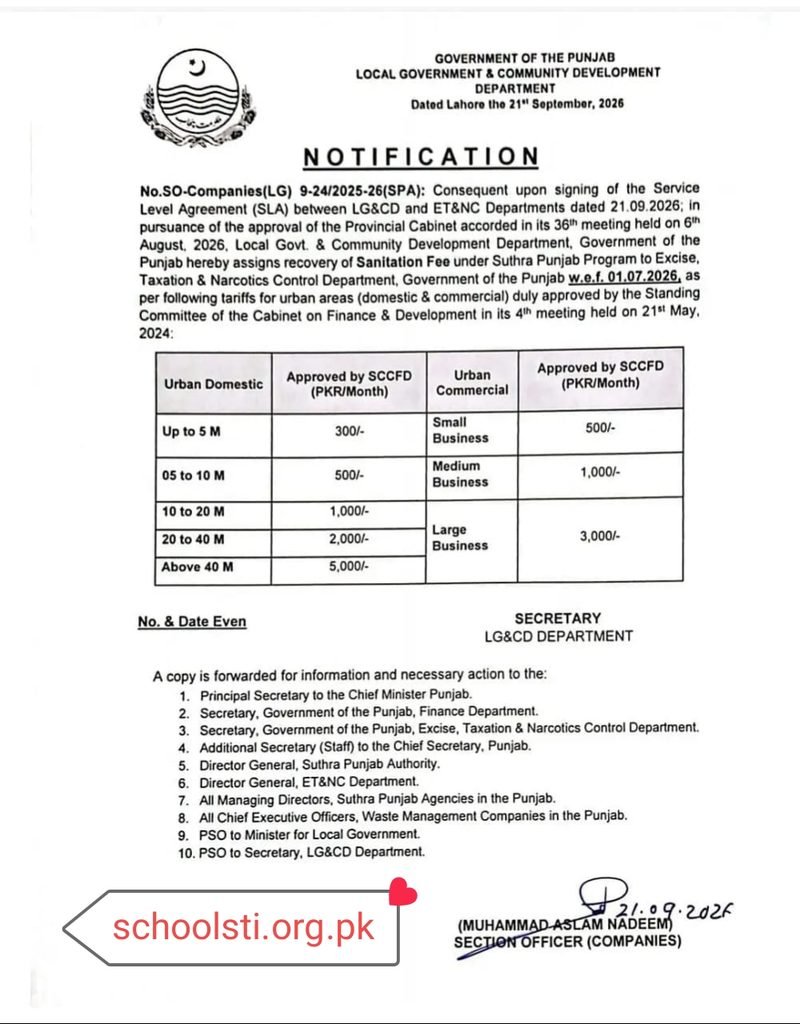
The Government of the Punjab has formally issued an official notification operationalizing the recovery of the Sanitation Fee under the flagship Suthra Punjab Program. In a major institutional restructuring, the collection mechanism has been officially assigned to the Excise, Taxation & Narcotics Control (ET&NC) Department in collaboration with the Local Government & Community Development (LG&CD) Department.
This comprehensive guide breaks down the legal background, specific monthly tariff rates for domestic and commercial urban properties, billing implementation, and administrative implications for citizens across Punjab.
Background and Policy Context
The Suthra Punjab Program is the provincial state’s comprehensive initiative aimed at overhauling municipal solid waste management, establishing zero-waste infrastructure, and ensuring daily street sweeping, waste collection, and landfill management across both metropolitan and secondary cities.
According to Notification No. SO-Companies(LG) 9-24/2025-26(SPA) issued from Lahore on 21st September, 2026:
- Inter-Departmental SLA: The assignment follows a formal Service Level Agreement (SLA) executed between the Local Government & Community Development Department and the Excise, Taxation & Narcotics Control Department.
- Cabinet Ratification: The policy was approved by the Provincial Cabinet during its 36th meeting held on 6th August, 2026.
- Tariff Approval: The approved monthly rate schedule stems from decisions made by the Standing Committee of the Cabinet on Finance & Development (SCCFD) in its 4th meeting on 21st May, 2024.
- Retroactive Effective Date: The sanitation fee applies with effect from (w.e.f.) 1st July, 2026 (the initiate of the financial twelve months).
Citizens seeking official circulars, administrative summaries, and general circulars can review ongoing policy releases through the Punjab authority notification archive on schoolsti.org.pk.
Approved Sanitation Fee Tariff Structure (Urban Areas)
The notification delineates two apparent categories for urban settlements: Domestic Properties (categorized by plot size in Marlas and Kanals) and Commercial Properties (categorized by firm scale).
1. Urban Domestic Tariff Rates
The residential sanitation fee is progressive, scaling proportionally with the covered area or plot size of the dwelling:
| Property Size Category | Plot Size Equivalent | Monthly Fee (PKR) | Annual Total (PKR) |
|---|---|---|---|
| Up to 5 Marla | Up to ~1,125 – 1,360 sq. ft. | Rs. 300/- | Rs. 3,600/- |
| 05 to 10 Marla | ~1,360 – 2,720 sq. ft. | Rs. 500/- | Rs. 6,000/- |
| 10 to 20 Marla | Up to 1 Kanal (~5,440 sq. ft.) | Rs. 1,000/- | Rs. 12,000/- |
| 20 to 40 Marla | 1 Kanal to 2 Kanal | Rs. 2,000/- | Rs. 24,000/- |
| Above 40 Marla | Over 2 Kanal | Rs. 5,000/- | Rs. 60,000/- |
2. Urban Commercial Tariff Rates
Commercial enterprises, retail shops, wholesale outlets, and corporate offices are categorized based on their operational scale:
| Category | Typical Classification | Monthly Fee (PKR) | Annual Total (PKR) |
|---|---|---|---|
| Small Business | Neighborhood grocery shops, kiosks, minor retail | Rs. 500/- | Rs. 6,000/- |
| Medium Business | Bakeries, restaurants, pharmacies, plazas, medium retail | Rs. 1,000/- | Rs. 12,000/- |
| Large Business | Departmental stores, corporate offices, shopping malls, banks | Rs. 3,000/- | Rs. 36,000/- |
Why Excise & Taxation Is Managing Fee Collection
Historically, municipal committees and waste management companies struggled with low recovery ratios when attempting direct consumer billing. By transferring recovery to the Excise, Taxation & Narcotics Control Department, the provincial administration leverages an existing, highly structured urban property tax database.
Key Operational Highlights:
- Integrated Urban Property Database: Excise maintains standardized Urban Immovable Property Tax (UIPT) assessment registers (PT-10 rolls) with verified plot dimensions and ownership records.
- Unified Challan Generation: The sanitation fee will be integrated with annual or semi-annual urban property tax challans or issued via computerized billing through e-Pay Punjab.
- Streamlined Accountability: Centralizing billing under Excise prevents parallel municipal collection squads and minimizes arbitrary field assessments.
Comparative Assessment: Domestic vs. Commercial Charges
Monthly Sanitation Fee (PKR) Comparison:
┌─────────────────────────┬──────────────┐
│ Up to 5 Marla (Res.)    │ ₨ 300        │
├─────────────────────────┼──────────────┤
│ 5–10 Marla (Res.)       │ ₨ 500        │
├─────────────────────────┼──────────────┤
│ Small Business (Comm.)  │ ₨ 500        │
├─────────────────────────┼──────────────┤
│ 10–20 Marla (Res.)      │ ₨ 1,000      │
├─────────────────────────┼──────────────┤
│ Medium Business (Comm.) │ ₨ 1,000      │
├─────────────────────────┼──────────────┤
│ 20–40 Marla (Res.)      │ ₨ 2,000      │
├─────────────────────────┼──────────────┤
│ Large Business (Comm.)  │ ₨ 3,000      │
├─────────────────────────┼──────────────┤
│ Above 40 Marla (Res.)   │ ₨ 5,000      │
└─────────────────────────┴──────────────┘
Equity and Distribution Dynamics:
- Base Tier Protection: The lowest slab (Rs. 300/month for up to 5 Marla) aims to keep the monthly burden manageable for low-to-middle-income families while establishing universal civic participation.
- Parity Between Mid-Tiers: A 5–10 Marla house pays the identical fee (Rs. 500/month) as a little commercial company, reflecting modest refuse generation volumes in those brackets.
- Progressive High-End Rates: Large residential properties exceeding 2 Kanals (Above 40 Marlas) carry the highest single domestic charge at Rs. 5,000 per month, recognizing higher waste footprints and greater municipal resource allocation.
Implementation Workflow and Inter-Agency Oversight
The notification has been formally circulated to key provincial stakeholders to ensure cross-departmental coordination:
- Suthra Punjab Authority (SPA): Directing field operations, fleet dispatch, and waste transfer logistics.
- Local Waste Management Companies (WMCs): Managing localized solid waste handling across Lahore, Multan, Rawalpindi, Faisalabad, Gujranwala, and secondary districts.
- Excise & Taxation Directorates: Handling billing generation, bank reconciliation, arrears tracking, and tax integration.
- Provincial Finance Department: Ensuring recovered funds are ring-fenced specifically for sanitation machinery, staff salaries, and disposal sites.
For verified administrative documentation and general service circulars, readers can access regular updates via schoolsti.org.pk’s educational and governance portal.
Analysis
The Suthra Punjab sanitation tariff notification marks a structural transition from subsidized municipal cleaning to a formal cost-recovery model:
- Fiscal Sustainability for Municipalities: Municipal waste companies in Punjab have faced chronic deficits, relying on ad-hoc provincial bailouts for machinery maintenance, diesel costs, and sanitary worker wages. An institutionalized fee creates a sustainable recurring revenue stream.
- Exploiting Established Administrative Infrastructure: Designating the Excise Department resolves the historical bottleneck of revenue collection. Since Excise already possesses legal enforcement powers and established recovery networks for property taxes, collection costs remain low.
- Financial Impact of Retroactive Application: Because the tariff is effective from 01.07.2026, the initial billing cycle will incorporate arrears for accrued months. Taxpayers must account for these cumulative charges in upcoming property tax invoices.
- Uniformity Across Urban Punjab: By establishing standardized provincial slabs, the notification eliminates disparate municipal council rates, setting uniform civic utility pricing across all designated urban centers.
For broader governance guidelines and policy frameworks, citizens can visit the official Government of the Punjab official portal.
Opinion: Expert Verdict
The transition toward a self-sustaining municipal waste model is fundamentally sound, but its long-term viability hinges on two critical operational factors: service equity and billing transparency.
Historically, urban residents have expressed reluctance to pay local development and conservancy cesses because municipal services were frequently irregular, especially outside core commercial avenues and high-income localities. If the Punjab state levies Rs. 300 to Rs. 5,000 per month, citizens will expect measurable improvements: daily door-to-door trash retrieval, clean neighborhood skips, and prompt redressal of overflowing containers.
Furthermore, integrating the fee into Excise billing must be accompanied by intuitive digital options via e-Pay Punjab and transparent challan line items. If the government pairs disciplined revenue recovery with visible, street-degree cleanliness, Suthra Punjab can establish a dependable model for modern civic administration across the province.
Frequently Asked Questions (FAQs)
What is the legal basis for the Suthra Punjab Sanitation Fee?
The fee was instituted under Notification No. SO-Companies(LG) 9-24/2025-26(SPA), following approval by the Provincial Cabinet in its 36th meeting on 6th August 2026, pursuant to tariff schedules approved by the Standing Committee of the Cabinet on Finance & Development (SCCFD) on 21st May 2024.
Which department is responsible for collecting the fee?
While the Local Government & Community Development (LG&CD) Department oversees municipal operations, the Excise, Taxation & Narcotics Control (ET&NC) Department is formally assigned to handle recovery and billing.
What is the monthly rate for a standard 5 Marla house?
Residential properties measuring up to 5 Marla in urban areas are assessed at Rs. 300/- per month (Rs. 3,600 annually).
How a great deal of do commercial establishments have to pay?
Commercial properties are billed according to three tiers:
- Small Business: Rs. 500/- per month
- Medium Business: Rs. 1,000/- per month
- Large Business: Rs. 3,000/- per month
When does the sanitation fee take effect?
The fee is effective retrospectively from 1st July, 2026. Citizens will see charges calculated from the beginning of the 2026–2027 fiscal twelve months.
How will residents pay this fee?
The fee will appear as a designated line item in Excise property tax challans and will be payable through scheduled banking counters and the government’s e-Pay Punjab online system.
Conclusion
The notification of the Suthra Punjab Sanitation Fee under the joint coordination of the LG&CD and Excise departments represents a determined effort to stabilize municipal finances and maintain clean urban centers across Punjab. With transparent, size-tiered rates ranging from Rs. 300 to Rs. 5,000 for residential properties and Rs. 500 to Rs. 3,000 for commercial entities, the policy provides a apparent framework for civic contributions.
To ensure sustained communal cooperation, municipal authorities must now demonstrate consistent daily service delivery, justifying these utility rates through clean neighborhoods and modern solid waste infrastructure across the province.