1st Year Pairing Scheme 2026 for Punjab Boards
1st Year Pairing Scheme 2026 for Punjab Boards: Complete Guide for Biology, Physics, Chemistry, and Mathematics
Securing foremost marks in the Intermediate Part-1 (11th Class) annual examinations requires strategic preparation rather than blind memorization. For FSc (Pre-Medical and Pre-Engineering) and ICS students across Pakistan, the 1st Year Pairing Scheme 2026 serves as an essential academic roadmap. Aligned with the latest Student Learning Outcomes (SLOs) policy regulated by the Punjab Curriculum and Textbook Board (PCTB) and implemented across all nine Boards of Intermediate and Secondary Education (BISE) in Punjab—including BISE Lahore, Faisalabad, Multan, Gujranwala, Rawalpindi, Sargodha, Bahawalpur, DG Khan, and Sahiwal—this assessment framework breaks down exact chapter weightages for Multiple Choice Questions (MCQs), Short Questions, and Long Questions.
By understanding how examiners pair chapters in the subjective and objective sections, students can optimize their study schedules, prioritize high-yield chapters, and walk into the examination hall with complete confidence. You can access the entire 1st Year Pairing Scheme 2026 PDF collection to keep these subject breakdowns handy on your devices for offline revision.
Why the 2026 Punjab Boards Pairing Scheme Matters Under the New SLO Policy
The examination system across Punjab Boards has transitioned away from rote learning toward conceptual and analytical testing. Under the current board evaluation guidelines set in coordination with the Inter Boards Coordination Commission (IBCC), papers are structured around three core cognitive domains:
- Knowledge-Based Questions (50%): Direct definitions, laws, formulas, and recall-based concepts from textbook chapters.
- Understanding & Conceptual Questions (35%): Questions requiring students to explain mechanisms, compare biological or chemical processes, and interpret scientific phenomena.
- Application & Analytical Questions (15%): Unseen numerical problems, genuine-planet scenarios, and diagram-based inquiries that test practical application.
Given that the syllabus for 11th Class Science subjects is vast, attempting to cover every single page with equal intensity commonly leads to burnout. A verified pairing scheme bridges the gap between hard work and smart labor, allowing you to identify which chapters carry the highest mark density and which chapters are paired together in the 24-mark (Science) or 30-mark (Mathematics) descriptive sections.
11th Class Biology Pairing Scheme 2026 (FSc Pre-Medical)
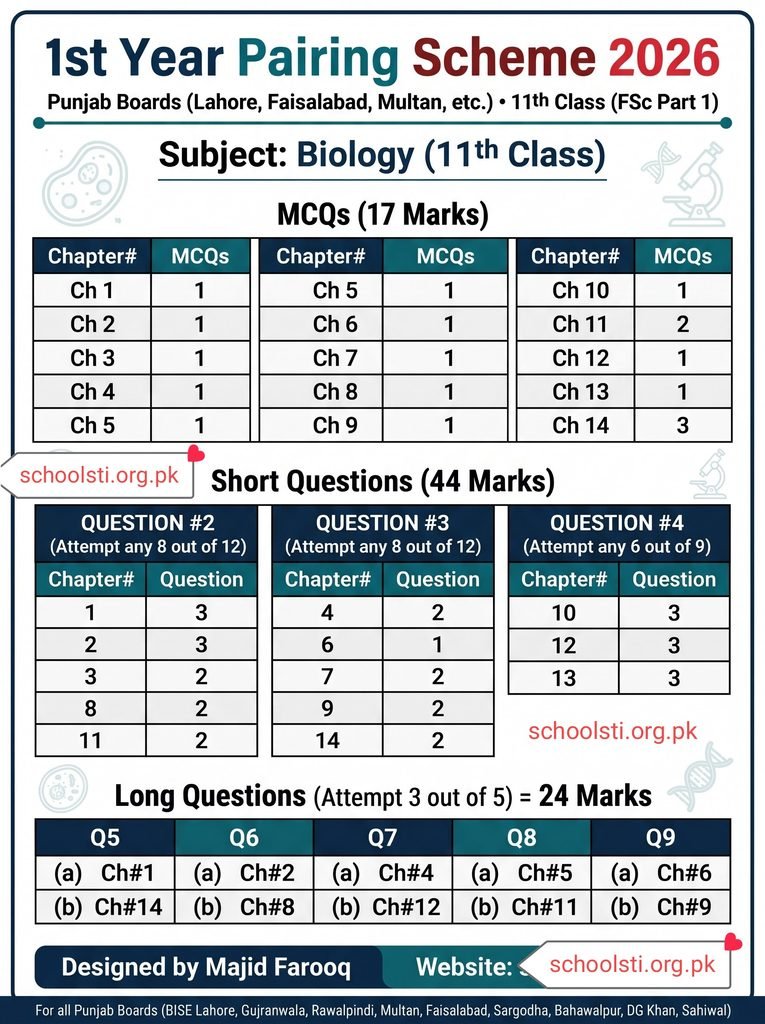
The 1st Year Biology paper carries a total of 85 theory marks, divided into 17 marks for Objective MCQs, 44 marks for Short Questions, and 24 marks for Long Questions.
1. Biology MCQs Distribution (17 Marks)
Every chapter in the 11th-grade Biology textbook contributes to the objective paper, with Chapter 11 (Bioenergetics) and Chapter 14 (Transport) carrying the highest weightage.
- 1 MCQ each: Chapters 1, 2, 3, 4, 5, 6, 7, 8, 9, 10, 12, and 13.
- 2 MCQs: Chapter 11.
- 3 MCQs: Chapter 14.
2. Biology Short Questions Breakdown (44 Marks)
This section is split into three distinct questions, offering roughly 33% internal choice in each block:
| Question Block | Internal Choice | Chapter-Wise Question Allocation | Total Marks |
|---|---|---|---|
| Question #2 | Attempt any 8 out of 12 |
| Ch 1 (3), Ch 2 (3), Ch 3 (2), Ch 8 (2), Ch 11 (2)
| 16 Marks |
| Question #3 | Attempt any 8 out of 12
| Ch 4 (2), Ch 6 (1), Ch 7 (2), Ch 9 (2), Ch 14 (2)*
| 16 Marks |
| Question #4 | Attempt any 6 out of 9
| Ch 10 (3), Ch 12 (3), Ch 13 (3)
| 12 Marks |
(Note: In Question #3, standard board adjustments distribute the remaining 3 short questions across Chapters 7, 9, and 14 to entire the 12-question pool).
3. Biology Long Questions Pairing (24 Marks — Attempt Any 3 out of 5)
Each long inquiry consists of an (a) part and a (b) part, worth 4 marks each (8 marks per full inquiry).
- Q.5: Chapter 1 (a) + Chapter 14 (b)
- Q.6: Chapter 2 (a) + Chapter 8 (b)
- Q.7: Chapter 4 (a) + Chapter 12 (b)
- Q.8: Chapter 5 (a) + Chapter 11 (b)
- Q.9: Chapter 6 (a) + Chapter 9 (b)
11th Class Physics Pairing Scheme 2026 (FSc Pre-Medical, Pre-Engineering & ICS)
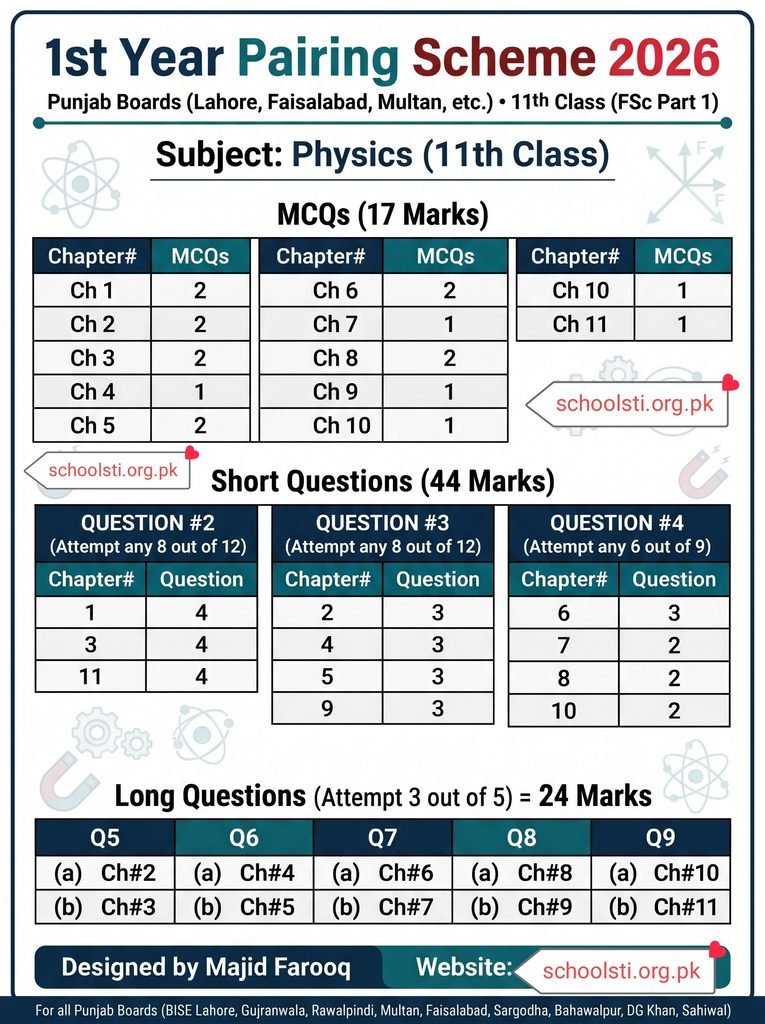
1st Year Physics is widely considered one of the most challenging subjects due to its blend of theoretical derivations and complex numerical problems. The theory paper totals 85 marks.
1. Physics MCQs Distribution (17 Marks)
- 2 MCQs each: Chapters 1, 2, 3, 5, 6, and 8 (12 Marks total).
- 1 MCQ each: Chapters 4, 7, 9, 10, and 11 (5 Marks total).
2. Physics Short Questions Breakdown (44 Marks)
Mastering the textbook exercise short questions along with key conceptual chapter checkpoints guarantees high marks in this section.
| Question Block | Internal Choice | Chapter-Wise Question Allocation | Total Marks |
|---|---|---|---|
| Question #2 | Attempt any 8 out of 12 |
| Ch 1 (4), Ch 3 (4), Ch 11 (4)
| 16 Marks |
| Question #3 | Attempt any 8 out of 12
| Ch 2 (3), Ch 4 (3), Ch 5 (3), Ch 9 (3)
| 16 Marks |
| Question #4 | Attempt any 6 out of 9
| Ch 6 (3), Ch 7 (2), Ch 8 (2), Ch 10 (2)
| 12 Marks |
3. Physics Long Questions & Numerical Pairing (24 Marks — Attempt Any 3 out of 5)
In Physics, one part is typically a theoretical derivation (5 marks) and the other is a numerical problem (3 marks).
- Q.5: Chapter 2 (a) + Chapter 3 (b)
- Q.6: Chapter 4 (a) + Chapter 5 (b)
- Q.7: Chapter 6 (a) + Chapter 7 (b)
- Q.8: Chapter 8 (a) + Chapter 9 (b)
- Q.9: Chapter 10 (a) + Chapter 11 (b)
11th Class Chemistry Pairing Scheme 2026 (FSc Part 1)
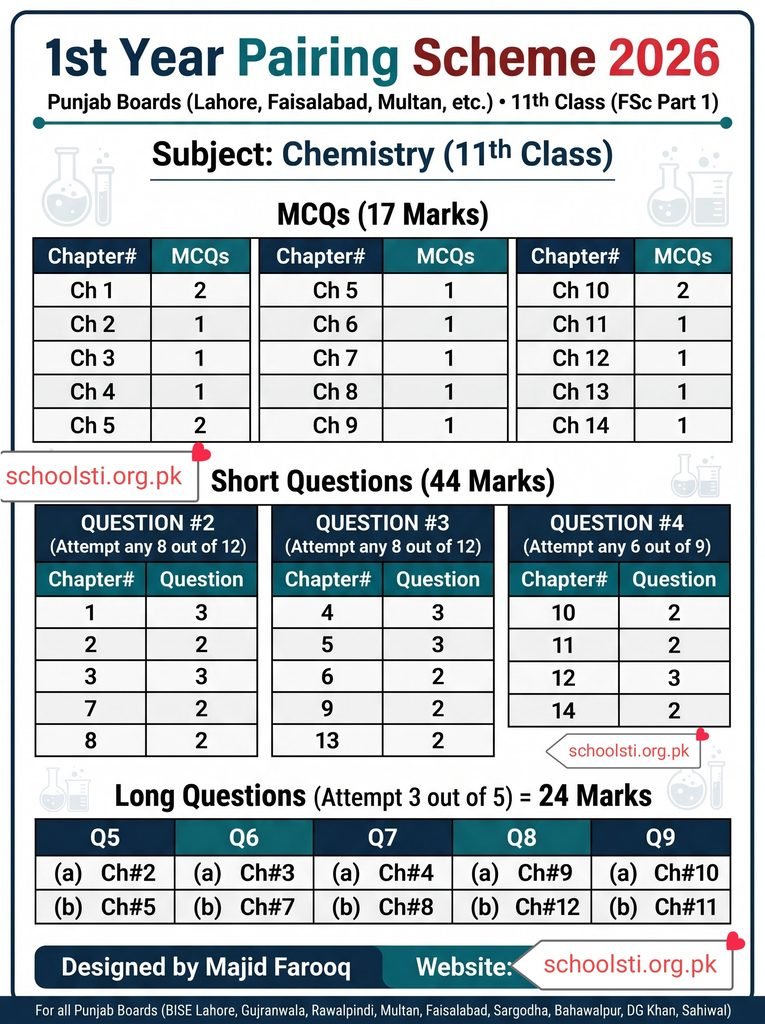
1st Year Physical and Inorganic Chemistry consists of 11 core chapters (historically numbered up to 14 across varying print editions) totaling 85 marks.
1. Chemistry MCQs Distribution (17 Marks)
- 2 MCQs each: Chapters 1, 5, and 10.
- 1 MCQ each: Chapters 2, 3, 4, 6, 7, 8, 9, 11, 12, 13, and 14.
2. Chemistry Short Questions Breakdown (44 Marks)
| Question Block | Internal Choice | Chapter-Wise Question Allocation | Total Marks |
|---|---|---|---|
| Question #2 | Attempt any 8 out of 12 |
| Ch 1 (3), Ch 2 (2), Ch 3 (3), Ch 7 (2), Ch 8 (2)
| 16 Marks |
| Question #3 | Attempt any 8 out of 12
| Ch 4 (3), Ch 5 (3), Ch 6 (2), Ch 9 (2), Ch 13 (2)
| 16 Marks |
| Question #4 | Attempt any 6 out of 9
| Ch 10 (2), Ch 11 (2), Ch 12 (3), Ch 14 (2)
| 12 Marks |
3. Chemistry Long Questions Pairing (24 Marks — Attempt Any 3 out of 5)
Note that numerical problems in Chemistry are heavily concentrated in Chapter 1 (Stoichiometry), Chapter 3 (Gases), and Chapter 8 (Chemical Equilibrium).
- Q.5: Chapter 2 (a) + Chapter 5 (b)
- Q.6: Chapter 3 (a) + Chapter 7 (b)
- Q.7: Chapter 4 (a) + Chapter 8 (b)
- Q.8: Chapter 9 (a) + Chapter 12 (b)
- Q.9: Chapter 10 (a) + Chapter 11 (b)
11th Class Mathematics Pairing Scheme 2026 (FSc Pre-Engineering & ICS)
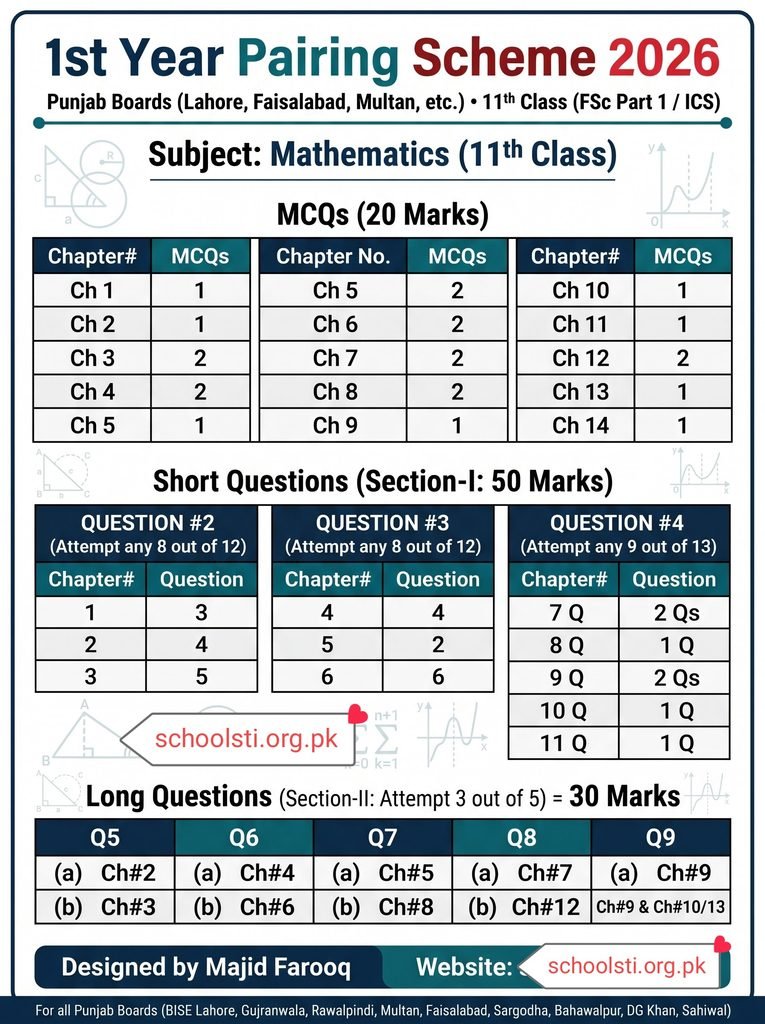
Unlike the lab-based sciences, 1st Year Mathematics carries a full 100 marks, with no practical examination. The paper comprises 20 marks for MCQs, 50 marks for Short Questions (Section-I), and 30 marks for Long Questions (Section-II).
1. Mathematics MCQs Distribution (20 Marks)
- 2 MCQs each: Chapters 3, 4, 6, 7, 8, and 12.
- 1 MCQ each: Chapters 1, 2, 5, 9, 10, 11, 13, and 14.
2. Mathematics Short Questions Breakdown (50 Marks)
Mathematics splits its short questions into Algebra, Sequences/Series, and Trigonometry:
| Question Block | Internal Choice | Chapter-Wise Question Allocation | Total Marks |
|---|---|---|---|
| Question #2 | Attempt any 8 out of 12 |
| Ch 1 (3), Ch 2 (4), Ch 3 (5)
| 16 Marks |
| Question #3 | Attempt any 8 out of 12
| Ch 4 (4), Ch 5 (2), Ch 6 (6)
| 16 Marks |
| Question #4 | Attempt any 9 out of 13
| Ch 7 (2), Ch 8 (1), Ch 9 (2), Ch 10 (1), Ch 11 (1) + Ch 12, 13, 14 (6 combined)
| 18 Marks |
3. Mathematics Long Questions Pairing (30 Marks — Attempt Any 3 out of 5)
Each full inquiry carries 10 marks (5 marks for part a, 5 marks for part b).
- Q.5: Chapter 2 (a) + Chapter 3 (b)
- Q.6: Chapter 4 (a) + Chapter 6 (b)
- Q.7: Chapter 5 (a) + Chapter 8 (b)
- Q.8: Chapter 7 (a) + Chapter 12 (b)
- Q.9: Chapter 9 (a) + Chapter 10 or Chapter 13 (b)
To supplement your practice across all four subjects, downloading Punjab Boards 11th class study notes and past papers will aid you test your readiness against actual board-style questions.
Comparison Section: 1st Year Core Science & Math Subjects at a Glance
Understanding the structural differences between your core subjects helps you allocate your daily revision hours proportionally.
| Evaluation Metric | Biology (11th) | Physics (11th) | Chemistry (11th) | Mathematics (11th) |
|---|---|---|---|---|
| Total Theory Marks | 85 Marks |
| 85 Marks
| 85 Marks
| 100 Marks
|
| Objective (MCQs) | 17 Marks (20 Mins)
| 17 Marks (20 Mins)
| 17 Marks (20 Mins)
| 20 Marks (30 Mins)
|
| Short Questions | 44 Marks (22 Attempts)
| 44 Marks (22 Attempts)
| 44 Marks (22 Attempts)
| 50 Marks (25 Attempts)
|
| Long Questions | 24 Marks (3 of 5)
| 24 Marks (3 of 5)
| 24 Marks (3 of 5)
| 30 Marks (3 of 5)
|
| Highest-Yield Chapters | Ch 1, 2, 4, 11, 14
| Ch 2, 3, 4, 5, 11
| Ch 2, 3, 4, 5, 7, 8
| Ch 2, 3, 4, 6, 9, 12
|
| Primary Scoring Challenge | Labeled Diagrams & Terminology | Numericals & Vector Derivations | Chemical Equations & Stoichiometry | Trigonometric Proofs & Algebra |
Analysis
A deep-dive evaluation of the 1st Year Pairing Scheme 2026 reveals several critical patterns that high-achieving students can leverage immediately:
- The “67% Choice Rule” in Short Questions: Across all four subjects, Short Questions represent the single largest scoring block—accounting for 51.7% of the total marks in Biology, Physics, and Chemistry (44/85), and 50% of the total marks in Mathematics (50/100). Because each sub-section provides a 33% buffer (e.g., attempting 8 out of 12), you can strategically master 3 to 4 core chapters per block and still secure 100% marks in Section-I.
- Sequential Pairing in Physics vs. Cross-Book Pairing in Biology: Physics follows a linear, sequential pairing model for Long Questions (Ch 2+3, Ch 4+5, Ch 6+7, Ch 8+9, Ch 10+11), making it remarkably predictable. Conversely, Biology pairs early foundational chapters with complex physiological chapters at the complete of the book (such as Ch 1 with Ch 14, and Ch 4 with Ch 12), forcing students to study both halves of the textbook.
- Trigonometry Dominance in Mathematics: In 11th Class Mathematics, Chapters 9 through 14 (Trigonometry) account forQuestion #4 entirely and anchor Question #8 and Question #9 in the long section. Students who struggle with Trigonometry cannot pass with an A+ grade, whereas mastering Chapters 2, 3, 4, and 6 alone locks in two whole Long Questions (Q.5 and Q.6) and up to 24 marks in Short Questions.
Opinion
From an academic strategy perspective, treating the pairing scheme as a shortcut to skip 40% of the syllabus is the biggest mistake an FSc or ICS pupil can make. While it is mathematically achievable to select just six chapters for Long Questions and leave the remaining chapters untouched for descriptive prep, the Punjab Boards’ 2026 SLO examination framework is specifically designed to penalize entire chapter omissions.
Here is my expert verdict on how you should actually utilize this scheme:
- Never Skip a Chapter for MCQs and Short Questions: Even if you drop a pair of chapters for Long Questions (such as Q.8 and Q.9), those chapters still contribute heavily to the 17/20-mark MCQ paper and the 44/50-mark Short Question section. Furthermore, entry tests like MDCAT and ECAT test 100% of the syllabus.
- Prepare One Extra Long Question Pair as a Buffer: Always prepare 4 Long Question pairs instead of the minimum required 3. Under the 15% Application/Analytical SLO quota, examiners occasionally insert a tricky conceptual twist or an unseen numerical in one of the long query parts. Having a fourth pair prepared acts as an insurance policy against losing 4 to 5 marks on exam day.
- Prioritize “Double-Duty” Chapters First: Start your revision with chapters that carry heavy weightage in both Short and Long Questions—such as Chapters 2, 3, and 4 in Physics, Chapters 1, 2, 11, and 14 in Biology, Chapters 3, 4, 7, and 8 in Chemistry, and Chapters 3, 4, and 6 in Mathematics.
Frequently Asked Questions (FAQs)
1. Is the 1st Year Pairing Scheme 2026 applicable to all Punjab Boards?
Yes, this pairing scheme is uniformly applicable across all nine BISE boards in Punjab: Lahore, Gujranwala, Rawalpindi, Multan, Faisalabad, Sargodha, Bahawalpur, DG Khan, and Sahiwal, as well as AJK Board which follows the PCTB curriculum.
2. Can the board change the pairing scheme at the ultimate minute?
While the MCQs and Short Question chapter groupings remain 95% consistent with the official assessment model, boards do not legally guarantee Long Question pairings. Occasionally, a minor 1-question shift can occur under the updated SLO policy, which is why preparing one backup long inquiry is always recommended.
3. Which chapters are top to select for Long Questions in 1st Year Biology?
Most high-scoring Pre-Medical students opt for Q.5 (Ch 1 & 14), Q.6 (Ch 2 & 8), and Q.8 (Ch 5 & 11) since these chapters feature obvious, diagram-friendly topics where examiners seldom deduct marks.
4. Where do the MCQs come from in 11th Class Science papers?
Roughly 70% to 80% of the MCQs are taken directly from the textbook exercise questions and past board papers, while the remaining 20% to 30% are conceptual SLO-based statements extracted from chapter text, side-boxes, and tables.
5. Is there any choice in the numerical problems of 1st Year Physics?
No, there is no internal choice between a theory part and a numerical part within the identical Long Question. To earn the full 8 marks for any Long Question in Physics (e.g., Q.5), you must solve both the 5-mark theoretical derivation from one chapter and the 3-mark numerical from its paired chapter.
Conclusion
Mastering the 1st Year Pairing Scheme 2026 gives you a decisive competitive edge in your HSSC Part-1 board exams. By aligning your daily study blocks with the exact mark distribution for Biology, Physics, Chemistry, and Mathematics, you eliminate guesswork and channel your energy into the chapters that matter most. Pair this blueprint with consistent past paper practice, neat diagram presentation, and conceptual clarity to turn your 2026 board exams into a launchpad for your upcoming medical, engineering, or computer science career.