Complete Guide to the Teacher Rationalization Policy in Punjab 2026
Complete Guide to the Teacher Rationalization Policy in Punjab 2026
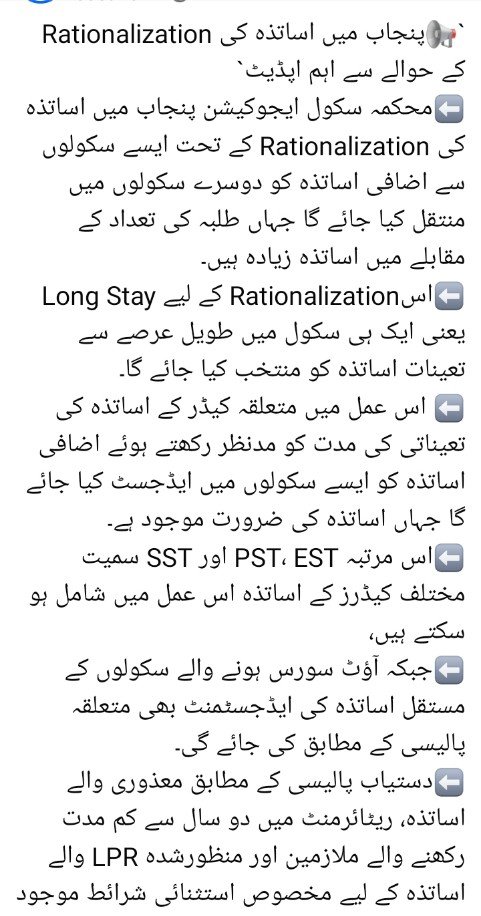
Complete Guide to the Teacher Rationalization Policy in Punjab: Rules, Long-Stay Criteria, and Exemptions
Introduction
The School Education Department (SED) Punjab has initiated a comprehensive teacher rationalization process across the province to resolve severe staffing disparities in public sector schools. Under this updated policy directive, surplus teachers—educators working in schools where the teaching staff exceeds the required pupil-teacher ratio (STR)—will be systematically transferred to understaffed institutions.
For years, urban and semi-urban schools in Punjab have frequently operated with an excess of educators, while rural and remote institutions struggled with acute educator shortages, multi-grade classrooms, and high pupil-to-educator ratios. By leveraging real-period enrollment and staffing metrics through the School Information System (SIS), the provincial state aims to balance human resources without immediately relying on costly mass recruitment drives.
This phase of rationalization directly impacts Primary School Teachers (PST), Elementary School Teachers (EST), and Secondary School Teachers (SST). It prioritizes shifting educators with the longest tenure at a single station (“long stay”), establishes obvious relocation pathways for permanent staff in newly outsourced schools, and preserves strict humanitarian protections for vulnerable employees. Whether you are a government educator checking your transfer vulnerability or an administrator auditing your school’s staffing ceiling, understanding the mechanics of this directive is critical.
Core Pillars of the Punjab Teacher Rationalization Update
To ensure transparency and prevent arbitrary administrative actions, the School Education Department (SED) Punjab has anchored the rationalization round in automated, algorithm-driven parameters on the SIS portal. The key operational directives contain:
- Identification of Surplus Staff: Any academy where the number of working teachers exceeds the official Student-Teacher Ratio (typically benchmarked at 1:40 for broad primary/elementary sections, alongside specific subject-to-section ratios for high schools) is flagged as holding surplus posts.
- The “Long Stay” Selection Rule: When a institution has surplus staff within a exact cadre, the educator with the longest continuous stay (tenure) at that current institution is selected for reassignment.
- Need-Based Reassignment: Reassigned educators are not transferred randomly; they are mapped directly to schools within the same cluster, tehsil, or district experiencing an acute deficiency of teaching staff in their exact cadre and subject.
- Multi-Cadre Coverage: Unlike limited adjustments that only targeted primary educators, this phase encompasses PST (BS-12/14), EST (BS-14/15), and SST (BS-16) cadres simultaneously.
- Adjustment of Outsourced School Staff: Permanent authority teachers currently posted in low-performing schools handed over to exclusive management under the Public School Reorganization Program (PSRP) are systematically relocated to nearby communal schools with vacant sanctioned posts.
- Protected Exemptions: Teachers with certified physical disabilities, educators with less than two years remaining until superannuation (retirement), and employees on approved Leave Preparatory to Retirement (LPR) are legally shielded from compulsory rationalization transfers.
How the “Long Stay” and Surplus Formula Works
A major point of friction in historical rationalization drives (such as the 2010 and 2019 frameworks) was the “junior-most” vs. “senior-most” debate. Under the updated framework, the SED utilizes the Long Stay Principle to determine who moves when a post is declared surplus.
1. Calculating Student-Teacher Ratio (STR) and Workload
Before any educator is touched, the SIS portal evaluates the school’s verified enrollment data:
- Primary Level: A minimum baseline of teachers is guaranteed per school, scaling upward at intervals of approximately 40 students per instructor. If enrollment drops below the required threshold (for instance, 1 teacher per 30 or fewer students in overstaffed stations), the excess post is marked as surplus.
- Elementary & Secondary Level: Assessed via both overall section sizes and subject-particular workload (e.g., Science/Math vs. Arts/General). A school might have a balanced overall STR but hold three SST (Arts) teachers for a single section while lacking an SST (Science).
2. Applying the “Long Stay” Tenure Filter
Once a exact cadre (e.g., PST or EST-General) in a academy is identified as having one or more surplus teachers, the framework ranks the working teachers of that exact cadre by their date of joining in the current school.
The educator who has enjoyed the longest uninterrupted stay at that station (provided they have completed at least three years of tenure there) is selected for rationalization. This prevents newly transferred or recently recruited teachers from being uprooted repeatedly while veteran staff remain permanently entrenched in high-comfort urban centers. Furthermore, geographic boundaries are respected wherever achievable—targeting needy schools within a 15 km radius for female teachers and a 25 km radius for male teachers within the markaz or tehsil.
Cadre-Wise Impact: PST, EST, and SST Breakdown
Because teaching requirements differ vastly between early childhood classrooms and matriculation laboratories, the rationalization policy applies distinct criteria across the three primary teaching cadres. Alongside temporary assist initiatives like the School Teacher Interns (STI) recruitment updates, redeploying permanent cadres remains the primary mechanism for stabilizing academic performance.
| Teacher Cadre | Basic Pay Scale | Basis of Surplus Calculation | Target Reassignment Priority |
|---|---|---|---|
| PST (Primary School Teacher) | BS-12 / BS-14 | Overall institution enrollment & Student-Teacher Ratio (1:40 benchmark). | Single-instructor primary schools, zero-educator schools, and high-STR primary sections. |
| EST (Elementary School Teacher) | BS-14 / BS-15 | Section enrollment (Classes 6–8) + Subject group (Science, Arts, Arabic, PET, Drawing). | Elementary schools and middle sections of high schools lacking subject specialists. |
| SST (Secondary School Teacher) | BS-16 | High institution section count (Classes 9–10) + Specific subject combinations (Math/Physics, Bio/Chem, CS, Arts). | Single-section high schools without science/IT staff and high-enrollment secondary schools. |
Adjustment of Permanent Teachers from Outsourced Schools
One of the most consequential reforms in Punjab’s education landscape is the outsourcing of thousands of low-enrollment and underperforming public schools to confidential partners and edupreneurs through the Punjab Education Foundation (PEF) and the Punjab Education Initiatives Management Authority (PEIMA).
When a state school is handed over to exclusive management under the Public School Reorganization Program (PSRP), the private partner recruits its own instructional staff. Nevertheless, the permanent authority teachers previously working in those schools retain complete civil service role security. Under the rationalization directive:
- Immediate Pool Placement: Permanent teachers from outsourced schools are placed in a priority adjustment pool at the Tehsil/District Education Officer (DEO) stage.
- Matching with Deficient Schools: Instead of sitting idle or drawing salaries without active classrooms, these teachers are mapped to the nearest non-outsourced state schools that have vacant sanctioned posts or high STRs.
- Preference by Seniority & Proximity: When multiple teachers from outsourced schools compete for a nearby needy institution, seniority and proximity (especially for female educators) govern the final placement order.
For detailed district-wise lists of affected institutions and ongoing staffing transitions, educators regularly consult the Punjab instructor transfer and rationalization portal to track SIS notifications and markaz-standard vacancy matrices.
Comparison: Standard E-Transfer vs. Rationalization Transfer
Many educators confuse standard E-Transfer rounds with Rationalization. While both are executed digitally via the SIS app, their legal triggers, eligibility rules, and outcomes are fundamentally varied.
| Feature / Parameter | Standard E-Transfer Policy | Rationalization Transfer Policy |
|---|---|---|
| Primary Nature | Voluntary (Teacher initiates the application on SIS). | Mandatory / Administrative (Department initiates based on STR data). |
| Core Objective | Employee convenience, promotions, mutual swaps, and compassionate hardship. | Equitable educator distribution and eliminating staff deficits in needy schools. |
| Selection Criteria | Merit score based on seniority, tenure, distance, wedlock, or disability. | Long Stay (longest tenure in the current academy) among surplus cadres. |
| Post Mobility | Teacher moves to an existing vacant sanctioned post. | Teacher is moved with or against a post to balance enrollment needs. |
| Minimum Stay Rule | Usually requires 3 years of stay to apply out of high-STR schools. | Targets teachers who have stayed the longest in low-STR (surplus) schools. |
| Refusal / Non-Compliance | Failure to join bars the instructor from applying for 3 years. | Non-compliance triggers strict disciplinary proceedings under PEEDA Act. |
Official Exemptions: Who is Protected from Rationalization?
Recognizing that forced relocation can inflict severe physical and financial hardship on vulnerable segments of the workforce, the Punjab School Education Department has codified strict exemptions. You will not be selected for compulsory rationalization if you fall into any of the following verified categories:
1. Teachers with Certified Disabilities
Educators possessing a valid Disability Certificate issued by the District Assessment Board / Social Welfare Department (and updated on their SIS profile) are exempt from compulsory displacement. If their school is outsourced, they are adjusted in the closest accessible institution to their residence.
2. Less Than Two Years to Retirement
Any educator whose date of superannuation (reaching the age of 60) falls within less than two years from the date of the rationalization order is protected. Uprooting an educator during the final 24 months of their service disrupts pension paper processing and service book verification.
3. Employees on LPR (Leave Preparatory to Retirement)
Teachers who have formally applied for and been granted Leave Preparatory to Retirement (LPR) (up to 365 days prior to retirement) are excluded from active rationalization rosters, as they are already transitioning out of active classroom duty.
Actionable Tip for Exempt Teachers: Ensure your SIS profile accurately reflects your disability certificate, retirement date, or LPR sanction order before the District Education Authority locks the rationalization data. If you are mistakenly tagged due to outdated SIS data, file a formal representation immediately with the District Grievance Redressal Committee (headed by the CEO DEA).
Analysis
A closer look at the Punjab School Education Department’s rationalization framework reveals four structural takeaways for the province’s education ecosystem:
- Shift from Hiring to Optimization: With fiscal constraints tightening provincial budgets, the Punjab administration is prioritizing human resource optimization over mass regular recruitments. By combining institution outsourcing (PSRP) with aggressive rationalization, the SED is liberating thousands of permanent teachers from low-enrollment schools and funneling them into overcrowded classrooms.
- Closing the Urban-Rural Divide: Historically, political interference allowed influential teachers to cluster in urban centers, leaving rural schools functionally crippled. Tying rationalization to SIS enrollment metrics and the “Long Stay” rule removes human discretion at the clerk and DEO levels, forcing an objective redistribution of talent.
- Ending the “Comfort Zone” Stagnation: Selecting teachers based on “long stay” rather than picking on the junior-most recruits addresses a long-standing grievance of younger educators. Previously, newly hired teachers were bounced from institution to school as surplus, while senior staff remained untouched for decades.
- Administrative Friction Ahead: While the policy is sound on paper, absorbing permanent teachers from thousands of outsourced schools into remaining communal schools will temporarily inflate STRs in semi-urban clusters, requiring meticulous micro-planning by District Education Authorities (DEAs).
Opinion
From an educational policy and open administration standpoint, rationalization based on the “Long Stay” principle is a essential, overdue corrective measure—provided it is executed with geographic empathy.
No open education framework can justify paying full civil-service salaries to five teachers in a school of 60 students while a neighboring academy of 350 students operates with just two educators. Using digital SIS enrollment data to move PSTs, ESTs, and SSTs to where students actually sit is the hallmark of modern governance. Furthermore, exempting differently-abled teachers and those within two years of retirement demonstrates institutional maturity and respect for employee welfare.
Nonetheless, the true test of this policy lies in its distance parameters and grievance redressal. Moving a long-stay educator to a needy institution 8 to 15 kilometers away solves an educational crisis; moving a female instructor 50 kilometers away into an area without open transport creates a retention crisis and fuels absenteeism. If the School Education Department strictly enforces cluster-based proximity, maintains 100% transparency on the SIS portal, and honors its exemption clauses without bureaucratic hurdles, this rationalization drive will stand out as one of the most effective structural reforms in Punjab’s academic history.
Frequently Asked Questions (FAQs)
What is meant by instructor rationalization in the Punjab Education Department?
Teacher rationalization is an administrative process conducted by the School Education Department (SED) Punjab to balance the Student-Teacher Ratio (STR) across communal schools. Surplus teachers from overstaffed or low-enrollment schools are systematically transferred to understaffed schools facing a shortage of educators.
Why are “long stay” teachers being selected for rationalization instead of junior teachers?
The department introduced the “long stay” criterion to ensure fairness and prevent recently posted teachers from being repeatedly displaced. Under this rule, when a school has surplus staff in a precise cadre, the instructor who has served at that particular station for the longest continuous duration is selected for reassignment to a needy school.
Which teaching cadres are included in this rationalization round?
This rationalization round applies across primary, elementary, and secondary tiers, specifically covering PST (Primary School Teachers), EST (Elementary School Teachers across all subject groups), and SST (Secondary School Teachers in Science, Arts, and Computer Science).
What happens to permanent state teachers working in outsourced (PEF/PEIMA) schools?
Permanent government teachers posted in schools handed over to personal management under the Public School Reorganization Program (PSRP) do not lose their government jobs. Instead, they are placed in a priority adjustment pool and transferred to nearby non-outsourced communal schools where vacant posts or high learner-educator ratios exist.
Who is officially exempt from the Punjab teacher rationalization process?
According to SED policy, three primary categories are exempt from compulsory rationalization transfers:
- Teachers with certified physical disabilities.
- Teachers who have less than two years remaining until their official retirement date.
- Employees who have been officially granted LPR (Leave Preparatory to Retirement).
Can a rationalized teacher file an appeal if transferred to a distant school or tagged by mistake?
Yes. If a instructor is erroneously marked as surplus due to incorrect SIS enrollment data, or if an exempt educator (disabled or near retirement) is issued transfer orders, they can submit a formal written representation with documentary proof to the District Grievance Redressal Committee at their respective Chief Executive Officer (CEO) District Education Authority office.