Punjab Healthcare Commission Directive on Mandatory Staff Uniforms
Punjab Healthcare Commission Directive on Mandatory Staff Uniforms and Infection Control: The Complete Compliance Guide (2026)
Introduction
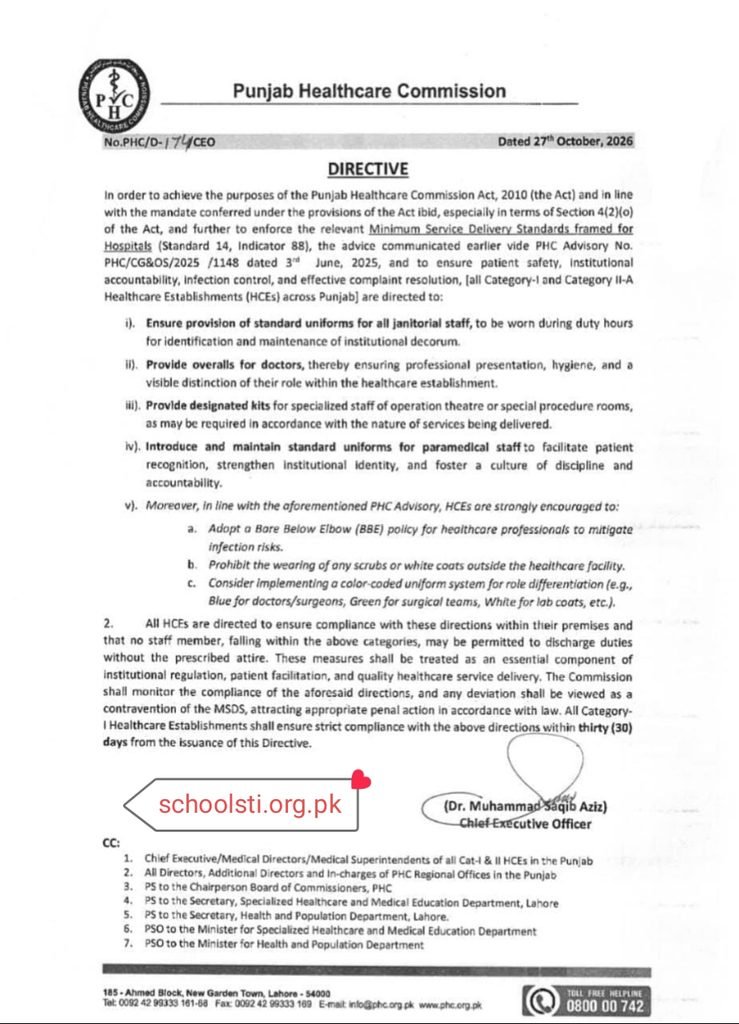
On October 27, 2026, the Punjab Healthcare Commission (PHC) issued a landmark regulatory order—Directive No. PHC/D-174/CEO—mandating standardized uniforms, protective clinical attire, and stringent infection control protocols across all Category-I and Category II-A Healthcare Establishments (HCEs) in Punjab. Signed by PHC Chief Executive Officer Dr. Muhammad Saqib Aziz, this directive transitions previous clinical dress code recommendations into strictly enforceable legal obligations under the Punjab Healthcare Commission Act, 2010.
For hospital administrators, medical superintendents, and clinical directors, this mandate is far more than a cosmetic makeover. Rooted in Section 4(2)(o) of the PHC Act and Standard 14, Indicator 88 of the Minimum Service Delivery Standards (MSDS), the directive directly links staff presentation to patient safety, nosocomial infection control, institutional accountability, and effective complaint resolution. With a strict 30-day compliance window initiated for Category-I hospitals, understanding the operational, legal, and clinical mechanics of this directive is critical to avoiding regulatory penalties and elevating patient trust.
Understanding the Legal & Regulatory Framework of PHC Directive No. PHC/D-174/CEO
To appreciate the weight of the October 2026 directive, healthcare leaders must examine its statutory foundation. The Punjab Healthcare Commission exercises broad statutory authority under the Punjab Healthcare Commission Act, 2010 to regulate open and private healthcare entities, eradicate quackery, and enforce clinical governance across the province.
Statutory Authority and MSDS Standard 14 (Indicator 88)
The directive specifically invokes Section 4(2)(o) of the Act, which empowers the Commission to issue legally binding regulations, guidelines, instructions, and directives to healthcare service providers. Furthermore, it operationalizes Standard 14, Indicator 88 of the Minimum Service Delivery Standards (MSDS) framed for hospitals.
Previously, the PHC communicated these expectations as guidance via PHC Advisory No. PHC/CG&OS/2025/1148, dated June 3, 2025. By elevating that advisory into a formal Directive, the Commission has closed the gap between voluntary finest practices and mandatory licensing compliance. Just as public sector institutions monitor institutional compliance and staffing directives to maintain administrative transparency, healthcare establishments in Punjab are now legally bound to ensure zero deviation from prescribed dress codes during duty hours.
Core Mandates: Breakdown of Mandatory Uniform & Attire Requirements
Directive No. PHC/D-174/CEO establishes four non-negotiable mandates (Clauses i to iv) and three strongly encouraged clinical governance protocols (Clause v) for all Category-I (50+ beds) and Category II-A hospitals across Punjab.
1. Mandatory Requirements by Staff Category
- Janitorial Staff (Clause i): All healthcare facilities must ensure the provision of standard uniforms for all janitorial and housekeeping personnel. These uniforms must be worn throughout duty hours to ensure immediate visual identification and preserve institutional decorum.
- Doctors and Medical Officers (Clause ii): Hospitals must supply standardized overalls (white coats) for doctors. This requirement guarantees professional presentation, reinforces clinical hygiene, and establishes a apparent, visible distinction of the physician’s role within the medical facility.
- Operation Theatre (OT) & Special Procedure Staff (Clause iii): Specialized personnel working inside Operation Theatres, Intensive Care Units, Labor Rooms, or special procedure suites must be provided with designated surgical kits and scrubs tailored to the sterile nature of the clinical services being delivered.
- Paramedical & Allied Health Staff (Clause iv): Establishments must introduce and maintain standard uniforms for all paramedical staff (nurses, technicians, phlebotomists, and ward assistants). This facilitates rapid patient recognition, strengthens institutional identity, and fosters a workplace culture of discipline and accountability.
2. Advanced Infection Control & Role Differentiation Protocols (Clause v)
In alignment with the June 2025 Clinical Governance & Organizational Standards (CG&OS) Advisory, the PHC strongly directs HCEs to integrate three internationally recognized infection prevention measures:
- Bare Below the Elbow (BBE) Policy: Healthcare professionals involved in direct patient care should adopt a strict BBE policy—eliminating wristwatches, stoned rings, bracelets, long sleeves, and ties during clinical interactions—to drastically reduce pathogen transmission and boost hand hygiene efficacy.
- Prohibition of Clinical Attire Outside Premises: Hospitals must strictly prohibit doctors, nurses, and technicians from wearing surgical scrubs or white coats outside the healthcare facility (such as in public markets, transport, or external cafeterias) to prevent community-to-hospital cross-contamination.
- Color-Coded Uniform System: Facilities are urged to implement a standardized color-coding matrix for effortless role differentiation:
- Blue: Doctors and Surgeons
- Green: Surgical and Operation Theatre Teams
- White: Laboratory Coats and Diagnostic Personnel
Reference Data Table: PHC Uniform & Attire Compliance Matrix
| Staff / Protocol Category | Prescribed Attire / Policy | Recommended Color Code | Core Regulatory Objective | Compliance Status |
|---|---|---|---|---|
| Doctors / Physicians | Professional Overalls / Lab Coats |
| Blue (Scrubs/Attire) / White Coat
| Role distinction, hygiene, and professional authority
| Mandatory
|
| Surgical & OT Teams | Designated OT Kits, Scrubs & Caps
| Green
| Sterile field maintenance and specialized infection control
| Mandatory
|
| Paramedical Staff | Standardized Institutional Uniforms
| Institution-Specific / Standardized | Patient recognition, institutional identity, and accountability
| Mandatory
|
| Janitorial Staff | Standard Duty Uniforms
| Distinct Utility Color | Identification, hygiene segregation, and institutional decorum
| Mandatory
|
| Hand & Arm Hygiene | Bare Below the Elbow (BBE) Policy
| N/A | Mitigating Healthcare-Associated Infections (HAIs)
| Strongly Encouraged
|
| External Movement | Ban on Scrubs/Coats Outside HCE
| N/A | Eliminating community-hospital pathogen transfer
| Strongly Encouraged
|
Why Clinical Attire Matters: Infection Control, Patient Safety, and Accountability
Clinical uniforms are frequently mischaracterized as mere administrative formalities. Still, epidemiological evidence from the World Health Organization (WHO) demonstrates that healthcare workers’ attire and forearm accessories act as major vectors for multi-drug resistant organisms (MDROs), including MRSA and Pseudomonas aeruginosa.
Microbiological Safety and the “Bare Below the Elbow” Standard
When physicians or nurses wear long-sleeved street clothes or white coats with unwashed cuffs from patient to patient, wrist areas accumulate high bacterial loads. Implementing a Bare Below the Elbow (BBE) protocol ensures that alcohol-based hand rubs and antimicrobial soaps thoroughly sanitize the wrists and forearms during the WHO’s “Five Moments for Hand Hygiene.” Similarly, banning surgical scrubs outside hospital zones prevents soil, dust, and community pathogens from entering high-dependency surgical units.
Empowering Patient Rights and Complaint Resolution
In crowded emergencies and outpatient departments across Punjab, patients and attendants frequently struggle to distinguish between qualified doctors, allied paramedics, ward boys, and security staff. This ambiguity breeds communication breakdowns and delays emergency interventions. By enforcing distinct visual identification:
- Patients can immediately identify clinical decision-makers during acute medical crises.
- Accountability is streamlined: If malpractice, negligence, or misconduct occurs, patients can accurately identify the staff category involved, directly supporting the PHC’s mandate for effective complaint resolution.
- Anti-Quackery Deterrence: Clear role differentiation prevents unqualified back staff from masquerading as medical practitioners within exclusive clinics and mid-tier hospitals.
Comparison: Previous PHC Advisory (June 2025) vs. Current PHC Directive (October 2026)
Understanding how the regulatory landscape has shifted between 2025 and 2026 is vital for hospital compliance officers:
| Parameter | PHC Advisory (June 3, 2025) | PHC Directive (October 27, 2026) |
|---|---|---|
| Reference Number | PHC/CG&OS/2025/1148 |
| No. PHC/D-174/CEO
|
| Legal Nature | Persuasive Clinical Governance Advisory
| Binding Statutory Directive under Section 4(2)(o)
|
| Target Facilities | General guidance for HCEs | All Category-I and Category II-A HCEs in Punjab
|
| Duty Discharge Rule | Recommended optimal practice | Zero Tolerance: No staff member permitted on duty without prescribed attire
|
| Enforcement Timeline | Open-ended progressive adoption | Strict 30-Day Deadline for Category-I HCEs (by November 26, 2026)
|
| Penalty for Deviation | Observational remarks during inspection | Contravention of MSDS; attracts penal action, fines, or licensing sanctions under law
|
Step-by-Step Implementation Roadmap for Category-I and II-A Hospitals
With Paragraph 2 of the directive stipulating that “no staff member, falling within the above categories, may be permitted to discharge duties without the prescribed attire,” Category-I hospitals must execute a rapid 30-day rollout before November 26, 2026. Organizations looking for structured administrative governance and standardized policy guidelines can adapt the following 4-week compliance blueprint:
Week 1: Policy Formulation & Procurement Audit
- Update Hospital SOPs: Revise Human Resource and Infection Control Standard Operating Procedures (SOPs) to integrate Directive No. PHC/D-174/CEO under MSDS Standard 14 (Indicator 88).
- Vendor Mobilization: Conduct an immediate headcount of janitorial, paramedical, OT, and medical staff to procure color-coded scrubs (Blue/Green), white coats, and utility uniforms.
Week 2: Infrastructure & Changing Room Readiness
- Dedicated Changing Facilities: To enforce the ban on wearing scrubs and lab coats outside the hospital, management must supply secure locker rooms and changing areas near staff entrances.
- In-House Laundry & Sterilization: Establish daily laundering protocols for OT kits and high-risk clinical uniforms to prevent staff from carrying contaminated garments home.
Week 3: Staff Sensitization & Signage
- Departmental Briefings: Nursing Superintendents and Heads of Departments (HODs) must conduct mandatory briefings on the Bare Below the Elbow (BBE) policy and dress code compliance.
- Visual Signage: Display color-coding charts in patient waiting areas, OPDs, and corridors so patients understand which uniform corresponds to doctors, surgeons, paramedics, and janitorial staff.
Week 4: Gate-Level Enforcement & Internal Audit
- Biometric/Roster Integration: Authorize floor supervisors and HR timekeepers to deny duty sign-in to any employee reporting without their prescribed uniform or overall.
- Mock PHC Inspection: Conduct an internal audit led by the Medical Superintendent using PHC’s MSDS checklist to verify 100% compliance ahead of official visits from Specialized Healthcare and Medical Education Department or PHC regional inspection teams.
Analysis
A closer examination of Directive No. PHC/D-174/CEO reveals three strategic takeaways for Pakistan’s healthcare ecosystem:
- Shift from Structural to Operational Regulation: Historically, PHC inspections heavily emphasized infrastructure, licensing paperwork, and equipment logs. This directive signals an aggressive pivot toward behavioral and operational clinical governance—regulating how healthcare professionals interact with the clinical environment in authentic moment.
- Bridging Public and Private Standards: Because the CC collection includes the Secretaries and Ministers of both the Specialized Healthcare and Medical Education Department and the Health and Population Department, alongside all PHC Regional Offices, the directive applies equally to sprawling public teaching hospitals and elite personal corporate hospitals.
- Direct Link Between Attire and Legal Liability: By explicitly classifying uniform non-compliance as a contravention of the MSDS, the PHC has given its inspection teams clear legal grounds to impose financial penalties, suspend departmental operations, or withhold license renewals for facilities that treat staff dress codes casually.
Opinion
From a healthcare caliber and clinical governance standpoint, Dr. Muhammad Saqib Aziz and the Punjab Healthcare Commission deserve commendation for issuing a pragmatic, evidence-based directive that addresses a chronic vulnerability in Pakistani hospitals. For years, the sight of medical staff walking through crowded street food stalls in surgical scrubs, or ununiformed paramedical staff blending indistinguishably with patient attendants, has undermined both infection control and institutional trust.
Nevertheless, the accurate test of this policy lies in equitable enforcement and administrative support. Hospital owners cannot simply shift the financial burden of compliance onto low-wage janitorial and paramedical workers; the directive rightly states that HCEs are directed to “ensure provision” and “provide” these uniforms and kits. Furthermore, getting senior consultants to adhere to the Bare Below the Elbow (BBE) policy will need a cultural shift led by senior medical leadership rather than punitive policing alone. If executed with institutional sincerity over the next 30 days, this single directive has the potential to significantly lower Healthcare-Associated Infections (HAIs) and immediately elevate the professional dignity of hospitals across Punjab.
Frequently Asked Questions (FAQs)
1. Which hospitals are legally required to follow the PHC Uniform Directive of October 27, 2026?
All open and private Category-I (50 or more beds) and Category II-A Healthcare Establishments (HCEs) operating across the province of Punjab are legally bound to comply with Directive No. PHC/D-174/CEO.
2. What is the deadline for complying with the recent PHC dress code mandate?
Category-I Healthcare Establishments must ensure strict, 100% compliance within thirty (30) days from the issuance of the directive—making the final compliance deadline November 26, 2026. Category II-A facilities must additionally implement these measures immediately as an ongoing condition of MSDS compliance.
3. Are hospitals required to pay for staff uniforms, or must employees buy their own?
The directive explicitly instructs Healthcare Establishments to “Ensure provision of standard uniforms for all janitorial staff”, “Provide overalls for doctors”, and “Provide designated kits for specialized staff of operation theatre”. Hence, the primary responsibility for provisioning and enforcing standardized attire rests with the hospital administration.
4. What happens if a doctor or paramedic reports to duty without the prescribed uniform?
Under Paragraph 2 of the directive, HCEs are strictly instructed that no staff member falling within the specified categories may be permitted to discharge their duties without the prescribed attire. Allowing ununiformed staff to labor constitutes a direct violation of MSDS Standard 14 (Indicator 88) and exposes the hospital to penal action under the PHC Act, 2010.
5. What is the recommended color code for hospital uniforms under the PHC directive?
To establish apparent role differentiation, the PHC strongly encourages a standardized color-coding structure: Blue for doctors and surgeons, Green for surgical and operation theatre teams, and White for laboratory coats.
Conclusion
The issuance of PHC Directive No. PHC/D-174/CEO marks a decisive milestone in the modernization of Punjab’s healthcare sector. By uniting visual accountability, role clarity, and microbiological safety under MSDS Standard 14 (Indicator 88), the Punjab Healthcare Commission has set an unambiguous benchmark for institutional discipline. For Chief Executives, Medical Directors, and Medical Superintendents across Punjab, the clock is ticking: proactive procurement, infrastructural readiness, and strict floor-level enforcement before the 30-day deadline are essential not only to satisfy regulatory mandates, but to safeguard every patient who walks through their doors.