Pakistan Public, Bank, and Optional Holidays 2026
Pakistan Public, Bank, and Optional Holidays 2026: Official Cabinet Division Schedule & Complete Guide
Introduction
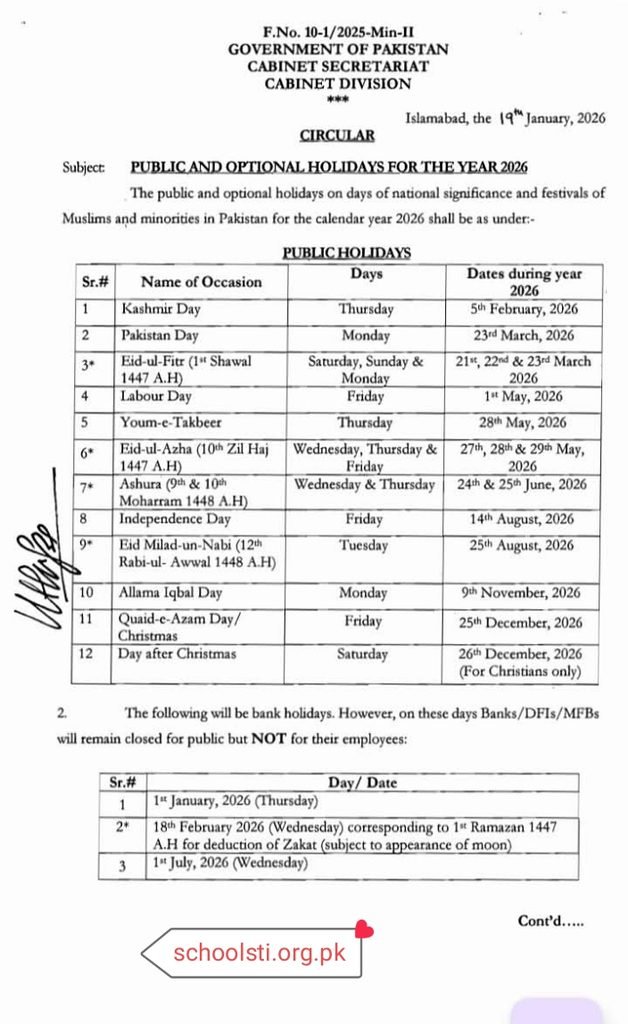
The Government of Pakistan Cabinet Secretariat (Cabinet Division) officially issued Circular F.No. 10-1/2025-Min-II on January 19, 2026, detailing the comprehensive calendar for Public, Bank, and Optional Holidays in Pakistan for the twelve months 2026.
In any calendar twelve months, Pakistanis observe 12 distinct general holiday occasions (spanning 16 to 17 total calendar days) alongside 3 mandatory bank holidays. Whether you are a federal or provincial state employee, a institution administrator planning academic assessments, a corporate HR manager mapping out annual leave policies, or a banking professional preparing for financial closing dates, having the exact state-notified dates is essential.
This authoritative guide breaks down every national festival, religious observance, and banking closure notified by the Cabinet Division, analyzes calendar overlaps for 2026, and explains the statutory rules governing communal, bank, and optional leaves across Pakistan.
Complete Schedule of Public Holidays in Pakistan 2026
Under the official circular issued from Islamabad, the following days of national significance and religious festivals for Muslims and minorities are observed as nationwide communal holidays across Pakistan during the calendar year 2026.
| Sr.# | Name of Occasion | Days of the Week | Official Dates (2026) | Holiday Category |
|---|---|---|---|---|
| 1 | Kashmir Day |
| Thursday
| 5th February, 2026
| National Solidarity |
| 2 | Pakistan Day
| Monday
| 23rd March, 2026
| National Significance
|
| 3* | Eid-ul-Fitr (1st Shawal 1447 A.H)
| Saturday, Sunday & Monday
| 21st, 22nd & 23rd March, 2026
| Islamic Festival
|
| 4 | Labour Day
| Friday
| 1st May, 2026
| International / Statutory |
| 5 | Youm-e-Takbeer
| Thursday
| 28th May, 2026
| National Defense Day |
| 6* | Eid-ul-Azha (10th Zil Haj 1447 A.H)
| Wednesday, Thursday & Friday
| 27th, 28th & 29th May, 2026
| Islamic Festival
|
| 7* | Ashura (9th & 10th Moharram 1448 A.H)
| Wednesday & Thursday
| 24th & 25th June, 2026
| Islamic Observance |
| 8 | Independence Day
| Friday
| 14th August, 2026
| National Significance
|
| 9* | Eid Milad-un-Nabi (12th Rabi-ul-Awwal 1448 A.H)
| Tuesday
| 25th August, 2026
| Islamic Festival
|
| 10 | Allama Iqbal Day
| Monday
| 9th November, 2026
| National Heritage |
| 11 | Quaid-e-Azam Day / Christmas
| Friday
| 25th December, 2026
| National / Minority Festival
|
| 12 | Day after Christmas (For Christians only)
| Saturday
| 26th December, 2026
| Minority Festival
|
*Note: All Islamic festival dates marked with an asterisk are subject to the sighting of the moon by the Central Ruet-e-Hilal Committee. The Cabinet Division of Pakistan issues separate confirmatory notifications prior to each lunar event.
Fixed National Holidays vs. Lunar Religious Festivals
Understanding how the 2026 calendar is structured helps institutions avoid scheduling conflicts:
- Fixed National Holidays: Seven occasions on the series—Kashmir Solidarity Day (Feb 5), Pakistan Day (Mar 23), Labour Day (May 1), Youm-e-Takbeer (May 28), Independence Day (Aug 14), Allama Iqbal Day (Nov 9), and Quaid-e-Azam Day/Christmas (Dec 25)—follow the Gregorian calendar. These dates remain locked regardless of lunar cycles.
- Lunar Holidays (1447–1448 A.H.): Four major Islamic holidays—Eid-ul-Fitr, Eid-ul-Azha, Ashura, and Eid Milad-un-Nabi—are calculated on the Hijri calendar. Given that the Islamic twelve months is approximately 10 to 11 days shorter than the solar twelve months, 2026 witnesses a transition from 1447 A.H. (during Ramadan, Eid-ul-Fitr, and Zil Haj) to 1448 A.H. (beginning in June with Moharram and continuing into Rabi-ul-Awwal in August).
Major Calendar Overlaps and Long Weekends in 2026
A closer inspection of the 2026 notification reveals two rare calendar overlaps and multiple built-in long weekends:
- The March Overlap (Eid-ul-Fitr & Pakistan Day): Eid-ul-Fitr is scheduled from Saturday, March 21 to Monday, March 23, 2026. Because Pakistan Day additionally falls on Monday, March 23, the two holidays merge on the final day rather than providing an additional separate day off.
- The May Overlap (Eid-ul-Azha & Youm-e-Takbeer): Since the state restored Youm-e-Takbeer (May 28) as a permanent gazetted holiday to commemorate Pakistan’s 1998 nuclear tests, 2026 presents an exact overlap: Thursday, May 28 is simultaneously Day 2 of Eid-ul-Azha (May 27–29) and Youm-e-Takbeer.
- Four 3-Day Long Weekends: Employees working a standard Monday-to-Friday schedule enjoy natural three-day weekends during Labour Day (Friday, May 1), Independence Day (Friday, August 14), Allama Iqbal Day (Monday, November 9), and Quaid-e-Azam Day / Christmas (Friday, December 25).
Official Bank Holidays in Pakistan for 2026
Paragraph 2 of the Cabinet Division circular designates three specific days as Bank Holidays. On these dates, all commercial banks, Development Finance Institutions (DFIs), and Microfinance Banks (MFBs) remain strictly closed for open dealing, yet NOT for their employees.
| Sr.# | Official Date & Day (2026) | Primary Purpose of Closure | Public Dealing | Bank Staff Attendance |
|---|---|---|---|---|
| 1 | 1st January, 2026 (Thursday) |
| New Year / Annual Closing of Accounts | Closed
| Mandatory (On Duty)
|
| 2* | 18th February, 2026 (Wednesday)
| 1st Ramazan 1447 A.H (Zakat Deduction)
| Closed
| Mandatory (On Duty)
|
| 3 | 1st July, 2026 (Wednesday)
| Mid-Year / Fiscal Year Closing of Accounts | Closed
| Mandatory (On Duty)
|
*Subject to the appearance of the Ramadan moon.
Why Banks Close for the Public But Remain Open for Staff
Many citizens mistake bank holidays for general general holidays. In practice, directives enforced by the State Bank of Pakistan (SBP) require banking personnel to report to their branches and headquarters on January 1, 1st Ramazan, and July 1 to perform critical back-office operations:
- Financial Reconciliation & Fiscal Closing: January 1 marks the end of the calendar year accounting cycle, while July 1 marks the start of Pakistan’s fresh Federal Fiscal Year. Banking staff utilize these customer-free days to balance ledgers, audit branch accounts, and finalize statutory reports.
- Mandatory Zakat Deduction (1st Ramazan 1447 A.H.): Falling on Wednesday, February 18, 2026, the initial day of Ramadan requires banks to calculate and deduct compulsory Zakat at 2.5% from eligible Saving, Profit and Loss Sharing (PLS), and similar bank accounts meeting the notified Nisab threshold (unless the account holder has submitted a valid CZ-50 exemption declaration).
- Digital Banking Availability: While physical branch doors are locked to walk-in customers, ATM networks, RAAST instant transfers, mobile banking apps, and online payment gateways continue operating normally.
Comparison: Public Holidays vs. Bank Holidays vs. Optional Holidays
To eliminate confusion for HR departments, state servants, and private-sector workers, the table below compares how Pakistan’s three holiday classifications function under federal regulations.
| Feature / Rule | Public (Gazetted) Holidays | Bank Holidays | Optional Holidays |
|---|---|---|---|
| Who Gets the Day Off? | All Federal/Provincial offices, schools, courts, banks, and private businesses. | Public only (walk-in bank customers). Bank staff must attend job. |
| Specific administration employees upon prior approval from their department head. |
| Educational Institutions | Strictly closed across all provinces. | Remain open as normal working days. | Remain open; individual staff may apply for leave. |
| Annual Quota / Limit | 12 notified occasions (all applicable citizens).
| 3 notified days per twelve months.
| 1 day per year for Muslim staff; up to 3 days per twelve months for non-Muslim minorities. |
| Prior Approval Needed? | No (Automatic nationwide closure). | N/A (Automatic branch closure for open).
| Yes—regulated so office operations are not disrupted. |
| Industrial / Export Exemption | Exporters are exempt only if they pay workers statutory overtime wages. | N/A (Regular working day for non-banking sectors). | N/A |
How Optional Holidays Work for Government Servants
Pages 2 and 3 of Circular F.No. 10-1/2025-Min-II outline a separate list of 22 Optional Holidays covering Muslim observances (such as Shab-e-Meraj on January 17, Shab-e-Barat on February 4, Chehlum on August 4, and Giyarvee Shareef on September 23) and minority festivals (including Basant Punchami, Holi, Good Friday, Easter, Baisakhi, Diwali, and the Birthday of Guru Nanak Dev Ji).
- For Muslim Employees: A administration servant may avail one optional holiday per calendar twelve months, provided the head of the office regulates permissions so adequate staff remains obtainable for the smooth continuance of authority job.
- For Minority Employees: Non-Muslim authority employees are permitted up to three optional holidays per calendar twelve months for festivals of religious significance, and circular rules explicitly state that such requests should not ordinarily be refused.
Impact on Schools, Educators, and Academic Calendars in 2026
For teachers, headmasters, and students across Pakistan—particularly within the Punjab School Education Department—gazetted open holidays directly shape the academic calendar, examination schedules, and instructional hours:
- Spring Examinations & SBA Alignment: The late-March cluster of Eid-ul-Fitr and Pakistan Day (March 21–23, 2026) falls right in the middle of annual academy transitions, School-Based Assessments (SBA), and board examinations. Educators and academy administrators planning their term schedules can check the latest school holidays and academic calendar updates to ensure classroom assessments and effect preparations do not clash with federal closures.
- Summer Vacation Overlaps: Both Ashura (June 24–25) and Independence Day (August 14) fall within the traditional summer vacation window observed by schools in Punjab and plains regions, meaning they do not reduce active teaching days during the summer term.
- Late-Year Academic Milestone (Allama Iqbal Day): Following the restoration of November 9 (Allama Iqbal Day) as a communal holiday, schools observe a three-day weekend in early November, right before winter timetable adjustments and December pre-board testing. Teachers looking for administrative circulars, leave rules, and teaching resources can access official SED notifications and educator guides to keep their school registers fully compliant with government directives.
For broader context on how statutory holidays intersect with industrial labor laws and overtime compensation, professionals can additionally review the legal frameworks published by the Auditor General of Pakistan.
Analysis
A strategic review of the Cabinet Division’s 2026 holiday circular highlights several critical takeaways for workforce planners, educators, and firm owners:
- Reduced Net Leave Days Due to Overlaps: Although the circular lists 12 general holiday occasions totaling 17 calendar entries, the exact overlap of Pakistan Day with Day 3 of Eid-ul-Fitr (March 23) and Youm-e-Takbeer with Day 2 of Eid-ul-Azha (May 28) reduces the net number of distinct communal holidays by two full days. Additionally, Day 1 and Day 2 of Eid-ul-Fitr fall on a Saturday and Sunday (March 21–22), absorbing a regular weekend for 5-day workweek employees.
- High Concentration of Friday & Monday Holidays: Four standalone holidays (May 1, August 14, November 9, and December 25) land on either a Friday or a Monday. This clustering prevents mid-week productivity fragmentation while giving employees four clean 3-day weekends across the twelve months.
- Strict Export Continuity Clause: Under Clause 6 of the circular, export-oriented manufacturers are legally exempt from closing on public holidays, provided they compensate workers with full overtime pay in addition to their regular daily wages—a vital provision for keeping Pakistan’s textile and industrial supply chains competitive in 2026.
Opinion
From an institutional planning and digital publishing standpoint, the 2026 Cabinet Division Holiday Circular is one of the most compact and firm-friendly schedules Pakistan has seen in recent years. Since both major Eid festivals overlap with either a weekend or an existing national holiday (March 23 and May 28), general and personal sector organizations lose noticeably fewer working days in the first half of 2026 compared to prior years.
Still, the schedule demands proactive management from academy heads and HR directors. In the education sector, the late-March Eid-ul-Fitr window requires tight coordination so annual paper marking, consequence tabulations, and new academic session enrollments in early April proceed without bottlenecks. Ultimately, organizations that map their project milestones around the late-May (Eid-ul-Azha) and late-June (Ashura) breaks well in advance will maintain peak operational efficiency throughout 2026.
Frequently Asked Questions (FAQs)
How several general holidays are in Pakistan in 2026?
The Government of Pakistan has notified 12 open holiday occasions for 2026. Counting multi-day festivals (3 days each for Eid-ul-Fitr and Eid-ul-Azha, and 2 days for Ashura), there are 15 distinct calendar days off for the general open (plus December 26 exclusively for the Christian community), accounting for the overlaps on March 23 and May 28.
Is November 9 (Allama Iqbal Day) a public holiday in 2026?
Yes. According to Serial No. 10 of the Cabinet Division Circular F.No. 10-1/2025-Min-II, Allama Iqbal Day on Monday, 9th November, 2026 is an official nationwide general holiday across Pakistan.
Is May 28 (Youm-e-Takbeer) a communal holiday in 2026?
Yes. Thursday, 28th May, 2026 is officially notified as a open holiday for Youm-e-Takbeer. In 2026, this date also coincides with the second day of the Eid-ul-Azha holidays (May 27–29).
Are schools and government offices closed on Bank Holidays in Pakistan?
No. Bank holidays (January 1, February 18 / 1st Ramazan, and July 1, 2026) apply strictly to general dealing at banks, DFIs, and Microfinance Banks. All schools, colleges, universities, courts, and government secretariat offices remain open as regular working days.
Can private exporters stay accessible during gazetted open holidays in 2026?
Yes. Under the Cabinet Division’s official guidelines, exporters and export manufacturers are exempt from general holidays, on the strict legal condition that they pay their workers overtime wages for those days in addition to their existing salary structure.
Conclusion
Staying ahead of the official Public and Optional Holidays for the Year 2026 (Circular F.No. 10-1/2025-Min-II) ensures seamless academic, financial, and personal planning throughout the twelve months. With major spring and summer overlaps around Eid-ul-Fitr and Eid-ul-Azha, alongside strategic long weekends in August, November, and December, the 2026 calendar offers a balanced mix of national commemoration and uninterrupted workweeks. Bookmark this schedule and keep an eye on official moon-sighting announcements from the Cabinet Division to stay updated on exact lunar holiday confirmations.