New National Curriculum of Pakistan (NNCP-2026)
New National Curriculum of Pakistan (NNCP-2026): Complete Notification, Subjects, and Implementation Guide
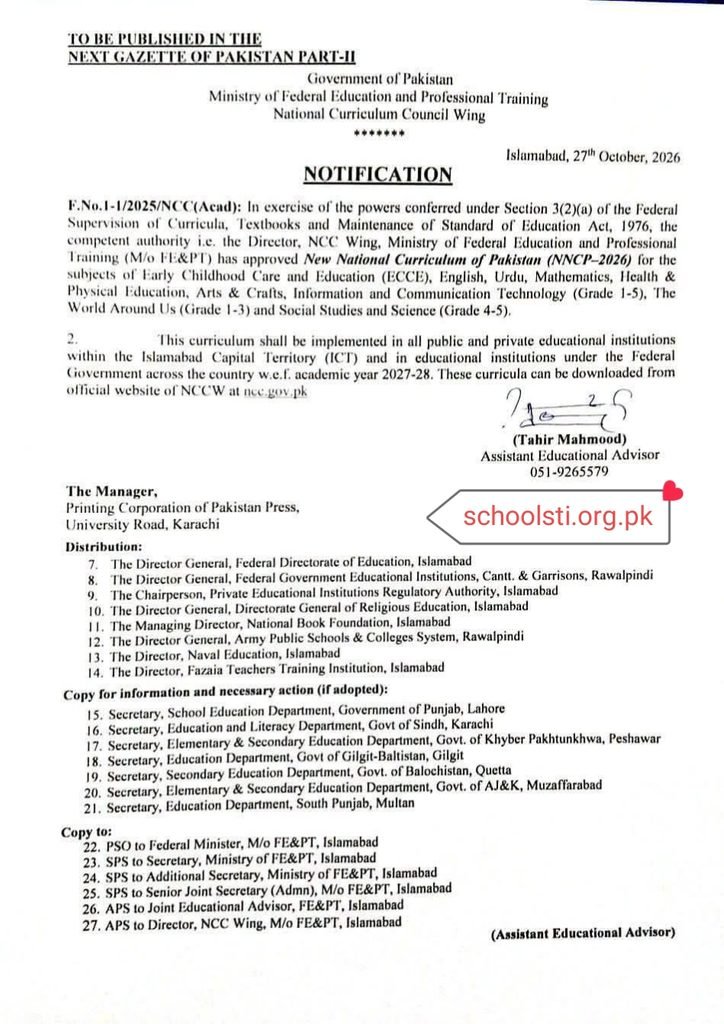
The New National Curriculum of Pakistan (NNCP-2026) is an updated educational framework officially approved by the National Curriculum Council (NCC) Wing under the Ministry of Federal Education and Professional Training (M/o FE&PT) on October 27, 2026. Exercising statutory authority under Section 3(2)(a) of the Federal Supervision of Curricula, Textbooks and Maintenance of Standard of Education Act, 1976, the federal state has mandated the transition to NNCP-2026 across all general and confidential educational institutions in the Islamabad Capital Territory (ICT) and federal educational networks nationwide, effective from the academic year 2027–28.
For decades, Pakistan’s educational landscape struggled with fragmented pedagogical standards, rote-learning dependencies, and a widening skills gap between public and personal schooling tiers. Following the foundational work of the Single National Curriculum (SNC) and the subsequent National Curriculum of Pakistan (NCP-2022/23), the newly ratified NNCP-2026 shifts the national focus from material memorization to competency-based, 21st-century learning. By integrating Information and Communication Technology (ICT), Health & Physical Education, and Arts & Crafts directly into the primary grades (Grades 1–5) alongside Early Childhood Care and Education (ECCE), the 2026 reform represents the most structurally balanced primary curriculum revision in the nation’s history.
Official Statutory Notification & Core Mandate (F.No.1-1/2025/NCC(Acad))
On October 27, 2026, the National Curriculum Council Wing in Islamabad issued a formal statutory notification (Reference: F.No.1-1/2025/NCC(Acad)), slated for publication in the Gazette of Pakistan Part-II. Signed by Tahir Mahmood (Assistant Educational Advisor, NCC Wing), the directive establishes the legal and operational baseline for primary education standardization across federal jurisdictions and provides a blueprint for provincial adoption.
Key Highlights of the Official Notification
- Issuing Authority: Competent Authority (Director, NCC Wing), Ministry of Federal Education and Professional Training (M/o FE&PT), Government of Pakistan.
- Legal Framework: Enacted under Section 3(2)(a) of the Federal Supervision of Curricula, Textbooks and Maintenance of Standard of Education Act, 1976.
- Effective Timeline: Mandatory rollout commences with the Academic Year 2027–28.
- Primary Jurisdiction: All public and exclusive schools operating within the Islamabad Capital Territory (ICT), as well as all federal administration educational institutions operating across Pakistan (including Cantonment, Garrison, Naval, Fazaia, and Army Public School systems).
- Digital Accessibility: Official curriculum documents, Student Learning Outcomes (SLOs), and progression grids are publicly hosted on the National Curriculum Council Portal (ncc.gov.pk).
To stay updated on how these federal directives translate into provincial academy compliance, teacher recruitment updates, and academic calendars, educators regularly consult Schools STI Educational Notifications & News for actual-moment policy tracking.
Breakdown of Approved Subjects by Grade Level in NNCP-2026
A defining strength of the New National Curriculum of Pakistan (NNCP-2026) is its developmentally appropriate segmentation of primary education. Rather than overwhelming early learners with heavy academic silos, the curriculum groups foundational environmental and scientific awareness into an integrated subject for lower primary (Grades 1–3) before branching into specialized disciplines in upper primary (Grades 4–5).
1. Early Childhood Care and Education (ECCE)
The ECCE framework focuses on pre-primary holistic child development, emphasizing cognitive readiness, socio-emotional learning, motor skills, and foundational phonetics and numeracy through play-based pedagogy.
2. Core & Co-Curricular Subjects (Grades 1 to 5)
For the primary period in a formal federal gazette notification, non-traditional subjects have been elevated to core curriculum status across all five primary grades:
- English (Grades 1–5): Focused on communicative competence, reading comprehension, phonics, and creative expression rather than rote grammar rules.
- Urdu (Grades 1–5): Emphasizes national linguistic heritage, functional literacy, listening/speaking fluency, and age-appropriate literature.
- Mathematics (Grades 1–5): Built around difficulty-solving, logical reasoning, mental math, and actual-world quantitative applications.
- Information and Communication Technology – ICT (Grades 1–5): Introduces foundational digital literacy, computational thinking, basic coding logic, and safe internet practices from Grade 1 onward.
- Health & Physical Education (Grades 1–5): Standardizes physical fitness, nutritional awareness, hygiene, mental well-being, and sportsmanship.
- Arts & Crafts (Grades 1–5): Cultivates visual literacy, fine motor skills, plan thinking, and indigenous cultural appreciation.
3. Progressive Subject Split: Lower Primary vs. Upper Primary
- The World Around Us (Grades 1–3): An interdisciplinary module combining basic broad science, civic awareness, geography, and environmental stewardship into a single cohesive narrative for young learners.
- Science (Grades 4–5): Transitions students into structured scientific inquiry, existence sciences, physical sciences, and earth/space sciences with hands-on experimental benchmarks.
- Social Studies (Grades 4–5): Introduces formal history, geography of Pakistan, civic rights and responsibilities, economic basics, and global citizenship.
NNCP-2026 Subject Matrix & Implementation Data Table
| Subject / Learning Stream | Target Grade Level | Pedagogical Focus & Core Competencies | Implementation Session |
|---|---|---|---|
| Early Childhood Care & Education (ECCE) |
| Pre-Primary (ECCE)
| Play-based learning, socio-emotional growth, school readiness | Academic Year 2027–28
|
| English & Urdu
| Grades 1 – 5
| Bilingual literacy, phonics, comprehension, oral communication | Academic Year 2027–28
|
| Mathematics
| Grades 1 – 5
| Quantitative reasoning, foundational geometry, analytical logic | Academic Year 2027–28
|
| Information & Communication Technology (ICT)
| Grades 1 – 5
| Computational thinking, digital literacy, cyber hygiene | Academic Year 2027–28
|
| Health & Physical Education
| Grades 1 – 5
| Physical wellness, motor coordination, personal hygiene | Academic Year 2027–28
|
| Arts & Crafts
| Grades 1 – 5
| Creative expression, visual arts, tactile craftsmanship | Academic Year 2027–28
|
| The World Around Us
| Grades 1 – 3
| Integrated environmental, social, and scientific exploration | Academic Year 2027–28
|
| General Science
| Grades 4 – 5
| Empirical observation, inquiry-based lab skills, STEM foundations | Academic Year 2027–28
|
| Social Studies
| Grades 4 – 5
| Civic literacy, national history, geography, cultural diversity | Academic Year 2027–28
|
Institutional Scope: Who Must Implement NNCP-2026?
According to the official distribution collection in the October 27, 2026 notification, the curriculum is directly binding on eight primary federal education directorates and regulatory bodies, while simultaneously being forwarded to seven provincial and regional education secretariats for adoption and alignment under the 18th Constitutional Amendment framework.
Mandatory Federal & Defense Educational Networks
- Federal Directorate of Education (FDE), Islamabad: Overseeing all public sector model colleges and schools in urban and rural ICT.
- Federal Government Educational Institutions (FGEI) – Cantt. & Garrisons, Rawalpindi: Governing schools across military cantonments nationwide.
- Private Educational Institutions Regulatory Authority (PEIRA), Islamabad: Mandating compliance across all low-cost and elite private schools registered within the federal capital.
- Directorate General of Religious Education (DGRE), Islamabad: Ensuring mainstream curriculum alignment within registered religious seminaries (Madaris) offering formal primary education.
- National Book Foundation (NBF), Islamabad: Tasked with developing, printing, and publishing model textbooks aligned with NNCP-2026 SLOs ahead of the 2027–28 session.
- Army Public Schools & Colleges System (APSACS), Rawalpindi: Standardizing primary education across the APS network.
- Directorate of Naval Education & Fazaia Teachers Training Institution: Aligning Pakistan Navy and Pakistan Air Force (Fazaia) educational systems with the fresh federal standards.
Provincial & Regional Coordination (For Information & Necessary Action)
To foster national cohesion without infringing upon provincial autonomy, the Ministry of Federal Education and Professional Training formally transmitted the NNCP-2026 framework to:
- School Education Department, Government of Punjab (Lahore) & South Punjab Secretariat (Multan)
- Education and Literacy Department, Government of Sindh (Karachi)
- Elementary & Secondary Education Department, Government of Khyber Pakhtunkhwa (Peshawar)
- Secondary Education Department, Government of Balochistan (Quetta)
- Education Departments of Gilgit-Baltistan (Gilgit) and Azad Jammu & Kashmir (Muzaffarabad)
Comparison: Evolution of Pakistan’s Curriculum (2006 vs. SNC/NCP vs. NNCP-2026)
Understanding the strategic value of NNCP-2026 requires examining how it resolves the structural bottlenecks of earlier reforms. While the 2020–2021 Single National Curriculum (SNC) focused heavily on uniform textbook content, NNCP-2026 embraces a flexible Student Learning Outcomes (SLO) model aligned with global benchmarks promoted by UNESCO’s International Bureau of Education.
| Feature / Dimension | 2006 National Curriculum | SNC / NCP (2020–2023) | New National Curriculum (NNCP-2026) |
|---|---|---|---|
| Core Philosophy | Content and syllabus-driven; high reliance on textbook memorization. | Uniformity-driven; aimed at bridging public, confidential, and Madrassah divides. | Competency & Learner-Centered; focused on critical thinking and 21st-century skills. |
| Primary ICT Integration | Absent in Grades 1–5; computer studies started in middle/high academy. | Basic digital awareness woven informally into universal subjects. | Standalone ICT Curriculum (Grades 1–5) focusing on computational thinking. |
|
| Holistic Development | Marginalized physical education and arts in favor of theory. | Included moral and civic themes within language/social books. | Dedicated Curricula for Health & Physical Education and Arts & Crafts (Grades 1–5).
|
| Lower Primary Science/Social | Taught as separate or fragmented General Knowledge units. | General Knowledge (Grades 1–3) with heavy factual load. | Redesigned as “The World Around Us” (Grades 1–3) for experiential learning.
|
| Textbook Policy | Single textbook monopoly per province. | Initially restrictive NOC policies; later opened to multiple publishers. | SLO-Based Open Framework; NBF and exclusive publishers develop diverse resources.
|
| Implementation Lead Time | Rolled out incrementally with minimal instructor training. | Immediate rollout causing textbook printing and training bottlenecks. | 10-Month Buffer Window (Approved Oct 2026; effective Academic Year 2027–28).
|
Strategic Impact on Teachers, Textbooks, and Classroom Assessment
The shift to NNCP-2026 requires a full overhaul of classroom execution between late 2026 and mid-2027. As the curriculum is anchored in the National Curriculum Framework (NCF) 2026, schools cannot simply swap out textbooks while retaining outdated lecture methodologies.
1. Textbook Development and No-Objection Certificates (NOCs)
The inclusion of the Managing Director, National Book Foundation (NBF) and PEIRA in the statutory distribution series signals immediate action on textbook development. Authors and publishers now have the 2026–27 academic cycle to draft manuscripts that satisfy the updated SLOs for subjects like The World Around Us and primary ICT. Confidential schools under PEIRA will retain the flexibility to select international or local publishers, provided the learning materials map directly to the NCC-2026 competency benchmarks.
2. Instructor Capacity Building and Pedagogical Tools
Teaching computational thinking to a earliest-grader or conducting inquiry-based science in Grade 4 requires specialized classroom scaffolding. Federal institutions like the Fazaia Teachers Training Institution and FDE training wings are tasked with upskilling primary educators ahead of the Fall 2027 launch. Educators looking for lesson plan templates, SLO progression grids, and assessment rubrics can explore the educational helping tools and guides for 2026–27 to streamline their classroom preparation and administrative compliance.
3. Formative vs. Summative Assessments
Under NNCP-2026, primary assessments move away from high-stakes rote examinations. Specifically, the inclusion of Arts & Crafts and Health & Physical Education mandates portfolio-based and observational formative assessments, ensuring that a child’s physical coordination, creativity, and collaborative spirit are valued alongside mathematical and linguistic proficiency.
Analysis
A rigorous analysis of the New National Curriculum of Pakistan (NNCP-2026) reveals several critical strategic shifts in how the Pakistani state approaches foundational education:
- Early Digital Mainstreaming: By establishing Information and Communication Technology (ICT) as an independent curriculum stream from Grade 1 to Grade 5, the Ministry of Federal Education acknowledges that digital literacy is now as fundamental as reading, writing, and arithmetic. Rather than teaching children merely how to employ legacy office software, the 2026 framework emphasizes computational logic and digital citizenship.
- Institutionalizing Co-Curriculars: Historically, physical education and arts were the first casualties of academic pressure in Pakistani schools—frequently replaced by extra math or science periods. Elevating Health & Physical Education and Arts & Crafts into gazetted statutory curricula forces general and personal academy administrators (monitored by FDE and PEIRA) to allocate dedicated timetable hours and resources to student well-being and creativity.
- Pragmatic Lead Time (2026 to 2027–28): Unlike previous curriculum overhauls that mandated immediate implementation within weeks of notification, issuing the approval in October 2026 for the 2027–28 academic year provides a realistic 9-to-10-month runway. This buffer allows the National Book Foundation (NBF) to print error-free textbooks, gives personal schools time to align their booklists, and enables educator training institutes to conduct meaningful workshops.
- Constitutional Balance: The notification carefully respects the post-18th Amendment constitutional structure. It enforces mandatory compliance within federal territories (ICT, Cantt/Garrisons, APS, Fazaia, Naval schools) while inviting Punjab (including South Punjab), Sindh, KP, Balochistan, AJK, and GB to adopt the standards collaboratively.
Opinion
From an educational policy and digital transformation perspective, NNCP-2026 is the most mature, forward-looking primary curriculum reform Pakistan has introduced to date—provided its execution matches its architectural ambition.
The brilliance of the 2026 revision lies in what it prioritizes for children aged 4 to 10 (ECCE to Grade 5). Consolidating early science and social studies into “The World Around Us” for Grades 1–3 reduces cognitive overload, allowing young learners to focus on core bilingual literacy (English and Urdu), numeracy, creative arts, physical health, and digital fluency.
However, a curriculum document downloaded from ncc.gov.pk is only as effective as the ecosystem supporting it. The primary hurdle for the 2027–28 rollout will not be textbook printing, however infrastructure and educator readiness. Delivering a Grade 1–5 ICT curriculum requires functional computer labs or tablet-assisted learning in rural ICT schools and far-flung federal garrisons. Similarly, provinces like Sindh and Khyber Pakhtunkhwa must be engaged diplomatically so that NNCP-2026 becomes a true unifying national standard rather than an isolated federal island. If the Ministry of Federal Education pairs this October 2026 notification with aggressive investments in primary academy IT labs and teacher stipends, NNCP-2026 will successfully equip Pakistan’s next generation for the AI-driven global economy.
Frequently Asked Questions (FAQs)
1. What is the New National Curriculum of Pakistan (NNCP-2026)?
The NNCP-2026 is the newly revised national educational curriculum framework approved by the National Curriculum Council (NCC) Wing, Ministry of Federal Education and Professional Training, via official notification F.No.1-1/2025/NCC(Acad) dated October 27, 2026. It modernizes learning standards from Early Childhood Care and Education (ECCE) through Grade 5 (alongside rationalized updates for higher grades).
2. When will NNCP-2026 be implemented in schools?
According to paragraph 2 of the official gazette notification, the NNCP-2026 curriculum will be implemented effective from the academic twelve months 2027–28 across all general and personal educational institutions in Islamabad (ICT) and federal government school networks nationwide.
3. Which subjects are approved under NNCP-2026 for primary classes?
The October 27, 2026 notification approves nine distinct subject streams:
- Pre-Primary: Early Childhood Care and Education (ECCE)
- Grades 1 to 5: English, Urdu, Mathematics, Information and Communication Technology (ICT), Health & Physical Education, and Arts & Crafts
- Grades 1 to 3: The World Around Us
- Grades 4 to 5: Social Studies and Science
4. Where can teachers and parents download the NNCP-2026 curriculum PDF?
All approved curriculum documents, subject progression grids, and Student Learning Outcomes (SLOs) can be downloaded no-cost of charge from the official website of the National Curriculum Council Wing at ncc.gov.pk.
5. Is NNCP-2026 mandatory for personal schools and provincial boards?
Yes, it is legally binding for all personal schools within the Islamabad Capital Territory regulated by PEIRA, as well as federal systems like APSACS (Army Public Schools), FGEI (Cantt/Garrisons), Fazaia, and Naval schools across Pakistan. For provincial government and exclusive schools in Punjab, Sindh, KP, Balochistan, GB, and AJK, the notification has been shared with provincial Education Secretaries for adoption and adaptation under provincial statutory mechanisms.
Conclusion
The official notification of the New National Curriculum of Pakistan (NNCP-2026) marks a decisive pivot toward modern, holistic, and skills-oriented primary education. By weaving computational thinking (ICT), physical wellness, and creative arts directly into the foundational fabric of Grades 1 to 5 alongside core literacy and inquiry-based science, Pakistan is setting a robust pedagogical standard for the 2027–28 academic year. Institution administrators, textbook publishers, and educators now have a obvious, statutory roadmap to align their classrooms, training modules, and learning resources with the upcoming of global education.