Pakistan Post Revised Inland Postal Tariff 2026
Pakistan Post Revised Inland Postal Tariff 2026: Complete Guide to New Rates (Effective 1st October 2026)
Introduction
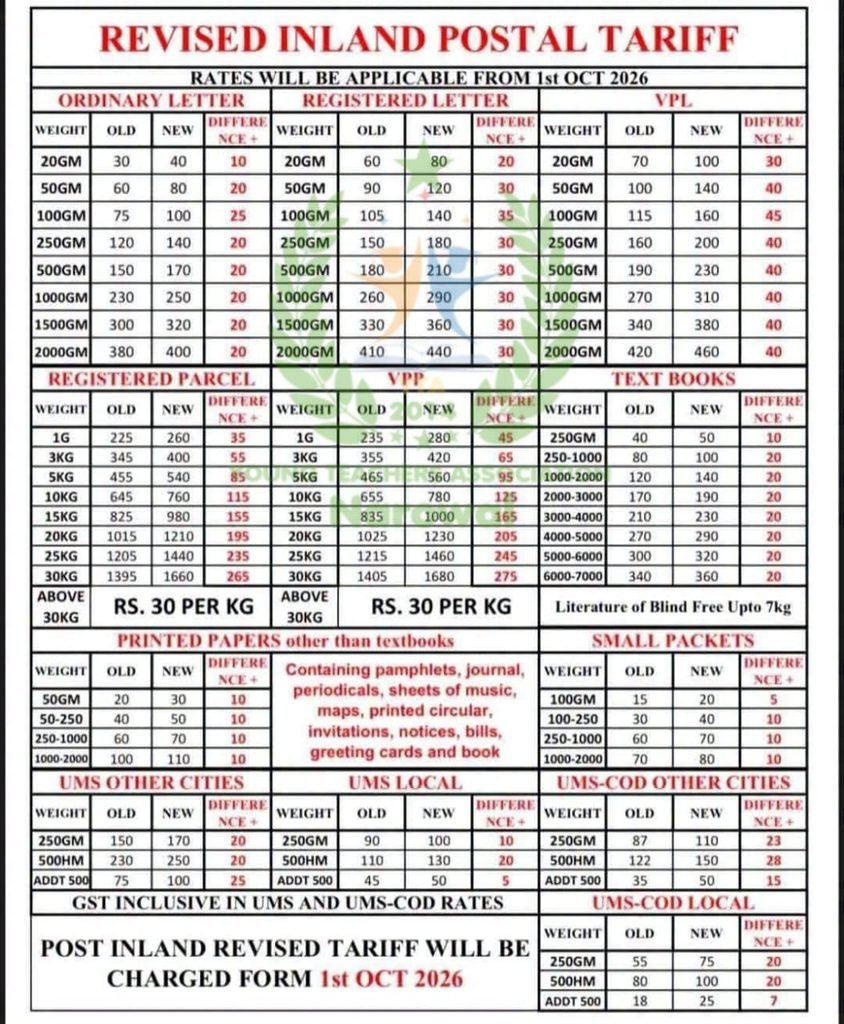
Pakistan Post has announced a revised inland postal tariff that applies to all domestic mail and parcel services from 1st October 2026. The revision touches almost every category — ordinary and registered letters, value-payable letters, registered parcels, VPP (cash-on-delivery style postal parcels), textbooks, printed papers, tiny packets, and the Urgent Mail Service (UMS) including UMS-COD.
For millions of Pakistanis who still rely on the post office — students receiving books, compact businesses shipping orders, families sending documents, and e-commerce sellers using COD — this modify directly affects everyday costs. In this whole guide, we break down every modern rate slab-by-slab, compare aged versus recent charges, analyse who is hit hardest, and answer the questions persons are actually asking.
Key Highlights at a Glance
If you are short on time, here is everything that matters in 60 seconds:
- Effective date: The modern inland tariff is charged from 1st October 2026 on all domestic postal articles.
- Scope: Rates revised across 12 service categories — letters (ordinary, registered, VPL), parcels (registered, VPP), textbooks, printed papers, tiny packets, and four UMS variants.
- Typical increase: Between Rs. 5 and Rs. 275 per slab, depending on weight and service.
- Steepest percentage hikes: Light mail bears the biggest relative burden — ordinary and registered letters up to 20g rise 33.3%, and printed papers up to 50g jump 50% (Rs. 20 → Rs. 30).
- Largest absolute increases: Heavy parcels — a 30kg VPP parcel rises by Rs. 275 (Rs. 1,405 → Rs. 1,680) and a 30kg registered parcel by Rs. 265.
- Gentlest increases: Textbooks and literature see the smallest revisions (Rs. 10–20 per slab), and literature for the blind remains complimentary up to 7kg.
- GST: Already included in all UMS and UMS-COD rates — no extra tax on leading.
Complete New Rate Tables (1st October 2026)
Below are the full revised tariffs, transcribed slab-by-slab from the official notification. All amounts are in Pakistani Rupees.
Ordinary Letter
| Weight | Old Rate (Rs.) | New Rate (Rs.) | Increase (Rs.) |
|---|---|---|---|
| 20g | 30 | 40 | 10 |
| 50g | 60 | 80 | 20 |
| 100g | 75 | 100 | 25 |
| 250g | 120 | 140 | 20 |
| 500g | 150 | 170 | 20 |
| 1000g | 230 | 250 | 20 |
| 1500g | 300 | 320 | 20 |
| 2000g | 380 | 400 | 20 |
Registered Letter
| Weight | Old Rate (Rs.) | New Rate (Rs.) | Increase (Rs.) |
|---|---|---|---|
| 20g | 60 | 80 | 20 |
| 50g | 90 | 120 | 30 |
| 100g | 105 | 140 | 35 |
| 250g | 150 | 180 | 30 |
| 500g | 180 | 210 | 30 |
| 1000g | 260 | 290 | 30 |
| 1500g | 330 | 360 | 30 |
| 2000g | 410 | 440 | 30 |
VPL (Value Payable Letter)
| Weight | Old Rate (Rs.) | New Rate (Rs.) | Increase (Rs.) |
|---|---|---|---|
| 20g | 70 | 100 | 30 |
| 50g | 100 | 140 | 40 |
| 100g | 115 | 160 | 45 |
| 250g | 160 | 200 | 40 |
| 500g | 190 | 230 | 40 |
| 1000g | 270 | 310 | 40 |
| 1500g | 340 | 380 | 40 |
| 2000g | 420 | 460 | 40 |
Registered Parcel
| Weight | Old Rate (Rs.) | New Rate (Rs.) | Increase (Rs.) |
|---|---|---|---|
| Up to 1kg | 225 | 260 | 35 |
| 3kg | 345 | 400 | 55 |
| 5kg | 455 | 540 | 85 |
| 10kg | 645 | 760 | 115 |
| 15kg | 825 | 980 | 155 |
| 20kg | 1,015 | 1,210 | 195 |
| 25kg | 1,205 | 1,440 | 235 |
| 30kg | 1,395 | 1,660 | 265 |
| Above 30kg | — | Rs. 30 per kg | — |
VPP (Value Payable Post)
| Weight | Old Rate (Rs.) | New Rate (Rs.) | Increase (Rs.) |
|---|---|---|---|
| Up to 1kg | 235 | 280 | 45 |
| 3kg | 355 | 420 | 65 |
| 5kg | 465 | 560 | 95 |
| 10kg | 655 | 780 | 125 |
| 15kg | 835 | 1,000 | 165 |
| 20kg | 1,025 | 1,230 | 205 |
| 25kg | 1,215 | 1,460 | 245 |
| 30kg | 1,405 | 1,680 | 275 |
| Above 30kg | — | Rs. 30 per kg | — |
Text Books
| Weight | Old Rate (Rs.) | New Rate (Rs.) | Increase (Rs.) |
|---|---|---|---|
| 250g | 40 | 50 | 10 |
| 250–1000g | 80 | 100 | 20 |
| 1000–2000g | 120 | 140 | 20 |
| 2000–3000g | 170 | 190 | 20 |
| 3000–4000g | 210 | 230 | 20 |
| 4000–5000g | 270 | 290 | 20 |
| 5000–6000g | 300 | 320 | 20 |
| 6000–7000g | 340 | 360 | 20 |
Relief for readers: Literature for the blind continues to travel free of charge up to 7kg.
Printed Papers (Other Than Textbooks)
This covers pamphlets, journals, periodicals, sheets of music, maps, printed circulars, invitations, notices, bills, greeting cards, and books.
| Weight | Old Rate (Rs.) | New Rate (Rs.) | Increase (Rs.) |
|---|---|---|---|
| 50g | 20 | 30 | 10 |
| 50–250g | 40 | 50 | 10 |
| 250–1000g | 60 | 70 | 10 |
| 1000–2000g | 100 | 110 | 10 |
Small Packets
| Weight | Old Rate (Rs.) | New Rate (Rs.) | Increase (Rs.) |
|---|---|---|---|
| 100g | 15 | 20 | 5 |
| 100–250g | 30 | 40 | 10 |
| 250–1000g | 60 | 70 | 10 |
| 1000–2000g | 70 | 80 | 10 |
UMS (Urgent Mail Service) — Other Cities
GST inclusive.
| Weight | Old Rate (Rs.) | New Rate (Rs.) | Increase (Rs.) |
|---|---|---|---|
| 250g | 150 | 170 | 20 |
| 500g* | 230 | 250 | 20 |
| Additional 500g | 75 | 100 | 25 |
UMS Local
GST inclusive.
| Weight | Old Rate (Rs.) | New Rate (Rs.) | Increase (Rs.) |
|---|---|---|---|
| 250g | 90 | 100 | 10 |
| 500g* | 110 | 130 | 20 |
| Additional 500g | 45 | 50 | 5 |
UMS-COD — Other Cities
GST inclusive.
| Weight | Old Rate (Rs.) | New Rate (Rs.) | Increase (Rs.) |
|---|---|---|---|
| 250g | 87 | 110 | 23 |
| 500g* | 122 | 150 | 28 |
| Additional 500g | 35 | 50 | 15 |
UMS-COD Local
GST inclusive.
| Weight | Old Rate (Rs.) | New Rate (Rs.) | Increase (Rs.) |
|---|---|---|---|
| 250g | 55 | 75 | 20 |
| 500g* | 80 | 100 | 20 |
| Additional 500g | 18 | 25 | 7 |
*Shown as “500HM” in the official chart — go through as 500 grams.
Old vs New Rates: Detailed Comparison and Analysis
Raw rupee figures only tell half the story. The table below converts the revision into percentage terms, which reveals who really carries the weight of this tariff adjust.
Comparison Table: Selected Slabs
| Service | Slab | Old (Rs.) | New (Rs.) | +Rs. | +% |
|---|---|---|---|---|---|
| Printed Papers | 50g | 20 | 30 | 10 | 50.0% |
| VPL | 20g | 70 | 100 | 30 | 42.9% |
| UMS-COD (Other Cities) | Addt. 500g | 35 | 50 | 15 | 42.9% |
| UMS-COD Local | Addt. 500g | 18 | 25 | 7 | 38.9% |
| UMS-COD Local | 250g | 55 | 75 | 20 | 36.4% |
| Ordinary Letter | 20g | 30 | 40 | 10 | 33.3% |
| Registered Letter | 20g | 60 | 80 | 20 | 33.3% |
| Small Packets | 100g | 15 | 20 | 5 | 33.3% |
| Text Books | 250g | 40 | 50 | 10 | 25.0% |
| UMS (Other Cities) | 250g | 150 | 170 | 20 | 13.3% |
| UMS Local | 250g | 90 | 100 | 10 | 11.1% |
| Registered Parcel | 30kg | 1,395 | 1,660 | 265 | 19.0% |
| VPP | 30kg | 1,405 | 1,680 | 275 | 19.6% |
| Registered Parcel | 1kg | 225 | 260 | 35 | 15.6% |
| VPP | 1kg | 235 | 280 | 45 | 19.1% |
What the Numbers Reveal
- Light letters are hit hardest in percentage terms. A basic 20g ordinary letter — the most frequent postal piece in the country — costs a third more than before. The similar pattern holds for registered letters and VPL at entry-standard weights.
- Printed papers saw the single steepest percentage jump. Sending a 50g pamphlet, invitation, or greeting card now costs 50% more, a change that wedding-card printers, event organisers, and publishers will feel immediately.
- Heavy parcels face the biggest absolute increases. Anyone shipping 20–30kg through registered parcel or VPP pays Rs. 195–275 more per consignment — a ~19–20% rise that scales directly with consignment size.
- The revision is deliberately progressive in structure. Percentage increases taper off as weight rises (an ordinary letter at 2kg rises only 5.3%), which cushions bulk senders while asking more from casual, light mail.
- Education is protected. Textbooks rise only Rs. 10–20 per slab — among the gentlest increases in the entire tariff — and no-cost carriage for blind literature up to 7kg is untouched.
- COD and urgent mail stay competitive. UMS local 250g rises just Rs. 10, and UMS-COD local remains among the cheapest tracked, payment-collecting delivery options in the country.
What the Revision Means for Different Senders
E-commerce Sellers and COD Businesses
If you ship cash-on-delivery orders through VPP or UMS-COD, your per-order shipping cost rises Rs. 15–65 depending on weight. On a typical 1kg VPP parcel, that is Rs. 45 more per order. At volume, this either trims margins or gets passed to customers — worth recalculating your shipping tables and no-cost-delivery thresholds before October.
Students and Parents
Good news: the education categories were treated gently. Mailing textbooks costs only Rs. 10–20 more per slab, and the educational resources for Pakistani students you rely on for admissions, results, and study guidance remain as accessible as ever. Students posting applications, documents, and forms should note the 33% rise on basic letters, though — batch your correspondence where you can.
Businesses, Publishers, and Event Organisers
Bulk mailers of printed material — bills, notices, circulars, wedding invitations, journals — face the sharpest percentage increase in the whole tariff (50% at the 50g slab). If your business posts thousands of printed items, renegotiate print-and-post budgets now and consider consolidating dispatches.
Rural and Everyday Users
Pakistan Post remains the only affordable logistics network reaching deep into rural areas, and even after the revision it undercuts private couriers on most routes. The increases are real, however a 20g letter at Rs. 40 is still the cheapest documented communication channel in the country.
7 Smart Ways to Save on Postal Costs Under the New Tariff
- Weigh before you post. A few extra grams can push you into the next slab. A kitchen scale pays for itself quickly if you post regularly.
- Use the right category. Books and printed matter travel cheaper as printed papers or textbooks than as ordinary letters — at no time pay letter rates for a book.
- Consolidate dispatches. One 500g letter (Rs. 170) beats several 20g letters (Rs. 40 each) when the contents can travel together.
- Choose registered over VPL/VPP when no payment is involved. Value-payable services cost more since they collect money on delivery — don’t pay for that feature if you don’t demand it.
- Prefer UMS Local for same-city urgency. At Rs. 100 for 250g, it remains excellent value for urgent city deliveries.
- Batch your COD shipments. VPP and UMS-COD increases are per consignment, so fewer, fuller parcels beat several small ones.
- Verify rates at the counter. Counters must charge the tariff in force on the day of booking — from 1st October 2026, that is the recent tariff. Keep the official chart on your phone; you can cross-check published rates on Pakistan Post’s official website.
Frequently Asked Questions (FAQs)
When do the modern Pakistan Post inland rates take effect?
The revised inland postal tariff is applicable from 1st October 2026. Any piece booked on or after that date is charged at the recent rates; articles booked earlier follow the former tariff.
How considerable does an ordinary letter cost now?
An ordinary inland letter up to 20g now costs Rs. 40 (previously Rs. 30). Rates rise by weight slab up to Rs. 400 for 2000g.
What is the cheapest method to send a parcel within Pakistan?
For non-urgent parcels, the registered parcel service is the most economical tracked option — Rs. 260 for up to 1kg under the recent tariff. Small packets (up to 2kg, from Rs. 20) are even cheaper for highly light items but suit documents and small goods.
What is the difference between VPP and VPL?
Both are “value payable” services, meaning the post office collects payment from the recipient on delivery — Pakistan Post’s built-in cash-on-delivery. VPL (Value Payable Letter) is for letters and documents; VPP (Value Payable Post) is for parcels. You pay a premium over ordinary postage for the collection service.
Are textbooks still cheaper to post than general parcels?
Yes. Textbook postage was deliberately kept low — a 250g textbook costs Rs. 50 to post, versus Rs. 140 for an ordinary letter of the similar weight. Literature for the blind travels free up to 7kg.
Is GST included in UMS rates?
Yes. The official notification states that GST is inclusive in UMS and UMS-COD rates, so the published figures are the final amount you pay at the counter.
Where can I confirm the official rates?
Invariably verify against Pakistan Post’s official website or the rate chart displayed at your local post office. Tariff policy for the postal sector falls under Pakistan’s Ministry of Communications, and international postal standards are coordinated by the Universal Postal Union (UPU), the UN specialised agency for postal services.
Conclusion
The 1st October 2026 revision is the most broad-based inland tariff update Pakistan Post has issued in recent years, and it follows a apparent logic: light, casual mail absorbs the largest percentage increases, heavy commercial parcels absorb the largest rupee increases, and education is deliberately sheltered. For most households the impact is modest — a letter here, a parcel there. For high-volume senders — e-commerce sellers, publishers, and bulk mailers — the recent slabs demand a fresh look at shipping budgets before October arrives.
Stay informed, weigh your articles, pick the right service category, and the revised tariff remains what Pakistan Post has consistently been: the most affordable way to reach every corner of the country. For ongoing education news and guides that assist students and families navigate official updates like this one, keep following our coverage.
Analysis: Key Takeaways
- Effective 1st October 2026, the revised inland tariff raises rates across all 12 domestic postal categories, with increases of Rs. 5–275 per slab.
- The burden is front-loaded on light mail: entry-level letter slabs rise ~33–43%, and 50g printed papers jump 50% — the steepest percentage increase in the tariff.
- Heavy parcels carry the biggest rupee cost: 30kg VPP (+Rs. 275) and registered parcel (+Rs. 265) consignments become materially more expensive, at roughly 19–20% higher.
- Education is protected: textbook slabs rise only Rs. 10–20, and blind literature stays no-cost up to 7kg — a deliberate policy choice worth acknowledging.
- UMS and UMS-COD remain competitively priced for urgent and cash-on-delivery needs, with GST already included and modest increases on local services.
- E-commerce and bulk mailers must act first: recalculate shipping tables, no-cost-delivery thresholds, and print-and-post budgets before the October cutover.
- Verification matters: counters must apply the tariff in force on the booking date — keep the official chart handy and cross-check at pakpost.gov.pk.
Opinion: Final Expert Verdict
As a pricing move, this revision is firm yet defensible. Pakistan Post operates one of the planet’s largest postal networks — over 13,000 post offices serving a country where exclusive couriers barely reach beyond major cities — and its tariffs had clearly lagged behind operating costs. The structure of the expand shows thought: shielding textbooks and blind literature, tapering percentage rises on heavier weights, and keeping UMS local genuinely affordable.
That said, the 33–50% jumps on the lightest, most everyday articles — the basic letter, the small printed paper — will sting ordinary citizens more than any parcel surcharge stings businesses. A phased raise on entry-degree letter slabs would have been kinder. Still, at Rs. 40 for a letter that can travel from Karachi to Khyber, Pakistan Post remains unmatched on value. The verdict: a needed, mostly well-designed revision — but one that high-volume senders should plan for now, not discover at the counter in October.