PECTAA 5th 8th Class Model Papers 2026-27

Educational Guide: How to Use the PECTAA 5th & 8th Class Model Papers 2026-27 Tool for Exam Success
Introduction
The transition from the legacy Punjab Examination Commission (PEC) to the Punjab Education Curriculum, Training and Assessment Authority (PECTAA) has fundamentally reshaped primary and elementary evaluations across Pakistan’s largest province. Gone are the days when rote memorization of textbook exercises guaranteed foremost marks in Grade 5 and Grade 8 board examinations. Under the 2026–2027 assessment policy, students are evaluated strictly on Student Learning Outcomes (SLOs), conceptual clarity, and higher-order cognitive skills.
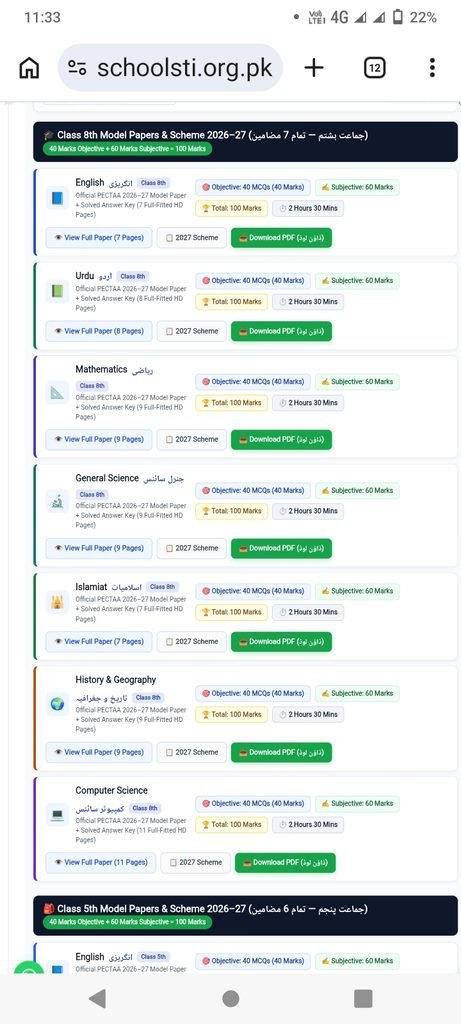
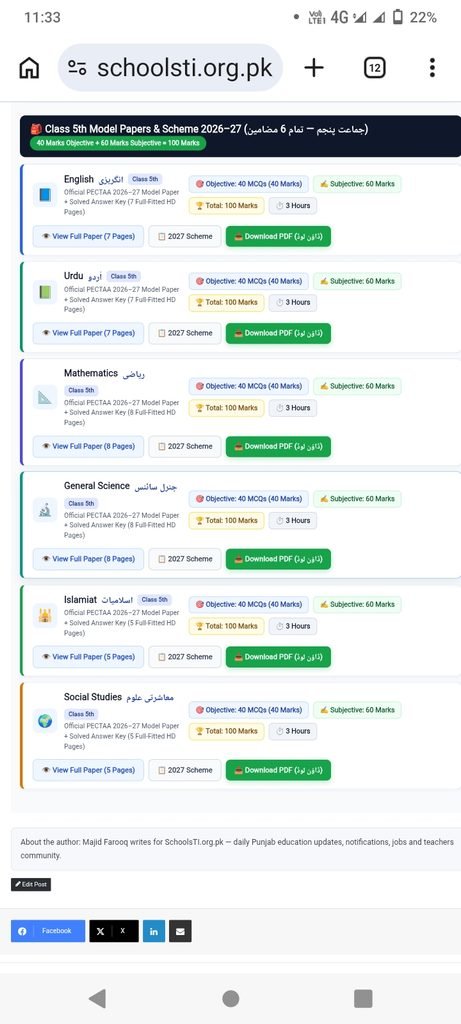
To bridge the gap between classroom instruction and standardized board expectations, educators and students are increasingly turning to interactive digital utilities. Specifically, the PECTAA 5th and 8th Class Model Papers 2026-27 interactive tool developed by Schools STI has emerged as an indispensable asset. Designed to provide instant access to bilingual (Urdu and English medium) model papers, chapter-wise weightage schemes, auto-graded self-assessment quizzes, and printable mock tests, this web application streamlines exam readiness for general and confidential schools alike.
This comprehensive educational guide walks teachers, parents, and students through the exact mechanics of using the PECTAA 2026–27 Model Papers instrument, breaks down the latest marking schemes, and outlines actionable pedagogical strategies to master the upcoming annual examinations.
Understanding the PECTAA 2026–27 Assessment Framework
Before diving into the mechanics of the digital application, it is essential to grasp the institutional shift driving these fresh model papers. Established as an integrated apex body by the Punjab School Education Department (SED), PECTAA merges curriculum development, educator training, and examination standards under one roof.
The Shift from Rote Learning to SLO-Based Testing
Traditional elementary testing heavily favored direct textbook replication. Nonetheless, the 2026–27 framework mandates that examination items test a pupil’s ability to apply concepts to unseen scenarios:
- Knowledge & Recall (20%–25%): Basic definitions, historical dates, and fundamental formulas.
- Conceptual Understanding (45%–50%): Explaining phenomena in one’s own words, interpreting unseen reading passages in Urdu and English, and translating word problems into mathematical equations.
- Application & Higher-Order Thinking (25%–30%): Analyzing scientific diagrams, solving multi-step geometric problems, and evaluating authentic-planet civic scenarios.
By aligning directly with the official PECTAA Model Papers repository, the Schools STI web utility translates these complex curricular rubrics into accessible, classroom-ready practice formats.
Step-by-Step Guide: How to Use the PECTAA 5th & 8th Class Model Papers Tool
The PECTAA 2026–27 digital utility is built with a lightweight, mobile-responsive interface so teachers in remote districts and students studying at home can access resources without heavy data consumption. Follow these sequential steps to maximize the instrument’s capabilities.
Step 1: Accessing the Portal and Selecting Your Grade Level
Navigate directly to the utility page on the Schools STI portal. Upon loading the interface, you are greeted with two primary grade modules:
- جماعت پنجم (Grade 5 – Primary Level)
- جماعت ہشتم (Grade 8 – Elementary/Middle Level)
Select the relevant grade tab to filter the database according to the appropriate curriculum difficulty and age group.
Step 2: Choosing the Subject and Medium of Instruction
One of the standout features of this educational instrument is its dual-medium support. Whether a learner is enrolled in an English-medium sections program or a traditional Urdu-medium government academy, the platform accommodates both. Select from the six core subjects:
- English (Reading comprehension, grammar mechanics, guided composition)
- Urdu (اردو) (Unseen passages, lexical structure, creative writing)
- Mathematics (ریاضی) (Arithmetic, algebra, geometry, data handling)
- General Science (جنرل سائنس) (Biological systems, physical sciences, earth & space)
- Islamiat (اسلامیات) (Quranic translations, Hadith, Seerat-un-Nabi, ethics)
- Social Studies (معاشرتی علوم) (History, geography, civics, economy)
Step 3: Reviewing the Chapter-Wise Examination Scheme
Before generating a paper or attempting a quiz, click on the “View Scheme” (اسکیم دیکھیں) button beneath your chosen subject. This opens a detailed breakdown of the syllabus weightage, highlighting which textbook chapters carry the highest allocation of Multiple Choice Questions (MCQs) and Constructed Response Questions (CRQs).
Step 4: Launching the Self-Diagnostic Online Quiz
To test authentic-time retention, click the “Play Online Quiz” (آن لائن کوئز کھیلیں) button.
- The system pulls randomized, SLO-aligned MCQs from the 2026–27 query bank.
- Students select their answers interactively and receive immediate visual feedback (accurate vs. incorrect) along with brief explanations and final percentage scores.
- This aspect is particularly effective for overcoming test anxiety and building speed for the objective portion of the board exam.
Step 5: Generating and Printing Custom Model Papers
For formal classroom testing or offline homework practice, click the “Paper Generator / Print” (پیپر جنریٹر / پرچہ) option.
- The application compiles a structured, 100-mark standard examination paper complete with an official header (space for Student Name, Roll Number, Section, and Time Allowed).
- It simultaneously generates an accompanying Answer Key and Marking Rubric for teachers to standardize their grading according to PECTAA evaluation criteria.
- Use your browser’s native print dialogue (
Ctrl + PorCmd + P) to save the document as a clean PDF or send it directly to a classroom printer.
PECTAA 2026–27 Subject Matrix and Marks Breakdown
To utilize the model paper generator effectively, educators and learners must keep the official structural parameters in mind. The table below outlines the standardized 2026–27 assessment structure across Grade 5 and Grade 8.
| Subject | Total Marks | Objective Section (MCQs) | Subjective Section (CRQs/ERQs) | Time Allowed | Core Assessment Focus |
|---|---|---|---|---|---|
| English | 100 Marks | 50 Marks (25–32 MCQs) | 50 Marks (Short & Long Responses) | 2.5 Hours | Unseen reading comprehension, contextual grammar, paragraph/letter writing |
| Urdu (اردو) | 100 Marks | 50 Marks (25–32 MCQs) | 50 Marks (Constructed Responses) | 2.5 Hours | Unseen prose/poetry comprehension, syntax, application & story writing |
| Mathematics | 100 Marks | 50 Marks (25–32 MCQs) | 50 Marks (Step-by-step Solutions) | 2.5 Hours | Real-world word problems, practical geometry, algebraic manipulation |
| General Science | 100 Marks | 50 Marks (25–32 MCQs) | 50 Marks (Analytical Questions) | 2.5 Hours | Scientific inquiry, diagram labeling, procedural experiments, environmental logic |
| Islamiat | 100 Marks | 40 Marks (MCQs) + Nazra | 60 Marks (Written + Oral Nazra) | 2.5 Hours | Thematic application of Quranic verses, Hadith in daily life, Islamic history |
| Social Studies | 100 Marks | 50 Marks (25–32 MCQs) | 50 Marks (Descriptive/Analytical) | 2.5 Hours | Map reading, chronological timelines, civic responsibilities, geographical impact |
Comparison: Static PDF Downloads vs. Schools STI Interactive PECTAA Tool
Many educational websites simply upload scanned, low-resolution PDFs of past papers. Nonetheless, preparing for modern exams requires dynamic tools. Notice how the interactive utility compares against traditional static resources—and why coupling it with the comprehensive 5th and 8th PECTAA Exam 2027 guide creates a complete ecosystem for schools:
| Feature / Dimension | Traditional Static PDF Portals | Schools STI Interactive PECTAA Tool (2026–27) |
|---|---|---|
| Format & Interactivity | Fixed, non-editable scanned documents | Dynamic HTML5 interface with live quizzes and paper generation |
| Language Flexibility | Often restricted to a single medium per file | Instant toggle between Urdu and English mediums within the similar module |
| Feedback Mechanism | Delayed; requires manual checking against separate keys | Instant automated scoring and diagnostic feedback during online quizzes |
| Syllabus Alignment | Frequently recycles outdated pre-2022 PEC papers | Strictly updated for the 2026–27 PECTAA SLO framework and pairing schemes |
| Classroom Utility | High ink consumption due to poor background scans | Clean, printer-friendly formatting with automated header customization |
| Data & Device Load | Requires downloading heavy multi-megabyte PDF files | Lightweight browser execution; works seamlessly on budget 3G/4G smartphones |
Strategic Action Plan for Teachers, Students, and Parents
Having access to high-caliber model papers is only half the battle; how you integrate them into your daily routine determines the final outcome.
For Classroom Teachers & School Heads
- Bi-Weekly Diagnostic Drills: Dedicate every alternate Friday to a 45-minute mock session using the tool’s printable CRQ sections. Grade the responses strictly using the rubric guidelines rather than awarding marks merely for response length.
- Rubric Familiarization: Train students on how partial credit works in Mathematics and Science. Under PECTAA rules, writing the correct formula and units earns marks even if the final arithmetic calculation slips.
- Targeted Remediation: Partner schools operating under the Punjab Education Foundation (PEF) can use the chapter-wise scheme viewer to align their Quality Assurance Test (QAT) preparation directly with high-weightage PECTAA chapters.
For Grade 5 & Grade 8 Students
- Master the 2.5-Hour Clock: Practice solving a complete generated paper under strict time constraints. Allocate no more than 50 minutes to the 50-mark MCQ section, leaving 1 hour and 40 minutes for the subjective CRQs.
- Conquer Unseen Passages: Never memorize essays or comprehension paragraphs from local guidebooks. Apply the English and Urdu model papers to practice extracting main ideas, inferring vocabulary meanings from context, and summarizing passages in your own words.
- Daily 15-Minute Quiz Habit: Before wrapping up evening study sessions, take one online self-assessment quiz on a smartphone or tablet to reinforce the chapter studied that day.
Analysis
An examination of the current educational landscape in Punjab reveals three critical takeaways regarding the 2026–27 assessment cycle and the tools supporting it:
- Structural Convergence with BISE Boards: PECTAA’s 50% objective and 50% constructed-response split is intentionally designed to acclimate middle-school students to the analytical rigor recently introduced across Punjab’s nine Boards of Intermediate and Secondary Education (BISE) for Grades 9 and 10. Students who master PECTAA model papers in Grade 8 experience a significantly smoother academic transition into matriculation.
- Elimination of the “Guess Paper” Culture: Because questions are drawn from conceptual SLO matrices rather than fixed textbook finish-of-chapter questions, traditional commercial guess papers have lost their predictive accuracy. Tools that emphasize chapter weightage and interactive concept testing are the only reliable preparation mechanism.
- Bridging the Urban-Rural Digital Divide: By embedding an interactive paper generator and bilingual quiz engine directly into a no-cost, accessible web portal, platforms like Schools STI democratize test preparation. A government institution instructor in a remote tehsil now has access to the exact similar standardized testing architecture as an elite urban confidential academy.
Opinion
From an educational technology and curriculum standpoint, the PECTAA 5th & 8th Class Model Papers 2026-27 tool represents exactly the kind of practical digital intervention Pakistan’s primary and elementary sectors urgently demand.
For years, policy reforms at the ministerial stage struggled to translate into classroom reality given that teachers lacked accessible, day-to-day instructional aids that mirrored new testing policies. When the authority announces a shift toward “SLO-based conceptual assessment,” the average parent or overburdened primary teacher is commonly left wondering what an SLO query actually looks like on paper.
By combining syllabus schemes, instant online self-testing, and one-click printable mock exams in both Urdu and English mediums, this tool removes the ambiguity surrounding PECTAA’s standards. Our final verdict: Educators who proactively integrate this interactive model paper utility into their weekly lesson plans during the October–February academic window will not only see a measurable surge in their students’ March board exam scores, but will also cultivate genuine analytical thinkers ready for higher secondary education.
Frequently Asked Questions (FAQs)
1. Is the PECTAA 5th and 8th Class Model Papers instrument free to use?
Yes, the interactive model paper generator, syllabus scheme viewer, and online quiz modules on Schools STI are 100% free for teachers, students, and parents across Punjab, requiring no paid subscriptions or complex logins.
2. Are the model papers obtainable in both Urdu and English mediums?
Absolutely. The instrument is fully bilingual. Users can view chapter schemes, attempt online MCQs, and print subjective model papers for Mathematics, General Science, and Social Studies in both Urdu and English mediums according to their institution’s instructional track.
3. What is the passing criteria for the PECTAA 2026–27 exams?
Under current PECTAA assessment regulations, candidates must secure a minimum of 33% marks in each individual subject, alongside an overall aggregate of 40%, to be declared successful and promoted with full competency credentials.
4. How does the PECTAA subjective paper differ from previous PEC exams?
Instead of accessible-ended long essay questions that rewarded memorization, PECTAA utilizes Constructed Response Questions (CRQs). These are structured, multi-part questions (labeled a, b, c) that call for concise, logical answers of 2 to 5 lines based on conceptual prompts, diagrams, or data tables.
5. When will the official PECTAA 5th and 8th class exams be held in 2027?
Based on the official academic calendar and previous testing cycles, the annual PECTAA assessments for Grades 5 and 8 are scheduled to take place in early March 2027, with official results expected to be announced in the primary week of April 2027.
Conclusion
Navigating the evolving landscape of Punjab’s elementary board examinations requires moving beyond outdated study habits. The PECTAA 2026–27 assessment framework rewards curiosity, analytical precision, and structured writing—skills that can only be honed through consistent, targeted practice. By leveraging the interactive PECTAA 5th & 8th Class Model Papers 2026-27 tool, students can demystify the exam format, teachers can automate their classroom test preparation, and parents can actively monitor their children’s academic readiness well ahead of the final March examinations.