PECTAA Teaching Observation Form
PECTAA Teaching Observation Form: How AEOs Monitor Classrooms via the PECTAA School Monitoring App
Educational governance in Punjab has entered an era of digital accountability and structured pedagogy. Under the overarching reforms led by the Punjab Education Curriculum, Training and Assessment Authority, school oversight is transitioning from administrative inspection to evidence-based classroom mentoring. A cornerstone of this shift is the PECTAA Teaching Observation Form, an assessment instrument administered by Assistant Education Officers (AEOs) using the official digital monitoring ecosystem.
Rather than relying on subjective paper registers, AEOs now evaluate classroom pedagogy in real moment through the PECTAA School Monitoring App on Google Play. This standardized instrument benchmarks pedagogical delivery, formative assessment, pupil-centered engagement, and critical thinking across primary and elementary schools in Punjab.
Whether you are an educator preparing for an upcoming visit or an education officer conducting monitoring, this comprehensive guide breaks down the framework, rating rubrics, indicator mechanics, and strategic implications of the PECTAA classroom assessment.
What Is the PECTAA Teaching Observation Framework?
The PECTAA Teaching Observation Framework is a standardized standard assurance protocol developed under the Punjab Education Curriculum Training and Assessment Authority (PECTAA) in coordination with the School Education Department Punjab.
Historically, academy visits by educational field staff focused predominantly on non-academic metrics: learner enrollment rosters, teacher attendance, physical infrastructure, clean drinking water, and hygiene facilities. While those operational baselines remain vital, they seldom captured the learning environment inside the classroom.
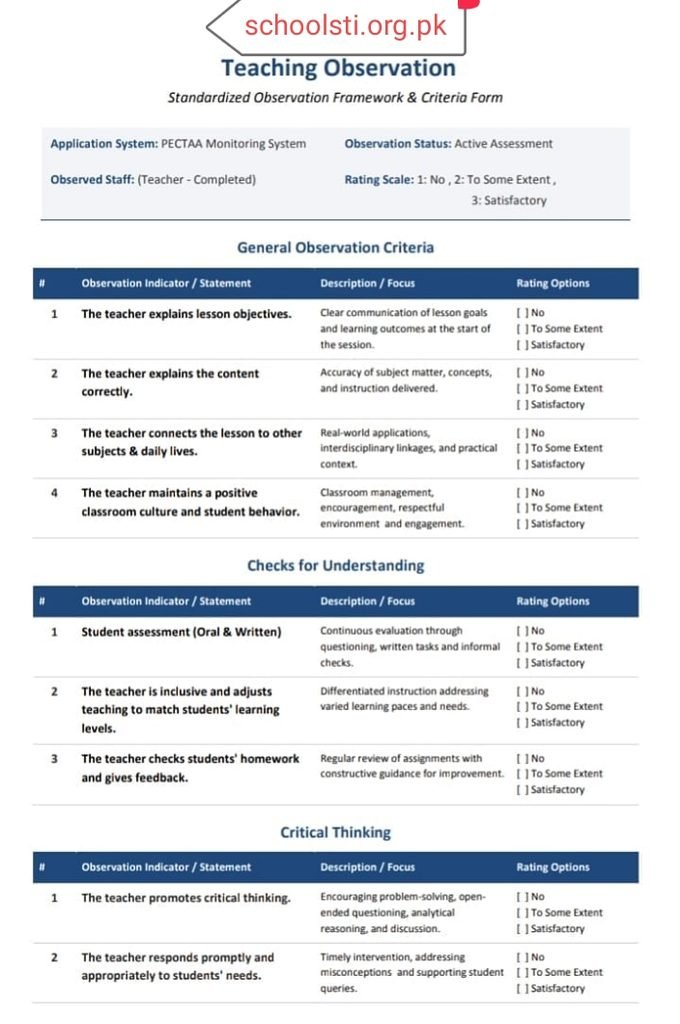
The PECTAA Teaching Observation Form shifts the focal point directly onto instructional delivery and learner cognition. Built around three core dimensions and nine observable indicators, the framework evaluates whether classroom instruction aligns with modern learner-learning objectives (SLOs) and pupil-centered teaching methodologies.
Core Architecture of the Observation Instrument
- Application System: PECTAA Monitoring System (Integrated with PMIU / PESRP Central Database)
- Assessment Mode: Active Assessment during live instructional periods
- Evaluation Target: In-class teaching practice and learner engagement
- Standardized 3-Point Rating Scale:
- No (Rating: 1): The observed behavior or pedagogical practice was absent.
- To Some Extent (Rating: 2): The practice was partially implemented, inconsistent, or rudimentary.
- Satisfactory (Rating: 3): The practice was clearly demonstrated, structured, and met benchmark caliber standards.
Teachers and academy administrators can download the PECTAA teaching observation form to review the exact rubric indicators and align their lesson planning prior to official visits.
How AEOs Record Observations via the PECTAA School Monitoring App
The deployment of the PECTAA School Monitoring App transforms field monitoring into an authenticated, data-driven cycle. Assistant Education Officers follow a systematic digital workflow during each academy visit:
[Arrival & Geo-Tagging] ➔ [Randomized/Assigned Class Selection] ➔ [20–30 Min In-Class Observation] ➔ [Form Indicator Input] ➔ [Real-Time Sync to PMIU Data Centre]
- Biometric and Geo-Fenced Check-In: The app verifies the AEO’s physical presence on school premises using GPS coordinates and timestamps, preventing off-site data entries.
- Teacher and Class Selection: The AEO selects the teacher and subject scheduled for monitoring from the digital roster linked to the School Information System (SIS).
- Dedicated Observation Interval: Observers spend an uninterrupted 20 to 30 minutes inside the active classroom, minimizing disruption while evaluating instructional delivery.
- Digital Rubric Scoring: For each of the nine performance indicators, the AEO selects No, To Some Extent, or Satisfactory, accompanied by qualifying field notes where required.
- Immediate Sync and Feedback: Upon submission, the observation record syncs directly to the provincial monitoring server, generating automated dashboards for District Education Authorities (DEAs) and feeding targeted training needs into forthcoming teacher development modules.
Breakdown of the 3 Dimensions and 9 Core Indicators
The observation form categorizes instructional competence into three interconnected dimensions: General Observation Criteria, Checks for Understanding, and Critical Thinking.
                           PECTAA OBSERVATION FORM
                                      │
     ┌────────────────────────────────┼────────────────────────────────┐
     ▼                                ▼                                ▼
[General Observation]      [Checks for Understanding]        [Critical Thinking]
 • Lesson Objectives        • Oral & Written Assessment       • Critical Inquiry
 • Content Accuracy         • Inclusivity & Differentiation   • Prompt Responsiveness
 • Real-World Context       • Homework & Feedback
 • Classroom Culture
1. General Observation Criteria
This section evaluates the structural setup, clarity, contextual relevance, and emotional climate of the lesson.
- Indicator 1: The instructor explains lesson objectives.
- Focus: Clear communication of lesson goals and expected Student Learning Outcomes (SLOs) at the highly beginning of the session.
- Exemplary Practice: Writing the day’s objective prominently on the board in accessible language and explicitly stating what students should be able to perform by the end of the period.
- Indicator 2: The instructor explains the material correctly.
- Focus: Scientific and conceptual accuracy of the subject matter, correct terminology, and structured pedagogical explanation.
- Exemplary Practice: Delivering error-free conceptual instruction, avoiding misconceptions in STEM subjects, and demonstrating a solid grasp of the curriculum.
- Indicator 3: The educator connects the lesson to other subjects & daily lives.
- Focus: Integrating genuine-globe applications, interdisciplinary linkages, and contextual challenge-solving.
- Exemplary Practice: Relating fractions to food sharing, linking atmospheric pressure to weather patterns, or connecting historical events to current civic dynamics.
- Indicator 4: The teacher maintains a positive classroom culture and learner behavior.
- Focus: Empathetic classroom management, positive reinforcement, mutual respect, equitable participation, and an orderly yet vibrant learning atmosphere.
- Exemplary Practice: Praising learner efforts, preventing peer bullying or ridicule, giving shy learners equal turns, and using calm, authoritative communication.
2. Checks for Understanding
This dimension focuses on formative assessment and adaptive instruction during the learning flow.
- Indicator 5: Student assessment (Oral & Written).
- Focus: Continuous diagnostic evaluation through targeted oral questioning, prompt notebook spot-checks, mini-slates, and informal checks for understanding.
- Exemplary Practice: Using randomized inquiry distribution across the room rather than relying solely on habitual front-bench respondents.
- Indicator 6: The educator is inclusive and adjusts teaching to match students’ learning levels.
- Focus: Differentiated instruction that accommodates varied learning paces, providing scaffolded support for struggling learners while keeping advanced students challenged.
- Exemplary Practice: Grouping mixed-ability students, using visual aids for auditory/visual balance, and re-explaining complex ideas using simpler analogies when comprehension stalls.
- Indicator 7: The instructor checks students’ homework and gives feedback.
- Focus: Regular, structured review of home assignments with actionable, constructive comments rather than superficial sign-offs.
- Exemplary Practice: Marking specific conceptual errors, writing motivating guidance, and allocating the primary five minutes of class to resolve widespread homework difficulties.
3. Critical Thinking
Moving beyond rote memorization (ratta culture), this category measures whether the learning environment cultivates cognitive agility and active pupil inquiry.
- Indicator 8: The teacher promotes critical thinking.
- Focus: Encouraging problem-solving, accessible-ended “why” and “how” questions, comparative analysis, and peer-to-peer discourse.
- Exemplary Practice: Asking students to predict outcomes, challenge assumptions, defend their reasoning, or propose alternative solutions to a scenario.
- Indicator 9: The teacher responds promptly and appropriately to students’ needs.
- Focus: Attentive and timely interventions, diagnosing misconceptions in actual time, and validating pupil inquiries without dismissiveness.
- Exemplary Practice: Recognizing facial cues of confusion, pausing instruction to clarify doubts, and circulating around the room to assist individual learners during practice drills.
Standardized Observation Framework Matrix
The table below outlines the full rubrics of the official PECTAA form:
| # | Domain / Dimension | Observation Indicator / Statement | Description & Evaluative Focus | Rating Options |
|---|---|---|---|---|
| 1 | General Criteria | The instructor explains lesson objectives. | Clear communication of lesson goals and learning outcomes at the start of the session. | No |
| 2 | General Criteria | The instructor explains the content correctly. | Accuracy of subject matter, concepts, and instruction delivered. | No |
| 3 | General Criteria | The educator connects the lesson to other subjects & daily lives. | Real-globe applications, interdisciplinary linkages, and practical context. | No |
| 4 | General Criteria | The instructor maintains a positive classroom culture and student behavior. | Classroom management, encouragement, respectful environment, and active engagement. | No |
| 5 | Checks for Understanding | Student assessment (Oral & Written). | Continuous evaluation through questioning, written tasks, and informal formative checks. | No |
| 6 | Checks for Understanding | The instructor is inclusive and adjusts teaching to match students’ learning levels. | Differentiated instruction addressing varied learning paces and diverse learner needs. | No |
| 7 | Checks for Understanding | The instructor checks students’ homework and gives feedback. | Regular review of assignments with constructive guidance for substantive improvement. | No |
| 8 | Critical Thinking | The teacher promotes critical thinking. | Encouraging issue-solving, open-ended questioning, analytical reasoning, and structured discussion. | No |
| 9 | Critical Thinking | The instructor responds promptly and appropriately to students’ needs. | Timely pedagogical intervention, addressing misconceptions, and supporting pupil queries. | No |
Comparison: Traditional Inspection vs. PECTAA Digital Observation System
Understanding this systematic evolution explains why the administration moved from manual visits to the integrated monitoring app.
| Key Parameter | Traditional School Inspection | PECTAA Digital Observation System |
|---|---|---|
| Primary Evaluation Focus | Registers, head counts, and civil infrastructure | Pedagogical caliber, learner understanding, and classroom culture |
| Observation Instrument | Paper checklists and subjective diary notes | Standardized 9-indicator digital rubric on Android tablets |
| Feedback Latency | Weeks to months via physical files | Instant provincial sync to PMIU/PECTAA analytical servers |
| Data Integrity & Traceability | Susceptible to manual overrides and proxy entries | Geo-tagged, time-stamped, and linked to teacher national IDs |
| Teacher Development Value | Primarily punitive; identifying infractions | Diagnostic; identifies specific professional training gaps |
| Assessment of Student Learning | Purely summative (exam marks) | Formative, assessing authentic-time critical thinking and understanding |
To explore regulatory updates, exam notifications, and official gazettes, follow the latest Punjab academy education updates on Schoolsti.
Actionable Strategies for Teachers to Achieve “Satisfactory” Scores
To consistently earn top ratings across all nine indicators, educators should adopt deliberate classroom routines:
- Begin with the End in Mind (Indicator 1): Write the particular SLO on the highest-right corner of the chalkboard in both Urdu and English. Dedicate the first two minutes to explaining what students will master nowadays and why it matters.
- Anchor Abstract Ideas to Local Reality (Indicator 3): Prepare at least two concrete, everyday examples for every theoretical concept (e.g., using bazaar transactions to explain negative numbers or regional crops to explain plant biology).
- Replace Chorus Answers with Cold Calling (Indicator 5): Eliminate choral responses (“Yes sir/miss!”). Instead, pose a prompt, supply five seconds of wait time, and call on exact students randomly across all rows.
- Use Structured “Exit Slips” (Indicator 6): Reserve three minutes at the end of the period for a one-inquiry written exit ticket. This provides immediate proof of differentiated learning checks to the observing AEO.
- Formulate Higher-Order Thinking Questions (Indicator 8): Frame questions starting with “What would happen if…”, “How would you compare…”, or “Can you provide an alternative method to solve this?” rather than questions requiring simple rote recall.
Frequently Asked Questions (FAQs)
What is the role of an AEO under the PECTAA monitoring setup?
An Assistant Education Officer (AEO) acts as both an academic supervisor and a mentor for primary and elementary schools in their designated cluster. Using the PECTAA School Monitoring App, the AEO observes classroom lessons, inputs rubric scores, and provides immediate mentoring to enhance teaching standards.
Does a “To Some Extent” rating effect in disciplinary action?
No. The observation rubric is designed as a developmental and diagnostic instrument rather than a punitive audit. Scores identify areas requiring in-service capacity building (such as CPD training by Quaid-e-Azam Academy for Educational Development – QAED). Consistent “No” ratings over extended cycles, nevertheless, trigger administrative reviews.
How is homework checked under this framework?
The indicator evaluates both regularity and pedagogical value. Checking notebooks requires date verification and qualitative feedback (corrections, guidance, or praise) rather than uncomplicated blank checkmarks.
Can teachers view their observation scores in the app?
Observation logs are submitted directly to the central PECTAA/PMIU database. While AEOs conduct debrief discussions at the finish of the visit, school heads and teachers can track performance trends and institutional feedback through the institutional SIS portal.
Analysis
The integration of the PECTAA Teaching Observation Form into the PECTAA School Monitoring App represents an key modernization of communal education in Punjab. Several structural insights emerge from this reform:
- Institutional Consolidation: The establishment of PECTAA as an apex body brings curriculum structure, teacher training, and field monitoring into a single unified feedback loop. Data gathered by AEOs in rural clusters directly influences upcoming curriculum revisions and teacher training modules.
- Deprecation of Rote Learning: By dedicating two of its three evaluative dimensions to Checks for Understanding and Critical Thinking, the framework creates administrative incentives against passive lecture methods and verbatim textbook memorization.
- Granular Accountability: Standardizing ratings into three unambiguous tiers (No, To Some Extent, Satisfactory) limits subjective grading variances between different visiting officers, ensuring standardized evaluations across all 36 districts of Punjab.
Opinion
The transition from infrastructure policing to pedagogical observation is a essential reform for Punjab’s general institution system. For decades, official monitoring incentivized neat registers and freshly painted whitewash over actual learner learning. The PECTAA Teaching Observation Form properly identifies the instructor-student dynamic as the core driver of educational outcomes.
Nonetheless, the framework’s ultimate success depends on how AEOs approach their role. If field officers treat the nine indicators as a mechanical compliance checklist, teachers may resort to staged performances during visits without adopting sustainable classroom habits.
For actual transformation, the provincial leadership must ensure that AEOs act as instructional coaches rather than punitive inspectors. When an AEO identifies a “No” or “To Some Extent” in critical thinking or differentiated instruction, the visit must conclude with practical, collaborative modeling of how to structure those activities. Paired with continuous mentorship, this digital monitoring framework has genuine potential to elevate teaching standard and pupil achievement across Punjab.
Conclusion
The PECTAA Teaching Observation Form represents a practical step toward structured, accountable, and pupil-focused classrooms. By tracking particular indicators—from objective-setting and differentiated learning to critical reasoning—the framework establishes transparent benchmarks for educators across the province. For teachers and school leaders, mastering these nine indicators is not merely regarding achieving compliance on the AEO’s monitoring app; it is about cultivating dynamic classrooms where every child is engaged, supported, and challenged to think critically.