PPSC Revised Syllabus for Combined Competitive Examination (CCE 2027)
PPSC Revised Syllabus for Combined Competitive Examination (CCE 2027): Complete Breakdown, Exam Pattern, and Preparation Strategy
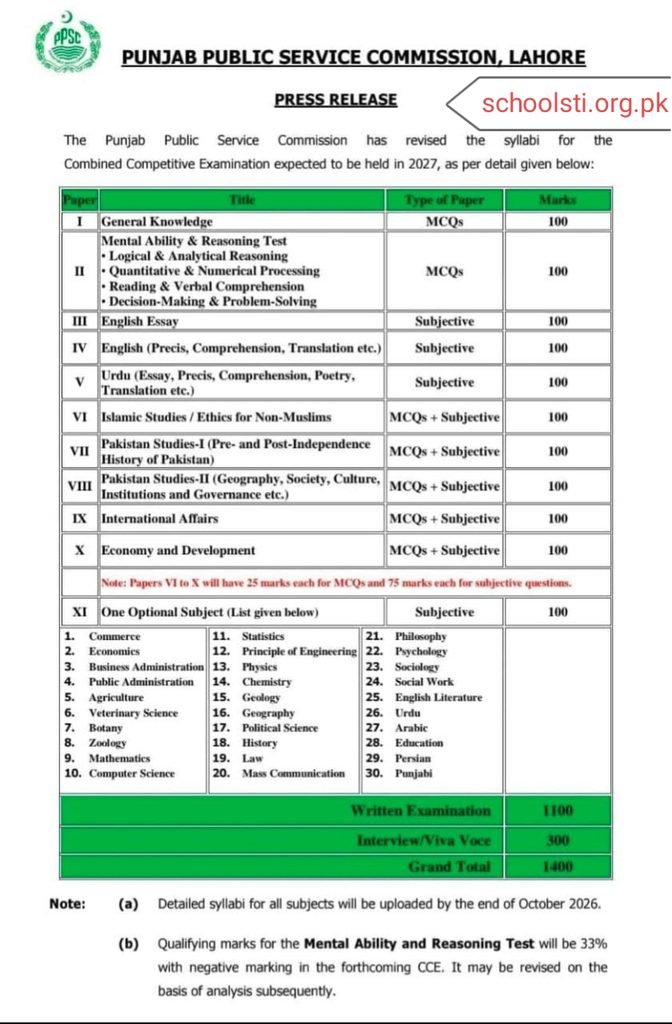
The Punjab Public Service Commission (PPSC), Lahore has officially issued a landmark press release notifying a comprehensive overhaul of the syllabus and examination structure for the Combined Competitive Examination (CCE / PMS) expected to be held in 2027.
This major policy revision modernizes provincial civil service recruitment, aligning Punjab’s examination framework with contemporary administrative demands, analytical competencies, and standardized global testing norms. The restructuring introduces dedicated cognitive assessment papers, splits legacy subjects into specialized modules, reduces optional subject weightage, and implements strict negative marking for screening components.
Below is an exhaustive, in-depth guide covering the full scheme of examination, paper-wise distribution, key structural changes, comparative analysis, strategic preparation methodologies, and an expert verdict on the modern scheme.
At a Glance: Key Highlights of PPSC CCE 2027
- Total Marks: 1400 Marks (Written Examination: 1100 Marks | Interview / Viva Voce: 300 Marks).
- Number of Written Papers: 11 Papers (10 Compulsory Papers + 1 Optional Subject), each carrying 100 marks.
- Major Addition: Introduction of a standalone 100-mark Mental Ability & Reasoning Test (MCQ-based with negative marking and a 33% qualifying threshold).
- Restructured Core Subjects: Pakistan Studies is now bifurcated into History (Paper VII) and Governance, Geography & Society (Paper VIII); dedicated standalone papers are established for International Affairs (Paper IX) and Economy & Development (Paper X).
- Hybrid Testing Model: Papers VI through X trait a mandatory 25% MCQ (Objective) and 75% Subjective allocation.
- Reduced Optional Weightage: Optional subjects have been consolidated from multi-paper groups into One Optional Subject (100 Marks) chosen from an approved series of 30 disciplines.
- Detailed Syllabi Release Date: Detailed subject-wise contents will be published on the Punjab Public Service Commission Official Portal by the finish of October 2026.
Detailed Scheme of Written Examination (1100 Marks)
Under the revised structure, the written phase comprises 11 distinct papers of 100 marks each. Compulsory subjects now carry 1000 marks (90.9% of the written score), underscoring the commission’s emphasis on a broad-based, standardized evaluation of all prospective civil servants.
Comprehensive Paper Breakdown Table
| Paper | Subject / Title | Examination Format | Total Marks | Marks Breakdown |
|---|---|---|---|---|
| Paper I | General Knowledge | MCQs (Objective) | 100 | 100% Objective |
| Paper II | Mental Ability & Reasoning Test | MCQs (Objective) | 100 | Negative marking applied; 33% qualifying cutoff |
| Paper III | English Essay | Subjective | 100 | Traditional Essay Composition |
| Paper IV | English (Precis, Comprehension, Translation etc.) | Subjective | 100 | Grammar, Precis & Applied English |
| Paper V | Urdu (Essay, Precis, Comprehension, Poetry, Translation etc.) | Subjective | 100 | Classical & Contemporary Urdu Competency |
| Paper VI | Islamic Studies / Ethics for Non-Muslims | Hybrid (MCQs + Subjective) | 100 | 25 Marks MCQs + 75 Marks Subjective |
| Paper VII | Pakistan Studies-I (Pre- and Post-Independence History of Pakistan) | Hybrid (MCQs + Subjective) | 100 | 25 Marks MCQs + 75 Marks Subjective |
| Paper VIII | Pakistan Studies-II (Geography, Society, Culture, Institutions and Governance etc.) | Hybrid (MCQs + Subjective) | 100 | 25 Marks MCQs + 75 Marks Subjective |
| Paper IX | International Affairs | Hybrid (MCQs + Subjective) | 100 | 25 Marks MCQs + 75 Marks Subjective |
| Paper X | Economy and Development | Hybrid (MCQs + Subjective) | 100 | 25 Marks MCQs + 75 Marks Subjective |
| Paper XI | One Optional Subject (Selected from 30 Disciplines) | Subjective | 100 | Discipline-Specific Subjective Paper |
| Total | Written Examination Aggregate | — | 1100 | 11 Papers |
Deep Dive into Structural Shifts & New Compulsory Papers
[ PPSC CCE 2027 Scheme: 1400 Total Marks ]
 ├── Written Examination: 1100 Marks (11 Papers x 100 Marks)
 │    ├── Pure Objective (MCQ): Papers I & II (200 Marks)
 │    ├── Pure Subjective: Papers III, IV, V, & XI (400 Marks)
 │    └── Hybrid (25% MCQ + 75% Subjective): Papers VI to X (500 Marks)
 └── Interview & Viva Voce: 300 Marks
1. Paper II: Mental Ability & Reasoning Test
The most significant pedagogical shift in CCE 2027 is the introduction of a dedicated cognitive paper. Evaluated entirely via Multiple Choice Questions (MCQs), this paper tests four core areas:
- Logical & Analytical Reasoning: Assessing deduction, induction, pattern recognition, and formal logical arguments.
- Quantitative & Numerical Processing: Testing core numeracy, basic statistics, arithmetic problem-solving, and data interpretation.
- Reading & Verbal Comprehension: Critical textual analysis, context-based deduction, and inference extraction.
- Decision-Making & Problem-Solving: Evaluating managerial aptitude, scenario-based dilemmas, and administrative reasoning.
Critical Rules for Paper II:
- Qualifying Cutoff: Candidates must obtain a minimum of 33% marks to pass.
- Negative Marking: Incorrect answers will incur mark deductions. Aspirants must develop disciplined accuracy rather than speculative guessing.
- Future Revisions: PPSC has explicitly stated that the passing threshold may be re-evaluated and revised based on statistical performance analyses in subsequent iterations. Candidates can check updated notifications and study materials via educational news and past papers on schoolsti.org.pk.
2. Bifurcation of Pakistan Studies (Papers VII & VIII)
In earlier exams, Pakistan Affairs conflated historical narratives with institutional, social, and constitutional issues within a single 100-mark paper. The 2027 syllabus establishes two independent disciplines:
- Pakistan Studies-I (Paper VII): Dedicated strictly to the historical continuum, covering pre-independence socio-political movements, colonial constitutional developments, the Pakistan Movement, and post-independence political history.
- Pakistan Studies-II (Paper VIII): Focuses exclusively on state-building, physical and economic geography, social stratification, cultural dynamics, civil-military institutions, communal governance, and constitutional evolution.
3. Dedicated Modules for Global Politics and Economic Policy
Reflecting the curriculum modernizations endorsed by the Higher Education Commission Pakistan, PPSC has elevated global diplomacy and macroeconomics into standalone compulsory papers:
- Paper IX (International Affairs): Covers geopolitical architecture, multilateral organizations, global security, diplomacy, and foreign policy dynamics.
- Paper X (Economy and Development): Focuses on macroeconomic indicators, fiscal and monetary policies, industrialization, energy security, international trade, poverty alleviation, and sustainable development goals (SDGs).
4. The 25/75 Hybrid Assessment Structure (Papers VI to X)
To ensure balanced evaluation across both factual recall and conceptual synthesis, Papers VI through X aspect:
- 25 Marks for Objective MCQs: Testing precise factual knowledge, institutional frameworks, dates, treaties, economic indices, and statutory articles.
- 75 Marks for Subjective Essay-Style Questions: Requiring critical analysis, policy evaluation, flowcharts, and structured administrative arguments.
Approved List of Optional Subjects (Paper XI – 100 Marks)
In contrast to legacy systems where optional subjects accounted for up to 600 marks across multiple selection groups, CCE 2027 permits candidates to select only one optional subject carrying 100 marks. The paper is fully subjective and must be chosen from the following 30 designated subjects:
| Grouping Index | Discipline Name | Grouping Index | Discipline Name | Grouping Index | Discipline Name |
|---|---|---|---|---|---|
| 01 | Commerce | 11 | Statistics | 21 | Philosophy |
| 02 | Economics | 12 | Principle of Engineering | 22 | Psychology |
| 03 | Business Administration | 13 | Physics | 23 | Sociology |
| 04 | Public Administration | 14 | Chemistry | 24 | Social Work |
| 05 | Agriculture | 15 | Geology | 25 | English Literature |
| 06 | Veterinary Science | 16 | Geography | 26 | Urdu |
| 07 | Botany | 17 | Political Science | 27 | Arabic |
| 08 | Zoology | 18 | History | 28 | Education |
| 09 | Mathematics | 19 | Law | 29 | Persian |
| 10 | Computer Science | 20 | Mass Communication | 30 | Punjabi |
Comparative Analysis: Legacy PMS vs. PPSC CCE 2027
To grasp the practical implications of this reform, it is useful to contrast the traditional Punjab PMS framework with the incoming CCE 2027 syllabus:
| Feature / Dimension | Legacy PPSC PMS Pattern | Revised PPSC CCE 2027 Pattern | Strategic Impact on Candidates |
|---|---|---|---|
| Compulsory Weightage | 600 Marks (6 Papers) | 1000 Marks (10 Papers) | Minimizes subjective scoring disparities across academic backgrounds. |
| Optional Weightage | 600 Marks (3 Subjects x 200 Marks) | 100 Marks (1 Subject x 100 Marks) | Eliminates “high-scoring” optional subject gaming and subject-clustering advantages. |
| Cognitive Assessment | Embedded lightly inside General Knowledge | Dedicated 100-mark Mental Ability Test | Rewards analytical, quantitative, and challenge-solving competencies. |
| Marking Penalties | Standard negative marking on GK paper | Explicit Negative Marking on Paper II | Demands rigorous query-selection strategy and high calculation speed. |
| Economic & Global Focus | Bundled loosely into General Knowledge | Two Standalone Papers (200 Marks Total) | Requires mastery of international relations, macroeconomics, and developmental policy. |
| Subjective vs Objective | Predominantly subjective, except GK | Structured Hybrid (25% MCQ + 75% Subjective) | Mandates dual preparation: precise factual retention alongside analytical essay writing. |
| Interview Value | 200 Marks | 300 Marks | Increases the viva voce weightage to 21.4% of the overall aggregate. |
Actionable Preparation Strategy for CCE 2027 Aspirants
With the detailed syllabi scheduled for release by late October 2026, candidates should implement a phased preparation roadmap:
[ Phase 1: Analytical Foundation ] ──► [ Phase 2: Core Policy Mastery ] ──► [ Phase 3: Writing & Mock Drills ]
* Quantitative Aptitude               • Macroeconomics & Trade             • 25-mark MCQ Timed Drills
* Deductive Logic & Reasoning         • International Geopolitics          • Precis & Translation Practice
* Grammar & Reading Speed             • Constitutional History             • 75-mark Subjective Exam Simulations
- Master Core Aptitude Early: Since Paper II carries negative marking and an elimination threshold, solve daily difficulty sets in basic arithmetic, statistics, logical deduction, and verbal inference. Resources modeled after standard civil service aptitude tests from bodies like the Federal Public Service Commission (FPSC) offer excellent practice.
- Build Empirical Economic Literacy: Study fiscal deficits, circular debt, trade balances, tax-to-GDP ratios, and monetary policy mechanisms to prepare for Paper X (Economy and Development).
- Bridge History with Governance: For Pakistan Studies, separate your reading lists: consult academic historiographies for Paper VII, and focus on constitutional case law, open policy frameworks, local administration systems, and geography for Paper VIII.
- Targeted Optional Selection: Choose your single optional subject based on foundational academic strength, syllabus overlap with compulsory papers (e.g., Political Science, Economics, Public Administration, or Sociology), and access to grade reference literature. Aspirants can track subject-wise reading guides and notes through PPSC exam preparation resources on schoolsti.org.pk.
- Develop Hybrid Time Management: In Papers VI through X, allocate 25–30 minutes to whole the objective segment accurately before organizing and drafting the remaining 75 marks of subjective answers.
Frequently Asked Questions (FAQs)
What is the total mark distribution for PPSC CCE 2027?
The examination carries a grand total of 1400 marks, comprising 1100 marks for the written examination (11 papers of 100 marks each) and 300 marks for the Interview / Viva Voce.
How does negative marking work in the Mental Ability & Reasoning Test?
Paper II features a mandatory 33% qualifying cutoff alongside negative marking. A predetermined fraction of marks will be deducted for every incorrect MCQ response. Unanswered questions do not incur penalties.
Can candidates still select multiple optional subjects?
No. The revised framework allows candidates to choose only one optional subject (100 marks) from the approved series of 30 disciplines, shifting the primary competitive focus to compulsory subjects.
When will PPSC publish the complete, topic-wise syllabus?
According to the commission’s official press release, detailed syllabi for all compulsory and optional subjects will be uploaded on the PPSC website by the end of October 2026.
What is the MCQ-to-subjective proportion in Papers VI through X?
Papers VI (Islamic Studies/Ethics), VII (Pakistan Studies-I), VIII (Pakistan Studies-II), IX (International Affairs), and X (Economy and Development) allocate 25 marks to objective MCQs and 75 marks to subjective questions.
Analysis
The 2027 PPSC syllabus restructuring represents a fundamental shift in provincial bureaucratic recruitment:
- Leveling the Academic Playing Field: Under the legacy model, candidates opting for historically high-scoring technical subjects regularly secured disproportionate aggregate margins over candidates from humanities backgrounds. By slashing optional subjects to a single 100-mark paper, PPSC has established an egalitarian baseline where 90.9% of the written assessment is standardized.
- Prioritizing Administrative Aptitude Over Rote Learning: The introduction of Paper II (Mental Ability & Reasoning) and the 25/75 objective-subjective hybrid model directly targets the issue of rote memorization. Officers must now demonstrate demonstrable cognitive reasoning, data literacy, and quantitative problem-solving.
- Institutionalizing Technocratic Competence: Dedicating 200 compulsory marks to International Affairs and Economy & Development ensures that inductees into the provincial administration possess practical grounding in open finance, governance dynamics, and geopolitical strategy.
- Enhanced Interview Weightage: Raising the viva voce to 300 marks reinforces the commission’s focus on evaluating interpersonal communication, emotional stability, executive presence, and ethical suitability for general leadership.
Opinion
The Punjab Public Service Commission’s revised CCE 2027 syllabus is a progressive, overdue institutional reform. For decades, provincial competitive examinations have suffered from syllabus gaming, where subject selection was dictated by scoring trends rather than intellectual relevance to open administration.
By curtailing optional subjects to a single 100-mark paper and anchoring the written phase in cognitive analysis, economic literacy, and statecraft, PPSC has designed an examination that tests the actual skills required of a 21st-century civil servant. While the introduction of negative marking in the reasoning paper will initially expand attrition rates, it elevates meritocratic screening and aligns Punjab’s civil service with international general sector standards. Candidates who transition early from passive memorization to analytical issue-solving and structured policy writing will hold a decisive competitive advantage in CCE 2027.
Conclusion
The PPSC Combined Competitive Examination 2027 syllabus restructuring redefines civil service preparation in Punjab. With 10 compulsory papers covering quantitative reasoning, history, global affairs, language proficiency, and economic development, success will depend on intellectual versatility, disciplined testing strategy, and analytical depth. Aspirants should use the runway leading up to late 2026 to master core cognitive abilities, assemble robust conceptual frameworks across compulsory domains, and prepare thoroughly for this updated evaluation system.