Prime Minister Youth Chromebook Scheme 2026
Prime Minister Youth Chromebook Scheme 2026: Official Portal Registration, Eligibility Criteria, and Complete Guide
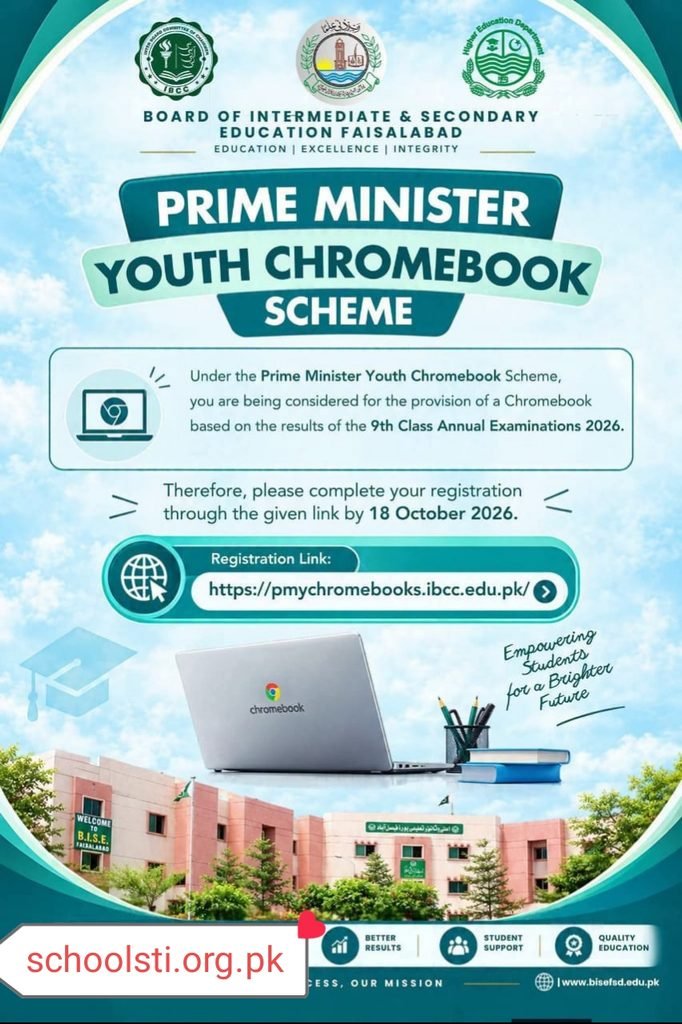
Pakistan’s open education system is witnessing a historic technological leap. Through the Prime Minister’s Youth Chromebook Scheme, the federal authority has officially expanded its flagship youth empowerment framework directly into the secondary school ecosystem. Administered digitally through the Inter Boards Coordination Commission (IBCC) centralized portal at pmychromebooks.ibcc.edu.pk, this ambitious initiative targets high-achieving matriculation students across the country.
While previous digital welfare drives focused primarily on higher education and tertiary university scholars, the 2026 scheme shifts the intervention down to high academy students in Grade 9 (SSC-I) and Grade 10 (SSC-II). Powered by cloud-centric ChromeOS hardware assembled locally in Haripur through a general-private partnership between the National Radio and Telecommunication Corporation (NRTC) and Tech Valley Pakistan’s Google assembly initiative, this roll-out marks an unprecedented bridge across the digital divide.
Below is the definitive, authoritative walkthrough of the registration protocol, eligibility thresholds, required documentation, and strategic implications of the pmychromebooks.ibcc.edu.pk online portal.
Understanding the Prime Minister’s Youth Chromebook Scheme 2026
The Prime Minister’s Youth Chromebook Scheme represents an targeted educational intervention under the overarching Prime Minister’s Youth Programme (PMYP). Announced by PMYP Chairman Rana Mashhood Ahmad Khan, the government has set an ambitious target of distributing up to 700,000 Chromebook devices to students nationwide.
Historical Context: From University Laptops to Secondary School Devices
For over a decade, the federal laptop distribution model rewarded university scholars pursuing undergraduate, MPhil, and doctoral programs. While impactful, it left a visible vacuum in early foundational STEM education. Most communal academy matriculation candidates enter secondary board examinations without basic personal computing access. By providing lightweight, ruggedized Google Chromebooks directly to foremost-performing 9th and 10th graders, the state aims to nurture digital literacy, programming foundations, and self-directed research at the secondary institution stage.
The Role of IBCC and Technical Architecture of the Portal
The Inter Boards Coordination Commission (IBCC) serves as the national nexus connecting all provincial and regional Intermediate and Secondary Education Boards (BISEs). The dedicated portal—hosted under the federal academic domain pmychromebooks.ibcc.edu.pk—directly interfaces with provincial board examination databases.
When a candidate inputs their examination credentials, the portal matches their details against the pre-cleared BISE merit lists in actual duration. This automated backend validation eliminates counterfeit records, manual data tampering, and partisan quota allocations.
Regional Eligibility Criteria: Who Qualifies for a Free Chromebook?
Eligibility for the 2026 Chromebook Scheme is strictly merit-based and governed by particular regional mandates agreed upon by the IBCC and participating examination boards.
1. The Public School Prerequisite
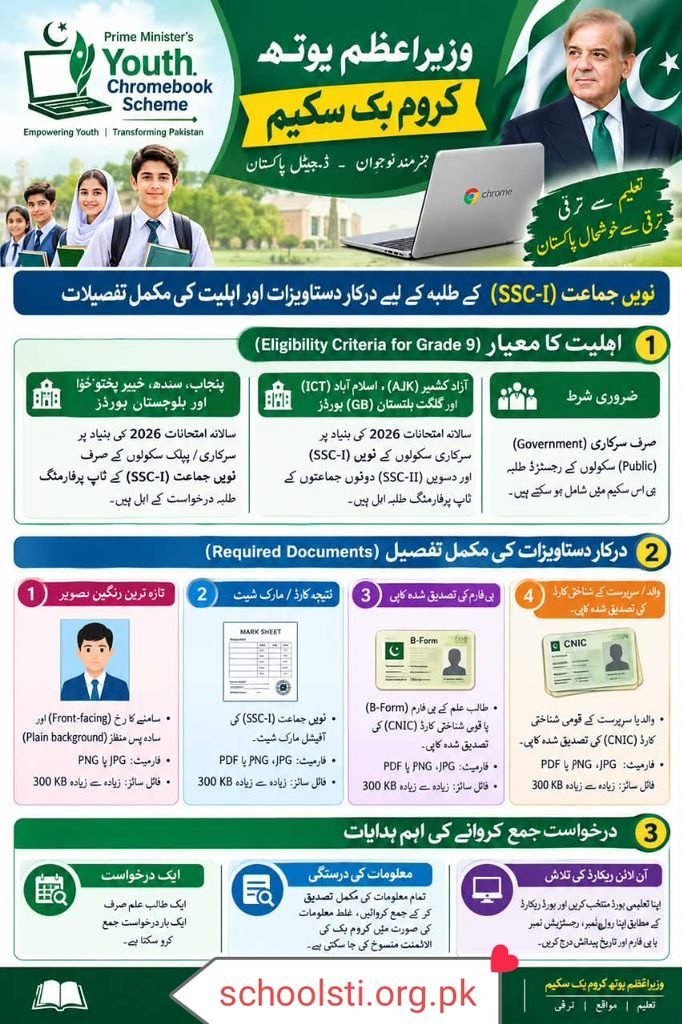
The foremost qualifying rule is institutional: only regularly enrolled students of Government (Public) Schools are eligible. Students enrolled in private academies, semi-private foundations, or appearing as private/external candidates are excluded from this precise scheme.
2. Provincial Boards (Punjab, Sindh, Khyber Pakhtunkhwa, Balochistan)
For the four major provinces, eligibility is tied strictly to the Annual Examination 2026 results of 9th Class (SSC Part-I):
- Only foremost-performing matriculation students from administration high schools who demonstrated exceptional academic standing in their SSC-I board exams qualify for consideration.
- Merit thresholds are established based on board-precise quota formulas (such as high marks in Science and Arts tracks established by individual boards like BISE Faisalabad, BISE Multan, BISE Lahore, and BISE Peshawar).
3. Special Territories (AJK, Gilgit-Baltistan, ICT Islamabad)
For federal and special administrative territories, the scope includes both foundational secondary grades:
- Eligible Grades: Top-performing general academy students of both 9th Class (SSC-I) and 10th Class (SSC-II) based on the 2026 annual examination results.
- Covered Jurisdictions: Azad Jammu & Kashmir (AJK), Gilgit-Baltistan (GB), and the Islamabad Capital Territory (Federal Board / FBISE).
| Jurisdiction / Region | Eligible Classes | Institutional Status | Qualifying Examination Base | Selection Basis |
|---|---|---|---|---|
| Punjab Boards (Faisalabad, Multan, Lahore, Rawalpindi, etc.) | Grade 9 (SSC-I) Only | Public / Government Schools Only | Annual Examinations 2026 | Top Academic Performers / Board Merit List |
| Sindh Boards (Karachi, Hyderabad, Sukkur, Larkana, etc.) | Grade 9 (SSC-I) Only | Public / Government Schools Only | Annual Examinations 2026 | Top Academic Performers / Board Merit List |
| Khyber Pakhtunkhwa Boards (Peshawar, Mardan, Swat, Abbottabad, etc.) | Grade 9 (SSC-I) Only | Public / Government Schools Only | Annual Examinations 2026 | Top Academic Performers / Board Merit List |
| Balochistan Boards (BISE Quetta, etc.) | Grade 9 (SSC-I) Only | Public / Government Schools Only | Annual Examinations 2026 | Top Academic Performers / Board Merit List |
| Federal Capital (ICT / FBISE) | Grade 9 (SSC-I) & Grade 10 (SSC-II) | Public / Federal Government Schools | Annual Examinations 2026 | Dual-Cohort Merit Quota |
| AJK & Gilgit-Baltistan Boards | Grade 9 (SSC-I) & Grade 10 (SSC-II) | Public / Government Schools Only | Annual Examinations 2026 | Dual-Cohort Merit Quota |
To stay updated on changing quotas, verification calls, and provincial education department circulars, candidates can follow the latest educational notifications and board updates published for educators and students.
Mandatory Documentation and Upload Specifications
Before accessing the online portal, applicants must prepare their official digital documentation. Every uploaded file undergoes digital scrutiny and institutional verification by institution heads.
Document Specifications Table
| Document Name | Required Format | Maximum File Size | Key Image & Content Guidelines |
|---|---|---|---|
| Recent Passport Photograph | JPG / PNG | 300 KB | Crisp, front-facing portrait with a plain background (white or light blue); apparent facial features without blur. |
| Official Result Card / Marksheet | JPG / PNG / PDF | 300 KB | Legible copy of the official SSC-I (or SSC-II) 2026 Annual Examination mark sheet issued by the relevant board. |
| Attested Copy of Student B-Form | JPG / PNG / PDF | 300 KB | Official NADRA-issued Child Registration Certificate (B-Form) or Student CNIC/Smart Card, attested by a Grade-17+ officer. |
| Attested Copy of Parent/Guardian CNIC | JPG / PNG / PDF | 300 KB | Front and back copy of Father’s or Legal Guardian’s Computerized National Identity Card, duly attested. |
Step-by-Step Registration Guide for pmychromebooks.ibcc.edu.pk
The registration procedure is streamlined, but applicants must adhere strictly to board records to avoid automated rejections.
[Access Portal] ➔ [Select BISE Board] ➔ [Enter Roll No & B-Form] ➔ [Verify Prefilled Bio] ➔ [Upload Files] ➔ [Submit Once & Print]
Step 1: Navigating to the Authorized Domain
Launch an updated web browser and navigate directly to the official URL: https://pmychromebooks.ibcc.edu.pk/. Avoid clicking suspicious third-party mirrors or shortlinks circulating on social messaging platforms.
Step 2: Locating Your Board Record
On the homepage, select your respective educational board (e.g., BISE Faisalabad, BISE Peshawar, BISE Multan, or FBISE Islamabad). Input your:
- 9th Class Annual 2026 Examination Roll Number
- Board Registration Number
- Student B-Form / CNIC Number
- Date of Birth (exactly matching your NADRA records)
Click on Search Record. If your academic standing falls within the board’s designated consideration bracket, your pre-verified academic data and academy name will load automatically.
Step 3: Bio-Data and Contact Verification
- Enter an active mobile phone number registered under the parent or guardian’s CNIC to ensure SMS verification alerts arrive promptly.
- Confirm your permanent residential and academy address.
Step 4: Document Uploading
Upload the four required files according to the strict 300 KB ceiling. Ensure scans are oriented upright, no-cost of shadows, and clearly legible.
Step 5: Final Review and Single-Submission Policy
Carefully review all form fields. The IBCC enforces a Strict Single-Submission Policy:
- A pupil can submit only one application.
- Any discrepancy between the online entry, uploaded files, and board master records will result in the immediate forfeiture and cancellation of the device allotment.
- Once submitted, download and print the final confirmation proforma. Have it signed by your school principal/headmaster for internal academy records and board countersigning.
Comparison: PM Youth Chromebook Scheme vs. Traditional PM Laptop Scheme
A common source of confusion among students is whether this program replaces the university-degree laptop scheme. They are distinct initiatives tailored for different academic tiers.
| Feature / Dimension | PM Youth Chromebook Scheme 2026 | PM National Laptop Scheme (HEC) |
|---|---|---|
| Target Demographic | Secondary School Students (Grade 9 & Grade 10) | Tertiary Higher Education Scholars (BS, MS, MPhil, PhD) |
| Administering Authority | Inter Boards Coordination Commission (IBCC) & BISEs | Higher Education Commission (HEC) Pakistan |
| Eligible Institutions | Government / Public Sector Schools Exclusively | Public Sector Universities & Degree Awarding Institutes |
| Operating System | Google ChromeOS (Cloud-First Architecture) | Microsoft Windows 11 Pro / Enterprise |
| Primary Use-Case | Classroom e-learning, digital literacy, web-based STEM tools | Advanced software engineering, data analytics, research, thesis writing |
| Hardware Manufacturing | Locally assembled at NRTC Haripur (Tech Valley / Google partner) | International OEM Procurement (Core i5 / i7 architecture) |
| Portal Endpoint | pmychromebooks.ibcc.edu.pk | laptop.pmyp.gov.pk |
Frequently Asked Questions (FAQs)
What is the official website for the PM Youth Chromebook registration?
The only official portal for the academy-level initiative is https://pmychromebooks.ibcc.edu.pk/.
Are private school students eligible for the Chromebook Scheme?
No. Under the current policy guidelines, only regular students enrolled in government/public schools who appeared through general institutions in the 2026 annual examinations are eligible.
Can 10th-grade (Matric) students apply in Punjab or Sindh?
In Punjab, Sindh, Khyber Pakhtunkhwa, and Balochistan, eligibility is restricted to students who sat for the 9th Class (SSC-I) Annual Examination 2026. Nonetheless, in AJK, Gilgit-Baltistan, and ICT (FBISE), highest performers from both Grade 9 and Grade 10 are eligible.
What is the application fee for the Chromebook Scheme?
There is zero application or registration fee. The entire program is fully funded by the Government of Pakistan. Applicants should not ever pay any intermediary, academy clerk, or agent offering guaranteed allotment.
Does completing online registration guarantee device delivery?
No. Registration confirms consideration under the merit quota. All applicant details undergo physical and institutional scrutiny by academy heads, the respective BISE, and the IBCC before final distribution ceremonies.
Analysis: Key Takeaways for Students, Schools, and Digital Governance
Evaluating the architecture and roll-out of the pmychromebooks.ibcc.edu.pk initiative highlights several pivotal takeaways:
- Decentralized Coordination with Centralized Scrutiny: By channeling the registration through IBCC while tying verification to regional BISE exam results, the federal government has established a transparent mechanism that bypasses local institutional favoritism.
- Infrastructure-Conscious Hardware Choices: Chromebooks running ChromeOS are deliberately suited for open institution students. Unlike Windows-based machines, ChromeOS features negligible virus vulnerability, rapid boot times, low power consumption, and seamless cloud syncing—making them resilient in environments with intermittent electrical power.
- Encouraging Domestic Tech Industrialization: Sourcing devices through domestic assembly lines at NRTC Haripur strengthens local high-tech assembly capacity while drastically lowering procurement costs for the national exchequer.
- Urgent Window for Verification: Because board-notified registration deadlines (such as October 18, 2026, for BISE Faisalabad and BISE Multan cohorts) operate on tight timelines, general academy administrators must actively assist eligible students in procuring attested B-Forms and mark sheets.
For additional resources on academic schedules, institutional verification procedures, and educational administration, refer to the Schools STI educational portal, which regularly curates verified policy circulars across Pakistan.
Opinion: Expert Verdict on Pakistan’s Secondary School Chromebook Pivot
The federal government’s decision to pivot toward cloud-native Chromebooks for secondary school cohorts represents one of the most pragmatically sound educational policies Pakistan has adopted in recent years.
Historically, distributed Windows laptops regularly faced software degradation, unpatched operating systems, malware vulnerabilities, and battery failures within months of reaching students with limited technical assist. ChromeOS sidesteps these pitfalls: it updates seamlessly in the background, demands minimal hardware overhead, and integrates effortlessly with Google Classroom and educational productivity suites.
However, the ultimate success of the Prime Minister’s Youth Chromebook Scheme will not be measured by how numerous boxes are handed out on stage. It hinges on two critical follow-through factors:
- Campus Connectivity: Supplying a cloud-reliant Chromebook to a learner whose school or home lacks consistent internet connectivity risks turning an interactive digital terminal into an offline notepad. The authority must bundle basic educational data packages or offline content caches with device distribution.
- Curriculum Modernization: Distributing 700,000 devices will achieve meaningful economic return only if matriculation curricula move beyond rote memorization toward coding, digital layout, and research-driven learning.
If supported with structured digital curricula and teacher training, the pmychromebooks.ibcc.edu.pk portal could mark the inflection point where Pakistan’s general schooling genuinely joins the digital economy.
imtiazalijatoi007@gmail.com
Nice post thanks for sharing
I have a complaint:
Remember last year govt. introduced “tech subjects” & tech students got above 90% in 9th grade but in that “Chromebook” list of 2000 students, the board has not considered the tech* students.
What about their opportunities?
Is tech* neglected????
mseherkiller1@gmail.com
Province Sindh Board Shaheed Benazirabad Nawab Shah District Naushro Feroz Tahseel Bhiria City Village Khuda Bux Buriro
Howdy would you mind letting me know which webhost you’re using?
I’ve loaded your blog in 3 different internet browsers and
I must say this blog loads a lot faster then most.
Can you recommend a good hosting provider at a reasonable price?
Thanks, I appreciate it!
I’m now not certain the place you are getting your info, however great topic.
I must spend a while studying much more or understanding more.
Thanks for wonderful info I used to be looking for this info for my mission.
My name is mairab iwish the gorment is give me a laptop thankyou
555 391
(DPS) divisional public school and collage sahiwal ELLIGIBLE YES OR NO?
Mera 9th class ma 420 no. Ay tha
Respected Sir/Madam,
I would like to draw your attention towards an injustice being done to the students of the Computer Technology Group.
I am a student of Class 9th, Computer Technology Group, from Govt. Girls Higher Secondary School, Rohillanwali, Muzaffargarh.
The reason is that the Computer Technology Group has been ignored in this year’s Chromebook scheme, while last year the students of the same group were included by the Board itself.
It is unfair because the students of Computer Technology need a Chromebook more than any other group, as our entire study is based on computers and technology.
Therefore, I request you to please include the 9th Class Computer Technology Group students in the Chromebook Scheme and direct the concerned BISE Board and IBCC to update the merit list.
We will be very thankful to you.
School Govt. Girls Higher Secondary School, Rohillanwali, Muzaffargarh
Class 9th (Computer Technology Group)