Punjab Revised GP Fund Subscription Rates 2026
Punjab Revised GP Fund Subscription Rates 2026: Complete Notification Breakdown & Salary Impact
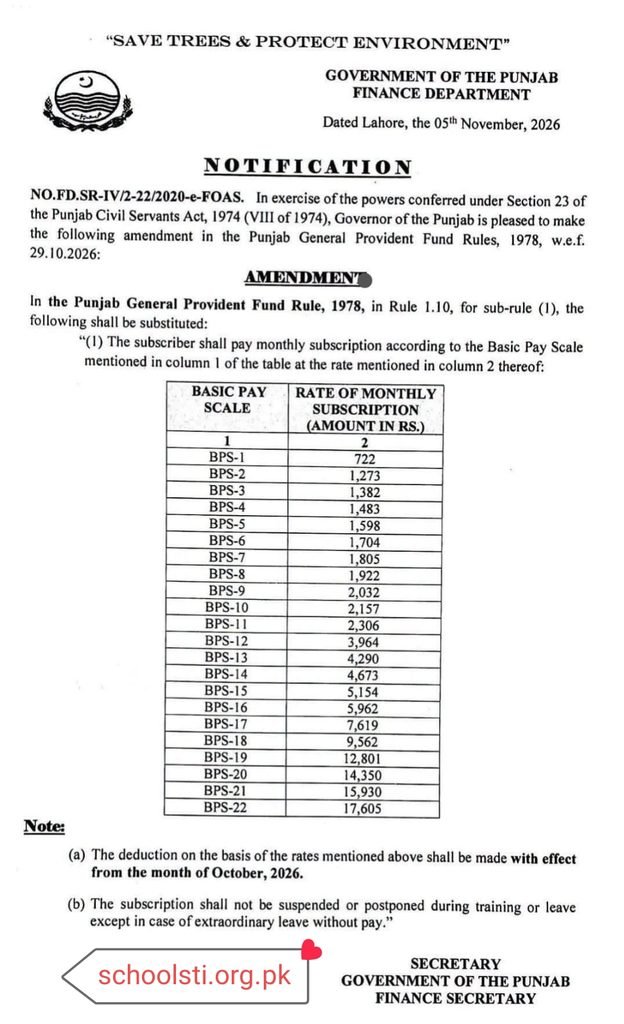
The Government of the Punjab Finance Department issued an official directive (Notification No. FD.SR-IV/2-22/2020-e-FOAS) on November 5, 2026, revising the monthly General Provident (GP) Fund subscription rates for all provincial civil servants across Basic Pay Scales (BPS) 1 to 22. Exercising powers under Section 23 of the Punjab Civil Servants Act, 1974, the Governor of the Punjab amended Rule 1.10, sub-rule (1) of the Punjab General Provident Fund Rules, 1978.
The updated deduction rates take retrospective effect from October 2026 (per the amendment effective date of October 29, 2026), meaning provincial employees will see the revised monthly contributions adjusted directly in their upcoming salary disbursements. While higher deductions slightly reduce immediate net take-home pay, every rupee contributed remains the personal property of the civil servant, compounding annually to construct a larger tax-no-cost retirement corpus.
Key Highlights of the Punjab GP Fund Notification 2026
For quick reference by Drawing and Disbursing Officers (DDOs), ministerial staff, educators, and civil servants, the core parameters of the latest financial directive contain:
- Issuing Authority: Government of the Punjab, Finance Department (Regulations Wing).
- Notification Tracking Number:
NO.FD.SR-IV/2-22/2020-e-FOAS. - Date of Issuance: November 5, 2026 (Lahore).
- Statutory Framework: Section 23 of the Punjab Civil Servants Act, 1974 (VIII of 1974), amending Rule 1.10(1) of the Punjab General Provident Fund Rules, 1978.
- Effective Timeline: Applicable with effect from October 29, 2026, with monthly payroll deductions commencing from the month of October 2026.
- Leave & Training Provision: Subscriptions cannot be suspended or postponed during training or regular leave, with the sole exception of extraordinary leave without pay (EOL).
Official Revised GP Fund Deduction Chart 2026 (BPS-1 to BPS-22)
Under the substituted sub-rule (1) of Rule 1.10, every subscriber is mandated to pay a fixed monthly subscription corresponding to their respective Basic Pay Scale. The official schedule of monthly deductions across all 22 pay scales is detailed below:
| Basic Pay Scale (BPS) | Revised Monthly Subscription Rate (Amount in PKR) | Annual Principal Accumulation (PKR) | Employee Category / Tier |
|---|---|---|---|
| BPS-1 | Rs. 722 |
| Rs. 8,664 | Support & Non-Gazetted Staff |
| BPS-2 | Rs. 1,273
| Rs. 15,276 | Support & Non-Gazetted Staff |
| BPS-3 | Rs. 1,382
| Rs. 16,584 | Support & Non-Gazetted Staff |
| BPS-4 | Rs. 1,483
| Rs. 17,796 | Support & Non-Gazetted Staff |
| BPS-5 | Rs. 1,598
| Rs. 19,176 | Junior Clerical & Technical Staff |
| BPS-6 | Rs. 1,704
| Rs. 20,448 | Clerical & Field Staff |
| BPS-7 | Rs. 1,805
| Rs. 21,660 | Clerical & Field Staff |
| BPS-8 | Rs. 1,922
| Rs. 23,064 | Technical & Supervisory Staff |
| BPS-9 | Rs. 2,032
| Rs. 24,384 | Technical & Supervisory Staff |
| BPS-10 | Rs. 2,157
| Rs. 25,884 | Senior Clerical Staff |
| BPS-11 | Rs. 2,306
| Rs. 27,672 | Official & Junior Administrative Staff |
| BPS-12 | Rs. 3,964
| Rs. 47,568 | Para-Professional & Supervisory |
| BPS-13 | Rs. 4,290
| Rs. 51,480 | Mid-Tier Technical & Educators |
| BPS-14 | Rs. 4,673
| Rs. 56,076 | Senior Assistants & Educators |
| BPS-15 | Rs. 5,154
| Rs. 61,848 | Senior Technical & Teaching Cadre |
| BPS-16 | Rs. 5,962
| Rs. 71,544 | Gazetted Officers / Superintendents |
| BPS-17 | Rs. 7,619
| Rs. 91,428 | Junior Gazetted Officers |
| BPS-18 | Rs. 9,562
| Rs. 114,744 | Mid-Career Gazetted Officers |
| BPS-19 | Rs. 12,801
| Rs. 153,612 | Senior Management Grade |
| BPS-20 | Rs. 14,350
| Rs. 172,200 | Senior Executive Grade |
| BPS-21 | Rs. 15,930
| Rs. 191,160 | Provincial Administrative Leadership |
| BPS-22 | Rs. 17,605
| Rs. 211,260 | Apex Civil Service Grade |
Legal Framework & Administrative Rules Explained
Understanding the statutory clauses attached to Notification No. FD.SR-IV/2-22/2020-e-FOAS ensures that both accounts personnel and subscribers avoid audit objections or payroll discrepancies.
1. Statutory Authority Under the Punjab Civil Servants Act, 1974
The revision is enacted under Section 23 of the Punjab Civil Servants Act, 1974, which empowers the Governor to frame and amend rules governing the terms, conditions, and financial benefits of provincial civil servants. By formally substituting sub-rule (1) of Rule 1.10 in the Punjab General Provident Fund Rules, 1978, these rates carry mandatory legal force across all provincial departments, autonomous bodies adopting provincial scales, and district accounts offices. Employees can review broader provincial service regulations and education sector updates directly on the School Education Department Punjab official portal.
2. Retroactive Deduction from October 2026
Note (a) of the notification explicitly states: “The deduction on the basis of the rates mentioned above shall be made with effect from the month of October, 2026.” Because the notification was released on November 5, 2026—after the October payroll cycle had already closed on November 1—District Accounts Offices (DAOs) and the Controller General of Accounts (CGA) Pakistan payroll systems (SAP/PRAL) will adjust the one-month differential arrear alongside the regular November 2026 deduction.
3. Rules Regarding Training and Leave Periods
Note (b) clarifies a critical operational rule: “The subscription shall not be suspended or postponed during training or leave except in case of extraordinary leave without pay.”
- Full or Half-Pay Leave: Whether an employee is on earned leave, medical leave, maternity/paternity leave, or study leave with pay, the full monthly GP Fund subscription must continue uninterrupted.
- Mandatory Deputation or In-Service Training: Civil servants attending promotion courses or departmental training remain active subscribers.
- Extraordinary Leave (EOL): Only when an employee proceeds on sanctioned Leave Without Pay (EOL) is the monthly deduction paused, as no monthly emoluments are drawn from the government treasury.
Comparison: Previous (2022) vs. New (2026) GP Fund Deduction Rates
Prior to this November 2026 amendment, Punjab state employees were contributing according to the rates notified on October 17, 2022 (following the Revised Basic Pay Scales 2022). Comparing the 2022 baseline with the 2026 revision reveals a consistent ~20.0% to 20.5% upward revision across all pay scales.
| Basic Pay Scale | Previous 2022 Rate (PKR) | New 2026 Rate (PKR) | Monthly Increase (PKR) | Percentage Increase (%) |
|---|---|---|---|---|
| BPS-01 | Rs. 600 | Rs. 722 |
| + Rs. 122 | + 20.33% |
| BPS-02 | Rs. 1,060 | Rs. 1,273
| + Rs. 213 | + 20.09% |
| BPS-03 | Rs. 1,150 | Rs. 1,382
| + Rs. 232 | + 20.17% |
| BPS-04 | Rs. 1,230 | Rs. 1,483
| + Rs. 253 | + 20.57% |
| BPS-05 | Rs. 1,330 | Rs. 1,598
| + Rs. 268 | + 20.15% |
| BPS-06 | Rs. 1,420 | Rs. 1,704
| + Rs. 284 | + 20.00% |
| BPS-07 | Rs. 1,500 | Rs. 1,805
| + Rs. 305 | + 20.33% |
| BPS-08 | Rs. 1,600 | Rs. 1,922
| + Rs. 322 | + 20.13% |
| BPS-09 | Rs. 1,700 | Rs. 2,032
| + Rs. 332 | + 19.53% |
| BPS-10 | Rs. 1,800 | Rs. 2,157
| + Rs. 357 | + 19.83% |
| BPS-11 | Rs. 1,920 | Rs. 2,306
| + Rs. 386 | + 20.10% |
| BPS-12 | Rs. 3,300 | Rs. 3,964
| + Rs. 664 | + 20.12% |
| BPS-13 | Rs. 3,570 | Rs. 4,290
| + Rs. 720 | + 20.17% |
| BPS-14 | Rs. 3,900 | Rs. 4,673
| + Rs. 773 | + 19.82% |
| BPS-15 | Rs. 4,290 | Rs. 5,154
| + Rs. 864 | + 20.14% |
| BPS-16 | Rs. 4,960 | Rs. 5,962
| + Rs. 1,002 | + 20.20% |
| BPS-17 | Rs. 6,350 | Rs. 7,619
| + Rs. 1,269 | + 19.98% |
| BPS-18 | Rs. 7,960 | Rs. 9,562
| + Rs. 1,602 | + 20.13% |
| BPS-19 | Rs. 10,660 | Rs. 12,801
| + Rs. 2,141 | + 20.08% |
| BPS-20 | Rs. 11,950 | Rs. 14,350
| + Rs. 2,400 | + 20.08% |
| BPS-21 | Rs. 13,260 | Rs. 15,930
| + Rs. 2,670 | + 20.14% |
| BPS-22 | Rs. 14,660 | Rs. 17,605
| + Rs. 2,945 | + 20.09% |
Structural Jump at BPS-12
A notable characteristic of the GP Fund architecture is the tier transition between BPS-11 and BPS-12. Given that standard GP Fund formulas calculate deductions on the mean of the basic pay scale using graded percentages—3% for BPS-1, 5% for BPS-2 to BPS-11, and 8% for BPS-12 to BPS-22—employees moving from BPS-11 (Rs. 2,306) to BPS-12 (Rs. 3,964) experience a substantial step-up in compulsory savings. General sector teachers and newly inducted staff tracking their pay slips can explore the latest Punjab education notifications and salary updates to see how these deductions align with recent ad-hoc relief allowances.
How the 2026 GP Fund Revision Impacts Your Salary & Retirement
While an increased deduction initially reduces monthly disposable income by Rs. 122 (for BPS-1) up to Rs. 2,945 (for BPS-22), the General Provident Fund acts as a high-yield, sovereign-backed compulsory savings instrument.
1. Compounding with Annual Mark-Up Rates
Every fiscal year, the Government of Pakistan Finance Division and provincial finance authorities notify the annual GP Fund profit (mark-up) rate, which tracks authority securities and National Savings yields (such as the 12.05% rate notified for FY 2025-26 and 12.46% for FY 2024-25). The annual profit is calculated using the standard formula:
$$\text{Annual GP Fund Profit} = \frac{\text{Sum of 12 Monthly Closing Balances} \times \text{Notified Interest Rate}}{1200}$$
Because the annual mark-up is added to the principal balance at the close of each financial twelve months on June 30, a 20% higher monthly contribution accelerates the compounding curve significantly over a 25-to-30-twelve months service tenure.
2. Liquidity Through Refundable & Non-Refundable Advances
Unlike pension commutation, which is locked until superannuation, GP Fund balances offer in-service liquidity:
- Refundable Advances: Civil servants can apply for temporary advances from their GP Fund credit to finance house construction, medical emergencies, or family weddings, repaying the principal in easy monthly installments.
- Non-Refundable Withdrawals: Once a subscriber reaches the prescribed age or length of service threshold (typically 45 or 50 years of age, depending on exact purpose rules), they can draw non-refundable advances up to a high percentage of their accumulated balance without any repayment liability.
For whole guides on leave rules, service matters, and educator career paths, visit our dedicated Punjab civil servants and teachers resource hub.
Analysis
Evaluating Notification No. FD.SR-IV/2-22/2020-e-FOAS from a macroeconomic and administrative standpoint highlights three primary takeaways for Punjab’s workforce:
- Alignment with Federal Pay Scale Adjustments: The Punjab Finance Department’s November 5, 2026 notification mirrors the federal GP Fund rate adjustments initiated earlier in the fiscal twelve months, establishing uniform deduction standards across federal and provincial accounting systems.
- Proportional 20% Escalation Across All Grades: Rather than altering the underlying percentage tiers (3%, 5%, and 8%), the Finance Department applied a uniform ~20.1% expand across all 22 scales to reflect inflation adjustments and basic pay progression since 2022.
- Double-Diff Adjustment in November Payroll: Because the directive mandates deductions effective October 2026 however was signed on November 5, 2026, employees should anticipate a one-time arrear differential (ranging from Rs. 122 to Rs. 2,945 depending on BPS) deducted alongside their revised November subscription on the December 1, 2026 pay slip.
Opinion
From a financial planning perspective, the 2026 GP Fund subscription revision is a net positive for regular provincial employees, despite the minor pinch on monthly take-home pay. In an economic climate where voluntary personal savings are frequently eroded by household inflation, a mandatoryRs. 284 to Rs. 1,602 monthly increase for mid-tier employees (BPS-6 to BPS-18) enforces financial discipline.
Furthermore, as GP Fund balances earn compound mark-up rates exceeding 12%—completely exempt from withholding taxes that apply to conventional commercial bank deposits—the General Provident Fund remains the single safest, highest-yielding fixed-income asset accessible to Pakistani civil servants. However, the Finance Department should streamline its notification timeline in forthcoming cycles; issuing a notification on November 5 with a retroactive October effective date creates avoidable payroll reconciliation hurdles for District Accounts Offices and DDOs across the province.
Frequently Asked Questions (FAQs)
1. When will the recent Punjab GP Fund rates 2026 be deducted from salaries?
According to Note (a) of Notification No. FD.SR-IV/2-22/2020-e-FOAS, the revised rates are effective from the month of October 2026. Since October salaries were already disbursed prior to the November 5 issuance date, the updated deduction (plus the one-month October differential) will reflect in the November 2026 salary slip (paid on December 1, 2026).
2. Is GP Fund deducted from Contractual or STI (School Teacher Intern) employees?
No. Under the Punjab General Provident Fund Rules, 1978, GP Fund subscriptions apply to civil servants holding regular/permanent or qualifying officiating posts. Contractual employees hired under fixed lump-sum packages or temporary interns (such as STIs) do not subscribe to the GP Fund unless and until their services are regularized under basic pay scales.
3. Can an employee stop GP Fund deductions during Maternity or Study Leave?
No. Note (b) of the notification explicitly mandates that GP Fund subscriptions shall not be suspended or postponed during any form of training or paid leave. Deductions are only halted if the civil servant is on sanctioned Extraordinary Leave Without Pay (EOL).
4. What is the fresh monthly GP Fund deduction for Primary, Elementary, and Secondary School Teachers in Punjab?
For regular educators in the Punjab School Education Department, the revised monthly deductions are:
- BPS-14 (EST / PST upgraded): Rs. 4,673 per month
- BPS-15 (Senior PST / EST): Rs. 5,154 per month
- BPS-16 (SST / Senior Educators): Rs. 5,962 per month
- BPS-17 (Subject Specialists / Headmasters): Rs. 7,619 per month
5. Does a promotion on an “Acting Charge” or “Current Charge” basis alter the GP Fund rate?
GP Fund subscriptions are tied to the substantive Basic Pay Scale drawn by the employee. Once an employee’s pay is officially fixed in the higher Basic Pay Scale by the relevant District Accounts Office, the GP Fund deduction automatically shifts to the rate prescribed for that higher scale.
Conclusion
The November 5, 2026 amendment to the Punjab General Provident Fund Rules, 1978 marks the primary major recalibration of monthly GP Fund subscriptions since October 2022. By raising monthly contributions by approximately 20% across BPS-1 (Rs. 722) to BPS-22 (Rs. 17,605) effective October 2026, the Punjab Finance Department has aligned employee retirement contributions with recent wage structures. All provincial civil servants should verify their upcoming payroll slips on the Accountant General Punjab portal to ensure their DDOs and Accounts Offices have accurately updated their subscription tier without discrepancy.