Approval of Paint Color for School Building Area 2026
Approval of Paint Color for School Building Area: Official SED Punjab 2026 Guidelines, Codes & Specifications
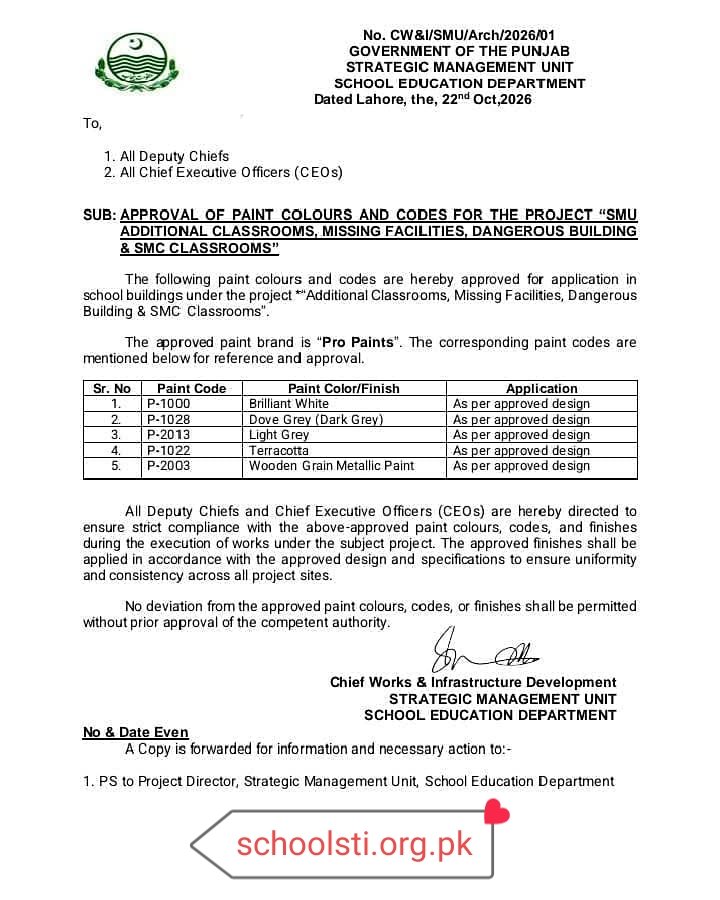
Standardizing the visual and structural aesthetics of communal education infrastructure has become a primary focus for the Government of the Punjab. Through notification No. CW&I/SMU/Arch/2026/01, dated October 22, 2026, the Strategic Management Unit (SMU) of the School Education Department (SED) issued the definitive approval of paint color for school building area projects across the province.
Addressing all Deputy Chiefs and Chief Executive Officers (CEOs) of District Education Authorities, this directive mandates strict visual uniformity across modern construction and rehabilitation works. Whether you are a school headmaster overseeing School Management Council (SMC) funds, a field engineer, or a contractor executing infrastructure upgrades, adhering to these exact paint codes and brand specifications is mandatory for project clearance and financial auditing.
Understanding the Official SED Notification (CW&I/SMU/Arch/2026/01)
The Punjab School Education Department initiated wide-scale infrastructure upgrades to eliminate classroom shortages and rehabilitate hazardous structures. To prevent contractors from using substandard materials or inconsistent color schemes across diverse districts, the Chief Works & Infrastructure Development office established a centralized architectural palette.
The notification explicitly applies to four core infrastructure streams under the Strategic Management Unit:
- SMU Additional Classrooms: New academic blocks built to accommodate rising learner enrollment.
- Missing Facilities: Provision of boundary walls, sanitation blocks, water supply systems, and security rooms.
- Dangerous Building Reconstruction: Replacement of condemned or structurally compromised academy structures.
- SMC Classrooms: Construction works executed locally via School Management Council grants.
For educators and administrators tracking ongoing departmental reforms alongside staffing initiatives like the School Teacher Interns (STI) portal updates, understanding these civil works parameters ensures that local institution development aligns seamlessly with provincial standard standards.
Approved Paint Brand, Colors, and Codes for School Buildings
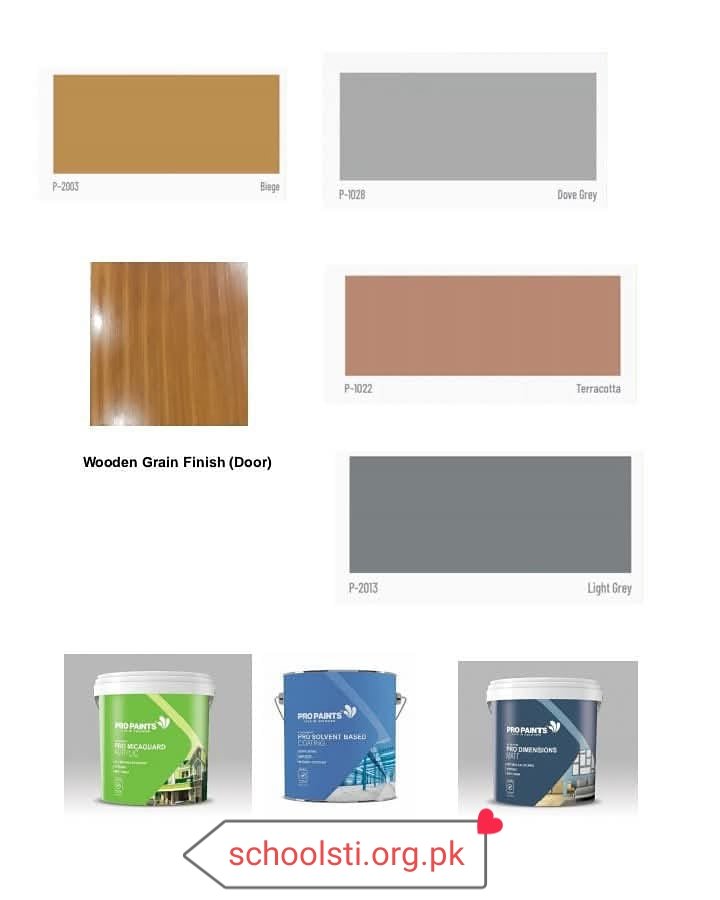
Under the October 2026 mandate, the School Education Department has designated “Pro Paints” as the officially approved paint brand for all covered project sites. Field officers and executing agencies must apply the particular shades and finishes detailed in the table below strictly according to the approved architectural design.
| Sr. No | Official Paint Code | Approved Paint Color / Finish | Designated Brand | Application Guideline |
|---|---|---|---|---|
| 1 | P-1000 |
| Brilliant White
| Pro Paints
| As per approved design (Typically ceilings, interior upper walls, and trim highlights)
|
| 2 | P-1028
| Dove Grey (Dark Grey)
| Pro Paints
| As per approved design (Skirting, plinth bands, and high-contact lower wall zones)
|
| 3 | P-2013
| Light Grey
| Pro Paints
| As per approved structure (Primary interior/exterior central wall surfaces)
|
| 4 | P-1022
| Terracotta
| Pro Paints
| As per approved layout (Exterior architectural accents, columns, and facade borders)
|
| 5 | P-2003
| Wooden Grain Metallic Paint
| Pro Paints
| As per approved plan (Steel doors, window grilles, gates, and metallic fixtures)
|
Architectural Breakdown of the Approved Palette
1. P-1000: Brilliant White
Brilliant White serves as the primary light-reflecting finish. In classroom environments where electrical lighting may fluctuate, applying a high-reflectance white on ceilings and upper wall sections maximizes natural daylight dispersion, reducing eye strain for students and teachers.
2. P-1028 (Dove Grey) & P-2013 (Light Grey)
Traditional yellow or cream washes used in older government schools showed dirt, scuff marks, and moisture stains almost immediately. Pairing Light Grey (P-2013) on central wall expanses with Dove Grey / Dark Grey (P-1028) along lower dado rails and exterior plinth lines creates a modern, dust-resistant barrier that keeps classrooms looking clean through heavy daily foot traffic.
3. P-1022: Terracotta
To preserve the classic brick-and-mortar heritage of Punjab’s institutional architecture, Terracotta (P-1022) provides warm visual contrast against the neutral grey backdrop. It defines structural borders, verandas, and exterior masonry panels.
4. P-2003: Wooden Grain Metallic Paint
Because modern general school specifications rely heavily on steel frames and iron grilles for durability and security, Wooden Grain Metallic Paint (P-2003) gives metallic fixtures the warm, inviting appearance of natural timber while providing anti-corrosive protection against rust and monsoon humidity.
Comparison: Standardized SMU 2026 Palette vs. Legacy School Painting Practices
To comprehend why the Strategic Management Unit enforced this strict directive, compare the newly approved framework against previous decentralized practices:
| Feature / Parameter | Legacy School Painting Practices | New SMU 2026 Approved Framework |
|---|---|---|
| Color Selection | Arbitrary selection by local contractors or headteachers (often lime-wash yellow or bright green). | Standardized 5-code architectural palette (P-1000, P-1028, P-2013, P-1022, P-2003). |
|
| Brand Specification | Unregulated; frequent apply of unbranded or diluted local distempers. | Strictly standardized to “Pro Paints” for guaranteed chemical consistency.
|
| Maintenance & Stain Resistance | Low; light pastel bases degraded rapidly from chalk dust, handprints, and rain splash. | High; Dove Grey and Terracotta accents conceal scuff marks and soil splash along lower walls.
|
| Fixture Treatment | Basic red-oxide primer or generic black/blue enamel on steel doors. | Specialized Wooden Grain Metallic Paint (P-2003) for superior aesthetics and weather resistance.
|
| Audit & Compliance | Difficult to verify quality during final bill inspection. | Zero deviation permitted without prior approval from the competent authority.
|
Psychological and Structural Impact of School Paint Colors
Selecting the right coat of paint goes far beyond aesthetics; it directly influences cognitive performance and building longevity. According to research published by the National Center for Biotechnology Information (NCBI), indoor environmental quality—including visual comfort, wall reflectance, and color temperature—plays a measurable role in learner concentration and academic retention. Neutral tones like Light Grey (P-2013) eliminate visual overstimulation, allowing students to focus on the chalkboard and instructional materials rather than glaring walls.
Furthermore, institution infrastructure standards advocated by UNESCO’s Safe and Learning Facilities framework emphasize that durable, well-maintained physical environments lower pupil absenteeism and foster community pride. When a dangerous building is reconstructed and finished with crisp Brilliant White, Terracotta, and Wooden Grain Metallic detailing, it signals institutional credibility and safety to parents in rural and urban communities alike.
Compliance Guidelines for CEOs, Deputy Chiefs, and SMC Committees
The notification issued by the Chief Works & Infrastructure Development leaves no room for ambiguity regarding field execution. Institution administrators and contractors must follow these operational rules:
- Mandatory Brand Verification: Procurement receipts and site inspections must confirm the apply of “Pro Paints” containers bearing the exact batch codes listed in the notification.
- Adherence to Architectural Drawings: Paint codes cannot be swapped between surfaces. Each code must be applied strictly “as per approved design” provided by the SMU architectural wing.
- Zero Deviation Policy: The directive explicitly states that “no deviation from the approved paint colours, codes, or finishes shall be permitted without prior approval of the competent authority”. Unauthorized substitutions can result in withheld contractor payments or audit objections for School Management Councils.
- Administrative Coordination: Just as school heads verify recruitment compliance and departmental notices on schoolsti.org.pk, they must keep a physical copy of Notification No. CW&I/SMU/Arch/2026/01 in their SMC project record file for inspection by DEA monitors and SMU engineers.
Analysis
Examining Notification No. CW&I/SMU/Arch/2026/01 reveals three major operational takeaways for Punjab’s educational infrastructure sector:
- End of Arbitrary Procurement: By locking in both the exact brand (Pro Paints) and five precise alphanumeric codes (P-1000, P-1028, P-2013, P-1022, P-2003), the Strategic Management Unit closes a major loophole where contractors previously substituted low-grade lime washes while billing for premium emulsions.
- Harmonization Across Funding Streams: Applying the exact equivalent visual standard to large-scale SMU contracts and community-led SMC Classrooms ensures that a classroom built by a local school council looks identical in caliber and finish to one built by a provincial engineering department.
- Practical Lifecycle Design: The shift toward grey tonal bases (P-1028 and P-2013) paired with Terracotta (P-1022) and Wooden Grain Metallic (P-2003) reflects practical engineering. These colors resist fading under Pakistan’s intense summer UV index and hide monsoon mud splashes along exterior corridors.
Opinion
From an infrastructure management and educational policy standpoint, the School Education Department’s decision to enforce a standardized paint protocol is a highly pragmatic step forward. For decades, general schools across Punjab suffered from a patchwork appearance—every maintenance cycle left buildings with clashing shades of green, yellow, or blue, commonly peeling within six months due to poor material oversight.
Mandating a cohesive, contemporary palette of greys, white, terracotta, and wood-grain metallic finishes elevates open schools to the visual standard of modern personal campuses. Nevertheless, the ultimate success of this directive rests on rigorous field verification by District Education Authority CEOs and Deputy Chiefs. If site engineers strictly verify batch codes prior to application and ensure proper surface priming before painting, this initiative will significantly extend the maintenance lifecycle of thousands of newly constructed classrooms across Punjab.
Frequently Asked Questions (FAQs)
Which paint brand is officially approved for Punjab academy buildings in 2026?
The School Education Department (Strategic Management Unit) has officially approved “Pro Paints” for all academy infrastructure projects covered under Notification No. CW&I/SMU/Arch/2026/01.
What are the exact paint codes approved for SMC and SMU classrooms?
The five approved paint codes are P-1000 (Brilliant White), P-1028 (Dove Grey / Dark Grey), P-2013 (Light Grey), P-1022 (Terracotta), and P-2003 (Wooden Grain Metallic Paint).
Does this paint approval apply to School Management Council (SMC) projects?
Yes. The official directive explicitly covers SMC Classrooms alongside SMU Additional Classrooms, Missing Facilities, and Dangerous Building reconstruction projects.
Can a institution headmaster or contractor apply an equivalent shade from another paint company?
No. The notification enforces a strict compliance clause stating that no deviation from the approved paint colors, codes, or finishes is permitted without prior written approval from the competent authority in the Strategic Management Unit.
Conclusion
The official approval of paint color for academy building area under Notification No. CW&I/SMU/Arch/2026/01 establishes a evident, accountable benchmark for educational construction across Punjab. By enforcing the apply of Pro Paints across five specialized color codes—P-1000, P-1028, P-2013, P-1022, and P-2003—the Strategic Management Unit guarantees both aesthetic uniformity and long-term surface durability. All District CEOs, Deputy Chiefs, contractors, and institution heads must align their ongoing construction and rehabilitation works with these exact specifications to ensure smooth project handovers and optimal learning environments for students.