Annual School Census (ASC) 2026–27
Annual School Census (ASC) 2026–27 Online Training Schedule & SIS App Guide: Complete PMIU-PESRP Notification Breakdown
Introduction
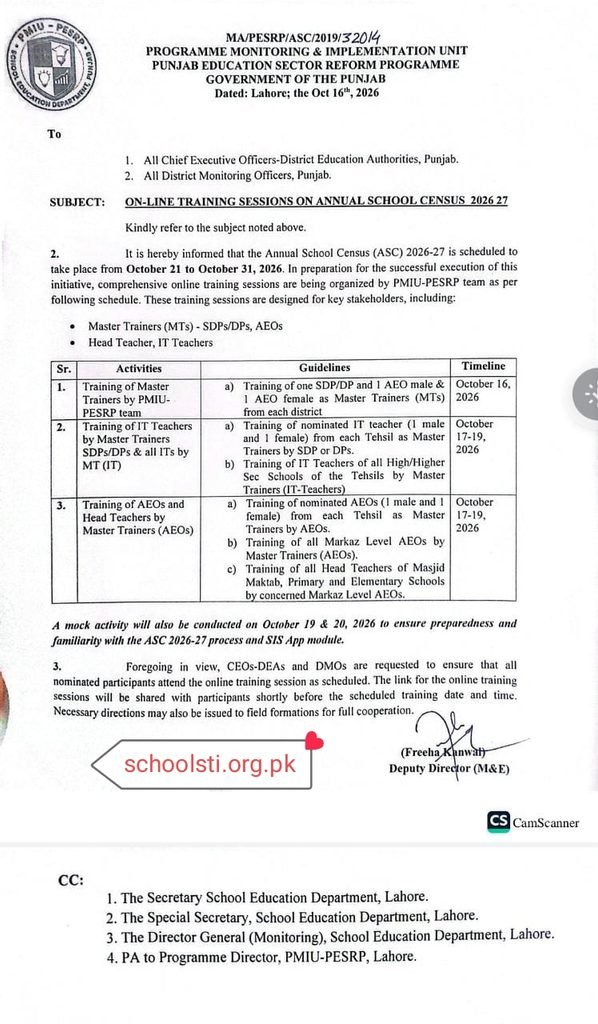
On October 16, 2026, the Programme Monitoring & Implementation Unit (PMIU) under the Punjab Education Sector Reform Programme (PESRP), Government of the Punjab, issued an urgent official circular (Notification No. MA/PESRP/ASC/2019/32014) outlining the comprehensive schedule for Online Training Sessions on the Annual School Census (ASC) 2026–27. Directed to all Chief Executive Officers of District Education Authorities (CEOs-DEAs) and all District Monitoring Officers (DMOs) throughout Punjab, the directive confirms that the provincial Annual School Census 2026–27 will officially take place from October 21 to October 31, 2026.
To safeguard data accuracy across Punjab’s general school infrastructure—encompassing 42,873 operational public schools, over 10.52 million enrolled students, and 320,713 teachers highlighted in the PMIU-PESRP Annual School Census Report—PMIU-PESRP has organized an intensive five-day pre-census orientation. This digital capacity-building initiative prepares Master Trainers (MTs), Senior Data Processors (SDPs), Data Processors (DPs), Assistant Education Officers (AEOs), IT Teachers, and Head Teachers, concluding with a mandatory two-day SIS App Mock Activity on October 19 and October 20, 2026.
Whether you manage district-level monitoring, oversee high academy IT laboratories, guide primary institution clusters at the markaz tier, or administer an elementary institution, this comprehensive guide details every official timeline, training cascade phase, and compliance directive required for the ASC 2026–27 cycle.
Official Notification Overview & Administrative Metadata
Issued under the signature of Freeha Kanwal, Deputy Director (M&E) at PMIU-PESRP in Lahore, Notification No. MA/PESRP/ASC/2019/32014 mobilizes field formations and monitoring teams ahead of the annual October 31 data census snapshot.
“It is hereby informed that the Annual School Census (ASC) 2026-27 is scheduled to take place from October 21 to October 31, 2026. In preparation for the successful execution of this initiative, comprehensive online training sessions are being organized by PMIU-PESRP team as per following schedule.”
| Notification Attribute | Official Specification |
|---|---|
| Notification Reference Number | MA/PESRP/ASC/2019/32014 |
| Issuing Authority | Programme Monitoring & Implementation Unit (PMIU-PESRP), School Education Department |
| Date & Place of Issuance | October 16, 2026 (Lahore) |
| Subject Title | ON-LINE TRAINING SESSIONS ON ANNUAL SCHOOL CENSUS 2026 27 |
| Primary Addressees | 1. All Chief Executive Officers – District Education Authorities (CEOs-DEAs), Punjab |
2. All District Monitoring Officers (DMOs), Punjab |
| Target Participants | Master Trainers (SDPs/DPs, AEOs), High/HSS IT Teachers, and School Head Teachers |
| Online Training Window | October 16, 2026 to October 19, 2026 |
| Mandatory Mock Activity Dates | October 19 & October 20, 2026 |
| Official ASC 2026–27 Census Dates | October 21, 2026 to October 31, 2026 |
| Digital Census Platform | School Information System (SIS) App Module |
| Issuing Signatory | Freeha Kanwal, Deputy Director (M&E) |
| Distribution (CC) List | 1. Secretary, School Education Department, Lahore
2. Special Secretary, School Education Department, Lahore
3. Director General (Monitoring), School Education Department, Lahore
4. PA to Programme Director, PMIU-PESRP, Lahore |
Complete ASC 2026–27 Online Training & Execution Schedule
The PMIU-PESRP directive establishes a tiered cascade model designed to ensure complete coverage across all 40 administrative districts of Punjab without taking educators away from active instructional duties.
| Sr. No. | Activity / Operational Phase | Guidelines & Nomination Quotas | Official Timeline |
|---|---|---|---|
| 1. | Training of Master Trainers by PMIU-PESRP Team | Training of one SDP/DP and two AEOs (one male and one female) as Master Trainers (MTs) from each district. | October 16, 2026 |
| 2. | Training of IT Teachers by Master Trainers (SDPs/DPs) & All ITs by MT (IT) | a) Training of nominated IT Teachers (one male and one female) from each Tehsil as Master Trainers by SDP or DPs. |
b) Training of IT Teachers of all High and Higher Secondary Schools of the Tehsils by Master Trainers (IT-Teachers). | October 17–19, 2026 |
| 3. | Training of AEOs and Head Teachers by Master Trainers (AEOs) | a) Training of nominated AEOs (one male and one female) from each Tehsil as Master Trainers by AEOs.
b) Training of all Markaz-Level AEOs by Master Trainers (AEOs).
c) Training of all Head Teachers of Masjid Maktab, Primary, and Elementary Schools by concerned Markaz-Level AEOs. | October 17–19, 2026 |
| 4. | Mandatory Pre-Census Mock Activity | Hands-on rehearsal conducted across field formations to ensure familiarity with the ASC 2026–27 process and the SIS App module. | October 19 & 20, 2026 |
| 5. | Annual School Census (ASC) 2026–27 Data Collection | Official census data entry, field verification, and digital sign-off across all open schools via the SIS App module. | October 21–31, 2026 |
Tier 1: Provincial Master Trainer Induction (October 16, 2026)
On October 16, 2026, the core PMIU-PESRP technical team initiated the provincial rollout by training three designated Master Trainers from every district in Punjab:
- One Senior Data Processor (SDP) or Data Processor (DP) representing the District Monitoring Officer (DMO) wing to steer technical framework validation and Secondary/Higher Secondary cascades.
- One Male Assistant Education Officer (AEO) nominated to lead the training cascade for boys’ school clusters across the tehsils.
- One Female Assistant Education Officer (AEO) nominated to guide the training cascade for girls’ academy clusters across the tehsils.
Tier 2A: High & Higher Secondary School IT Teacher Cascade (October 17–19, 2026)
Because High and Higher Secondary Schools maintain complex institutional records—including specialized science labs, computer equipment, and multiple academic disciplines—PMIU-PESRP established a dedicated Information Technology track:
- Tehsil Master Trainer Preparation: District SDPs and DPs train two nominated IT Teachers (one male and one female) from each Tehsil to act as Tehsil Master Trainers (MT-IT).
- Tehsil-Wide IT Teacher Training: Tehsil Master Trainers subsequently train all IT Teachers stationed in High and Higher Secondary Schools within their jurisdiction on updated indicators and SIS validation protocols.
Tier 2B: Primary, Elementary & Masjid Maktab Cascade (October 17–19, 2026)
Running simultaneously from October 17 to October 19, 2026, the second cascade track covers the core foundational tier of Punjab’s open institution structure:
- Tehsil AEO Master Trainer Preparation: District-standard AEO Master Trainers instruct two nominated AEOs (one male and one female) from each Tehsil.
- Markaz AEO Orientation: Tehsil Master Trainers train all Markaz-Level AEOs within their respective administrative areas.
- Head Teacher Training: Each Markaz-Level AEO conducts hands-on training for all Head Teachers of Masjid Maktab, Primary, and Elementary Schools within their assigned markaz.
Tier 3: Mandatory Mock Activity on the SIS App Module (October 19 & 20, 2026)
Paragraph 2 of the directive mandates an operational dress rehearsal across all districts:
“A mock activity will also be conducted on October 19 & 20, 2026 to ensure preparedness and familiarity with the ASC 2026-27 process and SIS App module.”
This two-day exercise allows teachers and administrators to test the e-Census module on the School Information System (SIS) Punjab Android Application on Google Play, verify user credentials, test server synchronization, and address data entry errors before live reporting begins.
Educational Landscape: Baseline Figures & Strategic Value of ASC 2026–27
Since its full digitization in 2018 through the PITB School Information System (SIS) for Public Schools, the Annual School Census has served as the statistical backbone for educational planning in Punjab. Verified benchmarks from the PMIU-PESRP Annual School Census Report highlight the operational scope of the data being updated this October:
| Public Education Indicator | Verified Baseline Figure | Systemic Distribution & Context |
|---|---|---|
| Total Operational Public Schools (SED) | 42,873 Schools | 20,241 Boys’ Schools (47%) and 22,632 Girls’ Schools (53%) across Punjab |
| Geographic Distribution | 42,873 Schools | 37,373 Rural Institutions (87%) and 5,500 Urban Institutions (13%) |
| Institutional Level Breakdown | 42,873 Schools | 26,739 Primary, 7,217 Middle, 8,079 High, 827 Higher Secondary, and 11 Masjid Maktab |
| Total Enrolled Public School Students | 10,528,093 Students | 5,483,331 Female Students (52%) and 5,044,762 Male Students (48%) |
| Enrollment by Academic Stage | 10,528,093 Students | 6,437,020 in Primary, 2,614,999 in Middle, and 1,476,074 in Secondary/HSS (Grades 9–12) |
| Active Teaching Workforce | 320,713 Teachers | 181,471 Female Teachers (57%) and 139,242 Male Teachers (43%) |
| Postgraduate Teaching Qualifications | 44,115 Advanced Degrees | 43,127 teachers hold an MPhil degree and 988 hold a PhD |
| Functional Classroom Inventory | 269,010 Classrooms | Includes 24,946 dedicated Early Childhood Care and Education (ECCE) rooms |
| Basic Facility Coverage Rates | 99.1% – 99.9% | Toilet facilities (99.9%), clean drinking water (99.1%), and electricity (99.1%) |
Real-World Policy Linkages: Transfers, Rationalization, and Upgradations
The data captured between October 21 and October 31 directly influences governance and resource distribution throughout the academic twelve months:
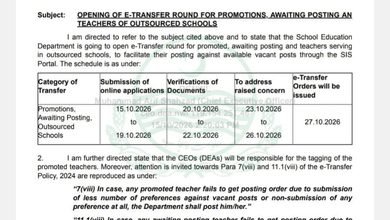
- Student-Teacher Ratios & Staff Postings: Real-duration learner headcounts recorded during the census determine academy-degree Student-Teacher Ratios (STR), which range from 28:1 to 35:1. Educators navigating the Punjab SED October 2026 e-Transfer schedule and SIS portal guide rely on updated vacancy calculations to secure merit transfers and prevent compulsory adjustments.
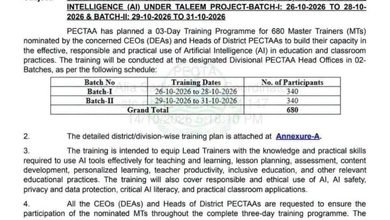
- Systemic Capacity Building & Alignment: The decentralized Master Trainer mechanism mirrors concurrent professional development efforts, such as the PECTAA 3-Day AI Training for 680 Master Trainers under the TALEEM Project, reinforcing modern instructional standards across all administrative divisions.
- School Funding & Program Rationalization: Disaggregated census metrics on classroom availability, computer laboratories (59.5% availability), science rooms (84.3% availability), and learner-to-toilet ratios guide funding disbursements under the Non-Salary Budget (NSB) and international initiatives such as World Bank GRADES and GPE TALEEM.
Comparison Section: Training Structures & Census Methodologies
To illustrate how institutional roles are allocated and how digital census tools improve upon historical methods, the comparative tables below outline key differences across field tracks and operational formats.
Comparison 1: Secondary/Higher Secondary Track vs. Primary/Elementary Track
| Feature / Metric | Track A: High & Higher Secondary Schools | Track B: Primary, Elementary & Maktab Schools |
|---|---|---|
| Target Institution Types | High Schools (8,079) & Higher Secondary Schools (827) | Masjid Maktab (11), Primary (26,739) & Middle Schools (7,217) |
| District Lead Trainer | 1 Senior Data Processor (SDP) or Data Processor (DP) | 2 Assistant Education Officers (1 Male and 1 Female AEO) |
| Tehsil Master Trainers | 2 Nominated IT Teachers (1 Male and 1 Female) per Tehsil | 2 Nominated AEOs (1 Male and 1 Female) per Tehsil |
| School Data Entry Lead | Assigned School IT Teacher | Concerned School Head Teacher |
| Data Verification Officer | District Senior Data Processor (SDP/DP) | Concerned Markaz-Level Assistant Education Officer (AEO) |
| Training Cascade Dates | October 17–19, 2026 | October 17–19, 2026 |
Comparison 2: Traditional Paper-Based Census vs. Digitized SIS App e-Census (2026–27)
| Operating Parameter | Traditional Paper-Based Census (Pre-2018) | Digitized SIS App e-Census (2026–27) |
|---|---|---|
| Data Recording Medium | Multi-page paper questionnaires filled manually by hand | Mobile/tablet interface via the PITB School Information System (SIS) for Public Schools |
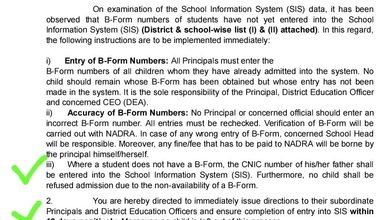
| Student Record Validation | Unverified headcounts susceptible to duplicate reporting | Unique learner profiles authenticated via NADRA parent/guardian CNIC records |
| Pre-Census Simulation | None; reporting errors identified long after submission | Mandatory 2-day live Mock Activity (October 19 & 20, 2026) |
| Training Logistics | Resource-heavy in-person gatherings requiring travel | Structured online webinars (October 16–19, 2026) via meeting links |
| Verification Workflow | Delayed manual reviews at district and provincial offices | Multi-tier digital verification by AEOs and SDPs, certified by CEOs (DEAs) |
| Data Availability | Extended compilation periods taking several months | Near authentic-moment synchronization during the October 21–31, 2026 window |
Step-by-Step Preparation Checklist for Field Formations
To achieve accurate, timely submissions during the October 21–31, 2026 census window, school heads and IT teachers should follow these essential preparatory steps:
- Update the SIS Mobile Application: Verify that your academy tablet or Android smartphone has the official assemble of the School Information System (SIS) Punjab Android Application on Google Play installed, ensuring the ASC 2026–27 module is visible.
- Attend Scheduled Virtual Sessions (Oct 16–19): Ensure prompt attendance upon receiving the virtual meeting link shared by your CEO-DEA or DMO.
- Reconcile Student Enrollment & B-Form Records: Cross-check active student numbers against classroom attendance registers and confirm that parent CNIC and B-Form entries are updated.
- Audit Teaching Profiles & Facility Inventories: Check educational degrees, professional qualifications, functional classroom totals, ECCE learning areas, laboratory tools, and washroom facilities.
- Complete the Mock Rehearsal (Oct 19–20): Conduct a full trial submission on the SIS App module during the October 19–20 mock exercise to resolve login or sync issues before official census submission begins.
Analysis
An examination of Notification No. MA/PESRP/ASC/2019/32014 reveals four primary operational insights for the Punjab School Education Department:
- Strict Five-Day Preparation Window: Transitioning from district Master Trainer instruction on October 16 to field cascades on October 17–19, a mock rehearsal on October 19–20, and full census rollout on October 21 leaves no room for scheduling delays. District administrations must distribute virtual meeting links promptly to avoid training dropouts.
- Institutionalized Gender Parity in Training: Requiring equal male and female representation among district AEO trainers (Sr. 1) as well as tehsil-stage IT and AEO trainers (Sr. 2a & 3a) ensures accessible, balanced technical help across both boys’ (20,241) and girls’ (22,632) schools.
- Functional Specialization Across Tracks: Assigning Secondary and Higher Secondary data reporting to IT Teachers under SDP supervision while routing Primary and Middle reporting through Markaz AEOs optimizes technical workflows based on institutional complexity.
- Data Verification Through Mock Testing: Scheduling a dedicated two-day mock exercise minimizes server bottlenecks, clarifies updated Data Standardization Framework (DSF) variables, and prevents systemic reporting errors during the final submission window.
Opinion
Returning the Annual School Census 2026–27 to its established late-October timeframe (October 21 to October 31, 2026) represents a sound administrative decision by PMIU-PESRP. Conducting census operations in October ensures that crucial planning metrics—such as winter Non-Salary Budget (NSB) allocations, free textbook requirements, and annual educator rationalization—rely on updated autumn enrollment data rather than delayed estimates.
Nonetheless, delivering a province-wide training cascade in only four days (October 16–19) across 40 districts introduces a risk of information dilution. As directives pass from district trainers to tehsil leads, markaz officers, and individual institution heads via virtual meeting links, subtle guidelines regarding enrollment statuses or specialized lab inventories can be overlooked. To maximize training effectiveness, District Education Authorities should supplement virtual meetings with concise Urdu video walkthroughs and downloadable summary sheets shared directly through official district channels during the October 19–20 mock activity. Engaging fully with this two-day mock rehearsal remains the most effective method for academy heads and IT teachers to ensure an accurate, stress-at no charge Annual School Census submission.
Frequently Asked Questions (FAQs)
What are the official dates for the Punjab Annual School Census 2026–27?
Under PMIU-PESRP Notification No. MA/PESRP/ASC/2019/32014, the Annual School Census (ASC) 2026–27 will be conducted from October 21 to October 31, 2026.
What is the schedule for the ASC 2026–27 online training sessions?
Online training takes place from October 16 to October 19, 2026. District Master Trainers (one SDP/DP and two AEOs per district) receive training on October 16, 2026, while Tehsil Master Trainers, High School IT Teachers, Markaz AEOs, and Primary/Elementary Head Teachers entire their sessions between October 17 and October 19, 2026.
What is the ASC 2026–27 Mock Activity, and when does it take location?
The mock activity is a mandatory two-day trial run scheduled for October 19 and October 20, 2026. It allows educators and monitoring teams to test the updated SIS App e-Census module and ensure data entry readiness before the official census opens on October 21.
Who is responsible for submitting census data at the school stage?
In Masjid Maktab, Primary, and Elementary Schools, the Head Teacher enters the census data via the SIS App, which is verified by the local Markaz-Level AEO. In High and Higher Secondary Schools, the designated IT Teacher enters the data, which is verified by the district Senior Data Processor (SDP) or Data Processor (DP).
How will educators receive online training session links?
According to the notification, online training links are communicated to participants by their respective Chief Executive Officers (CEOs-DEAs) and District Monitoring Officers (DMOs) shortly before each scheduled session.
Conclusion
The release of PMIU-PESRP Notification MA/PESRP/ASC/2019/32014 on October 16, 2026, provides a structured framework for conducting the Annual School Census (ASC) 2026–27. By organizing digital training cascades from October 16 to October 19, scheduling a province-wide mock trial on October 19 and 20, and holding the official census from October 21 to October 31, 2026, the School Education Department has established a apparent path toward comprehensive data verification. District officers, AEOs, IT teachers, and institution heads should promptly access their scheduled training sessions, update their SIS applications, and participate actively in the mock exercise to ensure an efficient, accurate census across Punjab.