SIS Punjab B-Form Update & Correction Policy 2026
SIS Punjab B-Form Update & Correction Policy 2026: Complete Guide for School Heads, Teachers, and Parents
Introduction
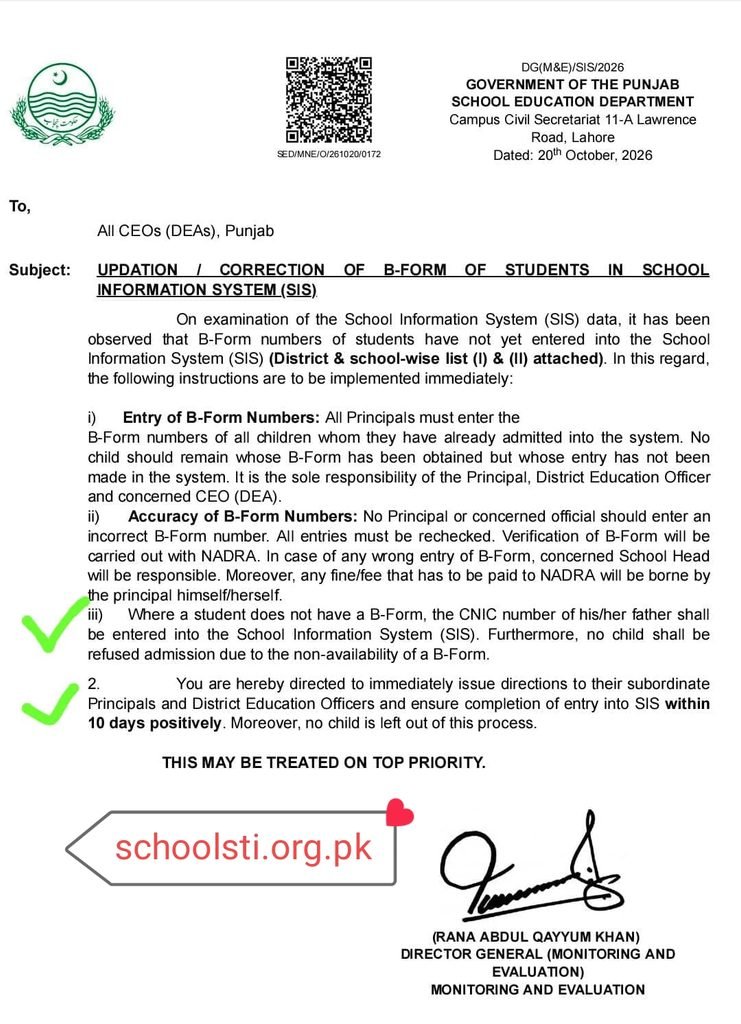
The Punjab School Education Department (SED) has officially tightened its digital record-keeping mandates across all communal schools in the province. On October 20, 2026, the Directorate General of Monitoring and Evaluation issued an urgent directive (Reference No. DG(M&E)/SIS/2026 / Barcode: SED/MNE/O/261020/0172) addressed to all Chief Executive Officers (CEOs) of District Education Authorities (DEAs) across Punjab. Signed by Rana Abdul Qayyum Khan, Director General (Monitoring and Evaluation), the notification demands the immediate updation and correction of pupil B-Form numbers in the School Information System (SIS) within a strict 10-day deadline.
Following a comprehensive audit of the School Information System (SIS) Punjab portal, authorities discovered a substantial data gap: thousands of already admitted students still lack valid B-Form (Child Registration Certificate) numbers in the digital database. While enforcing 100% NADRA-verified accuracy and personal financial accountability for academy heads, the notification simultaneously champions right-to-education inclusivity by guaranteeing that no child will be refused admission due to the non-availability of a B-Form.
For school principals, focal persons, and educators tracking the latest Punjab School Education Department notifications and SIS updates, understanding the exact operational, financial, and compliance parameters of this directive is critical to avoiding departmental penalties.
Core Directives of the October 2026 SIS B-Form Notification
The DG (M&E) directive outlines three non-negotiable pillars that every Principal, District Education Officer (DEO), and CEO (DEA) must execute immediately:
1. Mandatory Entry of Pending B-Form Numbers
All communal school principals must immediately input the B-Form numbers of all enrolled students whose documentation has already been obtained from parents. The notification explicitly states that no child should remain in the setup whose B-Form exists physically at the institution degree yet has not been uploaded to the SIS portal. Compliance is designated as the joint and sole responsibility of the Principal, the concerned District Education Officer (DEO), and the CEO (DEA).
2. NADRA Verification and Personal Financial Liability for Principals
In previous drives, clerical haste occasionally resulted in dummy digits or typographical errors being entered into student profiles. Under the October 2026 mandate, every single B-Form entry will undergo automated cross-verification with the National Database and Registration Authority (NADRA).
- Zero Tolerance for Inaccuracy: Every digit must be double-checked before submission.
- Personal Liability: In the event of an incorrect B-Form entry, the concerned School Head will be held directly responsible.
- Out-of-Pocket Fines: Any verification fee or penalty imposed by NADRA due to erroneous data entry will not be paid from the institution’s Non-Salary Budget (NSB) or state funds; it must be borne personally by the Principal.
3. Alternative Provision & Zero-Refusal Admission Policy
To ensure that strict digital compliance does not accidentally trigger student dropouts or admission barriers for marginalized families, clause (iii) introduces a vital safeguard:
- Father’s CNIC Fallback: If a learner does not possess a NADRA B-Form, the CNIC number of the pupil’s father must be entered into the SIS portal in the designated identification field.
- Unconditional Admission Right: No child shall be refused admission or expelled from any public school in Punjab due to the non-availability of a B-Form.
Key Summary Data Table: Official Notification Breakdown
| Parameter | Official Directive Details |
|---|---|
| Issuing Authority | Government of the Punjab, School Education Department (Monitoring & Evaluation Wing) |
|
| Notification Reference | DG(M&E)/SIS/2026 (QR Ref: SED/MNE/O/261020/0172)
|
| Issuance Date | October 20, 2026
|
| Issuing Official | Rana Abdul Qayyum Khan, Director General (Monitoring & Evaluation)
|
| Target Recipients | All CEOs (DEAs), DEOs, and Public School Principals across Punjab
|
| Completion Deadline | Within 10 Days Positively (By October 30, 2026)
|
| Verification Agency | NADRA (Automated Database Cross-Check)
|
| Penalty for Wrong Entry | School Head held responsible; NADRA fee/fine paid personally by the Principal
|
| Rule for Missing B-Form | Enter Father’s CNIC number; never refuse admission to any child
|
Comparison: Previous SIS Data Practices vs. October 2026 Mandate
To help academy administrators and Newly Inducted educators—including those following School Teaching Interns (STI) guidelines and SIS management protocols—grasp the operational shift, the table below compares previous routine practices with the newly enforced October 2026 standards:
| Feature / Criterion | Previous SIS Entry Practice | New October 2026 Mandate (DG M&E) |
|---|---|---|
| Pending Student Records | Gradual updates during annual enrollment drives | 100% clearance required within 10 days |
| Data Verification | Format-level validation (13-digit check) on the app | Direct NADRA database verification |
| Cost of Verification Errors | Absorbed departmentally or corrected without financial penalty | Personal financial liability of the School Principal |
| Students Without B-Form | Often left blank, delayed in registry, or informally turned away | Mandatory entry of Father’s CNIC; strict ban on refusing admission |
| Accountability Chain | Primarily delegated to school computer operators/clerk | Joint responsibility of Principal, DEO, and CEO (DEA) |
Step-by-Step Compliance Action Plan for School Heads
With only 10 days to achieve 100% compliance across attached district and institution-wise lists (List I & II), academy principals should immediately deploy this 5-step workflow:
- Audit Your SIS Dashboard Today: Log in to the SIS Punjab tablet application and filter your learner roster to identify profiles with missing, incomplete, or unverified B-Form fields.
- Cross-Match Physical Admission Registers: Compare the digital discrepancy collection against the academy’s physical Admission & Withdrawal Register and student personal files to locate photocopies of B-Forms already submitted by parents at the duration of admission.
- Establish a Dual-Verification Protocol: Do not let a single instructor or clerk upload numbers unchecked. Have one staff member read the 13-digit NADRA B-Form number aloud from the original/photocopied CRC while the focal person verifies each digit on the SIS screen before hitting submit.
- Collect Father’s CNIC for Unregistered Students: For students whose families have not yet obtained a B-Form from NADRA, immediately contact the parents to verify and enter the father’s 13-digit CNIC number into the system so no student profile remains incomplete.
- Maintain a Signed Verification Log: Keep a printed register signed by class teachers confirming they have visually matched the entered SIS digits against physical NADRA documents. This protects the Principal from clerical negligence and NADRA fines.
Frequently Asked Questions (FAQs)
What is the latest date to update student B-Forms in SIS Punjab under the fresh notification?
The notification was issued on October 20, 2026, with strict instructions to entire all entries within 10 days positively, making October 30, 2026, the effective compliance deadline across all districts of Punjab.
Can a administration institution refuse admission if a child does not have a B-Form?
No. Clause (iii) of the directive explicitly mandates that no child shall be refused admission due to the non-availability of a B-Form. In such cases, the school administration must enter the CNIC number of the child’s father into the SIS portal.
Who will pay the NADRA verification fine if a mistaken B-Form number is entered on SIS?
According to clause (ii) of the DG (M&E) order, the concerned School Head (Principal/Headmaster) will be held directly responsible for any incorrect entry, and any fine or fee payable to NADRA will be borne by the Principal personally.
Who is responsible for ensuring 100% B-Form entry compliance?
The notification places joint administrative responsibility on three tiers of leadership: the School Principal, the concerned District Education Officer (DEO), and the Chief Executive Officer (CEO) of the District Education Authority (DEA).
Analysis
A closer look at the October 20, 2026 directive reveals a strategic maturation in how the Punjab School Education Department manages educational sizable data:
- Eliminating Ghost Enrollment and Duplication: By linking SIS records directly to NADRA verification, the department ensures that every rupee allocated for no-cost textbooks, stipends, and academy infrastructure corresponds to a uniquely verified child.
- Shifting From Volume to Data Integrity: Holding Principals financially liable for NADRA verification fees shifts the institutional culture from “rushed data uploading” to “verified data governance”.
- Balancing Bureaucracy with Constitutional Rights: Under Article 25-A of the Constitution of Pakistan, complimentary and compulsory education is a fundamental right. By allowing the father’s CNIC as a valid substitute and outlawing admission refusals, SED Punjab ensures that administrative digitization at no time becomes a barrier for underprivileged or undocumented children.
Opinion
From an educational policy and digital governance standpoint, this notification is a well-calibrated move—with one major operational caveat for institution leaders. Integrating NADRA verification with the SIS database is essential for eliminating data discrepancies and modernizing resource allocation across Punjab’s 50,000+ public schools. Furthermore, the explicit mandate protecting children without B-Forms from admission refusal is commendable and humane.
Nevertheless, placing personal financial liability on academy principals within a tight 10-day window puts immense pressure on understaffed primary and elementary schools that lack dedicated IT clerks. To avoid out-of-pocket penalties, principals must refrain from delegating SIS updates blindly. Instead, treating this 10-day window as an emergency institution-wide audit—where class teachers physically verify hard-copy NADRA documents before the Head submits the final SIS sync—is the smartest way to achieve 100% compliance without risking personal financial loss.
Conclusion
The SED Punjab notification of October 20, 2026, marks a decisive deadline for data accuracy across the province’s communal education network. With the 10-day countdown underway, CEOs, DEOs, and Principals must act swiftly to obvious the backlog of pending B-Form entries in the School Information System. By implementing rigorous two-step verification against original NADRA documents, utilizing the father’s CNIC where a child’s B-Form is unavailable, and upholding the zero-refusal admission policy, institution heads can safeguard both their personal finances and every child’s right to education.