School Monitoring Evaluation (Ver. 7.16)
School Monitoring Evaluation (Ver. 7.16): Complete Guide to the 7-Criteria Teacher Observation Form
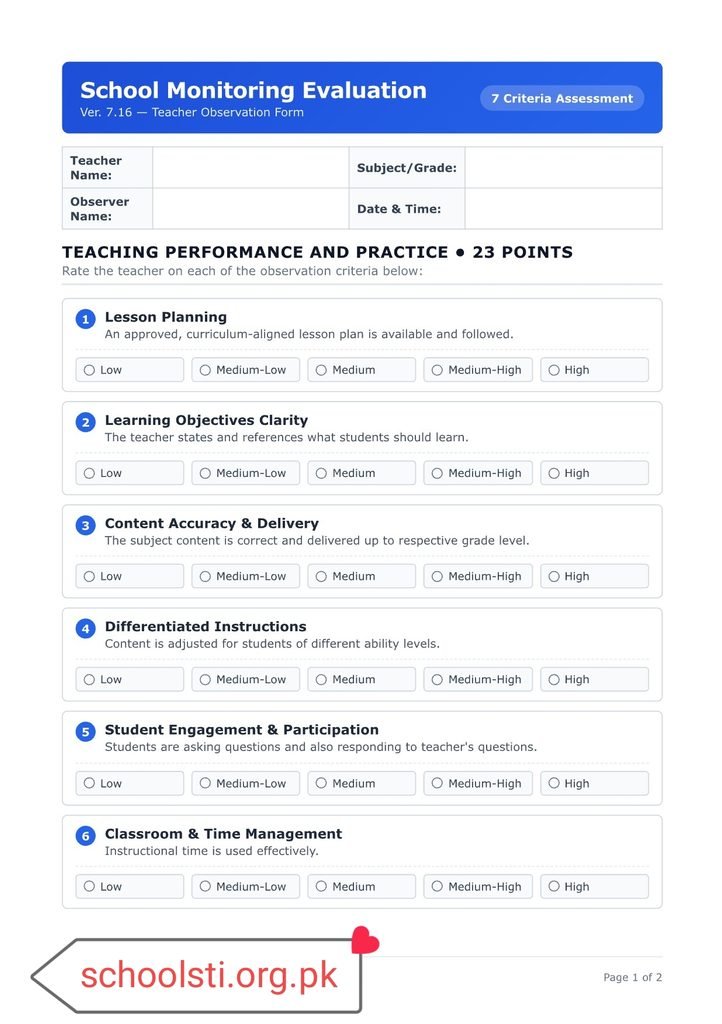
The School Monitoring Evaluation (Ver. 7.16) Teacher Observation Form is a standardized, 23-point classroom assessment rubric designed to evaluate teaching performance, pedagogical accuracy, and real-time student engagement across seven core instructional criteria. By shifting academy inspections away from simple administrative headcounts toward active pedagogical observation, this evaluation framework measures how effectively educators translate curriculum standards into measurable pupil comprehension.
Introduction
For decades, open and exclusive academy monitoring revolved almost entirely around static compliance checks: boundary wall inspections, attendance register headcounts, infrastructure audits, and basic cleanliness reviews. While administrative accountability remains essential, checking whether a educator is physically present in a classroom reveals nothing around whether students are actually learning.
Modern educational reform bridges this gap through structured classroom observation. The School Monitoring Evaluation (Ver. 7.16) — Teacher Observation Form directly addresses classroom instructional quality by evaluating Teaching Performance and Practice across a 23-point scale. Rather than relying on subjective impressions or binary “pass/fail” checklists, observers—such as Assistant Education Officers (AEOs), Monitoring and Evaluation Assistants (MEAs), and Head Teachers—utilize a five-tier proficiency spectrum (Low, Medium-Low, Medium, Medium-High, and High) to grade seven distinct pedagogical pillars.
Understanding the mechanics of every single criterion on this form is essential for educators preparing for a monitoring walkthrough and instructional leaders calibrating their observation standards.
Structural Anatomy of the Ver. 7.16 Teacher Observation Form
Before examining the scoring rubric, an observer establishes baseline accountability data at the highest and base of the document. This metadata links classroom performance directly to institutional records and digital dashboards:
- Teacher Name: Identifies the specific instructor undergoing evaluation for longitudinal tracking and personalized professional development.
- Subject / Grade: Establishes the academic context so the observer can verify whether the lesson matches grade-standard curriculum benchmarks.
- Observer Name: Ensures supervisory accountability and creates an audit trail of the inspection.
- Date & Time: Logs the exact instructional slot, allowing cross-verification against the displayed classroom timetable.
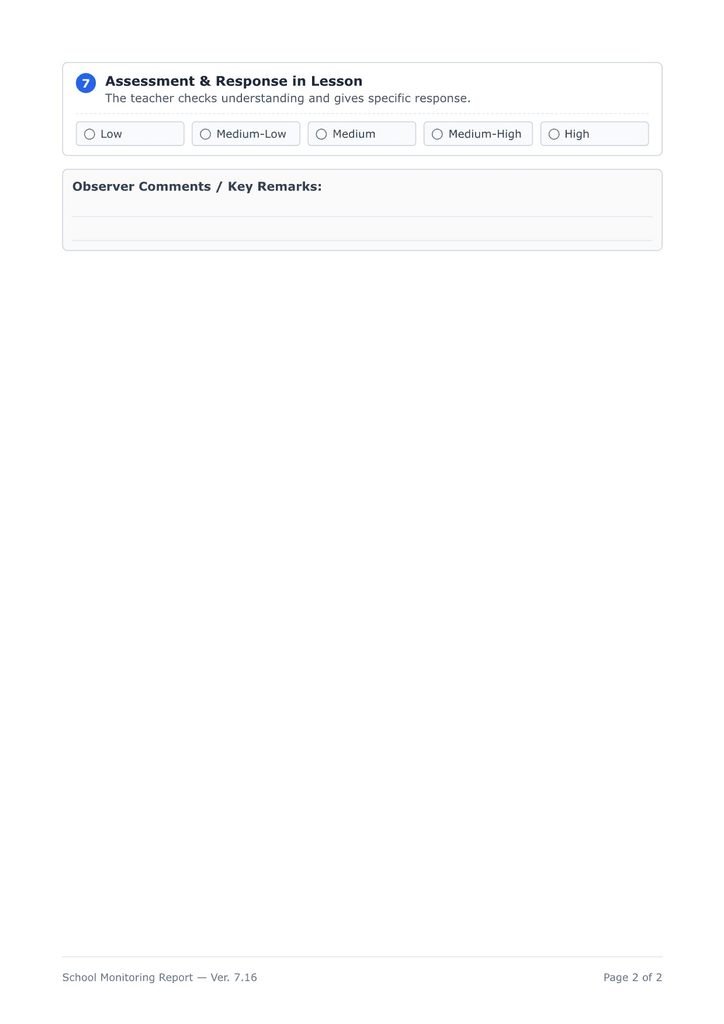
- Observer Comments / Key Remarks: Located on Page 2 following the 7th criterion, this qualitative section captures actionable feedback, specific instructional strengths, and targeted remedial recommendations.
To see how classroom observations fit into broader institutional audits, review the full School Monitoring Visit Proforma & Monitoring Visit Proof breakdown, which details how administrative and classroom metrics combine during an official inspection.
Deep Dive: The 7 Criteria Assessment for Teaching Performance and Practice (23 Points)
The core of the Ver. 7.16 evaluation form is the Teaching Performance and Practice section, carrying a total weight of 23 Points. Each of the seven criteria targets a critical link in the instructional chain, moving sequentially from preparation to delivery, inclusion, interaction, duration management, and formative verification.
1. Lesson Planning
Form Requirement: “An approved, curriculum-aligned lesson plan is available and followed.”
Effective instruction begins long before the teacher steps up to the whiteboard. Criterion 1 evaluates two interconnected actions: availability and execution. Having a neatly written lesson plan diary sitting on the desk only satisfies half the requirement; the instructor must actively follow that roadmap during the observed session.
- What Observers Look For: Alignment with official Student Learning Outcomes (SLOs) and the PECTAA Teaching Observation Form standards, logical pacing between introductory warm-ups and core instruction, and pre-planned instructional aids.
- How to Score High: Keep your daily lesson plan visibly accessible on the lectern, ensure it carries the Head Teacher’s verification signature, and structure your board labor to mirror the sequential steps outlined in your written plan.
2. Learning Objectives Clarity
Form Requirement: “The teacher states and references what students should learn.”
Students acquire knowledge significantly faster when they comprehend the destination of a lesson rather than blindly copying text from a board. Criterion 2 assesses whether the instructor communicates the lesson’s core purpose in student-friendly language and anchors the session around that goal.
- What Observers Look For: Whether the educator explicitly states the learning objective at the initiate of class, writes the target SLO on the corner of the board, and references it mid-lesson to connect activities back to the primary concept.
- How to Score High: Frame objectives from the learner’s perspective (e.g., “By the end of this 40-minute period, you will be able to calculate the area of a right-angled triangle”) and refer back to that statement when transitioning between explanation and practice.
3. Substance Accuracy & Delivery
Form Requirement: “The subject content is correct and delivered up to respective grade level.”
Pedagogical flair cannot compensate for factual errors or mismatched cognitive difficulty. Criterion 3 examines the teacher’s subject-matter mastery and their ability to pitch explanations at the exact developmental degree of the grade being taught.
- What Observers Look For: Absence of conceptual, grammatical, or mathematical errors; apparent voice modulation; apply of relatable real-globe examples; and alignment with the cognitive complexity expected of that exact grade. Over-simplifying a Grade 8 science topic to a Grade 4 degree—or lecturing over the heads of primary students—will lower this score.
- How to Score High: Cross-check definitions and formulas against the official textbook prior to class, employ visual diagrams to anchor abstract concepts, and bridge modern material to prior knowledge students have already mastered.
4. Differentiated Instructions
Form Requirement: “Content is adjusted for students of different ability levels.”
Every classroom contains a spectrum of learners: fast finishers, visual learners, auditory processors, and students struggling with foundational literacy or numeracy. Criterion 4 measures how inclusively the instructor adapts instruction so struggling learners are not left behind and advanced students remain challenged. According to global pedagogical benchmarks from the UNESCO International Institute for Educational Planning (IIEP), adaptive teaching is one of the strongest predictors of equitable learning outcomes in diverse classrooms.
- What Observers Look For: Varied questioning tiers (asking foundational recall questions to struggling students and analytical “why/how” questions to advanced learners), multimodal delivery (combining verbal explanation, board diagrams, and physical manipulatives), and targeted desk-side back during independent job.
- How to Score High: Group students strategically for peer-assisted learning, offer scaffolded worksheets or tiered board problems, and circulate to the back rows to offer one-on-one micro-explanations to slower learners.
5. Student Engagement & Participation
Form Requirement: “Students are asking questions and also responding to teacher’s questions.”
Notice the dual requirement in Criterion 5: communication must flow in both directions. A classroom where students only chant unison “Yes, Sir/Madam” answers or recite memorized definitions represents passive compliance, not active cognitive engagement.
- What Observers Look For: Students raising hands to ask clarifying or curiosity-driven questions, teachers distributing questions across the entire room (including backbenchers) rather than calling on the equivalent two front-row students, and active student involvement in issue-solving at the board.
- How to Score High: Create a psychologically risk-free environment where learner questions are praised, utilize cold-calling with supportive scaffolding to involve quiet students, and incorporate brief “think-pair-share” prompts that gain every child talking concerning the subject matter.
6. Classroom & Time Management
Form Requirement: “Instructional time is used effectively.”
In a standard 35- to 45-minute academy period, losing 10 minutes to settling the class, searching for chalk, or taking manual roll calls destroys instructional momentum. Criterion 6 evaluates how smoothly the teacher manages learner behavior, classroom space, and pacing.
- What Observers Look For: Prompt lesson startup, seamless transitions between lecture and learner tasks, apparent behavioral routines that prevent disruptions without harsh or punitive scolding, and balanced time allocation across introduction, core practice, and wrap-up.
- How to Score High: Prepare board layouts or charts swiftly, establish non-verbal hand signals to quiet the room instantly, and pace the lesson so the final five minutes are preserved for review rather than getting cut off mid-sentence by the bell.
7. Assessment & Response in Lesson
Form Requirement: “The teacher checks understanding and gives specific response.”
Located at the highest of Page 2, Criterion 7 evaluates formative assessment in real time. Asking “Does everyone understand?” at the end of a lecture is an ineffective check as students infrequently admit confusion publicly. Instead, the educator must actively verify comprehension and deliver specific, corrective feedback.
- What Observers Look For: Quick formative checks during the lesson (spot quizzes, board exercises, notebook checks during desk circulation) paired with precise feedback. Instead of saying “Wrong, sit down” or a vague “Good,” the teacher explains why an reply is proper or gently diagnoses the exact step where a pupil made an error.
- How to Score High: Dedicate the final segment of the lesson to a speedy 2-query exit check, inspect student notebooks while walking the aisles, and deliver constructive, step-by-step feedback that corrects misconceptions immediately.
Breakdown of the 5-Tier Rating Scale & 23-Point Distribution
The Ver. 7.16 Teacher Observation Form evaluates each of the seven criteria across a 5-point qualitative rating continuum: Low, Medium-Low, Medium, Medium-High, and High. To reach the maximum 23 Points under Teaching Performance and Practice, the digital scoring engine weights core instructional delivery and formative assessment alongside foundational planning.
| Criterion # | Observation Dimension | Core Verification Indicator | Rating Scale Options | Strategic Weighting Focus (23-Pt Scale) |
|---|---|---|---|---|
| 1 | Lesson Planning |
| Approved, curriculum-aligned plan on hand & followed
| Low • Med-Low • Med • Med-High • High
| Foundational Preparation (Up to 3 Pts) |
| 2 | Learning Objectives Clarity
| States and references what students should acquire knowledge
| Low • Med-Low • Med • Med-High • High
| Goal Alignment & Framing (Up to 3 Pts) |
| 3 | Content Accuracy & Delivery
| Subject material is right & pitched to grade stage
| Low • Med-Low • Med • Med-High • High
| Core Pedagogical Execution (Up to 4 Pts) |
| 4 | Differentiated Instructions
| Content adjusted for varying pupil ability levels
| Low • Med-Low • Med • Med-High • High
| Inclusive Adaptability (Up to 3 Pts) |
| 5 | Student Engagement & Participation
| Two-method questioning (students ask & respond)
| Low • Med-Low • Med • Med-High • High
| Active Learner Involvement (Up to 4 Pts) |
| 6 | Classroom & Time Management
| Instructional duration utilized without dead zones
| Low • Med-Low • Med • Med-High • High
| Pacing & Environment Control (Up to 3 Pts) |
| 7 | Assessment & Response in Lesson
| Checks understanding & delivers particular feedback
| Low • Med-Low • Med • Med-High • High
| Formative Verification Loop (Up to 3 Pts) |
What Each Proficiency Tier Means in Practice
- Low: The indicator is absent (e.g., no lesson plan exists, factual inaccuracies occur, or the instructor reads directly from the textbook with zero student interaction).
- Medium-Low: Minimal or superficial compliance (e.g., a lesson plan exists in the bag however is not followed; only one or two front-row students are asked recall questions).
- Medium: Satisfactory baseline execution (e.g., content is accurate and duration is managed decently, yet differentiation for slower learners and pupil-initiated questions are limited).
- Medium-High: Strong, purposeful instruction (e.g., objectives are clear, students actively participate across the room, and the educator checks understanding regularly).
- High: Exemplary pedagogical mastery (e.g., seamless alignment between lesson plan, stated SLOs, multi-standard differentiation, two-method pupil inquiry, and particular formative feedback).
Comparison: Traditional School Inspection vs. Ver. 7.16 Pedagogical Observation
Educational governance frameworks—such as the Programme Monitoring & Implementation Unit (PMIU-PESRP) in Punjab and the World Bank’s Teach Classroom Observation Framework—have increasingly transitioned from quantitative facility audits to qualitative classroom evaluations. The table below illustrates how the Ver. 7.16 Teacher Observation Form compares to traditional inspection models:
| Evaluation Dimension | Traditional Inspection Proforma | Ver. 7.16 Teacher Observation Form (7 Criteria) |
|---|---|---|
| Primary Focus | Physical infrastructure, attendance headcounts, register maintenance, and cleanliness. | Live classroom pedagogy, substance accuracy, learner differentiation, and formative feedback. |
|
| Measurement Style | Binary checklists (Yes/No, Present/Absent, Available/Not Available). | 5-tier graduated proficiency rubric (Low to High) across 23 total points.
|
| Teacher Role | Passive auditee providing registers and attendance verification. | Active practitioner demonstrating instructional craft and pupil engagement.
|
| Student Role | Counted physically to verify SIS enrollment vs. register presence. | Active participants whose questions, responses, and comprehension drive the score.
|
| Feedback Loop | Punitive or administrative demonstrate-cause notices for missing records. | Constructive coaching via the Observer Comments / Key Remarks section.
|
Actionable Checklist: How Teachers Can Score 23/23 on Observation Day
- Keep Your Lesson Plan Open & Visible: Do not wait for the observer to ask for your lesson plan diary. Location the curriculum-aligned plan on your desk before the period starts and structure your lesson phases around it.
- Write the SLO on the Top Corner of the Board: Dedicate the earliest 60 seconds of class to stating the learning objective aloud and pointing to it on the board. Reference it again halfway through the lesson.
- Use the “Rule of Three” for Differentiation: Present every core concept in three ways—a verbal explanation, a visual board diagram or chart, and a practical sample—while pairing struggling learners with capable peers.
- Prompt Student-Generated Questions: Mid-lesson, pause and say, “Who can ask me a tough ‘why’ or ‘how’ question about what we just covered?” This directly satisfies Criterion 5’s requirement that students ask questions.
- Audit the Back Benches: Walk down the aisles during practice tasks, check at least five notebooks in the back rows, and supply exact verbal guidance (“Your formula is right, Ahmed, now check the decimal placement in step two”) to lock in full marks on Criteria 4, 6, and 7.
Frequently Asked Questions (FAQs)
What is the total score of the School Monitoring Evaluation Ver. 7.16 Teacher Observation Form?
The Teaching Performance and Practice section of the Ver. 7.16 Teacher Observation Form carries a total of 23 points distributed across 7 core observation criteria.
What are the 7 criteria evaluated on the Ver. 7.16 Teacher Observation Form?
The seven criteria are: (1) Lesson Planning, (2) Learning Objectives Clarity, (3) Content Accuracy & Delivery, (4) Differentiated Instructions, (5) Student Engagement & Participation, (6) Classroom & Time Management, and (7) Assessment & Response in Lesson.
How is a instructor rated on each criterion during a classroom observation?
Instead of a basic pass/fail mark, observers rate each of the seven criteria on a five-level proficiency scale: Low, Medium-Low, Medium, Medium-High, and High.
Why does Criterion 5 need students to both ask and respond to questions?
Traditional rote-learning classrooms only test whether students can repeat memorized answers when questioned by the teacher. By requiring that “students are asking questions and also responding to teacher’s questions,” Criterion 5 verifies that genuine two-approach inquiry, curiosity, and critical thinking are taking place.
What is the purpose of the “Observer Comments / Key Remarks” section on Page 2?
Located immediately below Criterion 7, the Observer Comments / Key Remarks box allows the inspecting officer or head instructor to document qualitative context, highlight standout instructional techniques, and prescribe exact pedagogical improvements that numerical ratings alone cannot capture.
Analysis
A near structural examination of the School Monitoring Evaluation (Ver. 7.16) Teacher Observation Form reveals several crucial takeaways for educators and school administrators:
- Shift from Input Compliance to Output Quality: Only one of the seven criteria (Lesson Planning) deals with pre-class documentation, and even that criterion requires the plan to be actively followed. The remaining six criteria focus entirely on live classroom execution and pupil cognitive response.
- Interdependence of the 7 Criteria: None of the seven indicators operate in isolation. If a instructor fails to prepare a structured Lesson Plan (Criterion 1), their Classroom & Time Management (Criterion 6) inevitably suffers, leaving no moment at the end of the period for Assessment & Response in Lesson (Criterion 7). Conversely, stating clear Learning Objectives (Criterion 2) naturally anchors Student Engagement (Criterion 5) and formative checking.
- Nuanced Grading Prevents Unfair Penalization: The five-step scale (Low to High) protects teachers from harsh binary grading. An educator who attempts differentiated instruction or formative assessment with partial success can be accurately recognized at the Medium or Medium-High tier rather than being marked down as a total failure.
Opinion
From an educational systems and instructional structure perspective, the Ver. 7.16 Teacher Observation Form is a masterclass in streamlined, high-impact evaluation. Various classroom observation rubrics fail in the field because they are overly academic—cramming 30 or 40 micro-indicators onto a multi-page booklet that overwhelms the observer and turns the inspection into a frantic box-ticking exercise.
By distilling classroom excellence down to seven crystal-clear, observable behaviors across a two-page layout, Ver. 7.16 strikes the ideal balance between rigor and practicality. Its standout triumph is the explicit inclusion of Differentiated Instructions (Criterion 4) and two-approach Student Engagement (Criterion 5)—two areas historically neglected in South Asian communal and exclusive institution classrooms.
However, a rubric is only as transformative as the training of the person holding the clipboard. For this 23-point framework to genuinely elevate pupil learning outcomes across schools, monitoring officers and head teachers must apply it as a diagnostic coaching instrument rather than a bureaucratic weapon. When observers pair honest, calibrated ratings with empathetic, actionable guidance in the Observer Comments section, the Ver. 7.16 form stops being an intimidating inspection sheet and becomes a catalyst for educator growth and classroom transformation.
Conclusion
The School Monitoring Evaluation (Ver. 7.16) Teacher Observation Form represents a vital step forward in modernizing academy supervision. By holding classrooms to a obvious 23-point standard built around lesson planning, objective clarity, substance accuracy, learner differentiation, two-manner participation, time management, and particular formative feedback, the framework puts learner comprehension back at the center of education. Educators who internalize these seven criteria into their daily teaching habits will not only excel during official monitoring visits however additionally develop more dynamic, inclusive, and effective classrooms every single day.