Punjab Local Government Elections 2026
Punjab Local Government Elections 2026: ECP Summons Top Officials for November 5 Hearing
Introduction
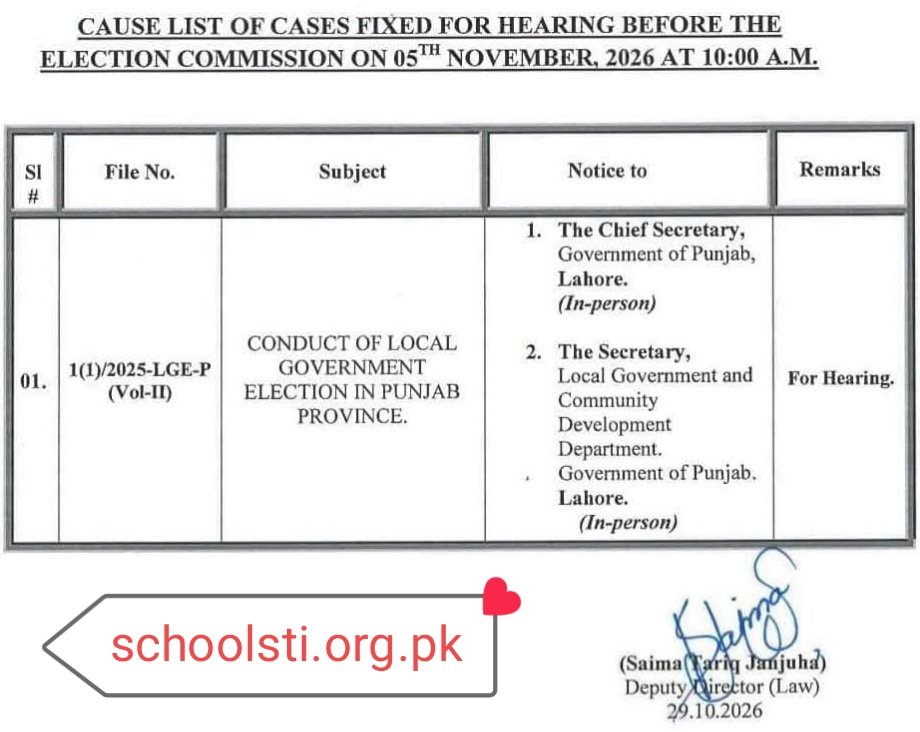
Grassroots democracy in Pakistan’s largest province has reached a critical juncture. Following years of administrative delays, legislative overhauls, and shifting timelines, the Election Commission of Pakistan (ECP) has taken a decisive step toward enforcing the constitutional mandate of local bodies. According to an official Cause List issued on October 29, 2026, by Saima Tariq Janjuha, Deputy Director (Law), the Election Commission has fixed a high-stakes hearing for November 5, 2026, at 10:00 A.M. concerning the Conduct of Local Government Election in Punjab Province (File No. 1(1)/2025-LGE-P (Vol-II)).
What makes this notice particularly significant is the strict directive attached to the summons: both the Chief Secretary, Government of Punjab, and the Secretary, Local Government and Community Development (LG&CD) Department, have been ordered to appear in-person. As over 120 million citizens await elected local representatives to resolve municipal, educational, and infrastructural challenges, this hearing represents a defining moment for devolution of power under the Punjab Local Government Act (PLGA) 2025 and the newly notified 2026 Election Rules.
Decoding the Official ECP Cause List (November 5, 2026)
To offer immediate clarity for legal observers, political stakeholders, and citizens, the table below breaks down the official parameters of the Election Commission’s notice.
| Parameter | Official Details from ECP Cause List |
|---|---|
| Hearing Date & Time | November 5, 2026, at 10:00 A.M. |
| Case File Number | 1(1)/2025-LGE-P (Vol-II) |
| Core Subject | Conduct of Local Government Election in Punjab Province |
| Summoned Party 1 | The Chief Secretary, Government of Punjab, Lahore (In-person) |
| Summoned Party 2 | The Secretary, Local Government and Community Development Department, Lahore (In-person) |
| Proceeding Status | Fixed For Hearing |
| Issuing Authority | Saima Tariq Janjuha, Deputy Director (Law) — Signed October 29, 2026 |
Why the ECP Issued an “In-Person” Summons to Punjab’s Top Bureaucracy
In standard regulatory proceedings, provincial departments regularly delegate representation to additional secretaries or legal advisors. When the Election Commission explicitly mandates an (In-person) appearance by the Chief Secretary—the administrative head of the province—and the Secretary of the Local Government and Community Development Department (LG&CD), it signals zero tolerance for bureaucratic ambiguity.
1. Eliminating Procedural Bottlenecks
Over the past several months, the Punjab government and the ECP have navigated complex prerequisites under the Punjab Local Government Act, 2025, including:
- Notification of the Punjab Demarcation, Classification and Naming of Local Areas Rules 2025.
- Enactment of the Punjab Local Government (Delimitation of Union Councils) Rules 2026 and Election Rules 2026.
- Approval and demarcation of 6,637 Union Councils across the province.
Despite completing the vast majority of paperwork and delimitation formalities, the final polling schedule has remained unannounced. By summoning the foremost leadership directly, the ECP aims to secure binding commitments on the ground rather than awaiting inter-departmental summaries.
2. Aligning the Electoral Timeline
While earlier consultations between the ECP and provincial authorities pointed toward a potential polling window between mid-December 2026 and January 2027, recent statements from provincial leadership suggested holding polls after Ramadan. The November 5 hearing is designed to reconcile these timelines, assess logistical readiness, and lock in a legally binding election schedule under Article 140-A and Article 219(d) of the Constitution of Pakistan.
Administrative Impact: How Local Government Elections Affect Public Sector Operations
Conducting local government elections across 6,637 Union Councils in Punjab is one of the largest logistical exercises in South Asia. Its execution directly impacts the provincial civil service, law enforcement, and the communal education sector:
- Deployment of Polling Personnel: The ECP relies heavily on general sector employees—particularly educators from the School Education Department (SED)—to serve as Presiding Officers, Assistant Presiding Officers, and Polling Officers. Educators and temporary faculty tracking departmental notifications, deployment rosters, and communal sector updates on School STI Punjab must stay attentive to upcoming ECP training schedules once the polling dates are finalized.
- Designation of Polling Stations: Thousands of state primary, elementary, and high schools across Punjab are designated as polling stations, requiring coordination between District Returning Officers (DROs) and District Education Authorities (DEAs) to ensure basic facilities, security boundary walls, and CCTV installation.
- Freeze on Administrative Transfers: Once the official election schedule is announced by the ECP, a strict ban is imposed on the transfer and posting of civil servants and local administration officials, as well as the announcement of new development schemes in the respective constituencies. Professionals monitoring recruitment drives and latest education and civic updates in Punjab should note that administrative timelines often adjust around major electoral windows.
Comparison:Administrator Rule vs. Elected Local Governments in Punjab
To understand why the ECP’s intervention on November 5 is vital for ordinary citizens, it helps to compare the current bureaucratic administrator model with an empowered, elected local government framework.
| Feature / Governance Metric | Bureaucratic Administrator Setup (Current) | Elected Local Government System (Post-Election) |
|---|---|---|
| Constitutional Standing | Temporary stop-gap arrangement | Mandated under Article 140-A of the Constitution |
| Decision-Making Authority | Concentrated in Deputy Commissioners & LG&CD officials | Devolved to Mayors, Town/Tehsil Chairmen, and UC Chairmen |
| Public Accountability | Upward accountability to provincial secretariat | Direct downward accountability to local voters |
| Municipal Service Delivery | Managed through foremost-down administrative initiatives | Driven by neighborhood-stage Union Council representation |
| Fiscal Development Funds | Allocated via provincial bureaucratic channels | Voted on by elected local councils based on ward priorities |
| Citizen Access | Requires navigating formal district offices | Direct access to local councilors within the immediate community |
Key Legal Frameworks Governing the 2026 Punjab LG Polls
The upcoming hearing operates within a strict statutory framework. Understanding these laws explains why the Election Commission holds the upper hand in compelling the provincial administration to act:
- Article 140-A of the Constitution: Mandates that each province shall, by law, establish a local administration framework and devolve political, administrative, and financial responsibility and authority to the elected representatives of the local governments.
- Section 219(d) of the Elections Act, 2017: Empowers the ECP to hold local state elections within 120 days of the expiry of the term of a local government, and grants the Commission full authority to issue directions to provincial governments to facilitate the method.
- Punjab Local Government Act (PLGA) 2025 & 2026 Rules: Establishes the structural tiers of urban and rural local bodies, defining the roles of Union Councils, reserved seats (women, youth, peasants/workers, and minorities), and joint candidacy mechanisms. As documented in recent policy coverage by Dawn, the completion of delimitation and rule-making leaves no further legal barrier to announcing the poll dates.
Analysis
A closer look at Case File 1(1)/2025-LGE-P (Vol-II) reveals three critical takeaways regarding the state of local governance in Punjab:
- Transition from Paperwork to Execution: The suffix (Vol-II) in the 2025 case file indicates an extensive history of correspondence, delimitation extensions, and legislative amendments over the past twelve months. With the demarcation of 6,637 Union Councils and the 2026 Election Rules now entire, the case has officially transitioned from technical preparation to executive scheduling.
- Institutional Assertion by the ECP: By summoning the Chief Secretary and LG&CD Secretary in person rather than accepting written compliance reports, the Election Commission is insulating itself against institutional blame for prolonged delays and placing the onus squarely on the provincial executive.
- The Winter vs. Spring Window: The primary point of contention during the November 5 hearing will be the exact polling date—specifically whether elections are held in the winter window (December 2026–January 2027) as initially proposed by the ECP, or pushed past Ramadan into spring 2027 due to administrative and weather considerations cited by provincial ministers.
Opinion
From a governance and constitutional standpoint, the Election Commission’s decision to summon Punjab’s highest-ranking civil servants for the November 5, 2026 hearing is a welcome and overdue intervention. For too long, local state elections across Pakistan have been treated by provincial administrations as an optional administrative exercise rather than a constitutional pillar. Repeated alterations to local state acts—from 2013 to 2019, 2022, and 2025—have repeatedly reset the clock on delimitation, leaving municipal governance in the hands of unelected administrators.
Accurate democratic stability and efficient service delivery—whether in sanitation, primary healthcare, community infrastructure, or local schooling—cannot be micro-managed from provincial capitals. The November 5 hearing must not complete with another open-ended committee or conditional timeline. The Election Commission should exercise its full constitutional authority to extract a definitive, non-negotiable polling date from the Punjab government, restoring grassroots representation to the citizens of Punjab once and for all.
Frequently Asked Questions (FAQs)
1. What is the purpose of the ECP hearing on November 5, 2026?
The hearing fixed for November 5, 2026, at 10:00 A.M. (File No. 1(1)/2025-LGE-P Vol-II) is convened by the Election Commission of Pakistan to review final preparations and establish a firm schedule for the Conduct of Local Government Elections in Punjab Province.
2. Who has been summoned by the Election Commission in this notice?
The ECP has issued mandatory in-person appearance notices to two top officials of the Punjab Government:
- The Chief Secretary, Government of Punjab, Lahore.
- The Secretary, Local Government and Community Development (LG&CD) Department, Lahore.
3. Have the Union Council delimitations in Punjab been completed?
Yes. Under the Punjab Local Government Act 2025 and the 2026 Delimitation Rules, the demarcation and naming of 6,637 Union Councils across Punjab have been finalized, clearing the primary technical hurdle for elections.
4. Who issued the official Cause List for the November 5 hearing?
The Cause List was officially signed and issued on October 29, 2026, by Saima Tariq Janjuha, Deputy Director (Law) at the Election Commission of Pakistan.
5. How will the Punjab Local Government Elections affect administration employees and teachers?
Once the ECP announces the official polling schedule following this hearing, thousands of public sector employees—especially school teachers and education officers—will be requisitioned and trained as polling staff (Presiding and Assistant Presiding Officers), and a temporary ban on official transfers and postings will take effect until the electoral procedure concludes.
Conclusion
The Cause List for November 5, 2026, is far more than a routine administrative notice; it is a decisive test of constitutional compliance in Punjab. With all legislative and delimitation prerequisites under the PLGA 2025 finally in site, the in-person appearance of the Chief Secretary and the LG&CD Secretary before the Election Commission should pave the way for an immediate election schedule. Citizens, political candidates, and public sector employees alike will be watching Islamabad closely at 10:00 A.M. on November 5 as the roadmap for Punjab’s local democracy is officially decided.