Teacher Observation Form Lesson Plan of All Classes PDF
Teacher Observation Form Lesson Plan of All Classes PDF: The Complete Instructional Guide
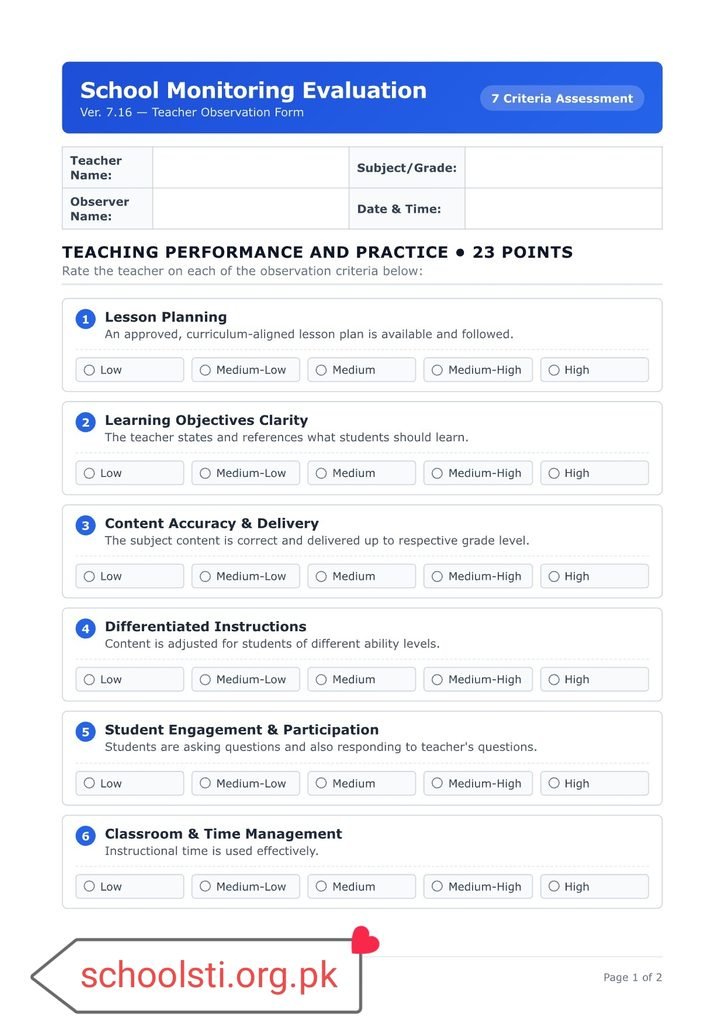
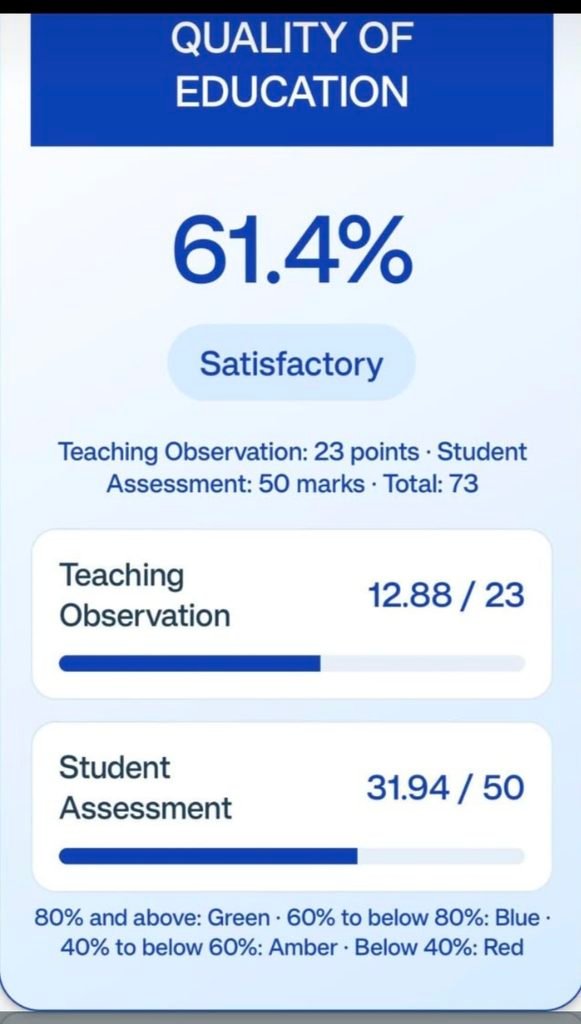
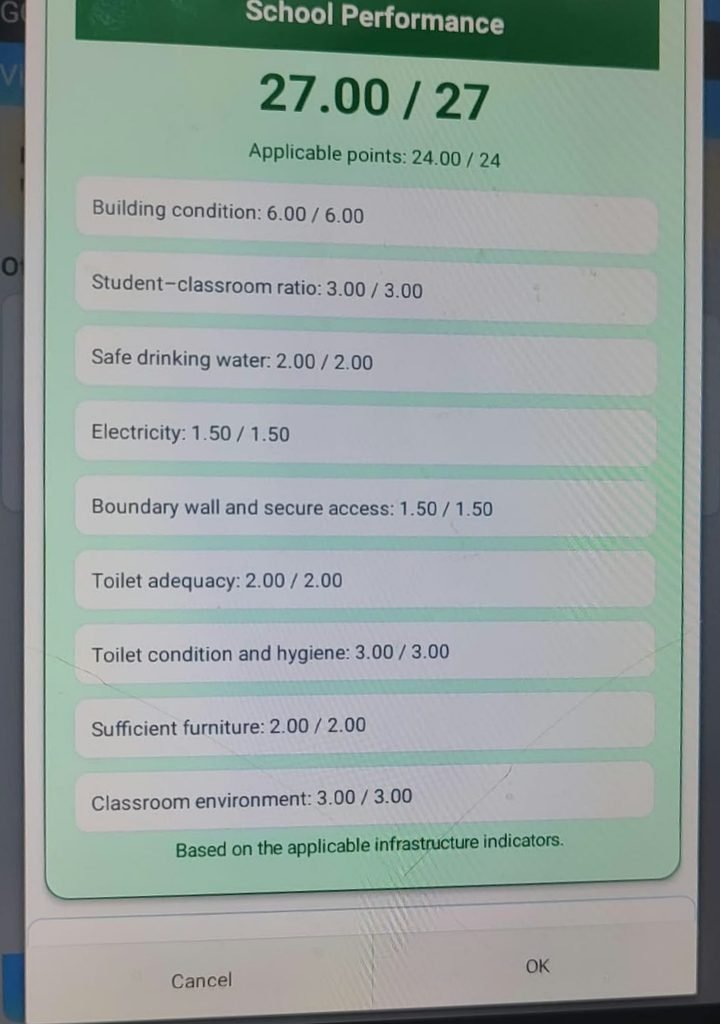
- 23 marks teachers ki observation k hain
- 50 marks bachon k test k hain
- Total 73 marks hain
اسسٹنٹ ایجوکیشن آفیسرز (AEOs) کے سکول وزٹ کے دوران دو اہم چیزوں کا جائزہ لیا جائے گا:
1۔ تدریسی مشاہدہ (Teaching Observation)
تدریسی مشاہدے کے دوران درج ذیل 7 نکات دیکھے جائیں گے:
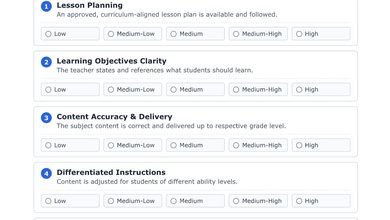
1۔ سبق کی منصوبہ بندی (Lesson Planning)
منظور شدہ نصاب سے ہم آہنگ سبق کا منصوبہ دستیاب ہو اور استاد اس کے مطابق تدریس کر رہا ہو۔
2۔ تعلیمی مقاصد کی وضاحت (Learning Objectives Clarity)
استاد واضح کرے کہ طلبہ نے سبق کے اختتام تک کیا سیکھنا ہے اور دورانِ تدریس ان مقاصد کا حوالہ بھی دے۔
3۔ مواد کی درستگی اور تدریس (Content Accuracy & Delivery)
مضمون کا مواد درست ہو اور متعلقہ جماعت کی سطح کے مطابق مؤثر انداز میں پڑھایا جائے۔
4۔ طلبہ کی مختلف صلاحیتوں کے مطابق تدریس (Differentiated Instruction)
مختلف صلاحیتوں کے حامل طلبہ کے مطابق تدریسی طریقہ کار اور مواد میں مناسب تبدیلی کی جائے۔
5۔ طلبہ کی شمولیت اور شرکت (Students Engagement & Participation)
طلبہ سبق میں بھرپور حصہ لیں، سوالات کریں اور استاد کے سوالات کے جوابات دیں۔
6۔ کلاس روم اور وقت کا انتظام (Classroom & Time Management)
تدریسی وقت کو مؤثر انداز میں استعمال کیا جائے اور کلاس روم کا نظم و ضبط برقرار رکھا جائے۔
7۔ دورانِ سبق جائزہ اور فیڈبیک (Assessment & Response in Lesson)
استاد دورانِ سبق طلبہ کی سمجھ بوجھ کو جانچے اور انہیں واضح اور مخصوص فیڈبیک فراہم کرے۔
2۔ طلبہ کا جائزہ / ٹیسٹ (Students Assessment)
- 3 جماعتوں کے طلبہ کا ٹیسٹ لیا جائے گا۔
- ہر منتخب جماعت سے 5 طلبہ کا ٹیسٹ ہوگا۔
پرائمری کلاسز
ہر طالب علم سے 9 سوالات پوچھے جائیں گے:
- انگریزی: 3 سوالات
- اردو: 3 سوالات
- ریاضی: 3 سوالات
مڈل کلاسز
ہر طالب علم سے 12 سوالات پوچھے جائیں گے:
- سائنس: 3 سوالات
- اردو: 3 سوالات
- انگریزی: 3 سوالات
- ریاضی: 3 سوالات
Here are the 11 Main Indicators of a Teacher’s Lesson Plan:
1. Topic / Subject: The name of the lesson and class.
2. Learning Objectives: What students will learn at the end of the lesson.
3. Previous Knowledge: What students already know about the topic.
4. Teaching Aids / AV Aids: Charts, models, board, multimedia used in lesson.
5. Teaching Methodology: Method used – Lecture, Activity, Discussion, etc.
6. Content / Subject Matter: Main points and explanation of the lesson.
7. Student Activities: What students will do – question answer, group work.
8. Teacher Activities: What teacher will do to explain the lesson.
9. Classroom Management: How to manage discipline and student participation.
10. Assessment / Evaluation: Questions to check if students understood the lesson.
11. Homework / Follow-up Work: Work given to students for practice at home.
Lesson Plan Builder — Select Class (1–10), Subject & Write Topic
Teacher Observation Form Controls (Ver. 7.16 — 7 Criteria • 23 Points)
School Monitoring Evaluation
Ver. 7.16 — Teacher Observation Form
| Teacher Name | Subject / Grade | Class 3 — General Knowledge | |
| Observer Name | Date & Time |
TEACHING PERFORMANCE AND PRACTICE • 23 POINTS
Total Score: 23 / 23 Points (100% - Exemplary)OBSERVER DIAGNOSTIC FEEDBACK & VERIFICATION
All 7 Teaching Performance and Practice criteria meet High quality standards under Ver. 7.16.
| Teacher Signature ______________________ |
Head Teacher Approval ______________________ |
Observer / AEO / MEA Sign ______________________ |
Criterion 6 Live 40-Minute Classroom Pacing Timer & Progress Bar
Phase 1 (00–05m): Warm-Up & SLO FramingInteractive 3-Column Classroom Whiteboard Simulator (تختۂ تحریر کا عملی خاکہ)
Upload Existing PDF Lesson Plan or Observation Form (پی ڈی ایف یا تصویر اپلوڈ کریں)
No file uploaded yet. Choose a PDF or image above to see the live upload progress bar (0%–100%) and preview it here.
Introduction
A teacher observation form lesson plan of all classes PDF is a standardized evaluation and instructional planning document used by academy administrators, headmasters, and academic coordinators to assess classroom delivery against pre-defined curriculum objectives across primary, elementary, and secondary grade levels. By integrating a structured lesson plan with an objective rubric, schools bridge the gap between theoretical syllabus coverage and real-time learner engagement.
Walking into a classroom with a blank notepad infrequently leads to meaningful instructional coaching. Whether you are a school headmaster overseeing thirty faculty members, a quality assurance officer conducting a walkthrough, or a newly inducted teacher preparing for an annual performance review, the connection between lesson planning and classroom observation determines educational outcomes. Without a standardized rubric, evaluations become subjective, feedback loses its punch, and learner learning stagnates.
This guide breaks down the exact structure of a multi-grade educator observation form and lesson plan framework. You will identify ready-to-use rubrics, grade-exact adaptations from Early Childhood Care and Education (ECCE) to Matriculation (Grades 9–10), comparative assessment models, and actionable strategies to turn routine inspections into collaborative professional growth.
Core Components of an Effective Teacher Observation Form and Lesson Plan
An impactful classroom evaluation does not treat the lesson plan and the observation sheet as two isolated pieces of paperwork. Instead, the observation form acts as a mirror reflecting how well the written lesson plan translates into student comprehension.
1. Pre-Observation Lesson Plan Metadata
Before an observer steps through the classroom door, the foundational parameters of the session must be documented:
- Administrative Details: Teacher’s full name, designation, subject, grade/section, date, total enrolled students, and actual attendance.
- Curriculum Alignment: Specific Student Learning Outcomes (SLOs) mapped directly to the national or provincial curriculum.
- Instructional Timeline: Breakdown of a standard 40-to-45-minute period into warm-up (PK testing), core presentation, guided practice, and formative wrap-up.
2. Pedagogical Execution & Delivery Rubric
During the live session, evaluators track how effectively the educator manages the instructional flow:
- Prior Knowledge (PK) Activation: Linking yesterday’s concepts to today’s topic using relatable, real-planet hooks.
- Instructional Variety: Shifting away from passive lecturing toward activity-based learning, visual aids, and collaborative group tasks.
- Differentiated Instruction: Adapting explanations and tasks to accommodate unhurried learners, average students, and high achievers simultaneously.
3. Classroom Management & Learning Environment
Even the most brilliant lesson plan falls flat in a chaotic room. Key observation markers comprise:
- Physical Setup & Visibility: Clear board labor, accessible teaching learning materials (TLMs), and seating arrangements that allow the educator to circulate freely.
- Time-on-Task & Pacing: Smooth transitions between activities without losing the class’s momentum.
- Positive Reinforcement: Encouraging student questions, correcting errors constructively, and maintaining mutual respect.
Grade-Wise Lesson Plan & Observation Matrix (All Classes)
A single generic rubric fails if applied identically to a Grade 1 phonics class and a Grade 10 physics lab. While the core structure of a teacher observation form lesson plan of all classes PDF remains consistent, the evaluative weight shifts across academic tiers.
| Academic Level | Primary Lesson Plan Focus | Core Observation Metrics | Recommended Assessment Check |
|---|---|---|---|
| ECCE & Lower Primary (Grades 1–3) | Phonics, foundational numeracy, motor skills, and storytelling. | Use of flashcards/realia, teacher warmth, song/activity transitions, and phonics articulation. | Oral responses, action games, and picture-matching tasks. |
| Upper Primary (Grades 4–5) | Reading comprehension, basic scientific inquiry, and mathematical operations. | Group job facilitation, notebook checking accuracy, and bilingual scaffolding. | Short board quizzes, peer-pair checks, and worksheet completion. |
| Middle / Elementary (Grades 6–8) | Conceptual transition, analytical thinking, and structured writing. | Questioning techniques (Higher-Order Thinking Skills), moment management, and interactive dialogue. | Exit tickets, concept maps, and 3-minute written summaries. |
| Secondary / High (Grades 9–10) | Board exam mastery, practical lab application, and critical issue-solving. | Deep subject command, exam-rubric alignment, practical demonstration, and error analysis. | Past-paper inquiry drills, lab observations, and structured rubrics. |
For educators managing open sector classrooms or preparing documentation for departmental reviews, staying updated with the latest official academy education templates and teaching resources ensures your lesson diaries and evaluation folders align with current district inspection standards.
Standard 4-Point Classroom Observation Rubric
When compiling your downloadable PDF forms, replacing vague checkboxes (“Yes/No”) with a 4-point behavioral scale gives teachers clear targets for improvement. This framework is aligned with international pedagogical benchmarks, such as the Danielson Framework for Teaching, which evaluates educators across planning, environment, and instruction.
| Evaluation Domain | 4 – Outstanding (Excellence) | 3 – Good (Proficient) | 2 – Acceptable (Minimum Standard) | 1 – Unacceptable (Needs Support) |
|---|---|---|---|---|
| 1. Lesson Alignment & SLO Clarity | SLOs are visibly displayed, measurable, and fully achieved by over 85% of students. | SLOs are stated clearly at the initiate and connects logically to the lesson activities. | Lesson topic is written on the board, but precise learning outcomes remain vague. | No written lesson plan present; teaching lacks evident direction or objective. |
| 2. Subject Knowledge & Explanations | Demonstrates mastery; connects concepts to daily life and prompts higher-order thinking. | Explains concepts accurately using evident examples and age-appropriate language. | Answers basic textbook questions correctly however relies heavily on rote reading. | Makes factual errors or fails to clarify learner confusion during the lesson. |
| 3. Student Engagement & Pedagogy | Student-led activities dominate; every learner participates actively through group or pair tasks. | Uses questioning and visual aids effectively to keep the majority of the class engaged. | Primarily educator-centered lecture; only front-row students respond to prompts. | Monotonous delivery; students are passive, distracted, or copying blindly from the board. |
| 4. Formative Assessment & Closure | Checks understanding continuously using varied tools and summarizes key takeaways with students. | Conducts a quick oral or written check at the finish of the lesson to verify SLO mastery. | Asks generic questions (“Did everyone understand?”) without verifying individual grasp. | Bell rings mid-explanation; no recap, assessment, or homework guidance provided. |
Comparison: Traditional Inspection vs. Modern Developmental Observation
Many schools still treat classroom observations as high-stakes policing exercises. Shifting toward a developmental model transforms how teachers prepare their daily lesson plans.
| Feature | Traditional Fault-Finding Inspection | Modern Developmental Observation |
|---|---|---|
| Primary Objective | Administrative compliance and grading the instructor. | Enhancing student learning outcomes and coaching the educator. |
| Lesson Plan Usage | Checked only to verify if the diary is signed and dated. | Analyzed alongside live delivery to see how adjustments are made in real time. |
| Observer’s Role | Silent judge sitting at the back looking for mistakes. | Active pedagogical partner observing both instructor actions and pupil responses. |
| Feedback Timeline | Delayed, one-manner remarks written in an annual confidential report. | Immediate, constructive 10-minute post-observation debrief within 24 hours. |
| Impact on Classroom | Triggers anxiety and staged “show lessons” that feel unnatural. | Builds ongoing psychological safety, experimentation, and authentic teaching. |
Research from UNESCO’s International Institute for Educational Planning (IIEP) consistently highlights that instructional leadership and supportive teacher supervision yield significantly higher literacy and numeracy gains than punitive inspection regimes.
How to Structure a Printable “All-in-One” Observation & Lesson Plan PDF
To save printing costs and streamline record-keeping, the most practical plan places the Teacher’s Lesson Plan on the front side of an A4 sheet and the Observer’s Evaluation Form on the reverse side.
Page 1: The Teacher’s Daily Lesson Plan (40-Minute Block)
- Header Block: Class, Subject, Topic, Sub-topic, Date, Duration, and Target SLOs.
- Required Audio-Visual Aids (TLMs): Low-cost/no-cost materials, charts, models, or digital tools.
- Phase 1: Warm-Up & PK Testing (5 Minutes): 2–3 targeted questions to spark curiosity and assess baseline knowledge.
- Phase 2: Core Concept Delivery (15 Minutes): Step-by-step instructional methodology, board job layout, and actual-planet examples.
- Phase 3: Guided & Independent Practice (12 Minutes): Group tasks, textbook exercises, or hands-on demonstrations where the educator circulates.
- Phase 4: Formative Assessment & Wrap-Up (5 Minutes): Quick quiz, thumbs-up/thumbs-down check, or 2-inquiry exit slip.
- Phase 5: Homework / Extension Task (3 Minutes): Creative application task rather than repetitive copy-task.
Page 2: The Observer’s Walkthrough & Feedback Sheet
- Checklist Matrix: The 4-point rubric covering Planning, Execution, Classroom Environment, and Assessment.
- Student Book & Diary Spot-Check: A fast verification of 5 random student notebooks to check if written task matches the lesson plan and whether instructor corrections are timely.
- Qualitative Coaching Notes (The 3-2-1 Method):
- 3 Key Strengths Observed: Specific praise (e.g., “Excellent use of fraction strips during guided practice”).
- 2 Areas for Growth: Actionable adjustments (e.g., “Direct questions to back-benchers using cold-calling techniques”).
- 1 Agreed Action Step: A concrete goal to review in next month’s observation.
- Sign-Off Block: Signatures of the Observee (Teacher), Observer (Headmaster/Coordinator), and Date of Debrief.
Educators applying for teaching posts, contract renewals, or promotions can also explore teacher recruitment updates and classroom management guides to align their portfolios with modern assessment criteria. Furthermore, utilizing accessible-access templates from institutions like Edutopia’s Classroom Management & Assessment Portal can help school leaders customize rubrics for specialized STEM or language arts tracks.
Analysis
Evaluating the intersection of lesson planning and classroom observation reveals several core operational takeaways for academy leaders and educators:
- Alignment Dictates Impact: A lesson plan without an observation rubric is an unverified intention; an observation form without a lesson plan is an unanchored critique. Combining both into a single workflow ensures accountability from preparation to assessment.
- Student-Centric Metrics Matter Most: High-performing observation templates focus less on the educator’s theatrical performance and more on observable learner behaviors—how numerous students are asking questions, solving problems, and demonstrating mastery of the SLO.
- Grade-Level Calibration Prevents Burnout: Applying a rigid, one-size-fits-all checklist across Grades 1 to 10 alienates teachers. Effective PDFs maintain a unified header and scoring scale while allowing flexible indicators for primary activity-based learning versus secondary exam-focused instruction.
- Data-Driven Professional Development: When headmasters aggregate scores from monthly observation forms across all classes, institution-wide patterns emerge immediately—revealing whether faculty require targeted workshops in formative assessment, moment management, or differentiated instruction.
Opinion
From an instructional design and school management standpoint, the biggest failure in modern schooling is treating the teacher observation form lesson plan of all classes PDF as bureaucratic compliance. In thousands of schools, teachers spend hours writing elaborate lesson diaries solely to satisfy a visiting monitor, while headmasters fill out observation sheets in their offices without ever watching a full 40-minute period.
If a lesson plan takes longer to write than the actual preparation of teaching aids, the form is broken. The ideal template must be a one-page, high-utility operational utility. It should take a educator no more than 10 minutes to map out their daily SLOs, activities, and assessment checks, and it should take an observer just 15–20 minutes of focused classroom presence to score and annotate. When academy leaders ditch the “gotcha” inspection mentality and utilize these forms as a two-manner coaching conversation, instructor confidence skyrockets—and student grades inevitably follow.
Frequently Asked Questions (FAQs)
1. What is the difference between a lesson plan and a educator observation form?
A lesson plan is a forward-looking roadmap prepared by the instructor before class, detailing the learning objectives (SLOs), teaching methods, materials, and duration allocation. A teacher observation form is an evaluative utility used by a principal, peer, or supervisor during the live lesson to measure how effectively that plan was executed and whether students achieved the intended outcomes.
2. Can a single observation form PDF work for all classes from Grade 1 to Grade 10?
Yes, provided the form uses competency-based domains rather than rigid subject-specific tasks. By structuring the PDF around universal pillars—Lesson Preparation, Concept Delivery, Student Engagement, Classroom Management, and Formative Assessment—evaluators can apply the exact identical 1-to-4 rating scale to a Grade 2 Urdu lesson or a Grade 9 Biology practical.
3. How commonly should teachers be observed using a formal rubric?
For sustainable professional growth, each educator should undergo one formal 40-minute scheduled observation per month (or at least twice per academic term), supplemented by brief, unannounced 10-minute “instructional walkthroughs” every two weeks to track consistency and notebook checking.
4. What should happen immediately after a classroom observation is completed?
An observation is incomplete without a post-observation debrief. Within 24 to 48 hours, the observer and instructor should meet for 10–15 minutes in a personal, supportive setting to review the rubric scores, celebrate classroom strengths, discuss learner engagement bottlenecks, and agree on one particular pedagogical goal for the next cycle.
Conclusion
Implementing a structured teacher observation form lesson plan of all classes PDF is one of the highest-leverage upgrades a school administration can make. By uniting obvious Student Learning Outcomes with transparent, 4-point behavioral rubrics, schools eliminate guesswork from teaching evaluations. Teachers gain clarity on exactly what instructional excellence looks like, administrators gather concrete data to guide faculty training, and students gain from well-paced, engaging, and purposeful daily lessons. Launch by adopting a streamlined two-sided A4 template, train your observers to coach rather than criticize, and watch your classroom culture transform.