Why 30 Days Is Enough — If Every Day Has a Job
Students who panic before board exams rarely lack time — they lack structure for it. Thirty days is roughly 240 hours, and even half of that, used deliberately, moves a shaky syllabus to exam-ready. Those who fail to finish usually lose the first hour each morning just deciding what to study.
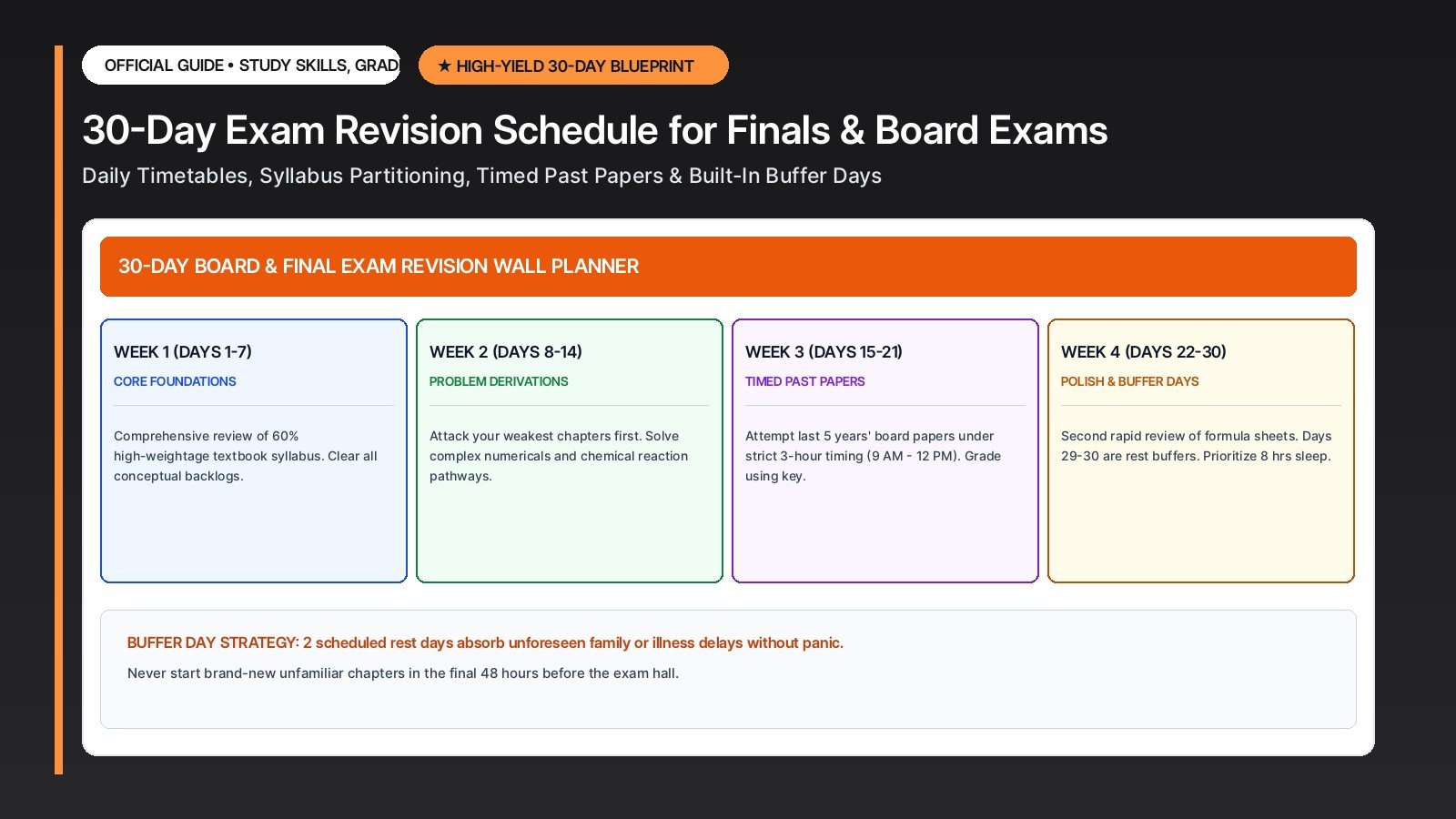
This plan fixes that with one idea: every day already has a job before you wake up. It runs on the rule of three passes: Days 1-10 complete the syllabus, Days 11-20 revise it with past papers, Days 21-25 attack weak areas under timed conditions, and Days 26-30 are pure polish. Three passes beat one heroic all-nighter every time.
One honest note: this assumes a partially studied syllabus. Starting fresh on Day 1? Spend Days 1-10 on the most important 60 percent of chapters and adapt using the troubleshooting section.
Build the Schedule Around YOUR Subjects in 7 Steps
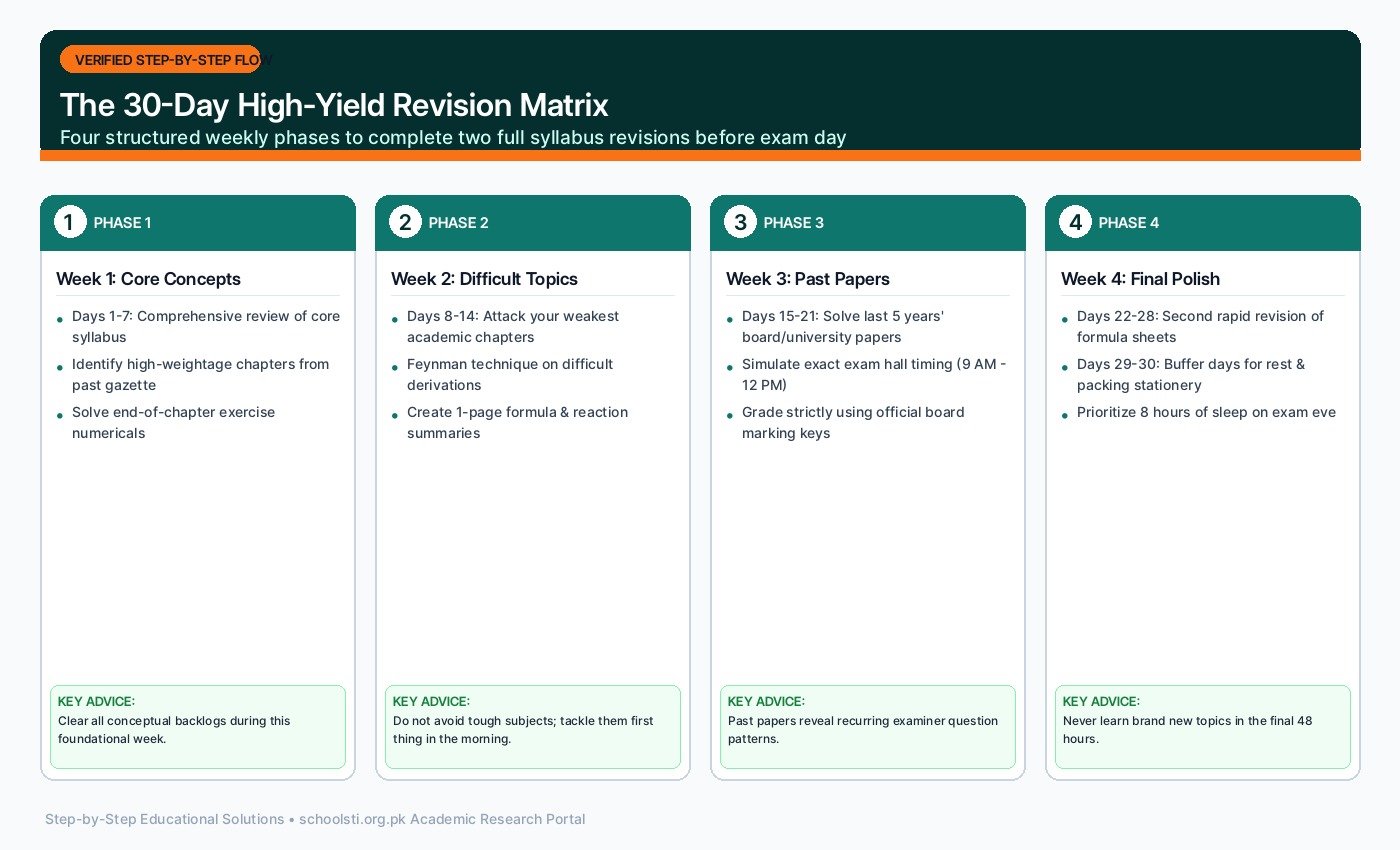
The day-by-day table in the next section is a template — your subjects decide the details. Walk through these seven steps once before Day 1, and the whole month becomes realistic instead of wishful.
- List every subject and count its chapters List each subject with its total chapters or units. Mark every chapter Strong, Okay, or Weak — this one page is your battlefield map for the month.
- Assign chapters to Days 1-10 Divide total chapters by 10 days. A typical FSc student covers 3-4 chapters daily in heavy subjects like Physics or Chemistry and more in lighter ones. Pair one heavy chapter with one light chapter each day.
- Slot past papers into Days 11-20 Place at least one past paper per subject across these ten days. Revise the relevant chapters each morning, solve the paper in the afternoon with a timer, and mark every question you miss.
- Reserve Days 21-25 for your Weak list Everything marked Weak in step 1, plus every missed past-paper question, goes here. Study a weak topic in the morning and test it with timed questions in the evening. No brand-new chapters here.
- Protect Days 26-30 as light days These are for short notes, formula sheets, and one-page summaries — never new learning. Cover two or three subjects lightly per day; sleep and calm matter more than extra hours now.
- Leave two buffer slots Mark Days 15 and 25 as half-buffer days: ahead of schedule, use them for extra past papers; behind, use them to catch up. Never borrow a buffer day early without replacing it.
- Adjust for your actual paper dates If a paper falls mid-schedule, shift that subject's heavy revision to the two days before it and rest other subjects. The plan bends — it does not break.
The Complete Day-by-Day Plan: All 30 Days
Follow this table row by row. Morning is your deep-work block (new chapters, hard topics). Evening is review and practice. The Checkpoint column tells you how to prove to yourself that the day worked — never end a day without it.
| Day | Focus | Morning (3-4 hrs) | Evening (2-3 hrs) | Checkpoint |
|---|---|---|---|---|
| Days 1-2 | Syllabus completion begins | Open heavy-subject chapters 1-2, make short notes | Light subjects: chapters 1-2, read and underline key points | Write 10 key points from each chapter from memory |
| Days 3-4 | Continue chapter coverage | Heavy subjects: chapters 3-4 with numericals or derivations | Light subjects: chapters 3-4, prepare one-page summaries | Recite each summary aloud without looking |
| Days 5-6 | Mid-phase push | Heavy subjects: chapters 5-6, solve book examples | Light subjects: chapters 5-6, mark difficult lines for review | Solve 5 short questions per chapter covered |
| Days 7-8 | Finish remaining chapters | Complete all leftover chapters in heavy subjects | Complete all leftover chapters in light subjects | Verify: every chapter opened at least once |
| Days 9-10 | Syllabus consolidation | Revise Days 1-4 chapters quickly using your notes | Revise Days 5-8 chapters, fill any gaps found | List your 10 weakest topics — this becomes the Weak list |
| Days 11-12 | Revision plus first past papers | Revise two subjects fully from short notes | Solve one past paper each for both subjects, untimed | Note every question you could not answer |
| Days 13-14 | Past papers continue | Revise two more subjects, focus on definitions and formulas | Solve past papers for these subjects, untimed | Compare missed questions with your Weak list, update it |
| Day 15 | Buffer and catch-up | Finish anything behind from Days 11-14 | Light revision of strong subjects only | Confirm: on schedule or identify the exact backlog |
| Days 16-17 | Timed past papers begin | Quick revision of two subjects from one-page summaries | Solve past papers with a strict timer, exam conditions | Record marks; any paper below 60 percent signals weak areas |
| Days 18-20 | Complete past paper cycle | Rotate remaining subjects, revise then test daily | One timed paper per subject per day, review mistakes same evening | Every subject tested at least once under time |
| Days 21-22 | Weak-area attack | Study top weak topics deeply, relearn from scratch if needed | Timed short-question sets only on weak topics | Retest one old weak topic — score must improve |
| Days 23-24 | Timed mixed practice | Mixed revision across all subjects, formulas and diagrams | Full timed papers for your two weakest subjects | Mistake notebook reviewed; no repeated errors |
| Day 25 | Buffer and confidence check | Catch up on any unfinished weak topics | Easy revision of strong subjects to rebuild confidence | Confirm Weak list is empty or nearly empty |
| Days 26-27 | Final polish begins | Read one-page summaries for half the subjects | Formula sheets, definitions, diagrams only — no new topics | Recite 20 formulas or definitions per subject from memory |
| Days 28-29 | Light revision and readiness | Read summaries for remaining subjects | Skim solved papers, review the mistake notebook | Pack stationery, check date sheet, confirm paper timings |
| Day 30 | Rest and exam mindset | Very light glance at summaries, morning only | No study after lunch — rest, pray, sleep early | Sleep 8 hours; arrive calm, not crammed |
Your Daily Timetable: Study Blocks, Prayer, Sleep, and Rest
A schedule fails when it ignores real life. This timetable builds study around prayer times, meals, and sleep — including an optional early start after Fajr, which many toppers in Pakistan swear by because the house is quiet and the mind is fresh. Adapt the exact hours to your family routine, but protect the phone-free blocks: phone in another room, notifications off. Fifty focused minutes beat three distracted hours.
Sleep is not laziness during exam month — it is when your brain files what you studied. Six and a half to eight hours nightly is the target; the timetable below gives you eight. Cutting sleep to study more backfires within three days.
| Time | Activity |
|---|---|
| 5:00 - 5:30 | Fajr prayer, fresh air, light breakfast — optional early start |
| 5:30 - 8:30 | Morning deep block: heavy subjects, new chapters, hard topics |
| 8:30 - 9:00 | Break: walk, stretch, no phone scrolling |
| 9:00 - 11:30 | Second block: continue morning topic or start second subject |
| 11:30 - 2:00 | Lunch, Zuhr prayer, rest or short nap (20-30 minutes max) |
| 2:00 - 4:30 | Afternoon block: past papers, practice questions, timed work |
| 4:30 - 5:30 | Asr prayer, tea, family time, complete rest |
| 5:30 - 7:30 | Evening block: revision of morning work, short notes, summaries |
| 7:30 - 9:00 | Dinner, Maghrib and Isha prayers, family, light walk |
| 9:00 - 10:00 | Night checkpoint: self-test the day, update Weak list, plan tomorrow |
| 10:00 - 5:00 | Sleep — phone on silent, in another room |
How to Know the Plan Is Working
You do not need to guess whether this schedule is paying off. Three simple measures tell the truth every week. First, checkpoints completed: if you finished at least 80 percent of daily checkpoints, your syllabus is genuinely moving. Second, timed paper scores: your marks on past papers should rise between Days 16 and 24 — even five extra marks per paper is real progress. Third, the Weak list shrinks: topics should move off it, not pile onto it.
Keep a single notebook page titled Mistake Notebook. Every question you miss in a past paper goes here with the correct answer written beside it. Review it every Sunday and on Days 23, 28, and 29. Students who maintain one stop losing the same marks twice — and in board exams, repeated mistakes are the difference between grades.
Troubleshooting: Common Student Problems & Verified Solutions
Real-world issues reported by Pakistani applicants and students, with actionable step-by-step solutions:
⚠️ Problem: My syllabus is not finishing on time — I am behind by Days 7-8.
✅ Verified Solution: Stop and re-prioritize instead of rushing. Rank chapters by weightage using past paper trends and finish high-weightage ones first; low-weightage chapters get summary-level study only. Use your Day 15 buffer to catch up and merge two light chapters into one morning block.
⚠️ Problem: I cannot wake up early for the morning block.
✅ Verified Solution: Shift the whole timetable later rather than forcing a 5 AM start on broken sleep — consistency beats earliness. Keep the phone out of the bedroom, put the alarm across the room, and ask a family member to wake you for the first three days. The plan cares about focused hours, not the clock.
⚠️ Problem: My mock and past-paper marks are low and it is demoralizing.
✅ Verified Solution: Low Phase 2 marks are diagnostic, not a verdict — they show exactly where marks leak. Write every correct answer in your Mistake Notebook and retest the topic within 48 hours. Compare Day 20 scores with Day 12 scores, not with a topper's. Rising even a few marks per paper means the plan works.
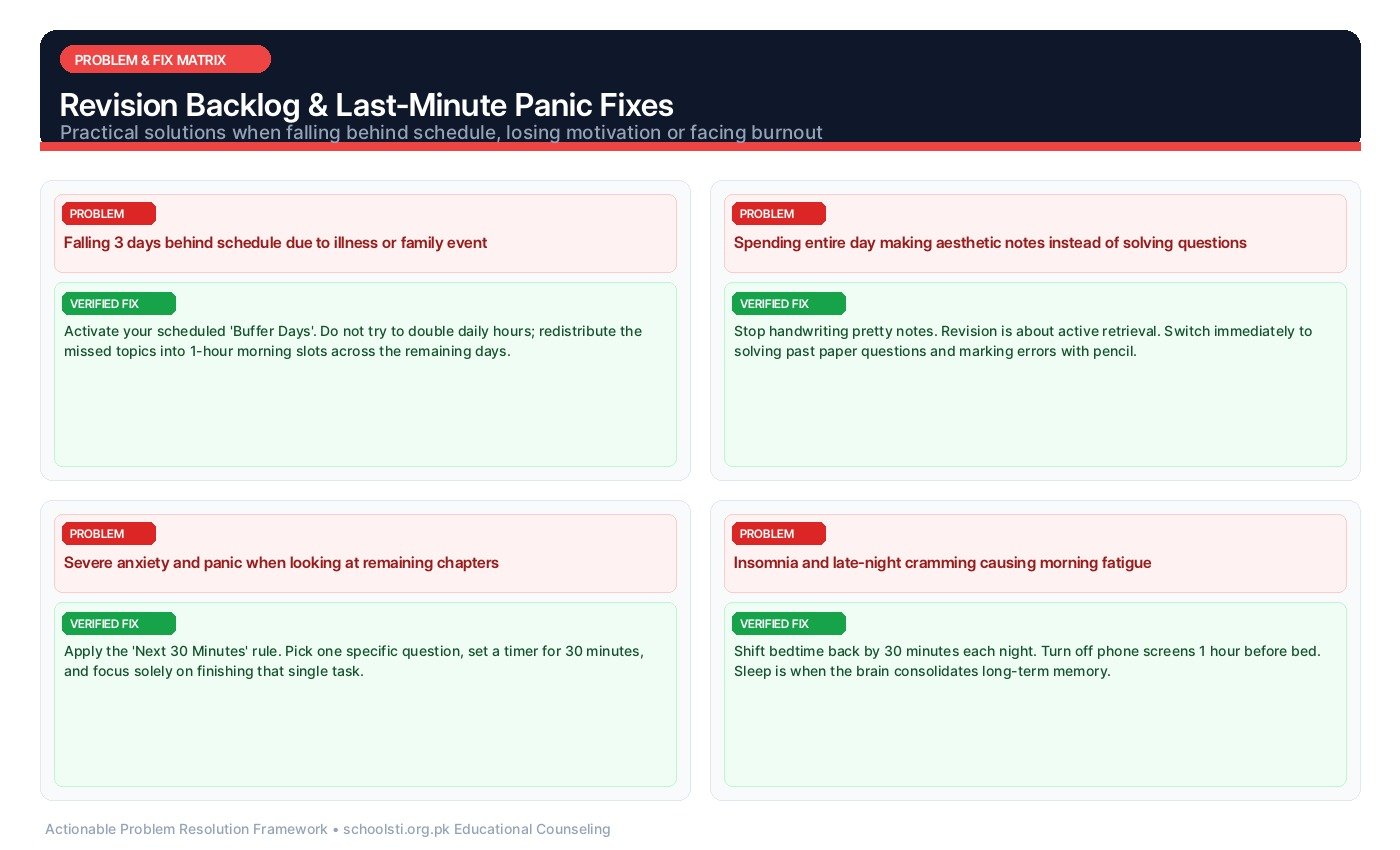
⚠️ Problem: I have fallen two or three days behind the schedule.
✅ Verified Solution: Never cram three days of work into one — that guarantees burnout. Use the Day 15 and 25 buffers, drop low-weightage chapters to summary level, and extend blocks by 30 minutes for a few days instead of doubling them. Rewrite the remaining plan on paper; an outdated plan you cannot follow is worse than a shorter one you can.
⚠️ Problem: I feel burned out in week 3 and cannot concentrate.
✅ Verified Solution: Take one genuine half-day off — no guilt, no phone scrolling, real rest with family or a walk. Then check the basics: 7 hours of sleep, proper meals, real breaks. Drop to 5 focused hours for two days, then ramp back up. A rested brain on Day 24 beats an exhausted one that studied 12 hours.
⚠️ Problem: There are constant distractions at home — guests, noise, chores.
✅ Verified Solution: Negotiate with your family once, clearly: show them the timetable and ask for two protected blocks daily. Study in the quietest corner, use earplugs if needed, and batch chores into rest periods instead of study time. If mornings are quietest in your house, that alone justifies protecting the morning block.
Frequently Asked Questions (FAQ)
Clear, direct answers to common questions about 30-Day Exam Revision Schedule: How to Plan Your Daily Routine for Finals: