Why Re-Reading Fools Your Brain: Active Recall
Many students in Pakistan spend hours re-reading textbooks, underlining lines and copying notes, and then walk into the exam hall and forget everything. This happens because re-reading creates a feeling of familiarity, not memory. Your brain recognizes the words and tricks you into thinking you know them, a trap psychologists call the fluency illusion.
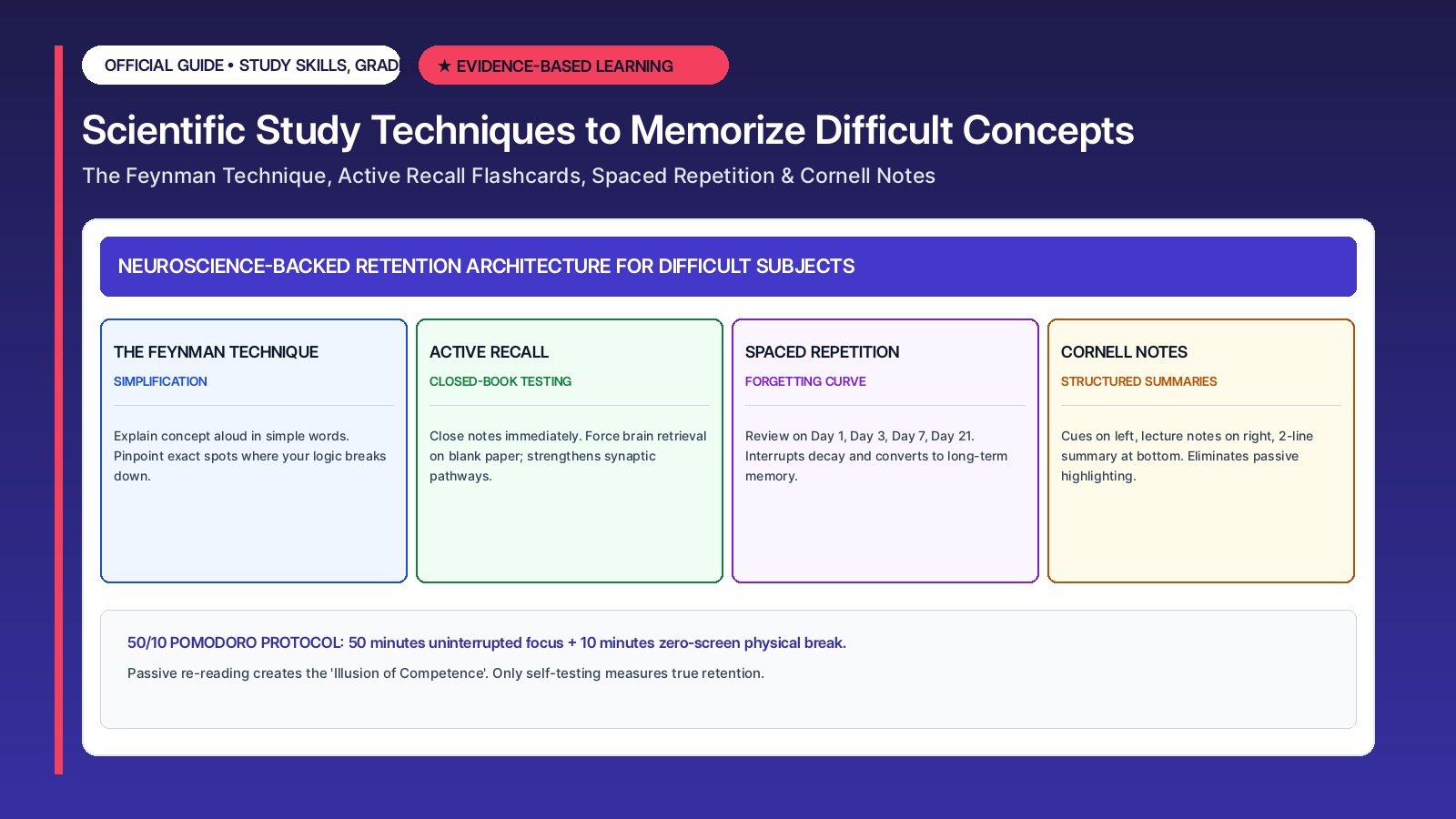
The opposite is active recall: forcing your brain to pull information out without looking. Close the book and ask: what is Newton's second law, word for word? Can I write the mechanism of esterification from memory? Can I label the chambers of the heart on a blank page? Can I list the causes of the 1971 crisis without peeking? Every effortful retrieval strengthens the memory pathway, even when you get it wrong, because the struggle itself is the learning.
Start every study session this way. Read a section once, close the book, and write down everything you remember. Then check, fill the gaps and repeat. Five minutes of recall beats thirty minutes of re-reading.
The Feynman Technique: Learn It by Teaching It
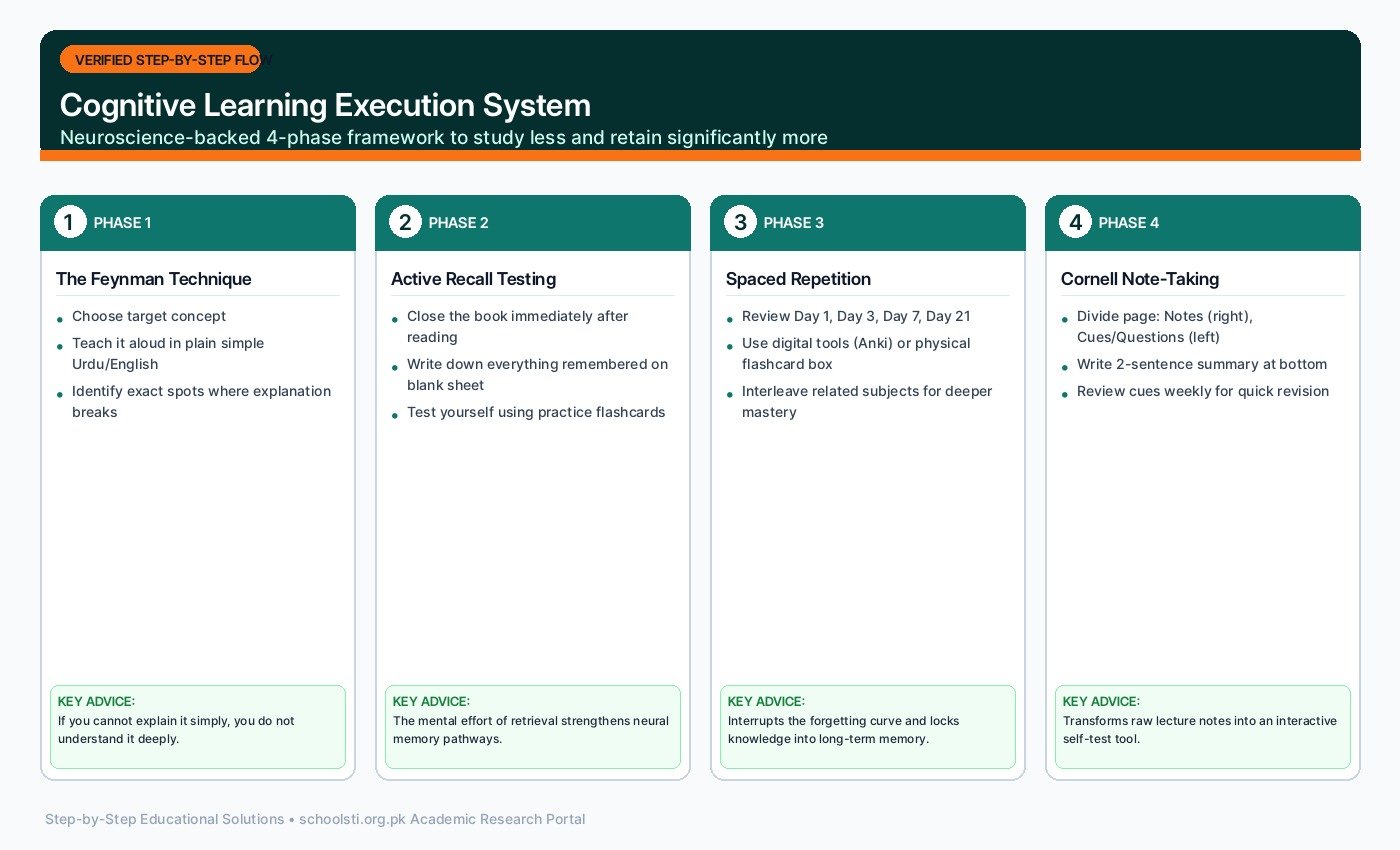
Richard Feynman, the Nobel-winning physicist, learned by teaching. The technique that carries his name is simple: if you cannot explain a concept in plain words, you do not really understand it. For dense chapters like thermodynamics, organic chemistry or cell biology, it is the fastest way to find hidden gaps in your knowledge.
- Choose one small concept Pick a single topic, like photosynthesis, chemical equilibrium or the water cycle. Never try a whole chapter at once, because small chunks expose gaps faster.
- Teach it in your own words Explain it out loud as if teaching a class-8 student, in Urdu or simple English. For example: photosynthesis is how plants cook their own food using sunlight, water and carbon dioxide, and release oxygen.
- Find where you get stuck The moment you hesitate, for instance on why equilibrium shifts when pressure changes, that is a gap. Mark it honestly instead of skipping it.
- Go back and fill the gap Reopen the book, understand that one point properly, then explain it again in your own words until it flows without jargon.
- Simplify with an analogy Turn it into a story: chemical equilibrium is like two teams passing balls at equal speed, no visible change but constant movement. Analogies make concepts stick through the exam.
Spaced Repetition: Review Before You Forget
Your brain forgets on a schedule: without review, most new material fades within days, a pattern Hermann Ebbinghaus called the forgetting curve. Spaced repetition defeats it by reviewing each topic at growing intervals, right when you are about to forget. Every review resets the curve and pushes the memory deeper into long-term storage.
You do not need any app. A simple notebook and this schedule work for every subject, from Islamiat to physics:
| Review | When | What to do |
|---|---|---|
| Day 1 | Same day | Close the book and recall everything you learned today. |
| Day 3 | Two days later | Solve past-paper questions on the topic from memory. |
| Day 7 | One week later | Teach it to someone, or write a one-page summary. |
| Day 14 | Two weeks later | Attempt a mixed practice set that includes this topic. |
| Day 30 | One month later | One final recall before exams. It should feel easy by now. |
Study Smarter: Interleaving, Elaboration and Dual Coding
Blocked practice means solving twenty similar algebra problems in a row. It feels smooth, but the board paper mixes everything. Interleaving means mixing topics in one session: ten minutes of trigonometry, then differentiation, then a physics numerical. It feels harder at first, yet it trains your brain to choose the right method, exactly what exams demand.
Elaboration is asking why and how while you study: why does ice float on water? How does this reaction link to what I learned about acids last month? Concrete examples help too. Instead of memorizing the definition of osmosis, picture potato slices shrinking in salty water. Your brain stores stories far better than definitions.
Dual coding pairs words with visuals: draw the nephron while memorizing its parts, sketch the timeline while studying the Pakistan Movement, map the Krebs cycle on paper. For stubborn lists, use mnemonics, and try the memory palace: place each item in a room of your house, so the front gate holds the first law of motion and the drawing room holds the second, then walk through the house mentally during the exam.
Focus and Time: Pomodoro and Choosing the Right Technique
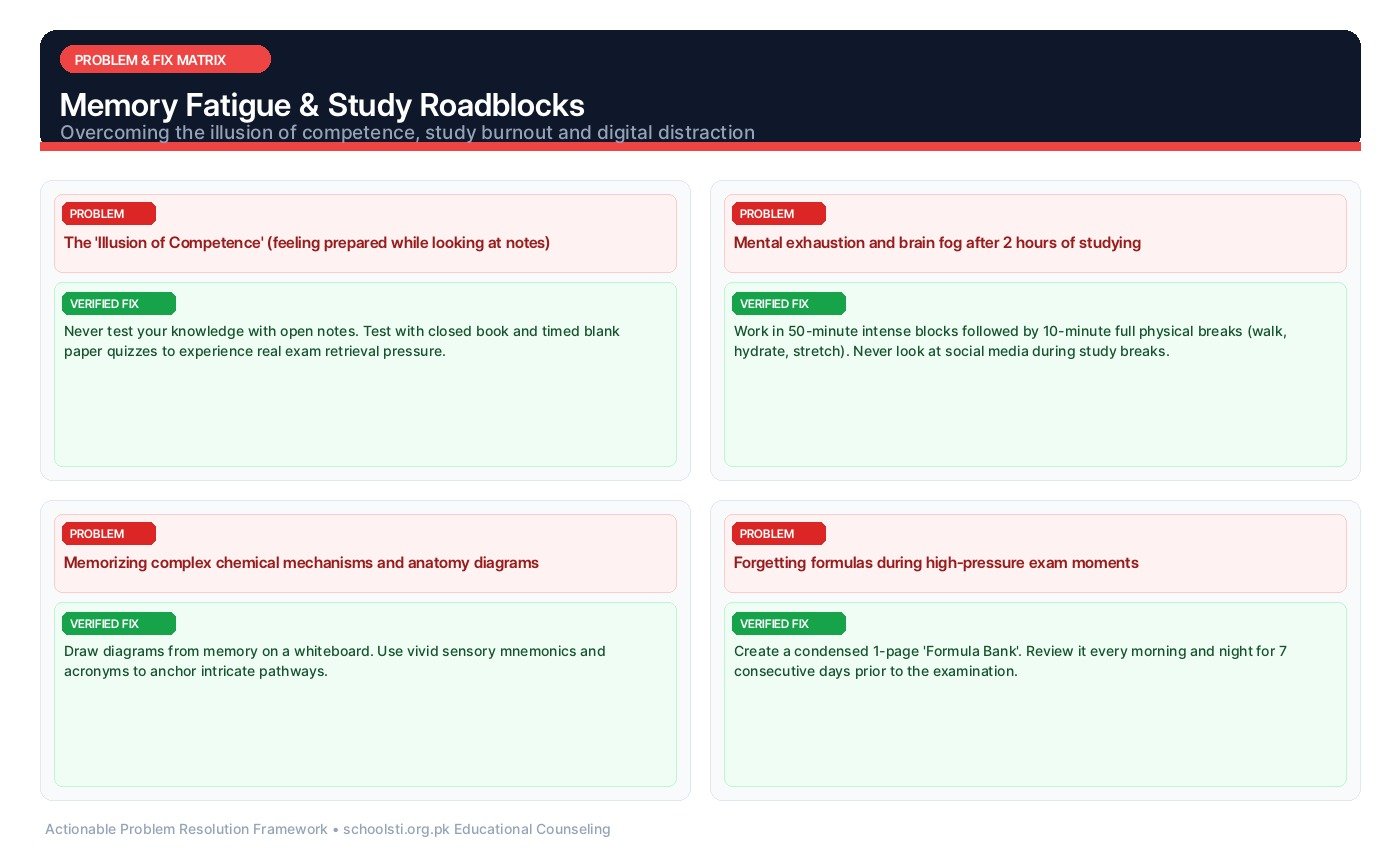
Long sessions fail because attention is not a four-hour resource. The Pomodoro method, 25 minutes of focused work followed by a 5-minute real break, fits how the brain actually works. For board exam prep, adapt it: use 50-minute study blocks with 10-minute breaks for deep subjects like physics derivations, and keep the phone in another room. Four honest sessions make a strong morning.
Not every technique fits every task. Use this comparison to pick the right tool for the job:
| Technique | What it is | Best for | Time cost |
|---|---|---|---|
| Active recall | Retrieving information with the book closed | Definitions, formulas, key points | 10-15 min per topic |
| Feynman Technique | Teaching the concept in simple words | Difficult concepts, derivations | 20-30 min per concept |
| Spaced repetition | Reviewing at growing intervals | Long-term memory of everything | 5-10 min per review |
| Interleaving | Mixing different topics in one session | Math, numericals, problem solving | Same session, rearranged |
| Dual coding | Combining diagrams with words | Biology, processes, timelines | 10-15 min per topic |
| Mnemonics / memory palace | Memory hooks and vivid associations | Lists, sequences, terms | 5-10 min to create |
Troubleshooting: Common Student Problems & Verified Solutions
Real-world issues reported by Pakistani applicants and students, with actionable step-by-step solutions:
⚠️ Problem: I study for hours but forget everything in the exam.
✅ Verified Solution: You are re-reading, not recalling. Shift every session to 70 percent recall and 30 percent input: read once, then close the book and write or speak everything from memory. Add spaced reviews on Day 3 and Day 7 so the memory survives until the paper.
⚠️ Problem: I re-read my notes and feel prepared, but I blank out in the hall.
✅ Verified Solution: That is the fluency illusion. Practice under test conditions: timed past papers with no book and no phone. Blanking out during practice is safe and teaches your brain to retrieve under pressure.
⚠️ Problem: I cannot memorize long derivations or formulas.
✅ Verified Solution: Use Feynman first to understand the logic, then recall in chunks: derive it yourself from memory on three different days. For formulas, link every symbol to its meaning and keep one mnemonic per list of constants.
⚠️ Problem: My exam is close and there is no time for spaced repetition.
✅ Verified Solution: Use compressed spacing: review after one hour, the same evening, the next morning, and the day before the paper. Even three short recalls beat one long cram session, and recall beats re-reading when hours are limited.
⚠️ Problem: My phone and social media keep distracting me.
✅ Verified Solution: Environment beats willpower. Keep the phone in another room or switched off during Pomodoros, and study with a visible timer. Tell your family your focus hours so nobody interrupts, and batch all messages into break time.
⚠️ Problem: I study late at night but retain nothing.
✅ Verified Solution: Sleep consolidates memory, so studying past midnight trades tomorrow's recall for tonight's hours. Move heavy topics to the morning or early evening, keep nights for light review, and protect 7 to 8 hours of sleep before exams.
Frequently Asked Questions (FAQ)
Clear, direct answers to common questions about Scientific Study Techniques to Memorize Difficult Concepts (Feynman Technique & Active Recall):