Understanding the 4.0 Scale: Letter Grades to Grade Points
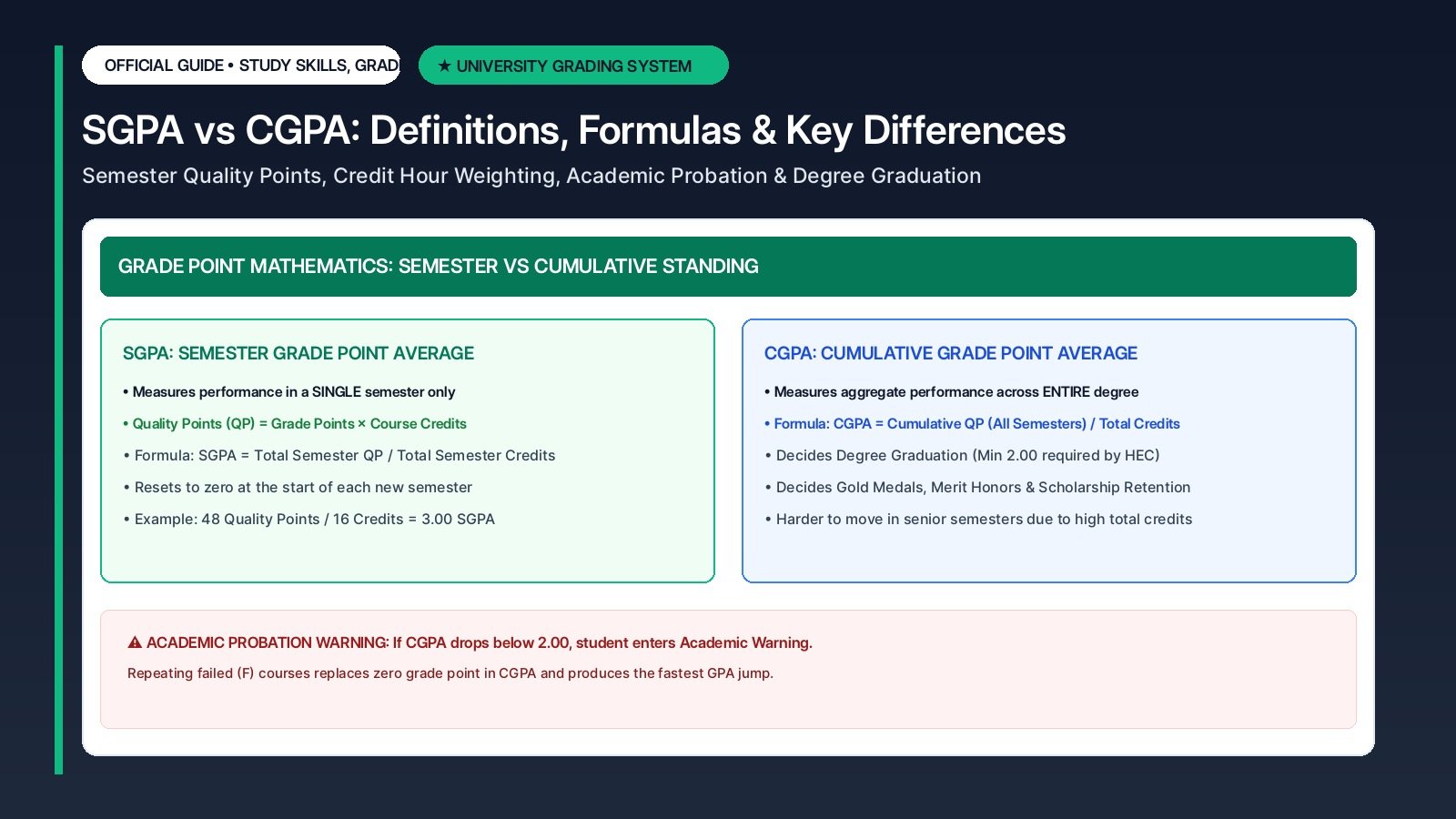
Before converting anything, understand the 4.0 grade-point scale used by almost every university in Pakistan. Your transcript shows letter grades for each course, and each letter maps to a fixed grade-point value. Your semester GPA (SGPA) is the credit-hour-weighted average of one semester's grade points; your CGPA is the credit-hour-weighted average across all semesters so far.
The mapping below is stable and widely used across Pakistani universities, as per the latest published policy of most institutions. Note that percentages are not converted directly from letters — the letter gives a grade point, the credit hours weight it, and the final GPA is what you convert to percentage.
| Letter Grade | Grade Points | Typical Marks Range |
|---|---|---|
| A+ | 4.0 | 85–100 |
| A | 4.0 | 80–84 |
| A− | 3.67 | 75–79 |
| B+ | 3.33 | 71–74 |
| B | 3.0 | 68–70 |
| B− | 2.67 | 64–67 |
| C+ | 2.33 | 61–63 |
| C | 2.0 | 58–60 |
| C− | 1.67 | 54–57 |
| D+ | 1.33 | 50–53 |
| D | 1.0 | 45–49 |
| F | 0.0 | Below 45 |
The Two Conversion Methods Used in Pakistan
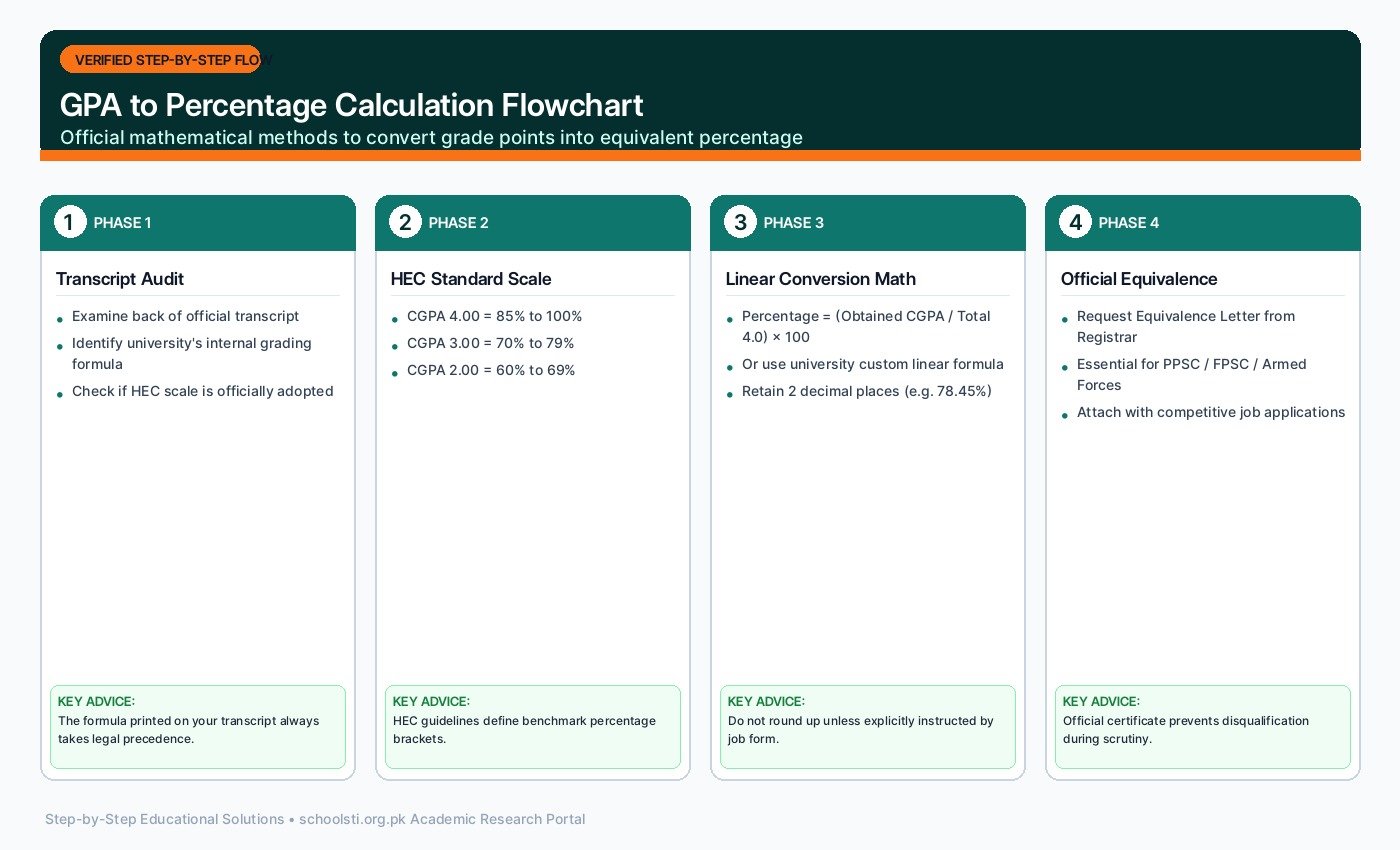
Here is the honest truth: there is no single national conversion formula in Pakistan. Each university may publish its own official conversion policy, so verify with your university's examination or registrar office which one applies to you — October 2026. Two methods dominate in practice.
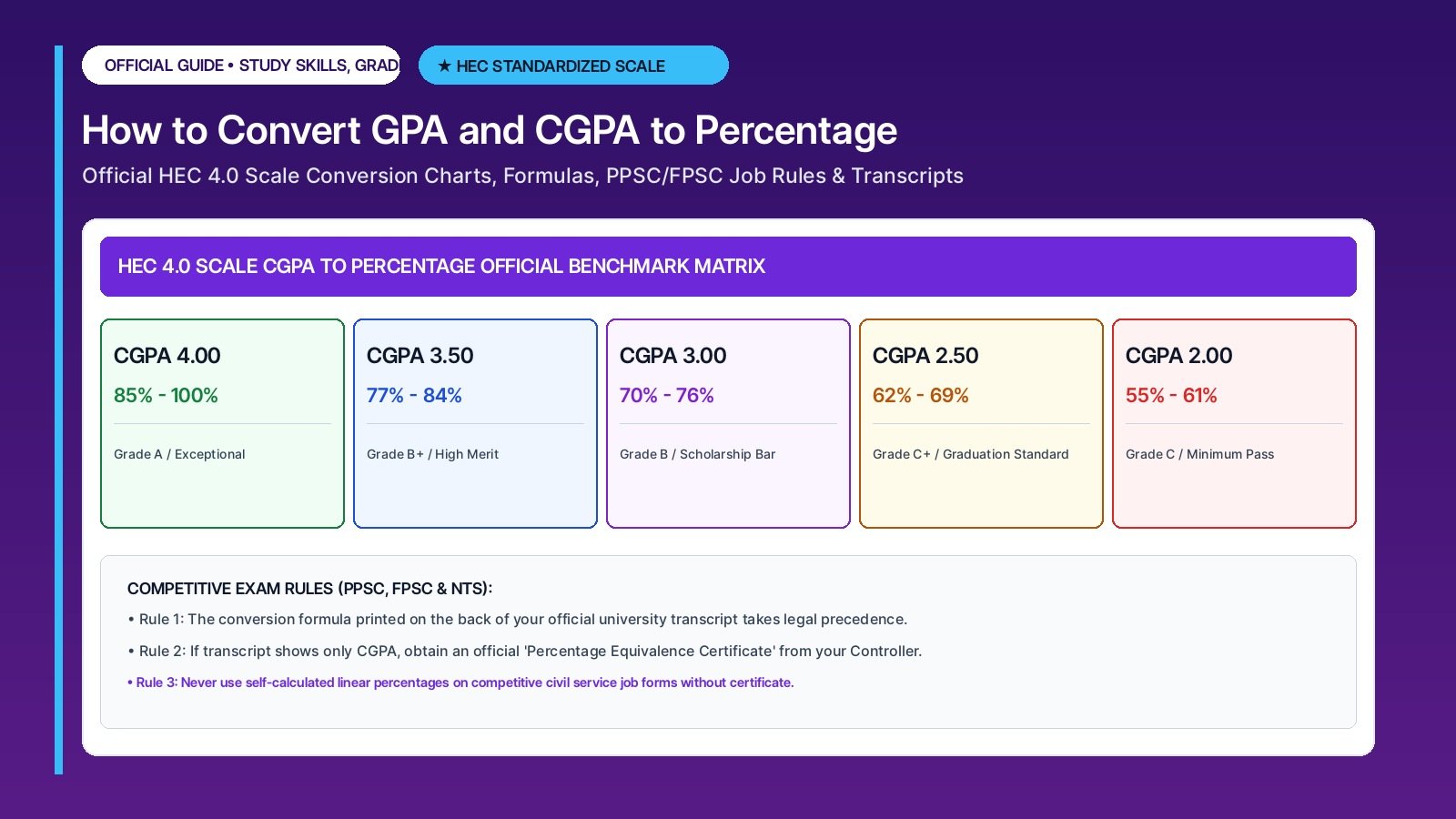
The proportional formula is the simplest and most quoted: Percentage = (CGPA ÷ 4) × 100. Many private universities and employers accept it directly. The HEC-style banded table instead maps CGPA ranges to percentage bands; several institutions use it for equivalence purposes, as per the latest published policy — verify on the official website before relying on it for anything official.
| Method | Rule | Example (CGPA 3.50) |
|---|---|---|
| Proportional formula | (CGPA ÷ 4) × 100 | 87.50% |
| HEC-style banded table | CGPA range → percentage band | 3.50 falls in the 85–89 band (confirm with your university) |
| University-specific table | Published by your own institution | Safest choice for official documents |
GPA to Percentage: Quick Lookup Chart (4.0 Scale)
The chart below uses the proportional formula (GPA ÷ 4) × 100 — the method students meet most often. It is a standard reference, not your university's official table: as per the latest published policy of each institution, verify on the official website (October 2026 review) before using it for transcripts or job applications.
Handy shortcut: every 0.1 of GPA equals 2.5 percentage points. Moving from 3.0 to 3.1 lifts your percentage from 75% to 77.5% — useful when setting semester targets.
| GPA / CGPA | Percentage | GPA / CGPA | Percentage |
|---|---|---|---|
| 4.00 | 100.0% | 3.00 | 75.0% |
| 3.70 | 92.5% | 2.70 | 67.5% |
| 3.50 | 87.5% | 2.50 | 62.5% |
| 3.30 | 82.5% | 2.30 | 57.5% |
| 3.20 | 80.0% | 2.20 | 55.0% |
| 3.10 | 77.5% | 2.00 | 50.0% |
Worked Examples and the Step-by-Step Process
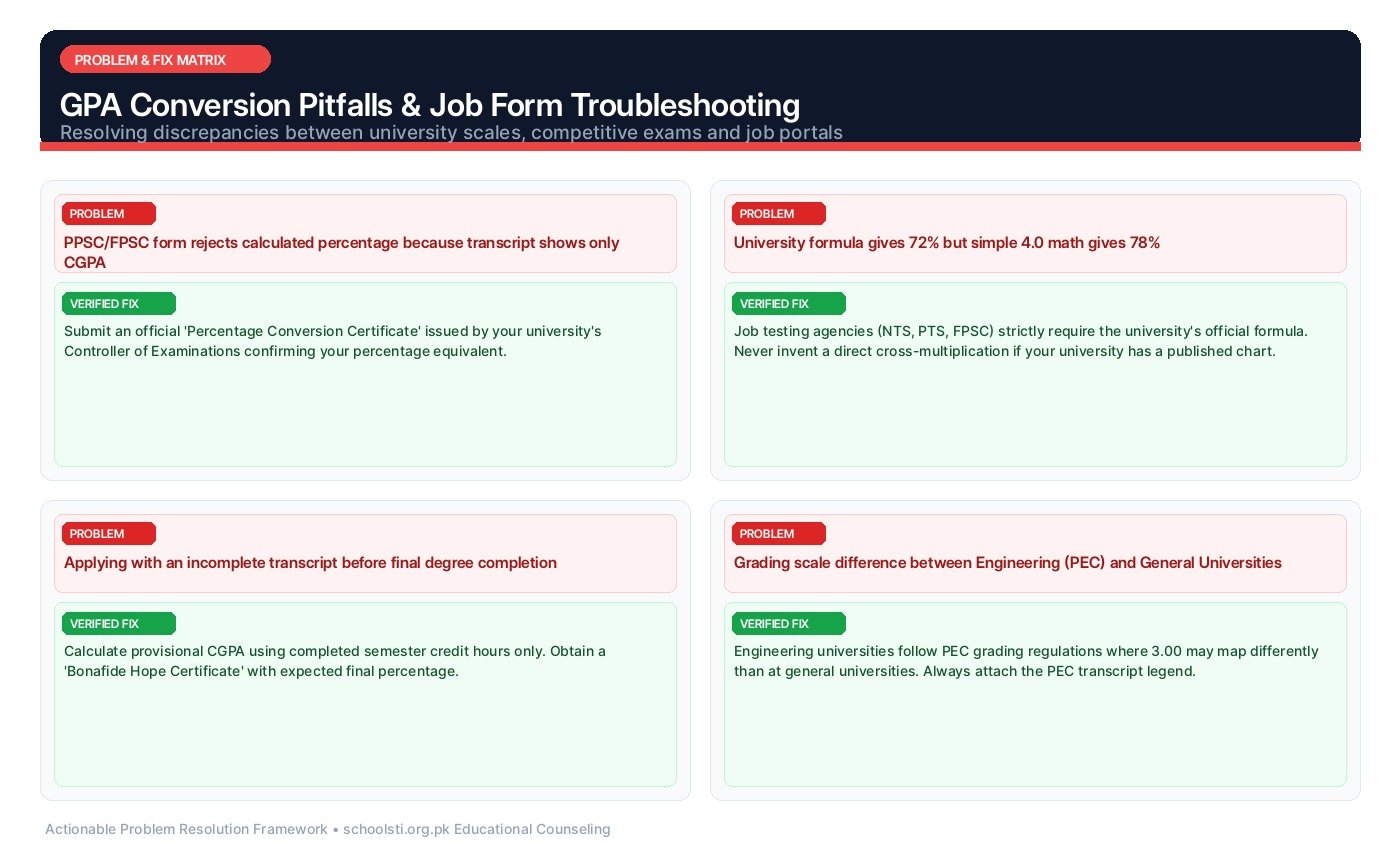
Example 1 — CGPA to percentage. A final-year student has CGPA 3.45. Step 1: 3.45 ÷ 4 = 0.8625. Step 2: 0.8625 × 100 = 86.25% — comfortably in first-division range.
Example 2 — Semester GPA to percentage. An SGPA of 2.67 converts as 2.67 ÷ 4 = 0.6675, then × 100 = 66.75% — just below the commonly cited 70% line.
Example 3 — Reverse: percentage to GPA. Board marks of 82% convert as GPA = (82 ÷ 100) × 4 = 3.28. For official forms, confirm your university's published reverse-conversion policy first.
- Step 1: Identify your scale Check your transcript: is it a 4.0 or 5.0 scale? If grade points go above 4.0 (A+ = 5.0), you are on the 5.0 scale and every divisor below changes to 5.
- Step 2: Pick the right formula For estimates or a CV, the proportional formula (GPA ÷ scale) × 100 is fine. For anything official, find your university's published conversion table first.
- Step 3: Do the arithmetic Divide your GPA by the scale maximum, then multiply by 100. Example: 3.45 ÷ 4 = 0.8625 → × 100 = 86.25%. Keep two decimals.
- Step 4: Sanity-check the answer A CGPA of 2.0 should land near 50% (the typical pass line) on the 4.0 scale. If the result looks wildly off, you used the wrong divisor.
- Step 5: Verify with the registrar Before putting the percentage on any official document, ask your examination or registrar office which conversion they certify. Their stamped figure ends every dispute.
The 5.0 Scale and Percentage-to-GPA Reverse Lookup
A few institutions in Pakistan use a 5.0 scale, where A+ can equal 5.0. The method is identical; only the divisor changes: Percentage = (GPA ÷ 5) × 100. So 4.20 on the 5.0 scale = 4.20 ÷ 5 × 100 = 84.0%. Dividing a 5.0-scale GPA by 4 inflates the percentage — the single most common conversion error, and one that can look like misrepresentation on a CV.
The reverse chart below converts common percentages to the 4.0 GPA scale via GPA = (Percentage ÷ 100) × 4 — handy for students moving from the annual percentage system (matric, FSc) into semester thinking.
| Percentage | Equivalent GPA | Percentage | Equivalent GPA |
|---|---|---|---|
| 90% | 3.60 | 70% | 2.80 |
| 80% | 3.20 | 60% | 2.40 |
| 75% | 3.00 | 50% | 2.00 |
Troubleshooting: Common Student Problems & Verified Solutions
Real-world issues reported by Pakistani applicants and students, with actionable step-by-step solutions:
⚠️ Problem: My university uses a different conversion table than this guide
✅ Verified Solution: That is normal — each Pakistani university may publish its own official policy. Use these charts for estimates and planning, but for jobs, scholarships, or equivalences apply your own university's published table, and ask the examination or registrar office for a written copy if it is not on the official website.
⚠️ Problem: A job ad asks for 70% but my transcript shows CGPA 3.0 — do I qualify?
✅ Verified Solution: Under the proportional formula, 3.00 converts to exactly 75.0%, which clears a 70% requirement — if the employer accepts that formula. Write “CGPA 3.00 / 4.0 (≈75.0% proportional conversion)” on your CV so the recruiter sees both figures, and keep your university's official table ready for the interview.
⚠️ Problem: I am confused between the 4.0 and 5.0 scales
✅ Verified Solution: Check your transcript's grade-point column: a maximum of 4.0 means the 4.0 scale; A+ shown as 5.0 means the 5.0 scale. The method is identical — only the divisor changes to (GPA ÷ 5) × 100. Never divide a 5.0-scale GPA by 4.
⚠️ Problem: A foreign university wants my percentage, but my degree shows only CGPA
✅ Verified Solution: Use the proportional formula for the form, and attach proof: your university's official published conversion table or a short registrar letter confirming the equivalent percentage. Admissions offices abroad routinely accept documented conversions.
⚠️ Problem: Should I write CGPA or percentage on my CV?
✅ Verified Solution: Lead with your official result and scale — “CGPA 3.45 / 4.0” — and add the percentage in brackets: “(≈86.25%)”. The CGPA is the verifiable figure on your transcript; never list a self-converted percentage alone.
⚠️ Problem: Can I convert each semester's GPA to percentage and average them?
✅ Verified Solution: No — semesters carry different total credit hours, so that math is wrong. A 21-credit semester must count more than a 15-credit one. Convert the final CGPA once, or recompute from credit-weighted marks.
Frequently Asked Questions (FAQ)
Clear, direct answers to common questions about How to Convert GPA and CGPA to Percentage (Standard 4.0 Scale Conversion Charts & Formulas):