What SGPA and CGPA Actually Mean
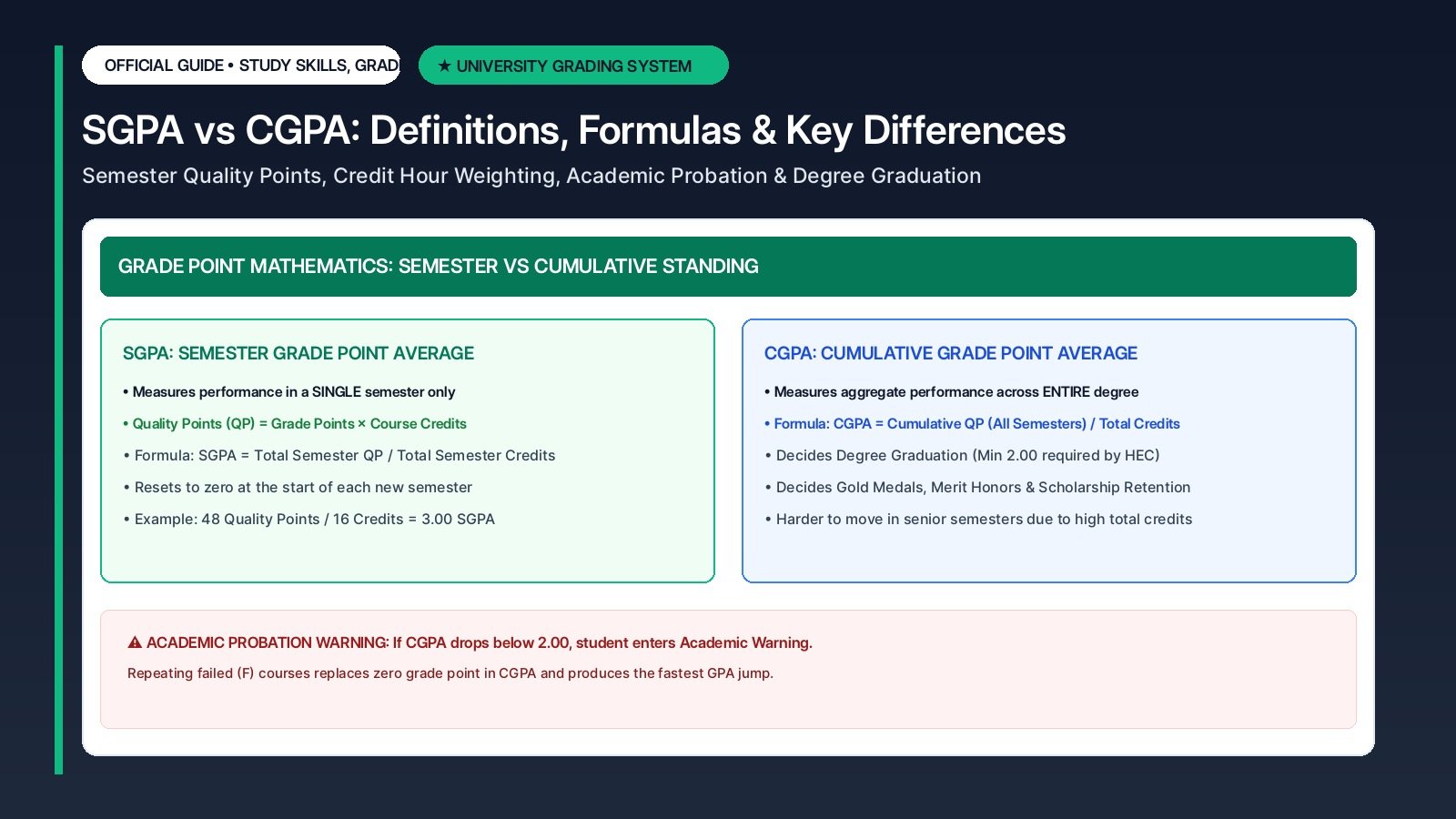
In a Pakistani semester-system university, two numbers follow you everywhere. SGPA (Semester Grade Point Average) is your average grade for one single semester. CGPA (Cumulative Grade Point Average) is your average across every semester completed so far in your degree.
Think of SGPA as a snapshot and CGPA as the running average of your whole degree. Each new semester brings a fresh SGPA, while your CGPA absorbs the new results into its running total. Both use the 4.0 scale and both are credit-hour weighted: a 4-credit-hour course moves your GPA twice as much as a 2-credit-hour one.
One honesty note: each university publishes its own grading policy, so mappings and repeat rules can differ. The scheme below reflects the widely used HEC-style system; as per the latest published policy, verify on the official website of your own university. Reviewed October 2026.
SGPA vs. CGPA: Key Differences at a Glance
The practical takeaway: a bad semester vanishes from your SGPA record next term, but stays inside your CGPA until good semesters outweigh it. That is why seniors say guard your CGPA in the first two semesters — early weak grades are the hardest to dilute, because few semesters exist yet to average them out.
| Difference | SGPA | CGPA |
|---|---|---|
| Definition | Average of one semester | Average of all completed semesters |
| Time span | One semester (4-6 months) | Your whole degree so far |
| Purpose | Shows how one semester went | Shows overall academic standing |
| Who asks for it | You, your adviser | Employers, scholarships, graduate admissions |
| Recovery | Resets every semester | Moves slowly; bad semesters fade gradually |
Grade-Point Mapping: How Letters Become Numbers
Note two things: an F earns 0.0 but its credit hours usually still count in the divisor, dragging the average down hard; and the full-point gap between an A (4.0) and a B (3.0) means lifting a couple of grades pays off more than most students expect.
| Letter Grade | Grade Points |
|---|---|
| A+ / A | 4.0 |
| A- | 3.7 |
| B+ | 3.3 |
| B | 3.0 |
| B- | 2.7 |
| C+ | 2.3 |
| C | 2.0 |
| C- | 1.7 |
| D+ | 1.3 |
| D | 1.0 |
| F | 0.0 |
Worked Examples: Calculating SGPA and CGPA Step by Step
Total hours: 4 + 3 + 4 + 2 + 1 = 14. Total quality points: 16.0 + 9.9 + 12.0 + 7.4 + 2.3 = 47.6. SGPA = 47.6 / 14 = 3.40. See how the 4-hour courses dominate — the A in Programming pulled the average up far more than the A- in 2-hour Islamic Studies. That is credit-hour weighting, and why high-credit-hour courses deserve the most revision time.
Example 2 — CGPA. CGPA is not the average of SGPAs; it is total quality points divided by total credit hours. Semester 1: 14 hours, 47.6 points (SGPA 3.40). Semester 2 (a rough one): 16 hours, 40.0 points, SGPA = 40.0 / 16 = 2.50. CGPA = (47.6 + 40.0) / (14 + 16) = 87.6 / 30 = 2.92.
Notice the simple average of the two SGPAs would be 2.95, but the true CGPA is 2.92 — the weaker semester carried more hours. This also answers why is my CGPA lower than my last SGPA? Now the recovery: semester 3 with 15 hours and 52.5 points (SGPA 3.50) gives CGPA = (87.6 + 52.5) / 45 = 140.1 / 45 = 3.11. One bad semester never destroys a CGPA; steady good semesters pull it back up, gradually.
| Course | Hours | Grade | Points | Quality Points |
|---|---|---|---|---|
| Programming Fundamentals | 4 | A | 4.0 | 16.0 |
| English Composition | 3 | B+ | 3.3 | 9.9 |
| Calculus I | 4 | B | 3.0 | 12.0 |
| Islamic Studies | 2 | A- | 3.7 | 7.4 |
| Computer Lab I | 1 | C+ | 2.3 | 2.3 |
How to Calculate Your Own SGPA and CGPA From a Transcript
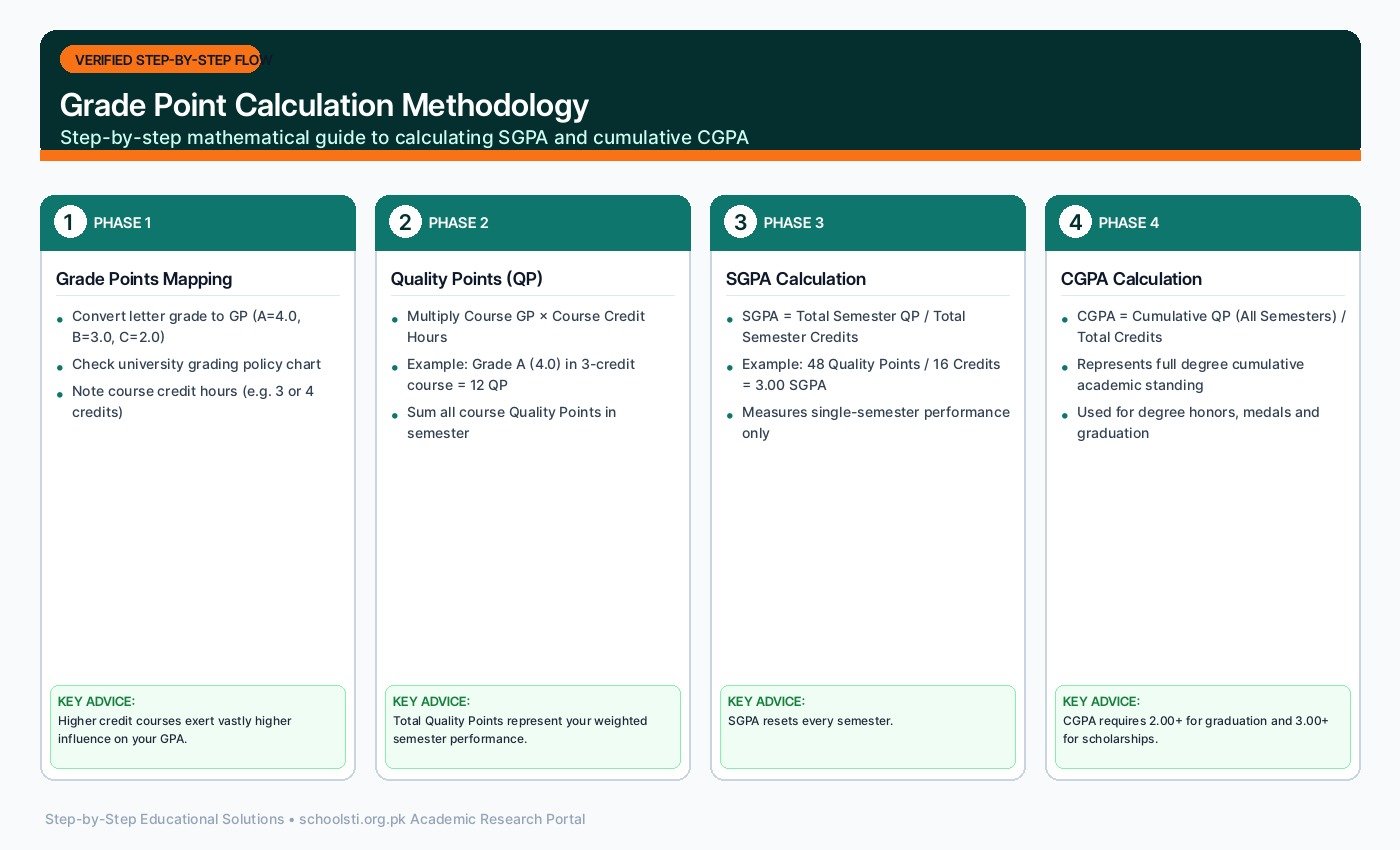
Grab your transcript or result card. A calculator and paper are all you need.
- List every course for the semester Write each course in a column, including labs — they carry credit hours and count fully toward the semester GPA every time.
- Note each course's credit hours Copy the hours exactly as printed (a 3+1 course is usually listed as 4). Add them for total hours attempted.
- Map grades to grade points Use your university's official grade table (A = 4.0, F = 0.0 in the common scheme). Write the points beside each course.
- Multiply hours by points per course Hours x grade points = quality points for that course, e.g. 3 hours x 3.0 (B) = 9.0.
- Sum both columns Add all credit hours into one total and all quality points into another. Recheck the addition.
- Divide for SGPA; accumulate for CGPA SGPA = quality points / credit hours. For CGPA, repeat for every completed semester, then divide the grand totals.
Practical Ways to Improve Your CGPA
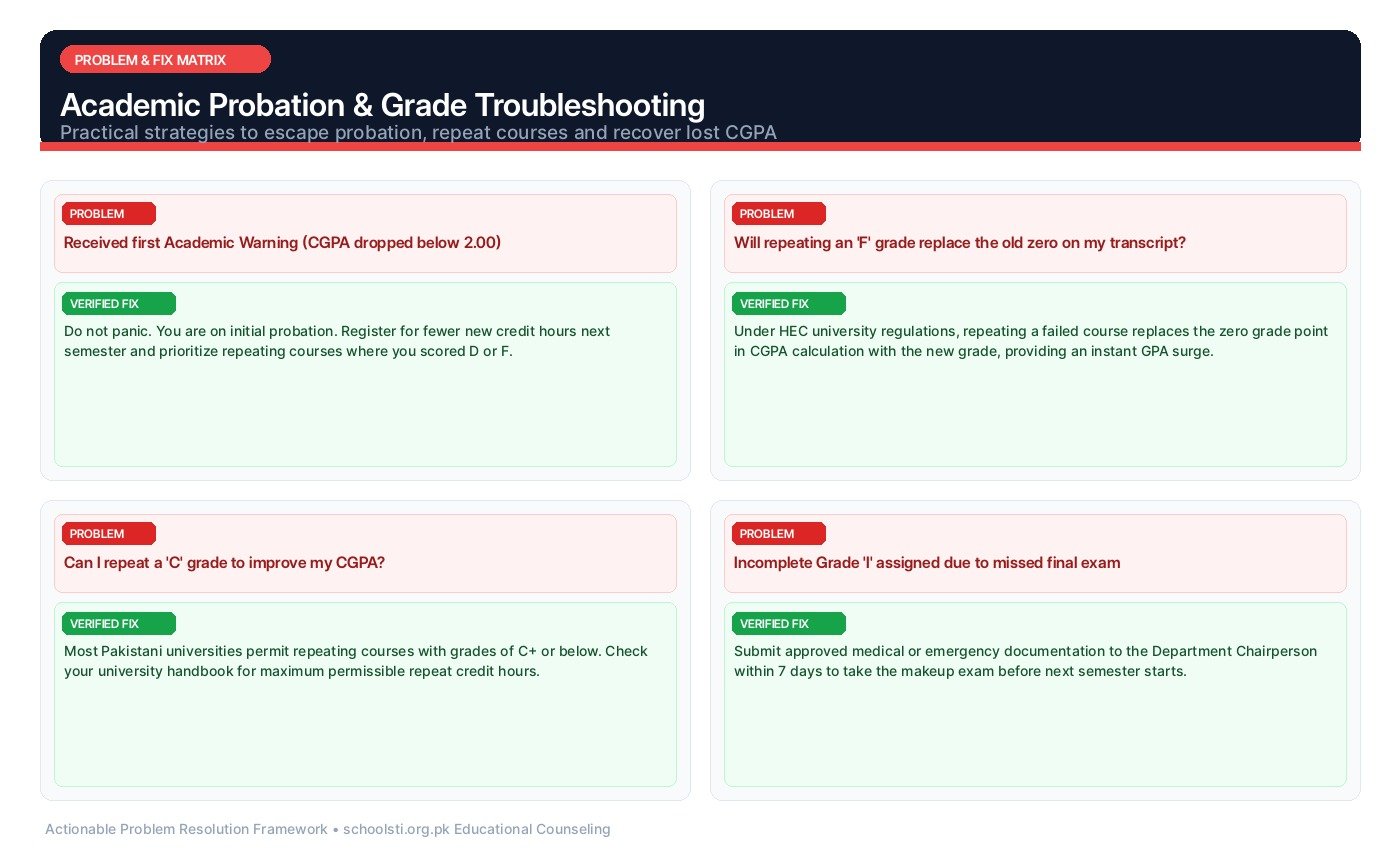
Raising a CGPA is a marathon, but these moves genuinely shift the number. Use repeat policies wisely. Most universities let you repeat a low-grade course and count the improved grade toward the CGPA. As per the latest published policy, verify on the official website which grades are repeatable and how many repeats are allowed. Reviewed October 2026. Retaking one 4-hour D lifts the CGPA more than acing two new 2-hour courses.
Use summer smartly. Summer semesters let you repeat weak or failed courses early — an F sitting at 0.0 in your totals is the heaviest anchor on a CGPA. Protect high-credit-hour courses first by budgeting revision time in proportion to hours. And fix the cause, not the symptom: if weak attendance or shaky prerequisites are behind the grades, see your course adviser early — academic counselling is free at most universities.
Troubleshooting: Common Student Problems & Verified Solutions
Real-world issues reported by Pakistani applicants and students, with actionable step-by-step solutions:
⚠️ Problem: My first-semester CGPA is low — can I still recover?
✅ Verified Solution: Yes. After semester one your CGPA equals your SGPA, so it looks alarming — but six or seven semesters remain to dilute it. The worked example above shows a 2.92 climbing past 3.1 with steady 3.5 semesters. Prioritise repeating failed or D-grade courses first, since replacing a 0.0 or 1.0 removes the heaviest drag.
⚠️ Problem: I am confused by my university's repeat policy.
✅ Verified Solution: Rules differ: some allow repeating only grades below C, others any grade; some cap the replacement grade or total repeats. As per the latest published policy, verify on the official website or ask the examination office in writing — do not rely on seniors' advice alone. Reviewed October 2026.
⚠️ Problem: Why is my CGPA lower than my last semester's SGPA?
✅ Verified Solution: CGPA averages every semester by credit hours, not just the latest one. A 3.6 SGPA cannot instantly erase earlier 2.5 semesters — it only adds its quality points to the running total. The CGPA climbs toward your recent performance gradually, semester by semester.
⚠️ Problem: My transcript shows a different CGPA than my calculation.
✅ Verified Solution: Usual causes: a slightly different official grade-point table, rounding instead of truncation, excluded courses (withdrawn or non-credit), or different handling of repeats. Recheck against the official table first; if the gap persists, the examination branch can explain the exact computation.
⚠️ Problem: Does a failed course count in my CGPA?
✅ Verified Solution: Usually yes — and harshly. An F gives 0.0 grade points while its hours typically stay in the divisor. Clearing it through a repeat, where policy lets the new grade replace the old, is the fastest repair. As per the latest published policy, verify on the official website how your university treats repeated failures. Reviewed October 2026.
⚠️ Problem: An internship asks for a CGPA cutoff I barely miss.
✅ Verified Solution: First check whether they accept the latest SGPA instead — some postings do, and your recent SGPA may qualify. Second, see if the cutoff is a hard filter or a guideline; a strong portfolio sometimes bypasses it. Long term, repeating one or two weak courses can push you past common cutoffs like 3.0.
Frequently Asked Questions (FAQ)
Clear, direct answers to common questions about SGPA vs. CGPA: Definitions, Key Differences & How Semester Grades Are Calculated: