What Marks Improvement Means and Who Should Consider It
A marks improvement examination is a second attempt at board subjects you have already passed, taken purely to raise your marks. Unlike a supplementary exam (which is for failed subjects), improvement is voluntary — you sit the paper again because your current marks are not enough for your target merit, such as MDCAT, ECAT, or a competitive university program.
Improvement makes sense when you missed your target aggregate by a small margin — a few dozen marks can shift your university merit dramatically. It is less sensible when the gap is huge, because a full extra year of preparation costs time you could spend on entry-test preparation or an alternative degree. Be honest with yourself about the gap before deciding.
Every BISE board (Lahore, Gujranwala, Rawalpindi, Multan, Faisalabad, and others, plus FBISE Islamabad) publishes its own improvement policy. The broad framework is similar across Punjab boards, but the number of chances, the time window, and the fee details differ. As per the latest published policy of your board — verify on the official website, reviewed October 2026 — confirm the exact rules before you plan anything.
The Core Rules: Chances, Time Window and Subjects
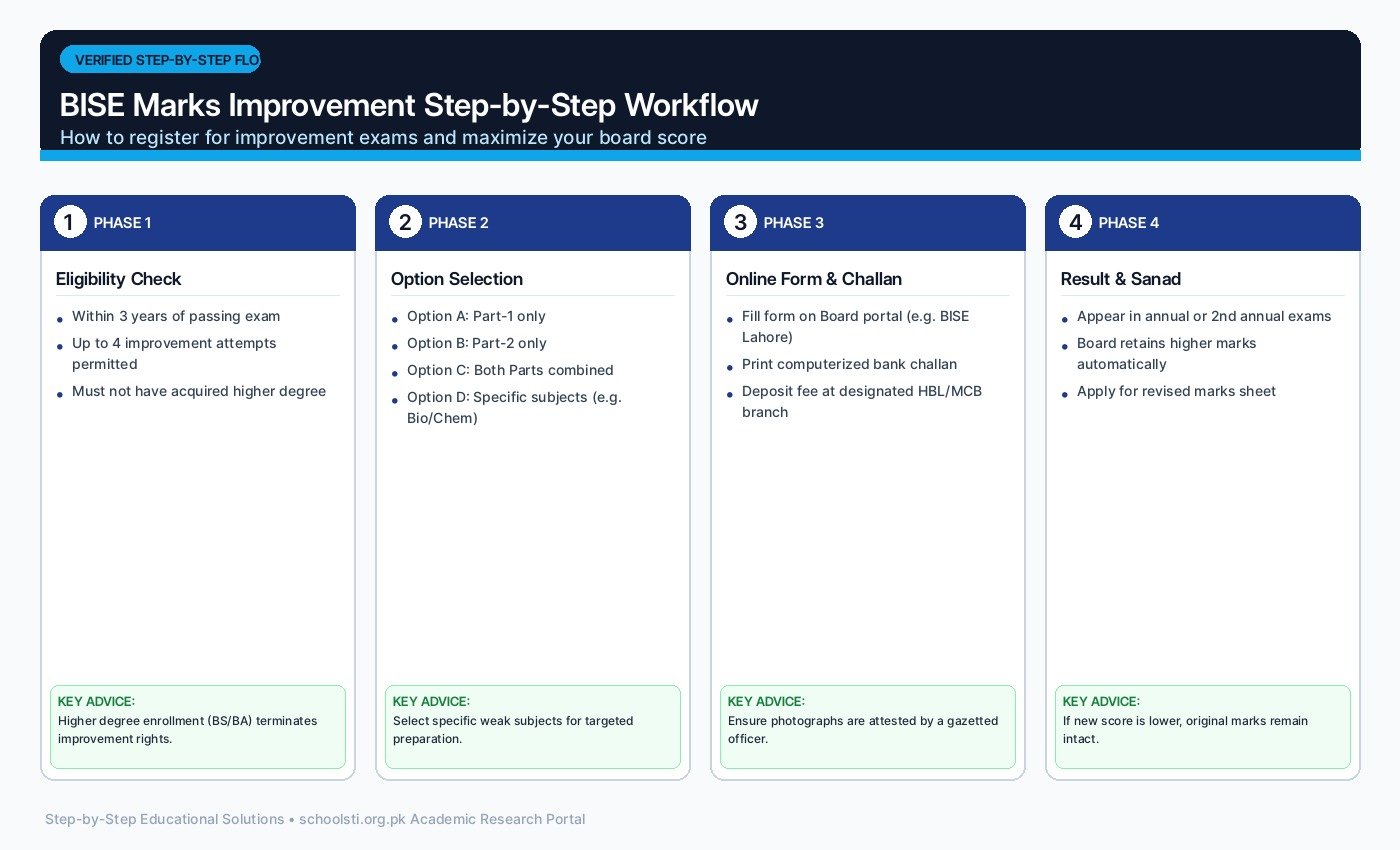
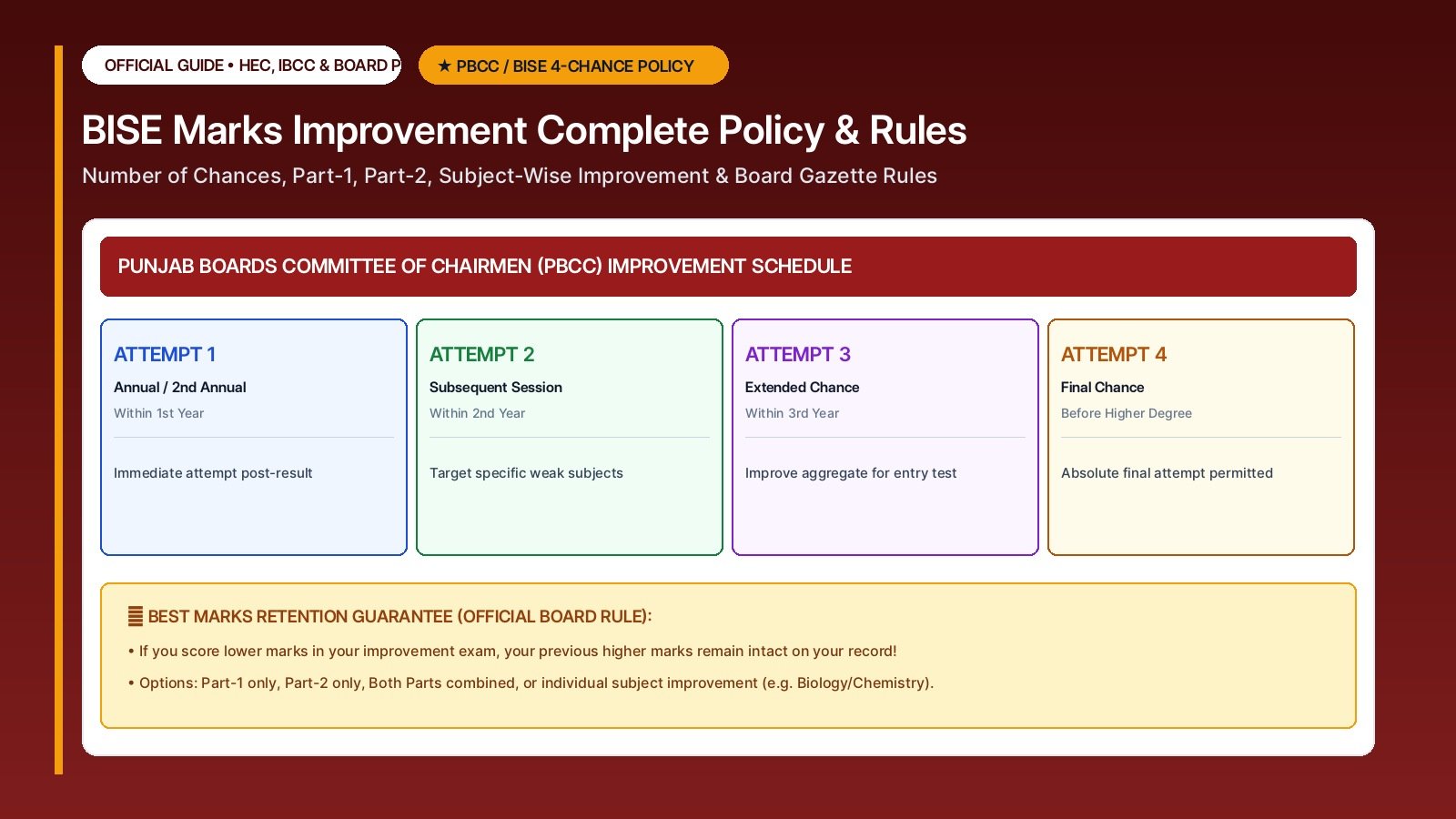
Improvement policies share a common structure across BISE boards, though the exact numbers change with each board's notifications. The table below summarises the typical framework — treat it as a guide and confirm every figure with your board's latest notification.
| Rule | Typical framework | What to verify |
|---|---|---|
| Number of improvement chances | Limited chances within a set number of years after passing | Exact number of chances and the year window on your board's site |
| Time window | Usually a few years from the original passing year | Whether your passing year still falls inside the window |
| Subject choice | All subjects or selected subjects, per board rules | Whether partial-subject improvement is allowed |
| Result treatment | The better of the two results is usually kept | Confirm whether improved marks replace old ones automatically |
| Practical subjects | Practicals are usually repeated with theory | How practical marks are handled on re-attempt |
| Already-improved subjects | Most boards disallow improving the same subject twice | Confirm before paying the fee |
Step-by-Step: Applying for a BISE Improvement Exam
The application process follows the board's regular admission schedule. Missing the announced last date is the single most common failure point, so start watching for the admission notice early.
- Confirm your eligibility Check that your passing year is inside the board's improvement window and that you have not exhausted your chances. If you improved a subject before, confirm whether a second attempt on the same subject is allowed — most boards do not permit it.
- Decide your subjects List the subjects you will re-attempt. Focus on subjects where a realistic effort can add the most marks — improving a subject you already scored highly in rarely pays off. Confirm whether you must repeat practicals alongside theory.
- Fill the online admission form Open your board's online admission portal during the announced schedule and select the improvement category. Enter your previous roll number, registration number, and year carefully — the board pulls your old record from these details, and a typo creates a record mismatch.
- Upload documents and photograph Upload a recent photograph and any documents the portal asks for, usually your previous result card and CNIC or B-Form copy. Keep the photograph to the specified size and background so the form is not held up.
- Pay the admission fee The portal generates a fee challan based on the number of subjects. Pay before the last date through the designated bank or digital channel. Improvement fees follow the board's published fee schedule — as per the latest published fee schedule, verify on the official website, reviewed October 2026.
- Collect your roll number slip The board issues your roll number slip on the portal a few weeks before the exams. Download it, verify your subjects, centre, and photograph, and report any error to the board immediately — errors found on exam day are almost impossible to fix.
- Appear in the exams and collect your result Sit the papers at your allotted centre with your original roll number slip and CNIC or B-Form. After the result, the board issues an updated result card reflecting the improved marks according to its result-treatment rule.
| Improvement Option | Subjects Examined | Practical Exam Required? | Mark Retention Protection | Best Suited For |
|---|---|---|---|---|
| Option 1: Part-1 Only | All 11th class subjects | No (Part-1 has no practicals) | Yes (Old marks kept if lower) | Students with low 1st year board marks |
| Option 2: Part-2 Only | All 12th class subjects | Yes (Full practical exam) | Yes (Old marks kept if lower) | Students who struggled in 2nd year finals |
| Option 3: Both Parts Combined | Full HSSC (Part-1 & Part-2) | Yes (Comprehensive practicals) | Yes (Old marks kept if lower) | Gap-year candidates needing 100+ marks surge |
| Option 4: Specific Subjects | 1 or 2 chosen subjects (Bio/Chem) | Yes (If improving both parts) | Yes (Subject-wise higher marks kept) | Targeted improvement for medical/ECAT aggregate |
Fees, Dates and Result Treatment
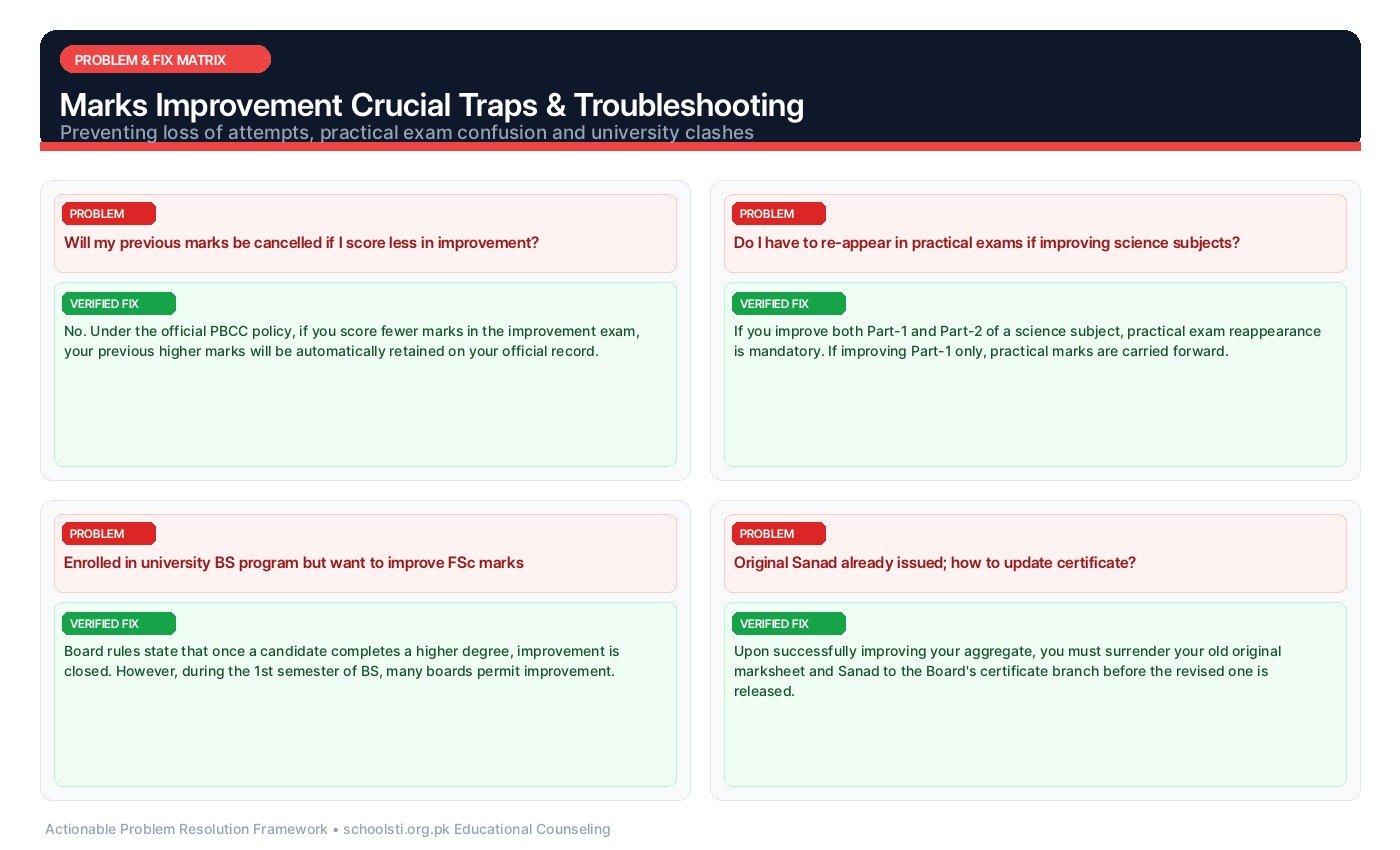
Improvement admission fees are charged per the board's published schedule and are generally higher than regular private-candidate fees. Late-fee slabs apply if you miss the normal deadline — each slab has its own last date, and the fee rises steeply. Set a reminder for the normal fee deadline, not the final one.
On results: most boards keep the better of your old and new marks for each improved subject, meaning a worse second attempt does not hurt you. However, this is a policy detail that boards have adjusted in the past, so confirm the current result-treatment rule in the latest notification rather than assuming it.
Practical examinations are usually conducted alongside the theory papers for science subjects. If you are improving only theory in a science subject, clarify with the board whether your old practical marks are carried forward or whether you must repeat the practical — the rule differs between boards and sessions.
Improvement vs. Repeating the Full Year: Making the Choice
Students often confuse improvement with repeating the entire class. Improvement targets only selected subjects while your original result stands; repeating means re-appearing in everything as a fresh candidate. Improvement is cheaper, faster, and lower-risk — but it only helps if your weakness is concentrated in a few subjects.
If your marks are low across the board, improvement in two or three subjects will not move your aggregate enough. In that case, a serious conversation with your teachers about repeating, switching to a different field, or focusing on entry tests and skill-based careers is more honest than another half-hearted attempt.
Also remember that some universities and entry-test bodies have their own rules about improved marks — a few programs historically treated improved results differently in merit. Check your target university's admission policy alongside the board's improvement policy so there are no surprises at admission time.
Troubleshooting: Common Student Problems & Verified Solutions
Real-world issues reported by Pakistani applicants and students, with actionable step-by-step solutions:
⚠️ Problem: The portal says my previous record was not found when I enter my roll number
✅ Verified Solution: Double-check the roll number, registration number, and passing year — a single wrong digit breaks the record lookup. Make sure you selected the correct board and the improvement category, not the regular private category. If the record still does not appear, visit the board's facilitation centre with your original result card.
⚠️ Problem: I missed the normal fee deadline and the late fee is very high
✅ Verified Solution: Check the late-fee slabs in the admission notification — there are usually two or three slabs, and the earliest late slab is much cheaper than the last. Pay in the earliest slab you can. If even the last date has passed, contact the board office immediately; in some sessions a special late window is announced, but it is not guaranteed.
⚠️ Problem: My roll number slip shows the wrong subject or centre
✅ Verified Solution: Report it to the board's examination branch at once, in person if possible, with your fee receipt and admission form printout. Corrections are possible before the exams start but become nearly impossible once papers begin. Do not just show up at the wrong centre hoping it will be sorted.
⚠️ Problem: I want to improve a subject I already improved once
✅ Verified Solution: Most boards do not allow a second improvement of the same subject. Check the latest notification — if it is disallowed, your fee for that subject will be wasted and the admission may be cancelled. Choose a different subject or accept the current marks.
⚠️ Problem: My improved result is lower than my original marks
✅ Verified Solution: Under the standard better-of-two rule, your original higher marks stand and nothing is lost — but confirm this rule in your board's current notification, because result treatment is a policy detail. Keep both result cards safe until the board issues the final updated documents.
⚠️ Problem: The board rejected my form saying I am outside the improvement window
✅ Verified Solution: The window is counted from your original passing year, and boards enforce it strictly. If you are genuinely outside it, improvement is closed for you — consider whether your target programs accept your current marks, or explore alternative fields. Arguing at the counter will not extend a published window.
Frequently Asked Questions (FAQ)
Clear, direct answers to common questions about BISE Marks Improvement Policy: Complete Rules, Number of Chances & Application Procedure: