What the IBCC Equivalence Certificate Is and Who Needs It
The Inter Board Committee of Chairmen (IBCC) issues equivalence certificates that translate foreign-system results — most commonly Cambridge O level and A level grades — into the equivalent Pakistani marks and division. Pakistani universities, medical and engineering entry-test bodies, and government employers use this certificate to calculate your merit on the same scale as local board students.
You need an O level equivalence certificate if you are applying to any Pakistani college, university, or entry test (MDCAT, ECAT, NUST NET, and others) after O levels. You need an A level equivalence certificate for undergraduate admissions, including medical, engineering, and business schools. Without it, your application is incomplete no matter how good your grades are.
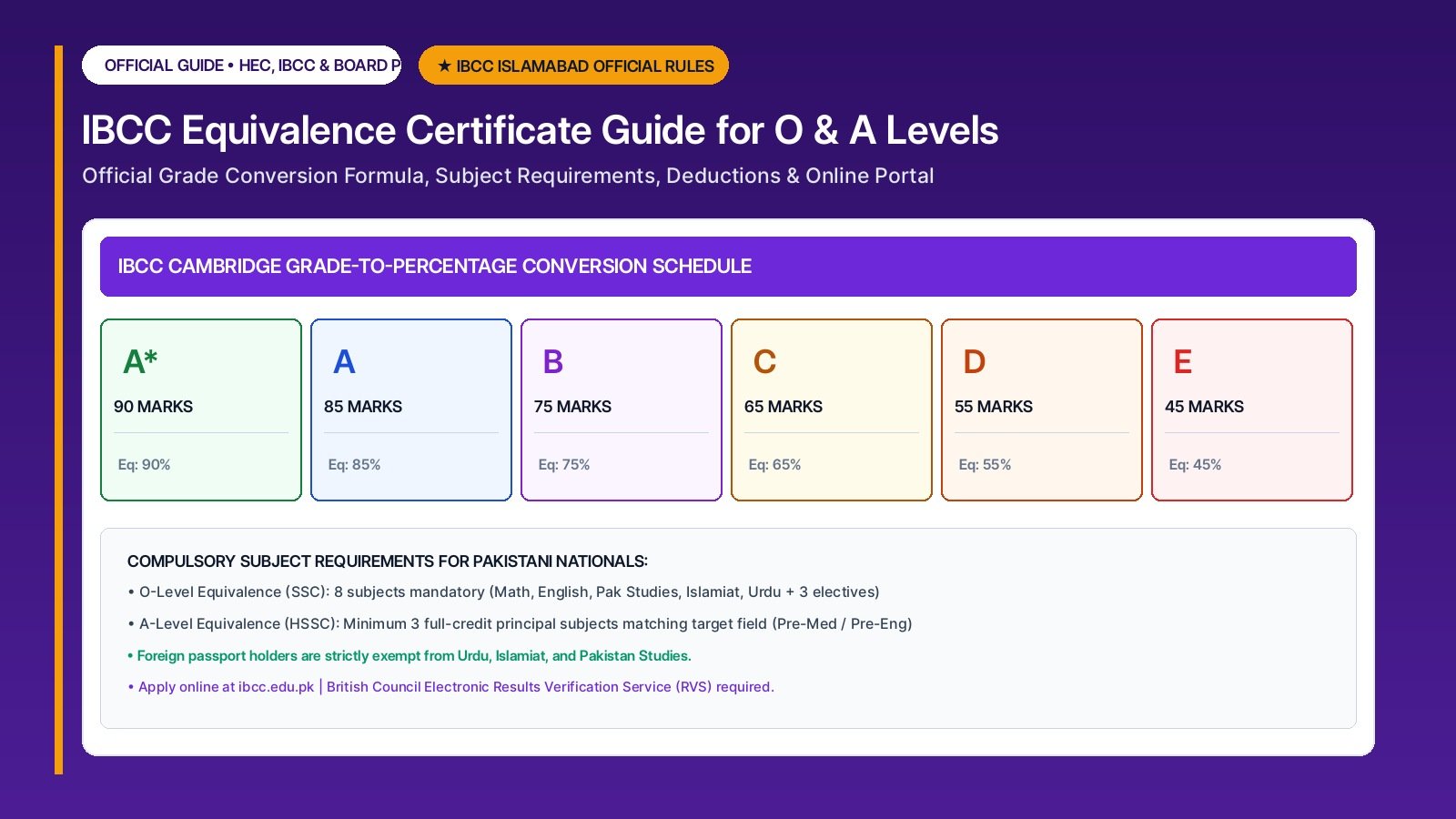
A crucial point: IBCC does not convert each grade on a curve. It uses a fixed grade-to-marks conversion table that has been stable for years. The widely published conversion is: A* equals 90 marks, A equals 85, B equals 75, C equals 65, D equals 55, and E equals 45 per subject. Always confirm the latest published conversion table on the official IBCC website — verify on the official website, reviewed October 2026 — before calculating your expected marks.
Grade Conversion Table and the Equivalence Formula
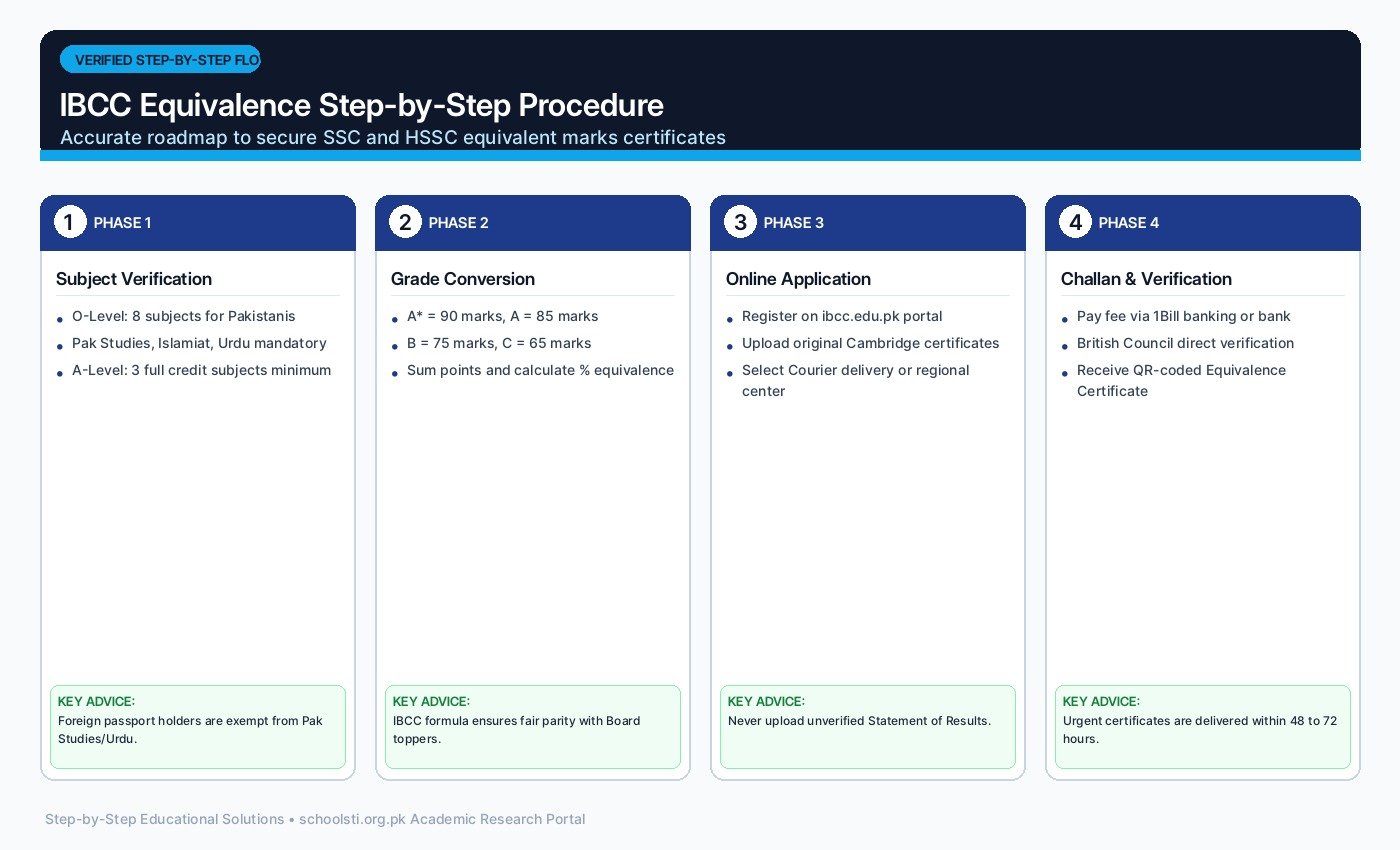
The equivalence formula is simple once you know the conversion table. Each subject grade becomes a marks figure, and the total is the sum of those marks. For O level equivalence, the standard package is 8 subjects including the compulsory ones; for A level equivalence, it is 3 principal subjects.
| Cambridge grade | Equivalent marks per subject | Notes |
|---|---|---|
| A* | 90 | Highest band in the conversion table |
| A | 85 | Distinction-level equivalent |
| B | 75 | Strong pass equivalent |
| C | 65 | Standard pass equivalent |
| D | 55 | Low pass equivalent |
| E | 45 | Minimum passing equivalent |
How the Equivalence Is Calculated: Worked Examples
For O level equivalence, take your 8 subjects, convert each grade to marks with the table above, and add them up. Example: grades of A*, A, A, B, B, C, A, B become 90 + 85 + 85 + 75 + 75 + 65 + 85 + 75, which totals 635 out of 800. That is your O level equivalent — roughly 79.4 percent.
For A level equivalence, convert your 3 principal subjects the same way. Example: grades of A, B, C become 85 + 75 + 65, which totals 225 out of 300, or 75 percent equivalent. Note that IBCC's standard A level equivalence uses the three principal subjects only — subsidiary or extra subjects are not counted in the headline total.
Some universities apply their own weighting on top of IBCC equivalence (for instance, counting only science subjects for certain programs). The IBCC certificate itself, however, follows the formula above. Special subject requirements — such as Pakistan Studies, Islamiyat, and Urdu for O level equivalence in some cases — have changed over the years, so confirm the current subject rules on the official IBCC website before you plan your subject combination.
Step-by-Step: Applying for IBCC Equivalence Online
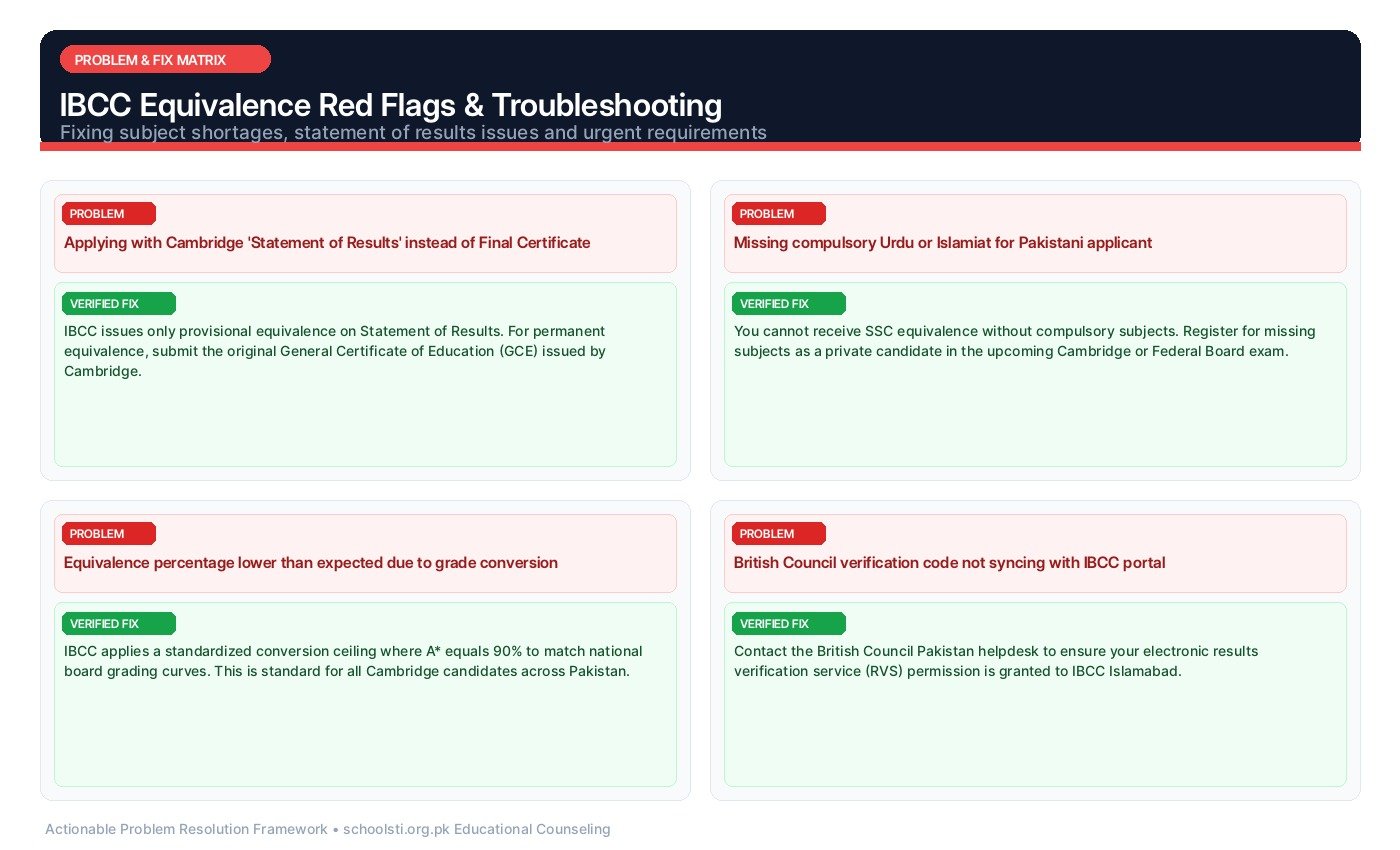
IBCC processes equivalence applications through its online portal. Complete the steps below in order, and keep scanned copies of every document ready before you begin.
- Create an account on the IBCC portal Register with your CNIC or B-Form number, an active email address, and a mobile number. Use the name exactly as it appears on your Cambridge certificates — spelling mismatches cause verification failures.
- Select the equivalence type Choose O level equivalence (secondary school level) or A level equivalence (higher secondary level) as needed. You can apply for both in separate applications if you need both certificates.
- Enter your subject details Add each subject with its grade exactly as shown on your statement of results. Do not round, estimate, or upgrade any grade — IBCC verifies directly against Cambridge records, and any mismatch leads to rejection.
- Upload scanned documents Upload your statement of results, final certificates, CNIC or B-Form, and a photograph as instructed. Scans must be clear, colour, and fully readable. For O level, IBCC typically wants both the statement of results and the final certificate.
- Pay the equivalence fee The portal generates a fee challan after submission. Pay through the designated bank or digital channel and keep the receipt. Equivalence fees are revised periodically — as per the latest published fee schedule, verify on the official website, reviewed October 2026.
- Submit and track verification After payment, your documents go through verification against the awarding body's records. Track your application status on the portal. IBCC may contact you if a document needs re-uploading — respond quickly to avoid your file going stale.
- Receive your equivalence certificate Once verification completes, IBCC issues the equivalence certificate showing your converted marks, percentage, and division. Collect it as instructed by the portal (in-person or through the announced delivery method) and check every detail before leaving.
Documents, Fees and Processing Time
Keep these documents ready: Cambridge statement of results, final O/A level certificates, CNIC or B-Form, recent photographs, and your fee payment receipt. If you studied at a school in Pakistan, IBCC may also ask for proof that the institution was registered — this is why keeping your school documents matters.
Processing time depends on verification with the awarding body. Straightforward cases are usually completed within a few working weeks, but applications filed during the admission season (July to September) face queues. Apply as soon as your final certificates arrive — do not wait for university deadlines to approach.
Fees differ for O level and A level equivalence and for urgent versus normal processing. As per the latest published fee schedule, confirm the current fee and the urgent-processing surcharge on the official IBCC website — verify on the official website, reviewed October 2026. Urgent processing is genuinely useful if an admission deadline is near, but it still depends on verification completing, so it is not instant.
Troubleshooting: Common Student Problems & Verified Solutions
Real-world issues reported by Pakistani applicants and students, with actionable step-by-step solutions:
⚠️ Problem: My grades are from multiple exam sessions and the portal asks for one session
✅ Verified Solution: Enter each session's subjects separately as the portal allows, and upload the statement of results for every session. IBCC verifies each session against awarding-body records, so omitting a session creates a mismatch. If the portal form seems to accept only one session, contact IBCC support before submitting rather than guessing.
⚠️ Problem: The name on my Cambridge certificate differs slightly from my CNIC
✅ Verified Solution: Minor spelling differences can still stall verification. First, try to get the name aligned — an affidavit and supporting documents submitted to IBCC is the usual route. Do not submit hoping the difference will be ignored, because verification is done against exact records.
⚠️ Problem: I lost my original Cambridge certificate
✅ Verified Solution: Request a replacement or certified statement from the awarding body through your school or the British Council office — this takes time, so start immediately. IBCC generally does not issue equivalence on photocopies alone, so plan for the replacement timeline in your admission schedule.
⚠️ Problem: My application has been stuck in verification for weeks
✅ Verified Solution: Check the portal for any pending action on your side first — unread messages asking for a re-upload are the most common cause. If everything is complete on your end, contact IBCC with your application number. Verification delays often come from the awarding body's response time, which IBCC cannot fully control.
⚠️ Problem: I calculated my equivalence but the university merit list shows different marks
✅ Verified Solution: Some universities apply their own formula on top of the IBCC certificate — for example, excluding certain subjects or weighting science subjects differently. Your IBCC certificate is correct; the university's admission policy explains the difference. Read the university's prospectus merit formula before panicking.
Frequently Asked Questions (FAQ)
Clear, direct answers to common questions about IBCC Equivalence Certificate for O/A Levels: Formula, Grade Conversion & Online Application Process: