What a Migration Certificate (NOC) Is and When You Need One
A migration certificate — commonly called an NOC (No Objection Certificate) in board offices — is an official document from your current BISE board stating that the board has no objection to you leaving its jurisdiction. It releases your registration so that another board or institution can register you without a duplicate-record conflict.
You need a migration certificate in these common situations: shifting from one BISE board to another (for example, from BISE Lahore to BISE Gujranwala after a family move), moving from a provincial board to FBISE Islamabad or vice versa, and joining a university or college whose admission office asks for an NOC from your previous board. Some institutions ask for it at admission time, others at the time of registration — check your new institution's requirement list first.
One point students often miss: you apply to the board you are leaving, not the board you are joining. The issuing board cancels or transfers your registration, and the receiving board registers you on the strength of the migration certificate.
Documents Required for a Migration Certificate
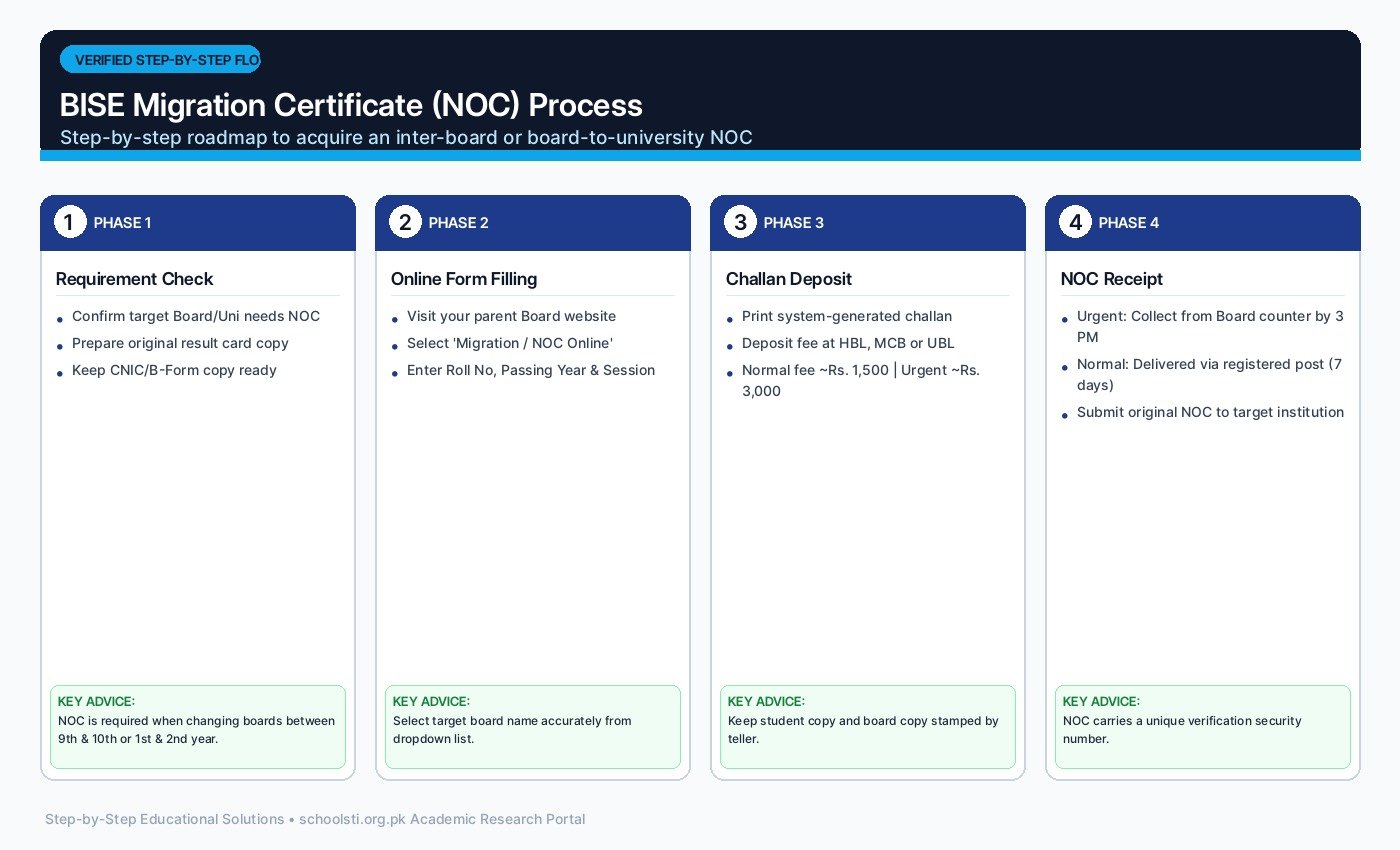
Boards ask for a standard set of documents with the migration application. Requirements vary slightly between boards, so confirm the list on your board's website or at its facilitation centre before you visit.
| Document | Why it is needed | Notes |
|---|---|---|
| Application form (prescribed by the board) | Official request record | Available at the board office or its website |
| Original registration card | Proves your registration with the board | Usually retained or cancelled by the board |
| Copy of latest result card / DMC | Confirms your academic record | Carry the original for verification |
| CNIC or B-Form copy | Identity verification | Father's CNIC copy is sometimes asked too |
| School/college leaving certificate | Shows you have left the previous institution | Required by most boards |
| Fee challan receipt | Proof of migration fee payment | Pay only through the official challan |
Step-by-Step: Applying for the Migration Certificate
The process is straightforward but involves a physical visit in most boards. Follow the steps in order to avoid repeated trips.
- Confirm the requirement with your new institution Get written confirmation of whether the migration certificate is needed at admission or registration, and whether they need the original or accept a copy initially. This sets your deadline.
- Get the prescribed application form Collect the migration form from your current board's office or download it from the board's website if available. Read the instructions on the form itself — some boards require the form to be attested by your school or college principal.
- Assemble your documents Prepare the documents from the table above. Make photocopies of everything and keep the originals in a file — board offices often ask to see originals even when they keep only copies.
- Pay the migration fee Pay the migration fee through the board's official challan at the designated bank. Migration fees follow the board's published fee schedule and are revised periodically — as per the latest published fee schedule, verify on the official website, reviewed October 2026. Keep the original receipt.
- Submit the application at the board office Submit the filled form, documents, and fee receipt at the board's relevant branch or one-window/facilitation centre. Take a receiving stamp or diary number on your copy of the form — this is your proof of submission and your tracking reference.
- Collect the certificate on the due date The board announces a collection date, usually a few working days later. Collect the migration certificate in person with your receipt, and check that your name, registration number, and the receiving board's name are all spelled correctly before leaving the counter.
- Submit it to your new institution Hand the original migration certificate to your new college, board, or university as required, and keep a photocopy for your own record. Your registration with the new board or institution proceeds on its basis.
| Migration Route | Processing Timeline | Prescribed Board Fee | Authorized Bank | Mandatory Document Pack |
|---|---|---|---|---|
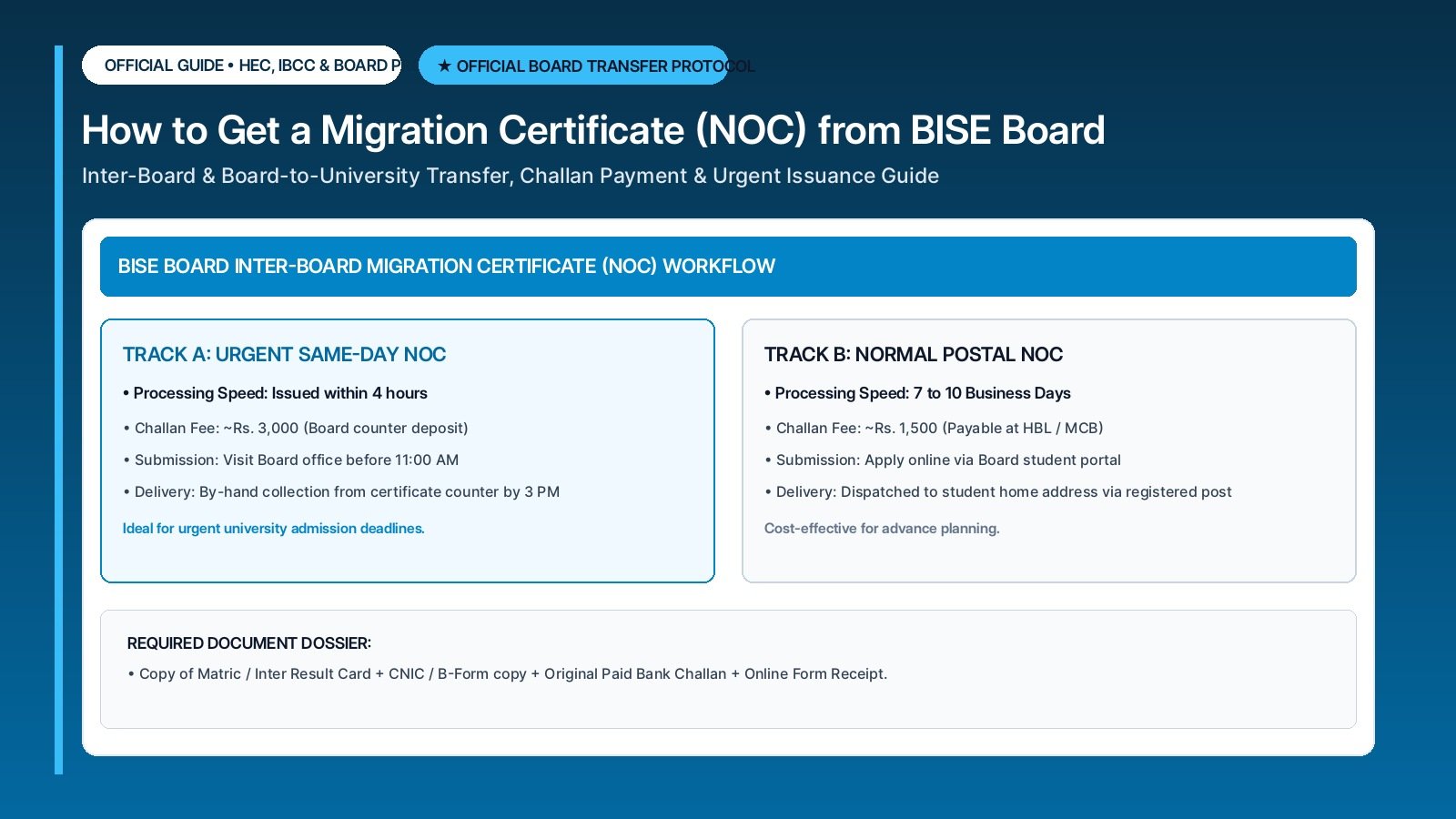
| Inter-Board (Punjab to Punjab Board) | Normal: 7 Days | Urgent: Same Day | Normal: Rs. 1,500 | Urgent: Rs. 3,000 | HBL / MCB / UBL Challan | Result card copy, CNIC/B-Form, original challan |
| Federal Board (FBISE to Punjab Board) | Online Tracking: 3 to 5 Days | Normal: Rs. 1,800 | Urgent: Rs. 3,500 | HBL Internet Banking / 1Bill | Computerized online application & registration card |
| Board to Public University | Normal: 5 Days | Urgent: 24 Hours | Normal: Rs. 1,600 | Urgent: Rs. 3,200 | Designated Board Bank Booth | Final HSSC marksheet copy & university offer letter |
| Cancellation of Issued NOC | 3 to 5 Business Days | Cancellation Fee: Rs. 1,000 | Board Central Cash Counter | Surrender original un-used NOC + written affidavit |
Fees, Processing Time and Urgent Cases
Migration fees are modest compared to other board services, but they are revised from time to time. As per the latest published fee schedule, confirm the current migration fee on your board's official website — verify on the official website, reviewed October 2026 — and pay only through the official challan.
Normal processing takes a few working days after submission. During admission season, facilitation centres get crowded, so go early in the day and early in the admission window. If your new institution's deadline is close, explain the urgency at the counter — boards sometimes prioritise genuine deadline cases, though this is discretionary and not a guaranteed fast-track service.
Some boards also offer postal delivery of the certificate for students who have moved cities. If you cannot collect in person, ask about the postal option at submission time and provide a correct, complete mailing address.
Special Situations: FBISE, Private Candidates and Universities
Moving between a provincial BISE board and FBISE Islamabad follows the same migration logic, but FBISE has its own admission and registration calendar — align your migration timing with it so you do not miss their registration window. Confirm FBISE's current requirements on its official website.
Private candidates also need migration when changing boards, and the process is the same except that the school leaving certificate requirement may be replaced by an affidavit or a different proof of status — ask your board's facilitation centre what applies to you.
For university admissions, note that many universities handle board-to-university transition through their own registration process and only some ask for a BISE migration certificate. Do not assume — check the university's admission checklist. Applying for a migration you do not need wastes time and surrenders your original registration card unnecessarily.
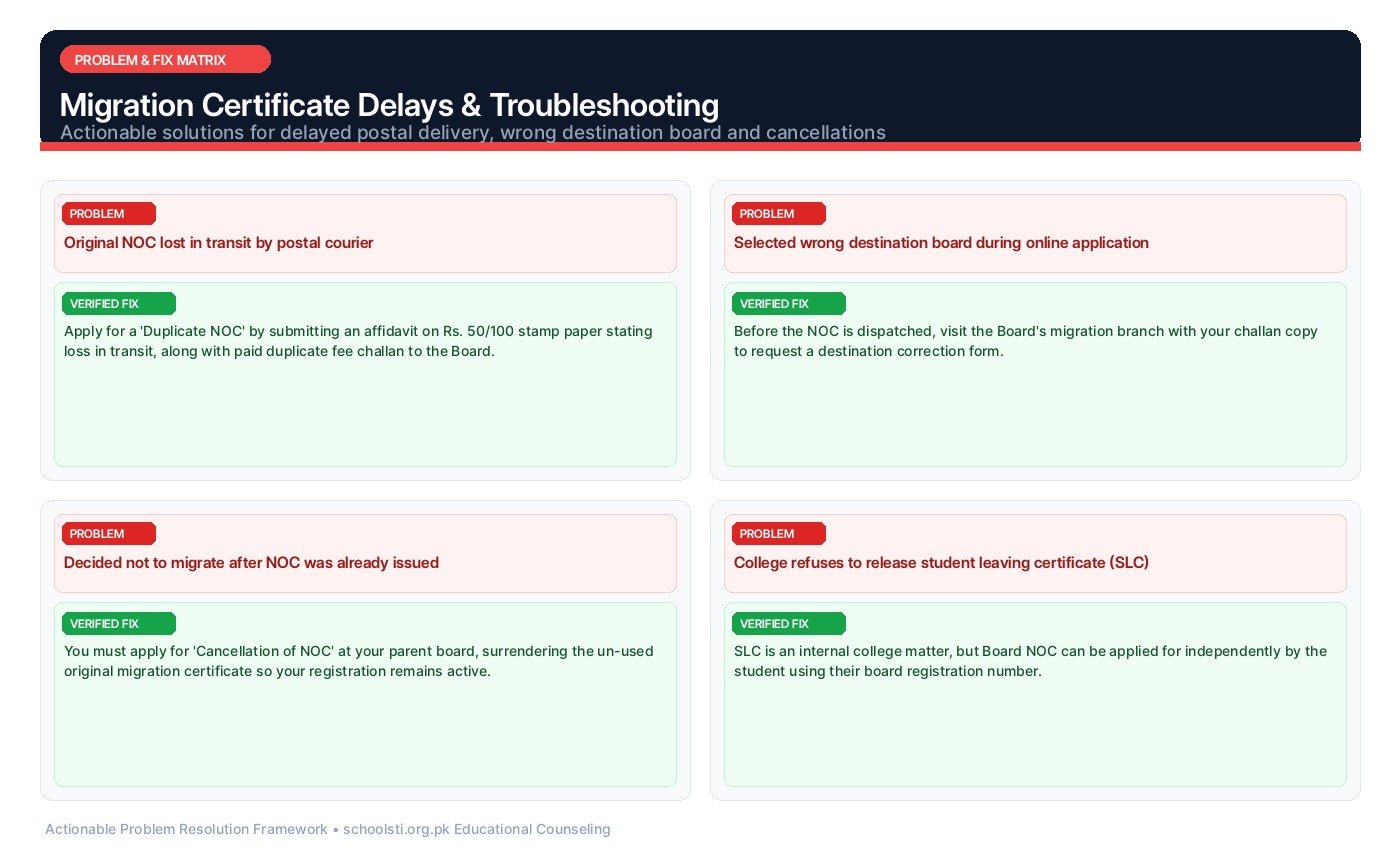
Troubleshooting: Common Student Problems & Verified Solutions
Real-world issues reported by Pakistani applicants and students, with actionable step-by-step solutions:
⚠️ Problem: My new college says I need the NOC urgently but the board gave a later collection date
✅ Verified Solution: Ask your college whether they will accept the fee receipt plus a copy of your submitted application as interim proof — many do. At the board office, politely explain the deadline with written proof (the admission letter showing the date); counters sometimes prioritise genuine deadline cases.
⚠️ Problem: The board says my registration record cannot be found
✅ Verified Solution: This usually means a wrong registration number or a record from a very old session that is archived. Bring your original registration card and result card to the facilitation centre so staff can trace the record manually. If the card is lost, apply for duplicate registration documents first.
⚠️ Problem: I lost my fee receipt before collecting the certificate
✅ Verified Solution: Go to the bank branch where you paid and request a duplicate receipt or payment verification — banks keep challan records. Also bring your CNIC and the diary number from your submission copy. Without proof of payment, the board cannot release the certificate.
⚠️ Problem: My name is spelled differently on my registration card and CNIC
✅ Verified Solution: Get the name corrected on the board record before applying for migration — the migration certificate must match your CNIC, or your new institution will reject it. Name correction is a separate process at the board, so start it immediately as it adds weeks.
⚠️ Problem: I already submitted my original registration card but now need it back
✅ Verified Solution: Boards normally retain or cancel the original registration card when issuing migration — that is the point of the process. If you submitted it by mistake without needing migration, visit the issuing branch with your diary number immediately and request withdrawal of the application before it is processed.
Frequently Asked Questions (FAQ)
Clear, direct answers to common questions about How to Get a Migration Certificate (NOC) from BISE Board to Change Board or University: