The Three Universities at a Glance
FAST-NUCES, NUST and GIKI are the three names that come up in almost every Pakistani family's discussion about studying Computer Science or Software Engineering. All three earned their reputations honestly — through decades of graduates working in the software industry, not through marketing.
That said, they are very different: different fees, cities, campus cultures and entry tests. The comparison below lays out those differences plainly. Fee levels are described only as higher or moderate bands — exact figures change yearly, so verify on each university's official website, reviewed October 2026.
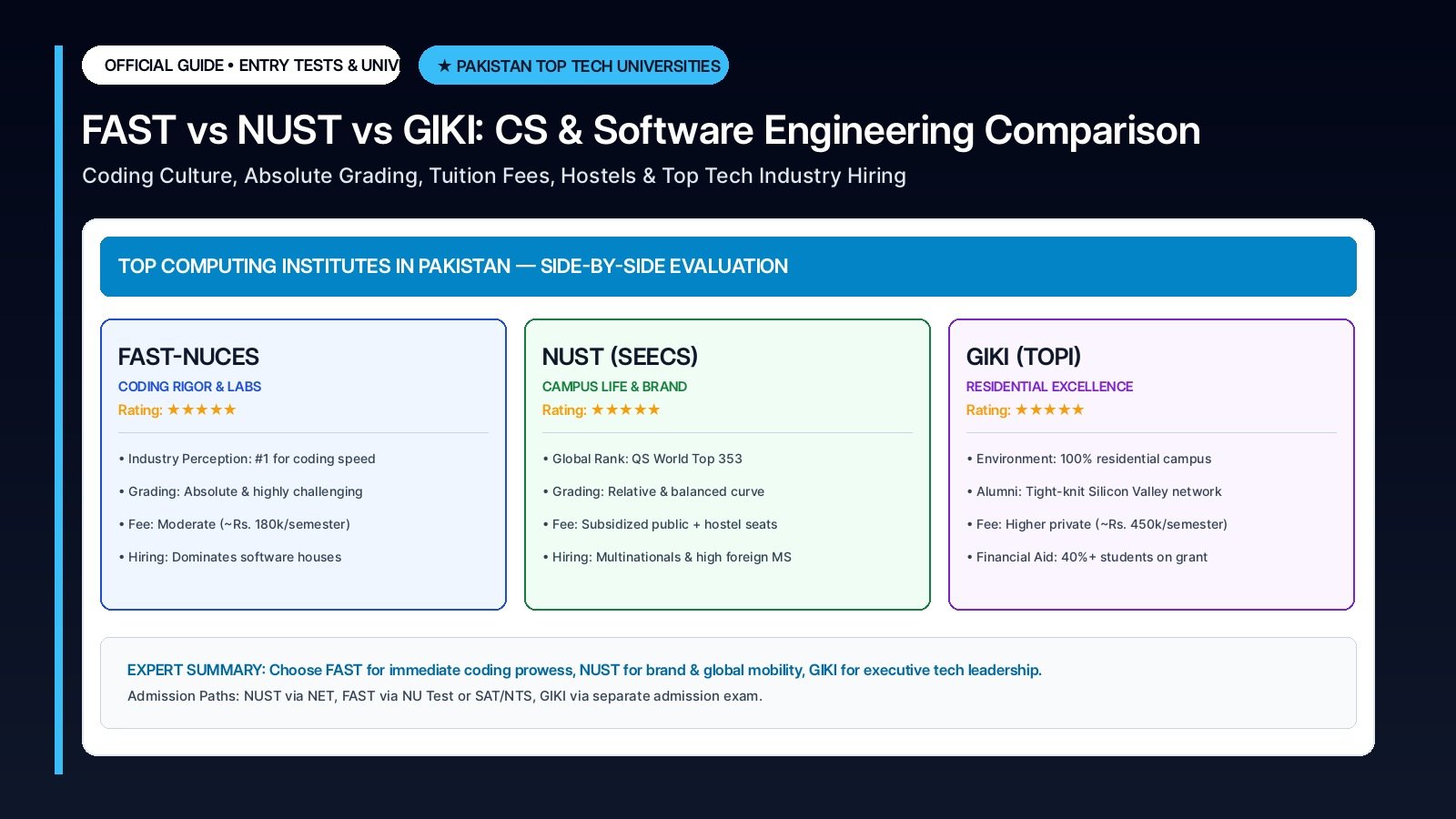
| Dimension | FAST-NUCES | NUST | GIKI |
|---|---|---|---|
| Reputation in CS/SE | Very strong — known for rigorous computing programs and a deep software-industry alumni network | Very strong — Pakistan's top-ranked university overall, with excellent computing schools (SEECS and others) | Strong — a respected engineering institute with solid CS and SE programs |
| Fee level | Higher (private university fee band) | Moderate (public university fee band) | Higher (private university fee band) |
| Locations | Multiple campuses, including Lahore, Karachi, Islamabad, Peshawar and Faisalabad | Main campus in Islamabad, with additional campuses elsewhere | Single residential campus at Topi, Swabi in Khyber Pakhtunkhwa |
| Entry test | FAST-NUCES admission test | NUST Entry Test (NET) | GIK admission test |
| Class culture | Large CS batches and a highly competitive peer group | Large batches with a diverse, high-achieving student body | Smaller batches and a close-knit residential community |
Academic Strength in CS and Software Engineering
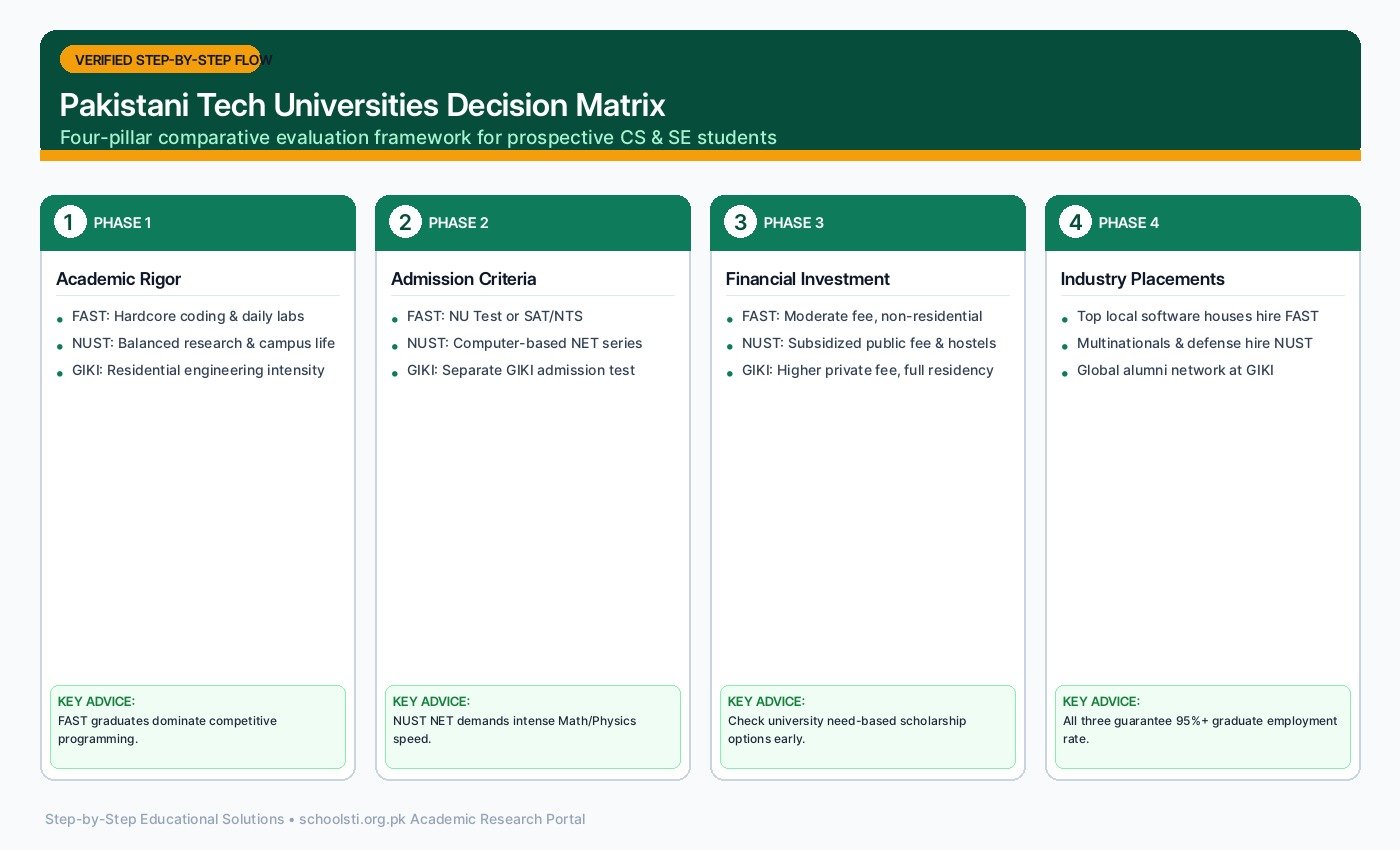
FAST-NUCES built its name almost entirely on computing. Its CS and SE programs are famously demanding — heavy coursework, tough grading, and students coding seriously from the first semester. Employers in Pakistan's software houses know this, which is why FAST graduates have historically found industry doors open.
NUST brings the weight of Pakistan's top-ranked university. Its computing schools combine strong faculty, serious research output and excellent labs with the breadth of a full university — societies, competitions and interdisciplinary options a pure computing institute cannot match.
GIKI offers something the other two cannot: a fully residential campus where you live, study and build projects with the same few thousand students for four years. Smaller batches mean closer faculty interaction and strong teamwork — at the cost of distance from Pakistan's big-city tech hubs.
| University | Strengths | Watch Out For |
|---|---|---|
| FAST-NUCES | Deep CS/SE focus, industry-connected curriculum, strong alumni presence in software houses | Higher fees, large class sizes, limited on-campus hostel culture at some campuses |
| NUST | Top national ranking, research output, strong faculty, diverse societies and programs | Highly competitive admission, higher Islamabad cost of living, large classes |
| GIKI | Residential campus with strong community, closer faculty-student interaction, solid engineering culture | Remote location, higher fees, fewer nearby industry and internship options |
Fees and Affordability: The Honest Picture
Let us be direct: all three are premium institutions, and none of them is cheap. As a public-sector university, NUST sits in a moderate fee band compared with the two private institutions — both FAST-NUCES and GIKI fall in the higher private fee band. But fee structures are revised almost every year and vary by program and campus, so this guide deliberately avoids quoting figures that would be outdated within months.
Budget for the full picture, not just tuition: hostel or rent, food, transport and a laptop. GIKI is fully residential; NUST means living in Islamabad, which is not cheap; FAST-NUCES costs depend on the campus city. All three offer merit scholarships and need-based aid as per published policies — check deadlines early, because aid applications often close before admission lists do.
Entry Tests and Admission Difficulty
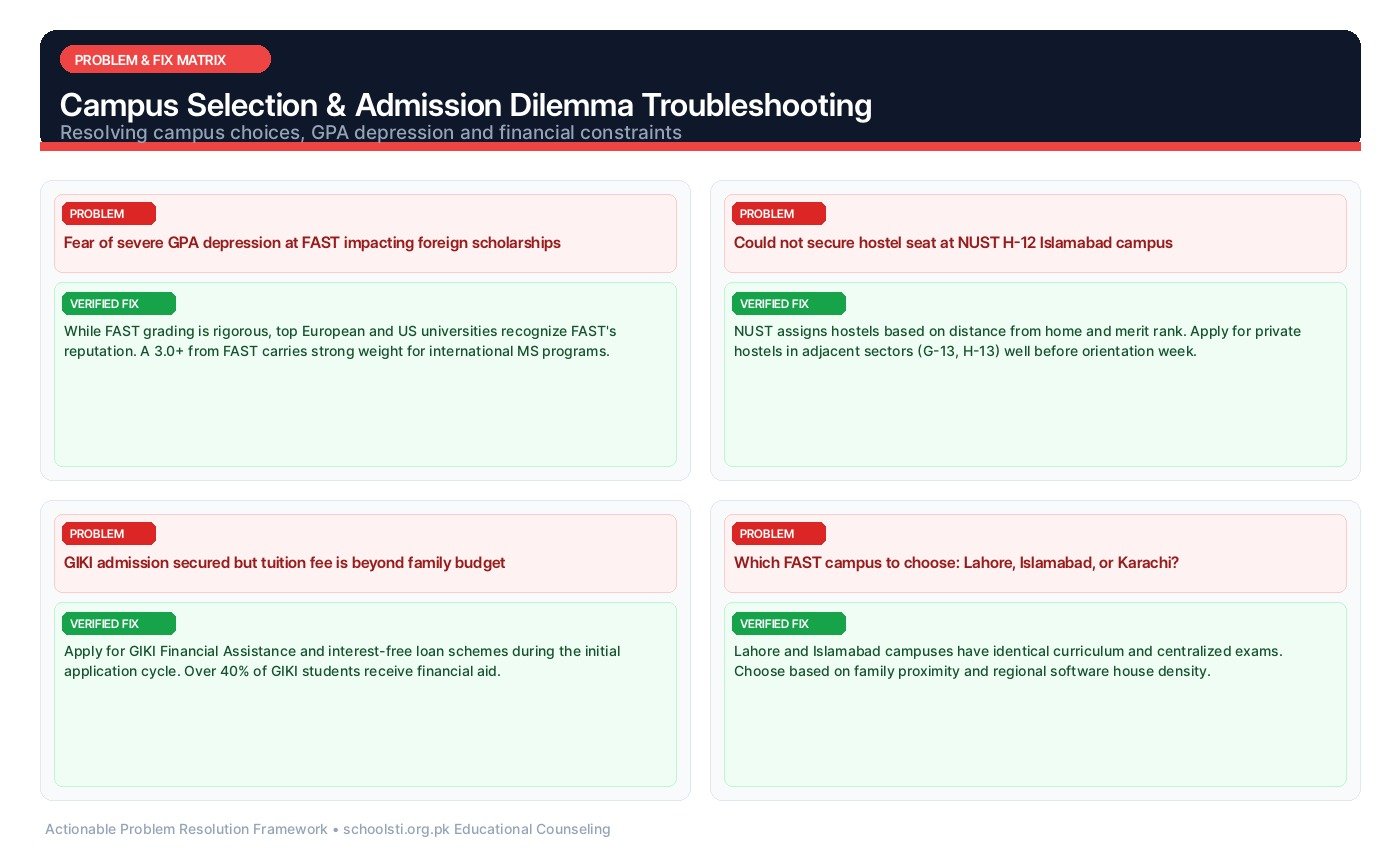
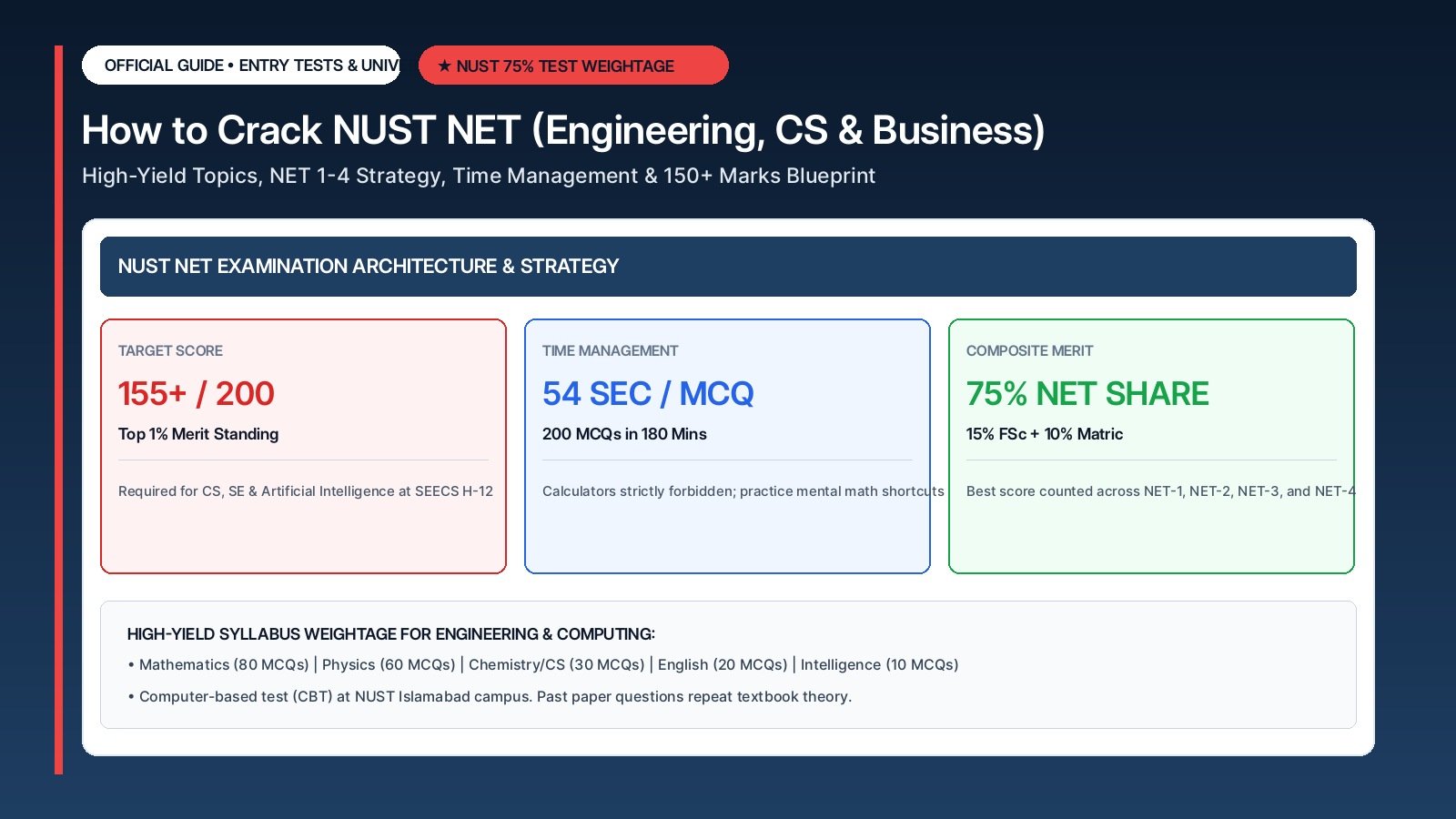
Each university runs its own entry test. The FAST-NUCES admission test focuses on subjects relevant to your program — mathematics and analytical skills feature heavily for CS and SE. The NUST Entry Test (NET) is a broader, highly competitive FSc-syllabus exam, and NUST traditionally allows multiple attempts per cycle with your best score counting — verify current attempt rules on the official website. The GIK admission test covers FSc-level physics, mathematics and English.
All three tests reward the same fundamentals: complete command of FSc concepts, serious practice with past papers, and calm time management. Start preparing alongside your board exams — students who treat entry-test prep as a last-month sprint consistently underperform.
Which One Suits You: A Decision Framework
There is no single winner — there is only the best fit for you. Work through the framework below honestly, ideally with your parents, because their budget and comfort matter as much as your ambition. Then read the verdict guidance at the end as a starting point, not a command.
Whichever you choose, remember the uncomfortable truth: the university opens the door, but you walk through it. Graduates from all three work at top software companies — and graduates from all three also struggle when they coast through four years without building real skills.
- Fix your budget honestly Calculate the full four-year cost — tuition plus hostel, food, transport and a laptop — for each option, and check each university's published financial-aid deadlines before you fall in love with a campus.
- Choose your city reality FAST-NUCES and NUST keep you in big cities with internships nearby; GIKI means four residential years in Topi. Be honest about which life you and your family actually want.
- Match your learning style Thrive on competition in big batches? FAST-NUCES or NUST will sharpen you. Prefer close faculty contact and a tight community? GIKI's residential model fits better.
- Weigh your career goals For a direct software-industry path, all three work well. For research, higher studies abroad or a broader experience, NUST's ranking and research culture add weight.
- Keep a backup plan Apply to at least two of the three plus one safe backup university. Merit lists are unpredictable, and a backup is what keeps one bad test day from costing you a year.
Final Verdict: Matching the University to the Student
If money is the deciding factor, compare net cost after financial aid, not sticker fees. All three publish merit scholarships and need-based assistance, and the cheapest headline fee is not always the cheapest final bill once hostel, food and transport are added. Apply for aid in parallel with admission, well before the published deadlines.
If you want the strongest research profile and the most recognised name for higher studies abroad, NUST leads the three. If you want the most intense, industry-connected software culture with big-city internships at your doorstep, FAST-NUCES is hard to beat. If you want a close-knit residential campus where faculty know you by name and the whole community lives the degree together, GIKI is the natural pick.
None of these choices is a mistake if you work hard once you get there. The uncomfortable truth is that the university opens the door but you walk through it — graduates from all three work at leading software companies, and graduates from all three also struggle when they coast through four years without building real skills.
Whatever you shortlist, verify the latest fee structure, entry-test pattern and scholarship deadlines on each university's official website before applying. Figures change every year, and this guide was reviewed in October 2026.
Troubleshooting: Common Student Problems & Verified Solutions
Real-world issues reported by Pakistani applicants and students, with actionable step-by-step solutions:
⚠️ Problem: The fees feel unaffordable for my family.
✅ Verified Solution: Do not reject an option before checking its financial-aid page. All three publish merit scholarships and need-based assistance with their own deadlines — apply for aid in parallel with admission, and compare net cost after aid, not the sticker fee. Bank education financing is a last resort, not a first one.
⚠️ Problem: My parents will not allow me to study in a far-off city.
✅ Verified Solution: This is a real constraint. FAST-NUCES has multiple campuses, so a nearer city may solve it; NUST means Islamabad; GIKI means residential life in Topi. Discuss hostel safety, travel frequency and costs with your parents before applying — not after the merit list.
⚠️ Problem: My entry test went badly and I missed the merit.
✅ Verified Solution: First, check whether the university allows another attempt in the same cycle — policies differ, so verify on the official website. Second, activate your backup: universities with later merit lists or spring admissions. A gap year spent preparing properly beats a panicked admission to a weak program.
⚠️ Problem: I am confused between Computer Science and Software Engineering.
✅ Verified Solution: Both lead to software careers. CS is broader and more theoretical (algorithms, systems, AI); SE is more applied (building and managing large software projects). At these three universities both degrees are respected — pick based on the actual course lists published by each university, not on which name sounds better.
⚠️ Problem: Can I transfer between these universities after the first year?
✅ Verified Solution: Transfers are generally difficult and rarely straightforward — credit-transfer policies vary and seats are limited. Verify the specific policy on the official website before counting on it. Choose carefully now rather than planning an escape route later.
Frequently Asked Questions (FAQ)
Clear, direct answers to common questions about FAST-NUCES vs NUST vs GIKI: Which is Best for Computer Science & Software Engineering?: