What Is the NUST NET?
The NUST Entry Test, usually called NET, is the university's own admission test for undergraduate programmes at the National University of Sciences and Technology. Unlike national tests such as MDCAT, NET is designed and conducted by NUST itself, and it is held on computers at designated test centres rather than on paper.
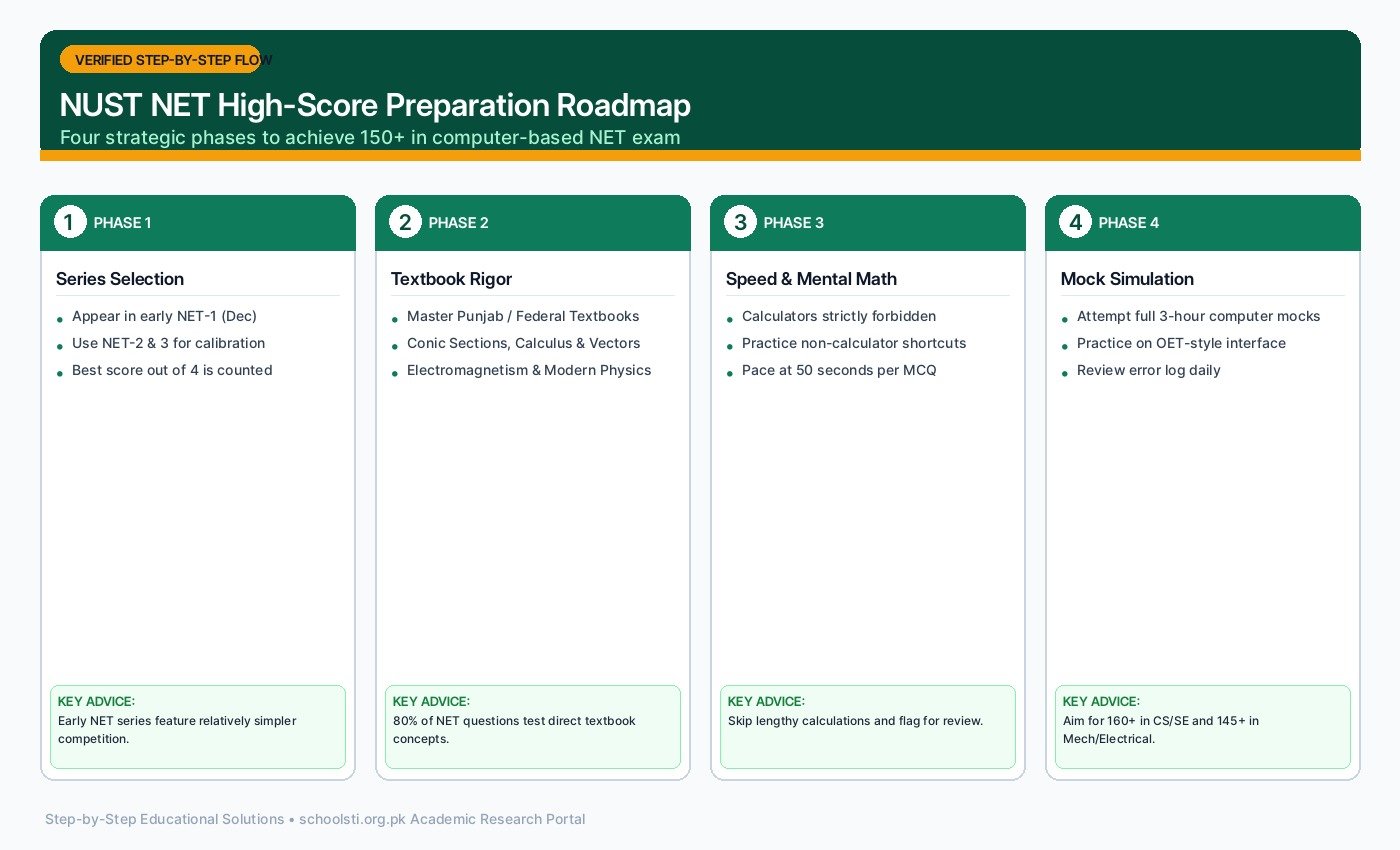
As per the latest published NUST policy, NET is conducted in multiple series spread across the admission cycle, so candidates get more than one chance in a year. Only your best score across the series you attempt is counted for merit, which makes the first series a valuable real-exam rehearsal. The exact number of series, their months and the best-score rule can change from year to year, so verify the current schedule on the official website. This guide was reviewed in October 2026.
NET covers engineering, computing, natural sciences and business programmes, but the subject mix changes with the stream you apply for. The next section breaks that down.
NET Test Pattern: Subject Sections by Stream
The table below shows the typical subject mix for each stream, as per the latest published NUST pattern. NUST can revise section counts and weightage, so treat this as a preparation map and verify the exact current pattern on the official website. This guide was reviewed in October 2026.
| Stream | Sections in the test | What to note |
|---|---|---|
| BS Engineering | Mathematics, Physics, Chemistry, English, Intelligence | Mathematics and Physics carry the heaviest load; Chemistry is the fastest scoring section. |
| Computing (BS CS, Software Engineering, AI) | Mathematics, Computer Science, English, Intelligence | A maths-heavy paper; Computer Science replaces Chemistry for most computing programmes. |
| Business and Social Sciences (BBA and related) | English, Mathematics (basic level), Intelligence and Analytical Reasoning | English and analytical ability dominate; prepare them like core subjects, not afterthoughts. |
Subject-Wise Preparation Strategy
Mathematics: the rank decider
Mathematics carries the largest share of the paper, so it deserves the largest share of your timetable. Cover the complete FSc Part 1 and Part 2 syllabus, but study for speed: learn short methods for differentiation, integration, matrices and trigonometry, because long textbook solutions will eat your time budget. Practise at least 40 to 50 mixed MCQs daily with a timer from the second month onward.
Physics: concepts first, formulas second
NET physics rewards understanding over memorisation. For every chapter, ask why a formula works before you memorise it, then drill numericals until the standard question types feel automatic. Chapters like electrostatics, current electricity, magnetism and modern physics appear again and again, so they deserve extra rounds of revision.
Chemistry: the highest marks per hour
Chemistry gives the best return on study time because most questions come straight from FSc textbooks. Master periodic trends and chemical bonding for inorganic chemistry, learn named reactions and mechanisms for organic chemistry, and do not skip the numerical chapters. Short, repeated revision cycles work better here than one long reading.
English: vocabulary and grammar rules
Many students lose easy marks in English because they prepare it last. Build vocabulary daily with 15 to 20 new words, and master the grammar rules that repeat every year: subject-verb agreement, tenses, prepositions, articles and sentence correction. Reading one English paragraph daily also sharpens the comprehension questions.
Intelligence and analytical reasoning: practise, not theory
This section cannot be crammed from a book. Work through practice sets on number series, odd-one-out, directions, blood relations, coding-decoding and non-verbal patterns. Speed comes from pattern recognition, and pattern recognition comes only from volume, so solve a little every single day.
| NUST Program Stream | Total MCQs | Time Allowed | Math / Bio Split | Physics Split | Safe Score for H-12 |
|---|---|---|---|---|---|
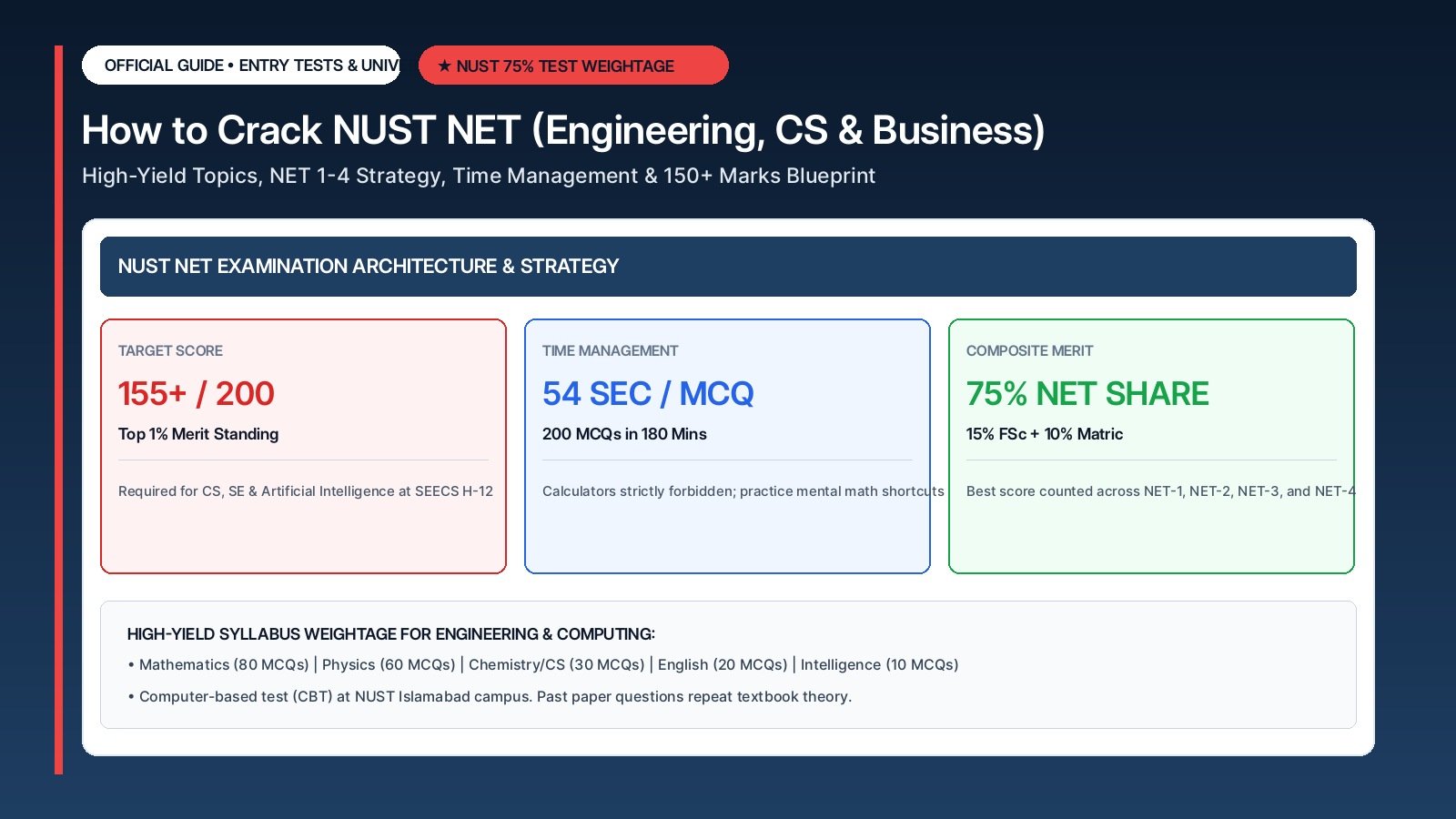
| BS Computer Science / Software Eng | 200 MCQs | 180 Minutes | 80 MCQs (40%) | 60 MCQs (30%) | 155+ / 200 Marks |
| BS Electrical / Mechanical / Civil | 200 MCQs | 180 Minutes | 80 MCQs (40%) | 60 MCQs (30%) | 142+ / 200 Marks |
| BS Artificial Intelligence / Data Science | 200 MCQs | 180 Minutes | 80 MCQs (40%) | 60 MCQs (30%) | 158+ / 200 Marks |
| BS Biotechnology / Applied Bio | 200 MCQs | 180 Minutes | 80 MCQs Biology | 60 MCQs (30%) | 135+ / 200 Marks |
| BBA / BS Public Administration (NBS) | 200 MCQs | 180 Minutes | 80 Quant Math | 40 Reasoning | 148+ / 200 Marks |
Time Management: Time Per MCQ and Section Order
With roughly 200 MCQs to finish in about 3 hours, you have under a minute per question, and that is the whole game. Students who know the syllabus but never practise against the clock routinely leave 20 to 30 questions unattempted. Follow this system from your very first mock test.
- Fix a personal time budget Divide the total minutes by the number of MCQs and subtract 10 minutes for review. That gives you roughly 50 seconds per question. Train yourself to move on the moment a question crosses its budget.
- Attempt sections in your strongest-first order Start with the subject where you score highest, usually Chemistry or English, to bank quick marks and build confidence. Save your weakest subject for the middle, never for the tired final stretch.
- Use the two-pass rule In the first pass, answer only questions you can solve within your budget and mark the rest for review. In the second pass, return to the marked ones with your remaining time. This guarantees you never miss easy marks hidden at the end of the paper.
- Never leave a question blank As per the latest published NUST policy, NET has no negative marking, so an unanswered question and a wrong answer cost exactly the same. Verify this in the current instructions, and if it still holds, attempt every single MCQ.
- Reserve the final 10 minutes for review Use this buffer only for marked questions and accidental mis-clicks. Do not start a fresh difficult question in the last two minutes; a calm review saves more marks than a rushed guess.
How Merit Works: Aggregate and Weightage
Your NET score alone does not decide admission. NUST computes a merit aggregate that combines your FSc (or equivalent) marks with your NET score according to a published weightage formula. As per the latest published NUST admission policy, both components carry significant weight, so a strong NET can lift an average FSc result, and a weak NET can drag down excellent board marks. Because the exact weightage ratio is a policy figure, verify the current formula on the official website before you plan around it. This guide was reviewed in October 2026.
Closing merits differ every year by discipline, campus and series, depending on the applicant pool. Instead of chasing last year's closing number as a target, aim to maximise your own aggregate: every extra NET mark directly improves your position on every merit list you qualify for.
Your 10-12 Week Plan, After-Attempt Review, and Common Mistakes
A realistic preparation cycle runs 10 to 12 weeks. Spend weeks 1 to 6 on complete syllabus coverage with daily MCQ practice, weeks 7 to 9 on timed mixed practice and weak-area repair, and weeks 10 to 12 on full-length computer-based mocks with detailed error logs. Revise formulas and vocabulary in short daily slots throughout, because forgetting is the silent marks-killer.
What to do after each NET attempt
Within 24 hours, write down every question type that troubled you while the memory is fresh. Spend the gap before the next series repairing exactly those chapters instead of re-reading the whole syllabus. If you are eligible for another series, treat the next attempt as a planned second shot, not a sign of failure, since only your best score counts.
Common mistakes to avoid
- Preparing for only one series and treating the others as backup plans you never use.
- Ignoring English and Intelligence until the last two weeks, although they decide close merit races.
- Practising without a timer and discovering the speed problem on test day.
- Studying from outdated pattern notes shared on social media instead of the latest published syllabus.
- Changing sleep schedule in the final week; take mocks at your actual test-day time slot.
Troubleshooting: Common Student Problems & Verified Solutions
Real-world issues reported by Pakistani applicants and students, with actionable step-by-step solutions:
⚠️ Problem: I missed the registration deadline for the current NET series.
✅ Verified Solution: Do not panic. Since multiple series are held each admission cycle, watch the official website for the next series announcement and keep your documents, photograph and fee payment method ready. Note the deadline in two places so it cannot slip again.
⚠️ Problem: My mock test scores are stuck below my target and not improving.
✅ Verified Solution: Stop taking more mocks for a week and analyse instead. Break your errors by subject and by cause: concept gap, silly mistake, or time pressure. Fix the biggest cause first, because repeating mocks without repair only rehearses the same mistakes.
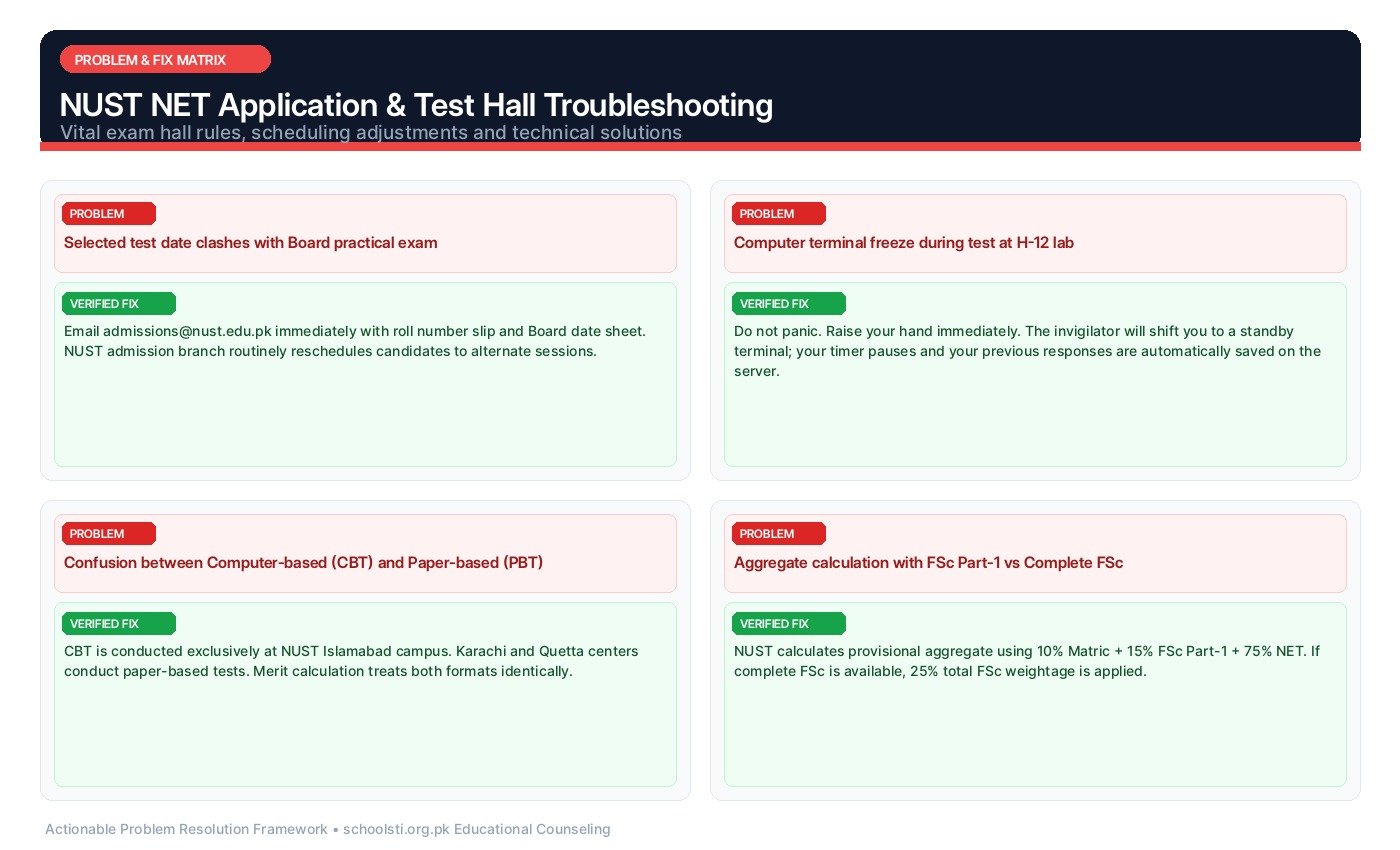
⚠️ Problem: The computer froze or malfunctioned during my test at the centre.
✅ Verified Solution: Raise your hand immediately and inform the invigilator instead of trying to fix it yourself. Note how much time was lost and politely ask that the interruption be logged, so there is a record if you need to raise the matter with NUST afterwards.
⚠️ Problem: I am confused by my result and where I stand on merit.
✅ Verified Solution: Remember that your best series score is the one used for merit, and merit lists are built from the weighted aggregate, not the raw NET score alone. Compare your aggregate against the officially published merit lists rather than against friends' raw scores.
⚠️ Problem: I prepared the wrong stream's subjects and my test is near.
✅ Verified Solution: Switch immediately to your actual stream's pattern and prioritise the sections with the largest weightage. Verify the correct subject mix from the latest published pattern on the official website, and adjust your remaining mocks to match it.
Frequently Asked Questions (FAQ)
Clear, direct answers to common questions about How to Crack NUST NET (Entry Test): Subject-Wise Preparation, Syllabus & Time Management: