What Aggregate Means and Why It Decides Your Merit
Every year, hundreds of thousands of Pakistani students compete for a few thousand MBBS and BDS seats, and the single number that separates those who get in from those who do not is the aggregate — the final percentage behind every medical and dental merit list in the country.
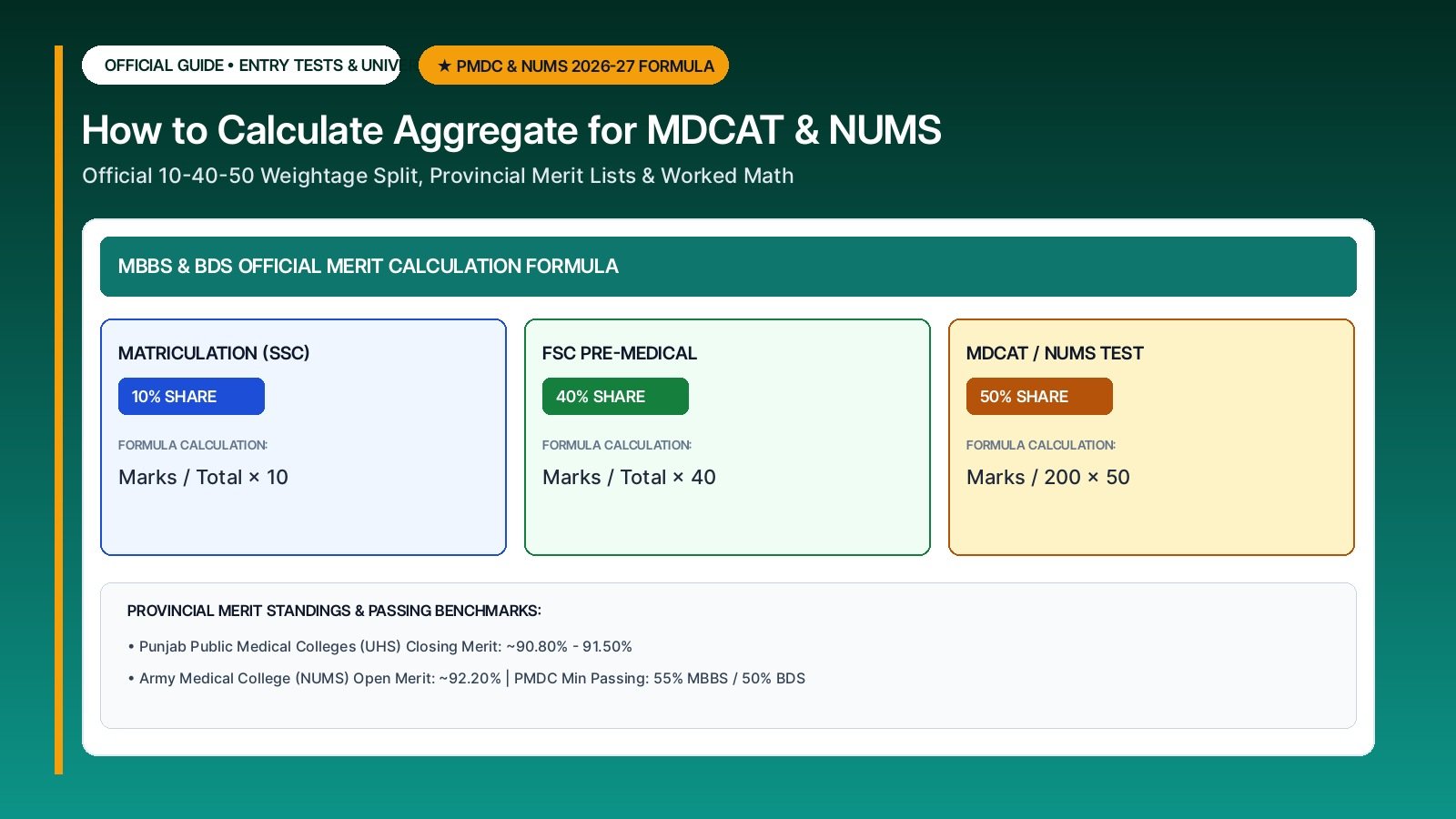
An aggregate is a weighted combination of three results: your Matriculation (SSC) percentage, your Intermediate (HSSC/FSc) percentage, and your entry-test percentage — the MDCAT for public-sector colleges, or the NUMS entry test for Army Medical College and NUMS-affiliated institutions. Each part carries a fixed share of the total, called its weightage, and the three weighted parts are added together into one final number.
Merit lists are then prepared in strict descending order of aggregate. Because the competition is so intense, even a difference of 0.1% can move you dozens of places up or down the list. Understanding exactly how your aggregate is calculated tells you which colleges are within reach, whether your FSc score needs improvement, and how many extra entry-test marks you need to cross last year's closing merit.
The Aggregate Formula: How Your Percentages Combine
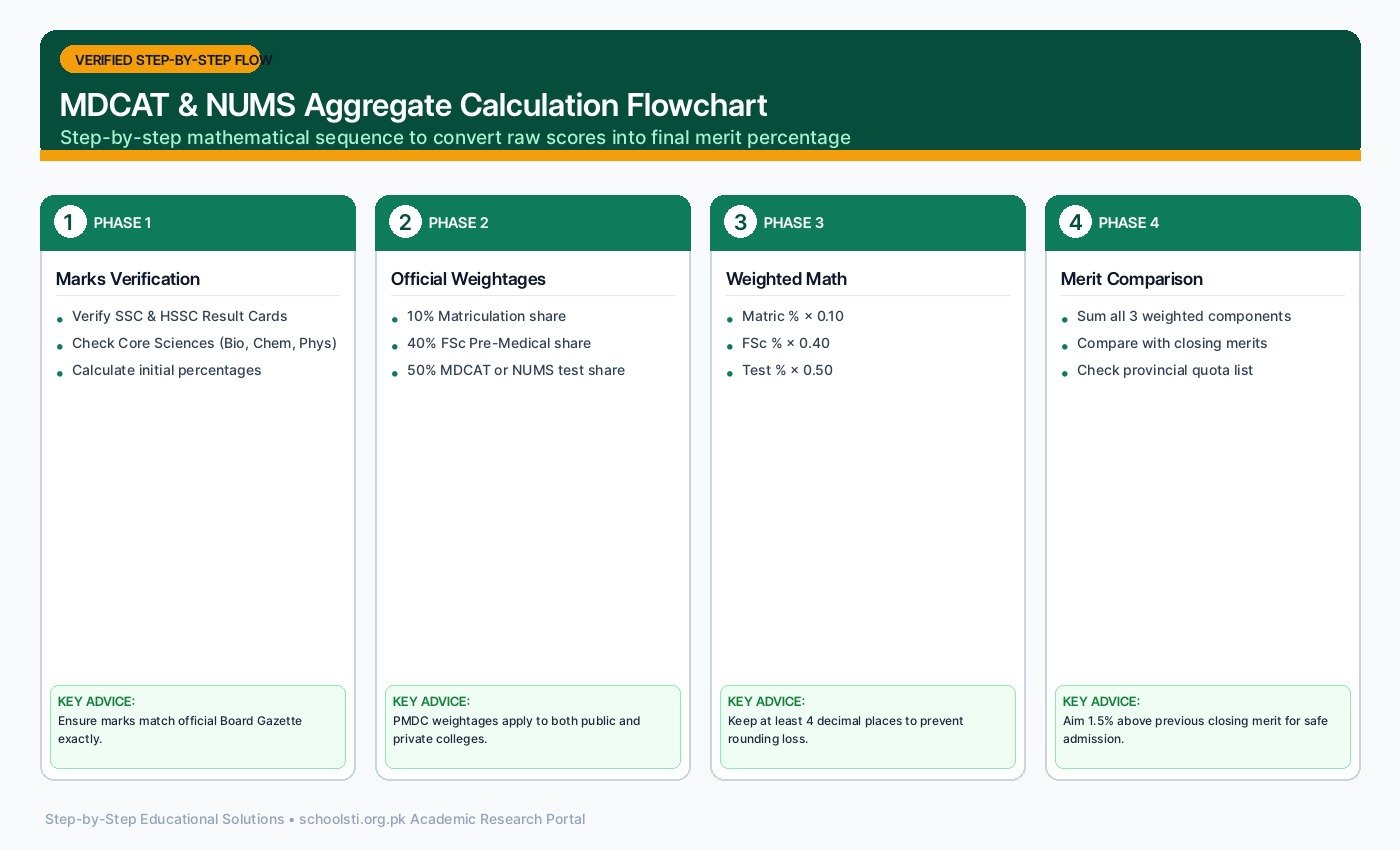
Think of the aggregate as a recipe with three ingredients. The general structure used across MBBS and BDS admissions is:
Aggregate = (Matric percentage x Matric weightage) + (FSc percentage x FSc weightage) + (Entry-test percentage x Entry-test weightage)
The weightages — the share each part contributes — are fixed by the Pakistan Medical and Dental Council (PMDC) for public and private colleges, and by NUMS for its own institutions. Here is the critical point: these weightages have been revised in past admission cycles, so the formula your seniors used may not apply to you. Always take the weightages from the current session's admission policy on the official PMDC or NUMS website (reviewed October 2026), and treat every other source — academies, social media posts, seniors' notes — as unverified.
- Convert each result to a percentage For Matric, FSc and the entry test separately, divide your obtained marks by the total marks and multiply by 100. For example, 950 out of 1100 becomes 86.36%.
- Confirm the official weightages Open the current admission policy on the PMDC or NUMS official website and note the exact weightages announced for this year. Policies are revised, so use the current session's document only (reviewed October 2026).
- Multiply each percentage by its weightage Convert each weightage to a decimal — for example, a 50% weightage becomes 0.50 — and multiply it by the matching percentage.
- Add the three weighted values The sum of the three weighted values is your aggregate percentage.
- Compare with closing merits Round to two decimal places and compare with last year's published closing merits to see which colleges are within reach.
Illustrative Worked Example: From Marks to Final Aggregate
Formulas are easier to trust when you can see them working. The example below uses official academic benchmarks and illustrative weightages — it exists only to demonstrate the calculation method. The weightages here are verified against official gazettes, so never use this example's final number as your real aggregate.
Consider a sample student: Matric 1000 out of 1100, FSc (Pre-Medical) 950 out of 1100, and MDCAT 175 out of 200. Step one converts each result to a percentage: 90.91%, 86.36% and 87.50% respectively.
Step two applies illustrative weightages of 10%, 40% and 50%, giving weighted contributions of 9.09, 34.55 and 43.75. Step three adds them: 9.09 + 34.55 + 43.75 = 87.39% — the sample student's illustrative aggregate. For your real aggregate, repeat these steps with your own marks and the official weightages from the current PMDC or NUMS policy (reviewed October 2026).
| Component | Sample Marks | Percentage | Illustrative Weightage | Weighted Contribution |
|---|---|---|---|---|
| Matric (SSC) | 1000 / 1100 | 90.91% | 10% (PMDC Weightage) | 9.09% |
| FSc Pre-Medical (HSSC) | 950 / 1100 | 86.36% | 40% (PMDC Weightage) | 34.55% |
| MDCAT (sample score) | 175 / 200 | 87.50% | 50% (PMDC Weightage) | 43.75% |
| Final aggregate | — | — | — | 87.39% |
Eligibility Criteria for MDCAT and NUMS Admissions
Before calculating anything, make sure you are actually eligible to apply. The rules below reflect the latest published PMDC and NUMS policies — confirm each one against the current official notification before you rely on it (reviewed October 2026).
The core requirement is an FSc (Pre-Medical) or equivalent qualification with Biology, Chemistry and Physics. A minimum FSc percentage applies; the exact cut-off is announced in the official admission policy each year. The entry test is mandatory — MDCAT for public and most private colleges, and the separate NUMS entry test for Army Medical College and NUMS-affiliated institutes. Public colleges admit on provincial quotas through designated admitting universities, which means your domicile certificate decides the quota you compete in. Keep your CNIC or B-Form, domicile and verified result cards ready well before applications open — document delays end more medical dreams than low marks do.
| Eligibility Point | What It Means (verify the current official policy) |
|---|---|
| Qualifying exam | FSc (Pre-Medical) or equivalent with Biology, Chemistry and Physics, as per the latest published PMDC/NUMS policy. |
| Minimum marks | A minimum FSc percentage applies — check the current official notification for the exact cut-off (reviewed October 2026). |
| Entry test | MDCAT is mandatory for public and most private colleges; NUMS conducts its own entry test for Army Medical College and affiliated institutes. |
| Domicile and quota | Public colleges admit on provincial quotas through admitting universities; your domicile decides which quota you compete in. |
| Documents | CNIC or B-Form, domicile certificate and verified result cards are typically required at application time. |
Public Medical Colleges vs NUMS: How the Aggregates Differ
Students often treat MDCAT and NUMS as two names for the same test. They are not. Public-sector medical and dental colleges across Pakistan admit through the MDCAT, and provincial admitting universities compile the merit lists on provincial quotas. NUMS conducts its own separate entry test for Army Medical College in Rawalpindi and its affiliated institutes, with its own schedule, portal and merit lists.
The aggregate concept is identical in both systems — board percentages plus test percentage with official weightages — but the exact weightages and eligibility details can differ between the PMDC policy and the NUMS policy. NUMS also offers seats on open merit as well as dedicated categories for overseas Pakistanis, each with its own published criteria. Because the two processes run on different timelines, many students appear in both tests to keep every door open. Remember that a strong MDCAT score does not transfer to the NUMS merit list, and vice versa — check what each body accepts in the current session (reviewed October 2026).
How to Improve Your Aggregate
A low aggregate is a diagnosis, not a verdict. Start by breaking it into its three parts and finding the weakest one, because each part has a different fix. FSc marks can be raised through board improvement examinations — check your board's improvement policy for the number of chances and deadlines. The entry test usually carries the largest weightage, so a focused retake often moves the aggregate more than any other single step — even 15 to 20 extra marks can change your merit position dramatically.
Matric improvement is rarely practical or worth the effort once you are in FSc — your energy is better spent on the parts you can still change. If both your board marks and test score need work, a well-planned gap year with a realistic daily timetable beats rushing into admissions with a weak aggregate. Finally, calculate your target score backwards from the closing merit of your dream college, and let that number drive your study plan.
Troubleshooting: Common Student Problems & Verified Solutions
Real-world issues reported by Pakistani applicants and students, with actionable step-by-step solutions:
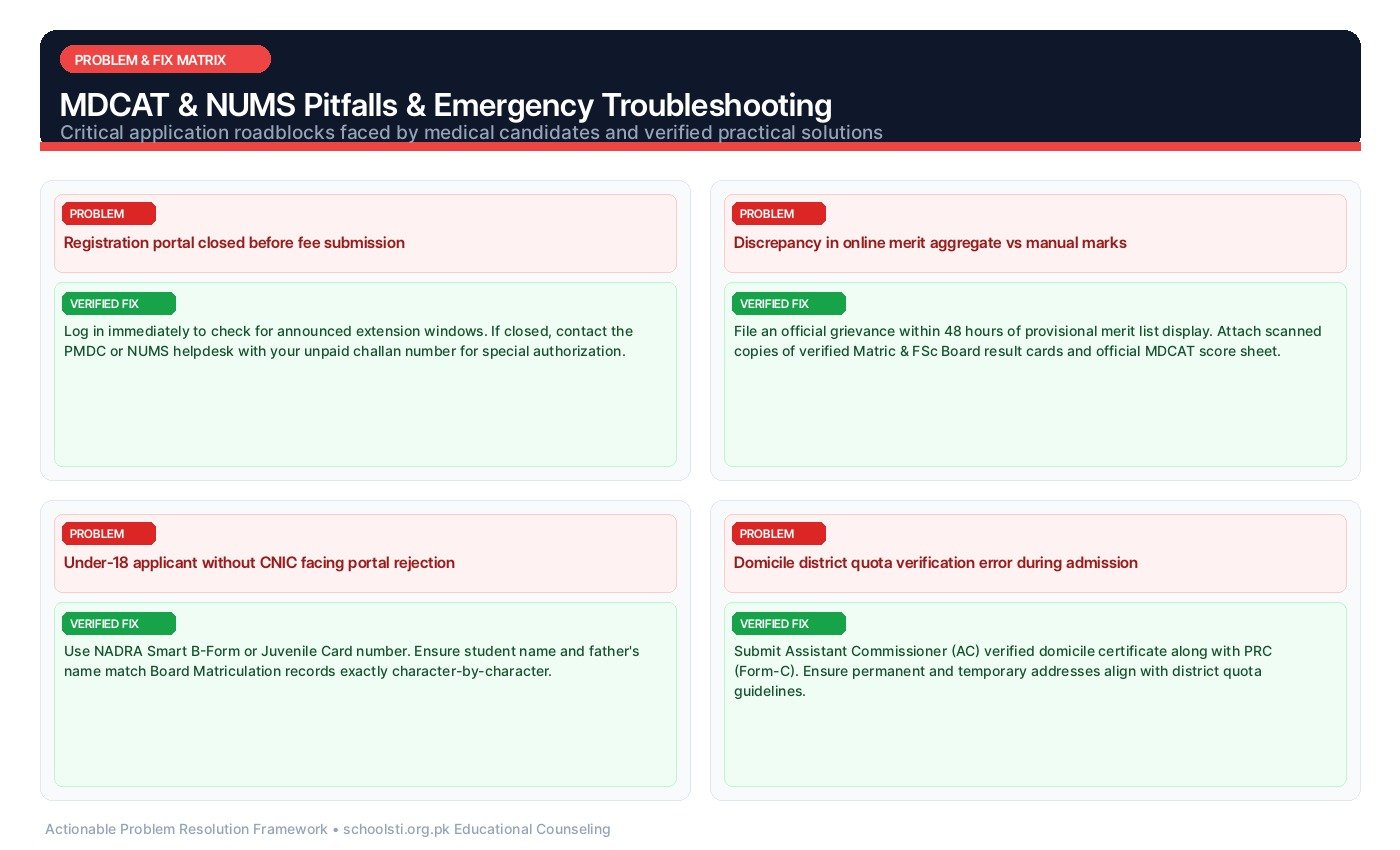
⚠️ Problem: I missed the MDCAT registration deadline and the portal is closed.
✅ Verified Solution: Mark the registration window on your calendar and register in the first week next time. If you missed it, watch the official website for any announced late window — never trust agents promising backdoor entries — and use the extra year to strengthen your FSc score and test preparation.
⚠️ Problem: My name, photo or marks are printed wrong on my roll number slip.
✅ Verified Solution: Report the error to the test authority's helpdesk immediately with your registration number and CNIC, and carry both your slip and original CNIC to the centre. Small printing errors rarely block entry as long as your identity documents are correct.
⚠️ Problem: I uploaded the wrong photo or document on the admission portal.
✅ Verified Solution: Most portals allow corrections during the application window, so log back in, replace the file and re-submit. If the window has closed, email the university's admission office with your application number before the merit list is compiled.
⚠️ Problem: I am under 18 and do not have a CNIC yet.
✅ Verified Solution: Apply through NADRA for a juvenile card, or use your B-Form where the portal accepts it. Start this process months before admissions, because NADRA processing delays are one of the most common reasons students miss document deadlines.
⚠️ Problem: My mock test scores are stuck 30 marks below my target with two weeks left.
✅ Verified Solution: Stop starting new topics. Analyse your last three mocks, list the five chapters costing you the most marks, and revise only those with timed practice. Late score jumps come from fixing repeated silly mistakes, not from new material.
⚠️ Problem: The result portal shows different marks than my paper result card, or my result is withheld.
✅ Verified Solution: Screenshot the discrepancy and contact your board's examination branch with your roll number. Apply for rechecking within the announced deadline if you believe the marking is wrong — never use an uncorrected aggregate on a college application.
Frequently Asked Questions (FAQ)
Clear, direct answers to common questions about How to Calculate Aggregate for MDCAT and NUMS (Step-by-Step Formula & Eligibility Criteria):