What Is HEC USAT and Who Runs It?
The Undergraduate Studies Admission Test, known as USAT, is a standardised entry test conducted by the Higher Education Commission (HEC) of Pakistan. Its purpose is simple: to give universities one fair, common yardstick for comparing applicants from different boards, so that undergraduate merit is not decided by board marks alone.
As per the latest published HEC policy, a growing number of public-sector universities require USAT for admission to their undergraduate programmes, and some private universities accept it as well. Each university decides for itself whether USAT is mandatory, optional or not used for a given programme, so you must confirm the requirement in the admission notice of every university you apply to. This guide was reviewed in October 2026.
Because one USAT result can be used at multiple participating universities, a single good score can open several admission doors at once. That makes USAT one of the highest-value tests a Pakistani intermediate student can prepare for.
USAT Categories: Pick the Right One
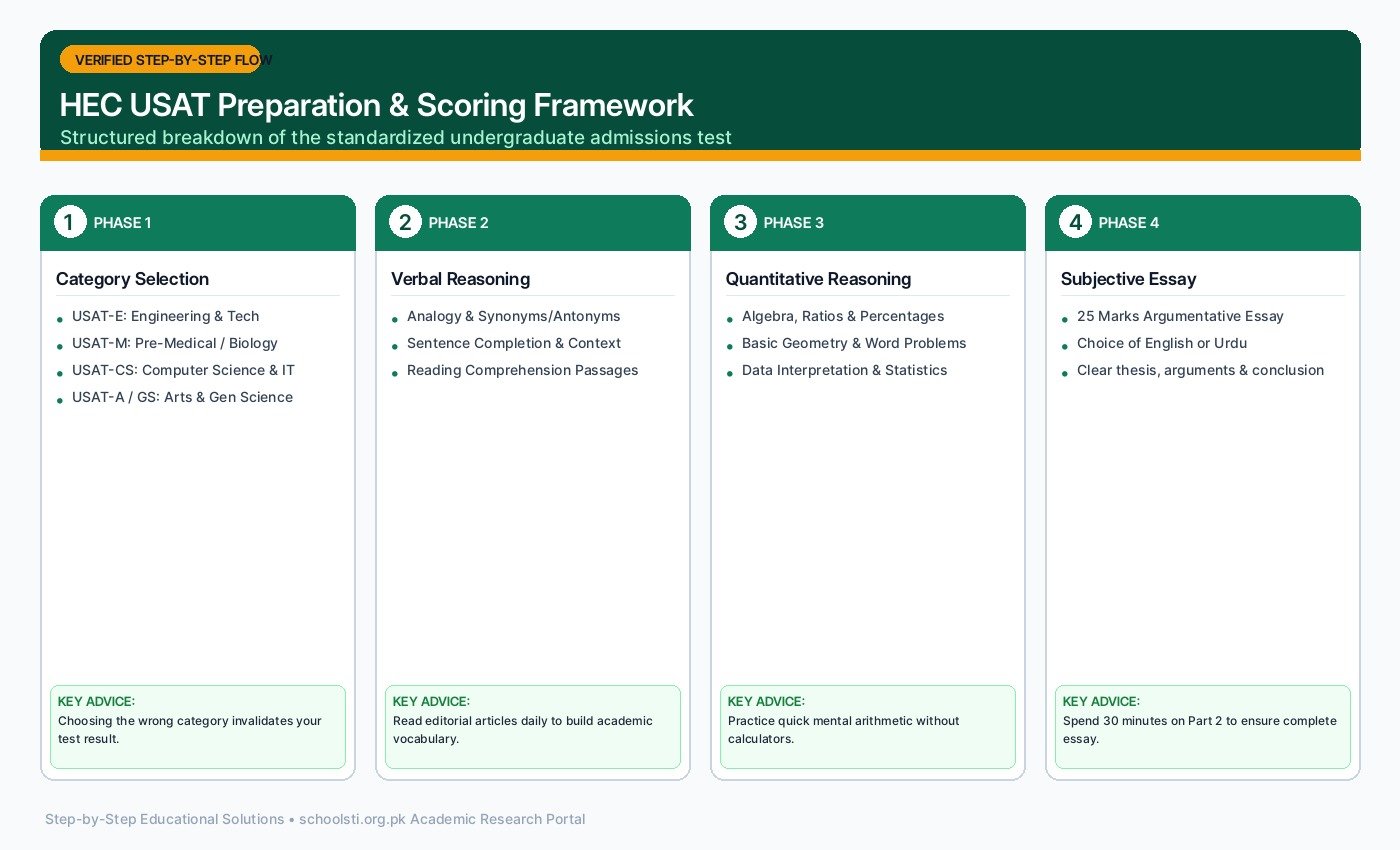
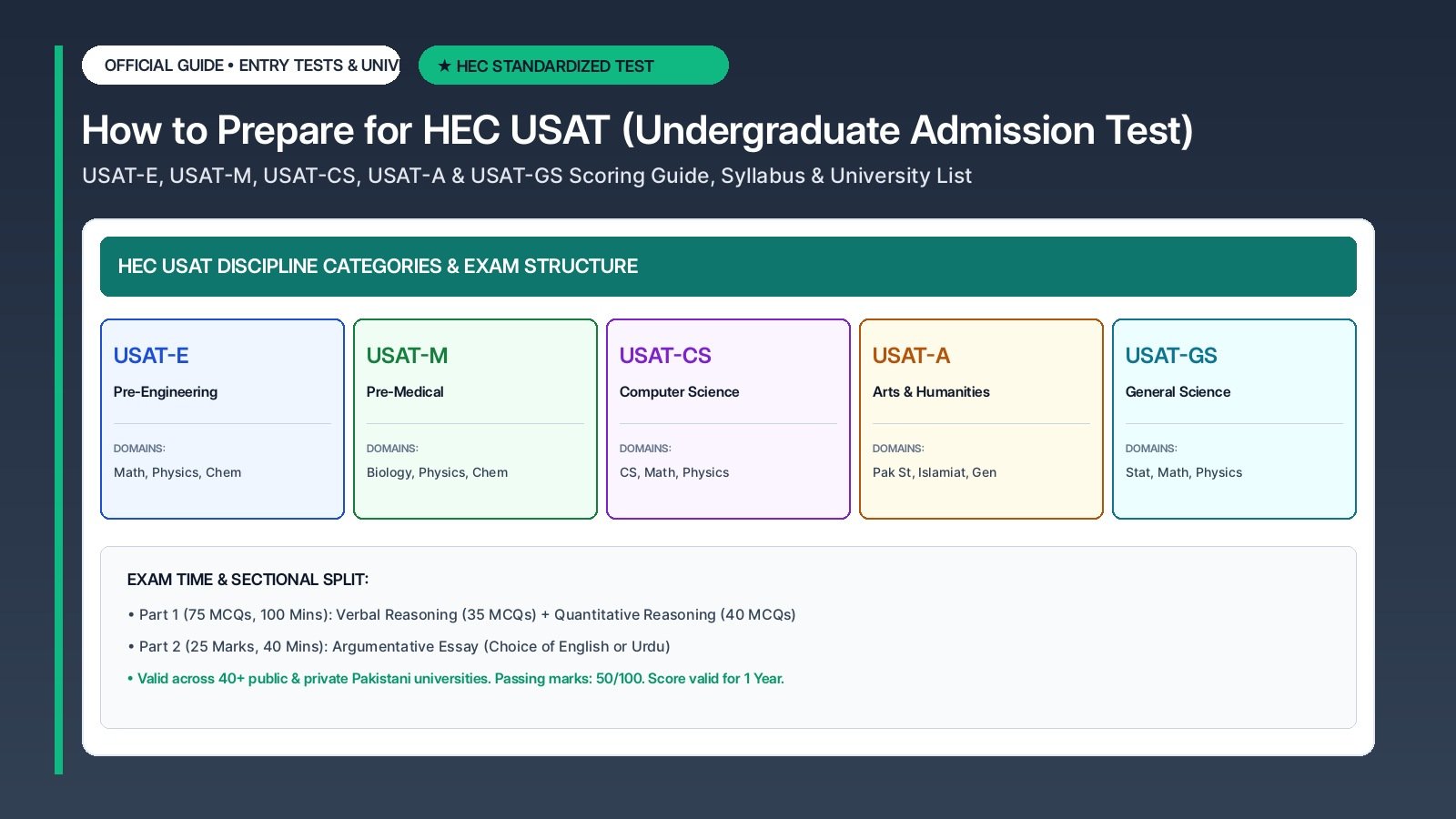
HEC offers USAT in separate categories matched to students' intermediate streams, so that every candidate is tested on subjects they have actually studied. Choosing the wrong category is one of the costliest mistakes you can make, because your subject sections will not match your preparation. The category list below reflects the latest published HEC pattern; HEC may add or revise categories, so verify the current list on the official website. This guide was reviewed in October 2026.
| Category | Designed for | Typical sections |
|---|---|---|
| USAT-E | Pre-engineering and ICS (Mathematics) students | Verbal reasoning, quantitative reasoning, physics and mathematics |
| USAT-M | Pre-medical students | Verbal reasoning, quantitative reasoning, biology and chemistry |
| USAT-CS | Computer science aspirants | Verbal reasoning, quantitative reasoning, mathematics and computing aptitude |
| USAT-GS | General science students | Verbal reasoning, quantitative reasoning and general science sections |
| USAT-A | Arts and creative programme applicants | Verbal reasoning with arts-related sections, as per the published pattern |
| USAT-H | Humanities and social sciences applicants | Verbal reasoning with humanities-related sections, as per the published pattern |
Syllabus and Marks Distribution
Every USAT category is built from the same three building blocks: verbal reasoning, quantitative reasoning and subject sections from your stream. The table below shows what each block tests and how to prepare for it. The exact number of questions and marks per section is set by HEC and published with each test announcement, so verify the current marks distribution on the official website before you plan your attempt strategy. This guide was reviewed in October 2026.
| Section | What it tests | How to prepare |
|---|---|---|
| Verbal reasoning | Reading comprehension, vocabulary, grammar, sentence completion and analogies | Read English daily, learn 15 to 20 new words a day, and practise comprehension passages with a timer. |
| Quantitative reasoning | Arithmetic, algebra, geometry, ratios, percentages and data interpretation | Revise FSc-level mathematics concepts and drill short numericals; speed matters more than advanced topics. |
| Subject sections | Intermediate-level knowledge of your stream subjects, such as physics, chemistry, biology, mathematics or computing | Revise your FSc textbooks chapter by chapter and practise board-style MCQs for each subject. |
Scoring, Qualifying Marks and Score Interpretation
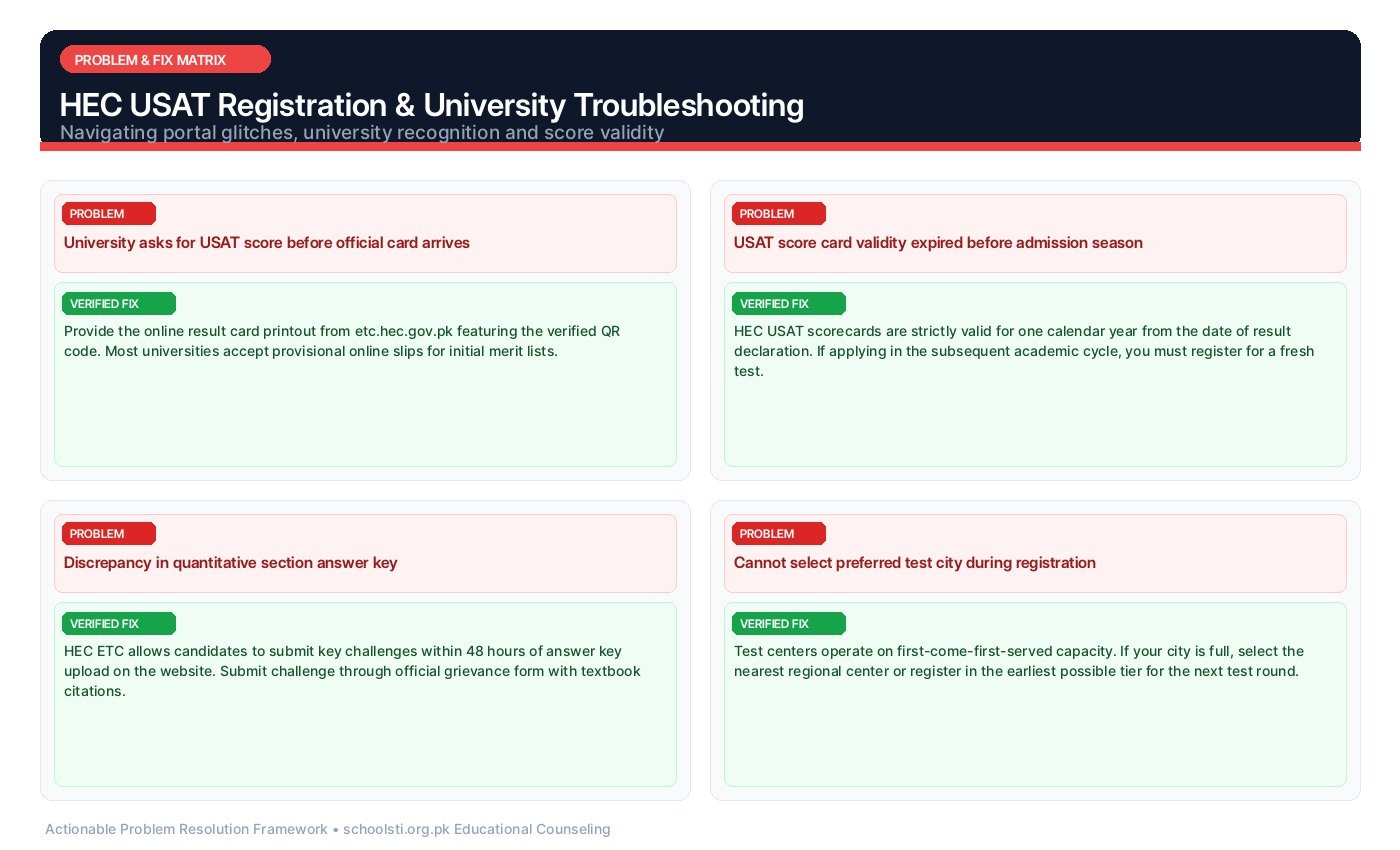
USAT scoring and the minimum qualifying marks are fixed by HEC policy and announced with each test cycle. As per the latest published HEC policy, candidates must reach the qualifying threshold for their result to be usable for admission; scoring below it means the result cannot support your application, no matter how strong your board marks are. Because qualifying marks are a policy figure, verify the current threshold on the official website. This guide was reviewed in October 2026.
Think of your score in three bands. Below the qualifying line, the result cannot be used. Just above the line, you are eligible, but competitive programmes will still prefer higher scorers. Well above the line, your USAT result actively strengthens your merit position at participating universities, especially when combined with solid intermediate marks. Aim for the third band from day one, because preparing merely to pass leaves no margin for a difficult paper.
Universities apply your USAT score within their own merit formulas, so the same score can carry different weight at different institutions. Check each university's published merit criteria to see how much your USAT result will count there.
Who Must Take USAT, Who Is Exempt, and How to Register
Whether you must take USAT depends on your target universities, not on HEC alone. If every university on your list runs its own entry test and does not accept USAT, you do not need it. If any of them requires USAT, you need a valid qualifying result before their admission deadline. Exemptions and alternative accepted tests vary by university and programme, so confirm directly with each admission office rather than relying on rumours.
Registration is handled through HEC's online application system. Follow these steps carefully, because registration mistakes are a common reason students miss the test.
- Confirm the requirement Check the admission notices of your target universities to confirm which of them require USAT, which category they accept, and the last date by which your result must be ready.
- Check your eligibility As per the latest published HEC policy, students who have passed intermediate or are appearing in it are generally eligible; verify the current eligibility conditions on the official website before applying.
- Create your account on the HEC e-services portal Register with your own email address and mobile number, because all test updates, roll number slips and results will go to these contacts.
- Fill the application and choose your category and test city Select the USAT category matching your stream and pick a test city you can realistically reach on test day. Double-check every entry before submitting.
- Pay the fee and keep the proof Pay the test fee through the prescribed method within the deadline, as per the latest published HEC policy, and save the payment receipt until your result is declared.
- Download your roll number slip and appear Download and print your roll number slip when it becomes available, then take the test and attach your result to each university application that requires it.
Preparation Strategy and Test-Day Tips
Verbal reasoning strategy
Verbal reasoning rewards steady habits, not last-minute cramming. Read one English passage daily and answer its questions against the clock, because comprehension speed is the real skill being tested. Build vocabulary in small daily batches and revise old words weekly, since forgotten words help nobody. For grammar and sentence completion, learn the standard rules once and then apply them through practice sets rather than re-reading theory.
Quantitative reasoning strategy
Quantitative reasoning tests how fast you apply basic mathematics, not how much advanced mathematics you know. Master percentages, ratios, averages, simple algebra and geometry formulas until they are automatic, then practise mixed sets with strict time limits. Learn to eliminate obviously wrong options quickly, because on a timed test a fast elimination is as valuable as a full solution.
Test-day tips
- Reach the test centre at least 45 minutes early; late entry rules are strict and non-negotiable.
- Carry your original CNIC or B-form, the printed roll number slip, and any other document named in the instructions.
- Attempt easier questions first and mark difficult ones for a second pass, so no easy marks are left behind.
- Keep calm if one section feels hard; USAT is designed so that relative performance matters more than perfection.
Troubleshooting: Common Student Problems & Verified Solutions
Real-world issues reported by Pakistani applicants and students, with actionable step-by-step solutions:
⚠️ Problem: I registered for the wrong USAT category.
✅ Verified Solution: Contact HEC support immediately with your registration details and ask whether a correction is possible before the deadline. Correction windows are governed by current HEC policy, so act fast and verify the procedure on the official website rather than waiting.
⚠️ Problem: My roll number slip is not downloading from the portal.
✅ Verified Solution: Try a different browser, clear your cache, and check that your application status shows as approved. If it still fails, contact HEC support with your registration number well before test day, and keep screenshots of the error.
⚠️ Problem: My quantitative reasoning scores are consistently low.
✅ Verified Solution: Drop advanced topics for two weeks and rebuild the basics: percentages, ratios, algebra and geometry, with 30 timed questions daily. Most low scores come from slow basics, not from missing advanced concepts.
⚠️ Problem: One of my target universities says it does not accept USAT for my programme.
✅ Verified Solution: Each university sets its own admission policy, so this is possible. Ask the admission office which test they require instead, and adjust your plan so you prepare for the right test for each university on your list.
⚠️ Problem: I missed the USAT test date.
✅ Verified Solution: HEC announces USAT on scheduled dates, so watch the official website for the next announced test and register early. Use the extra time to strengthen your weakest section instead of treating the delay as wasted.
⚠️ Problem: My result is not showing on the portal after the test.
✅ Verified Solution: Results are published on HEC's announced schedule, not instantly, so wait for the official result date first. If results are announced and yours is missing, contact HEC support with your roll number and test date.
Frequently Asked Questions (FAQ)
Clear, direct answers to common questions about How to Prepare for HEC USAT (Undergraduate Studies Admission Test): Scoring & Syllabus Guide: