What Is the HEC LAT and Who Has to Take It
The Law Admission Test, commonly called the LAT, is the entry test conducted by the Higher Education Commission (HEC) of Pakistan for admission to undergraduate law programmes — the five-year LLB. If you want to study law at a recognised university or law college in Pakistan, the LAT is the gateway you must pass through, as required under the latest published HEC policy.
The test measures the aptitude a law student needs: command over English and Urdu, general awareness of Pakistan and the world, basic reasoning and mathematics, and — uniquely among Pakistani entry tests — the ability to write a structured essay or personal statement. HEC conducts the LAT several times a year at test centres across the country, and you register through the HEC e-services portal within the announced window. Your score is then used by universities alongside your academic record when they prepare law merit lists. Because schedules, syllabi and passing criteria can be revised, always confirm the current session's details on the official HEC website (reviewed October 2026).
Eligibility Criteria for the Law Admission Test
Eligibility for the LAT is straightforward, but you must verify the current session's rules before applying. As per the latest published HEC policy, candidates need an Intermediate qualification — FA, FSc, ICom, ICS or an equivalent such as A-levels with an IBCC equivalence certificate — to sit the test (reviewed October 2026). Students awaiting their Intermediate result are generally allowed to appear provisionally, with final admission confirmed once the result is declared, though the exact rule for result-awaiting candidates can change, so check the current advertisement.
There is no restriction on the Intermediate group — science, commerce and humanities students can all take the LAT — which makes it one of the most accessible entry tests in the country. Keep your CNIC or B-Form, Intermediate roll number and a recent photograph ready before registration opens, because the HEC portal does not accept incomplete applications.
Test Pattern and Marks Distribution
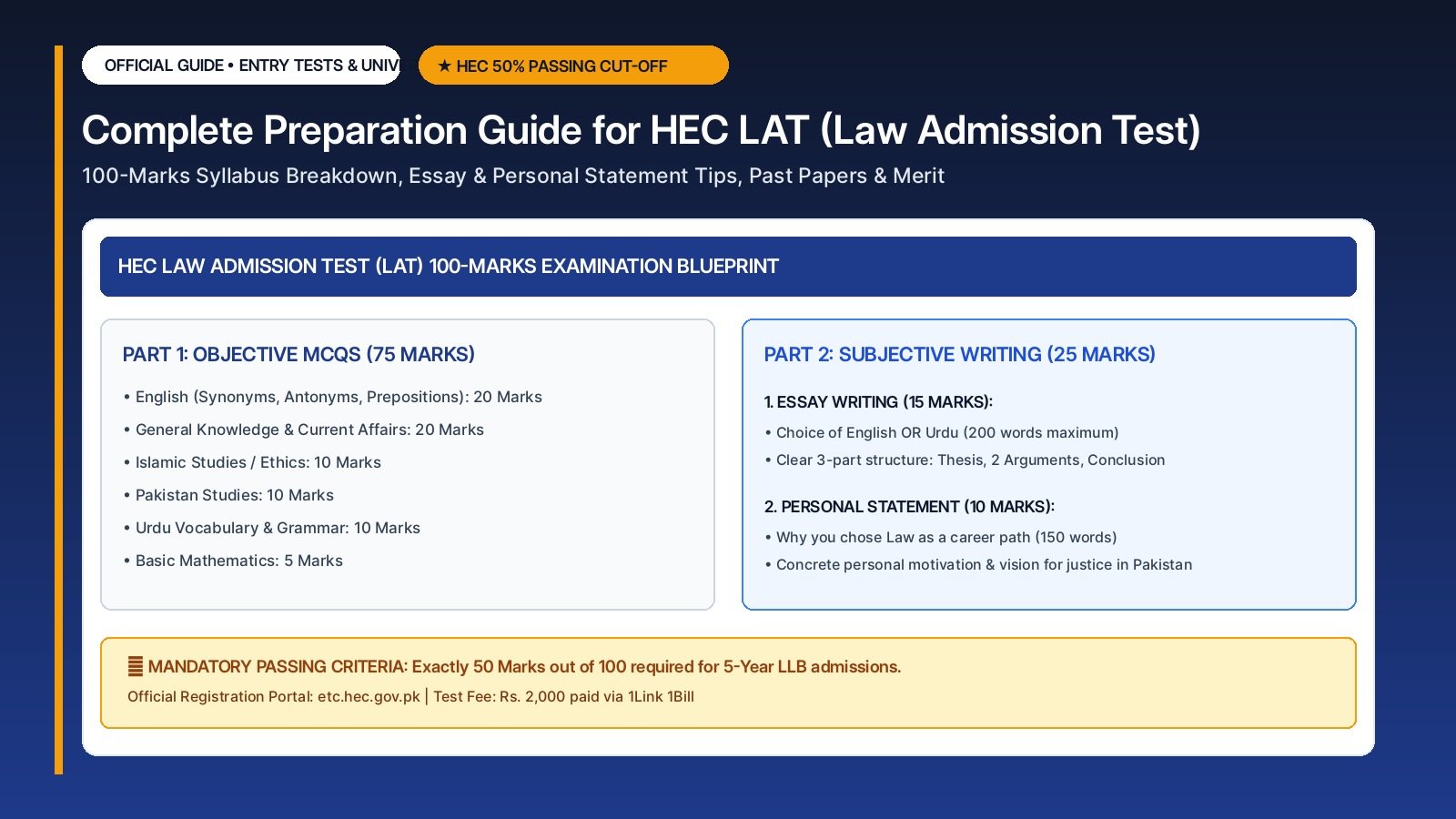
The LAT has two parts: a multiple-choice section and a written essay or personal statement. The table below shows the section-wise structure as per the latest published HEC pattern. HEC publishes the exact marks distribution in each session's advertisement — use that document, not this guide, for the numbers, because the pattern can be adjusted between sessions (reviewed October 2026).
Each MCQ section tests a different skill: English (comprehension, grammar, vocabulary), General Knowledge (current affairs, Pakistan and world affairs), Islamic Studies or Ethics (basic religious knowledge; non-Muslim candidates take Ethics), Pakistan Studies (independence movement, constitutions, geography), Urdu (grammar, idioms, comprehension), and Basic Mathematics (percentages, ratios, averages, simple algebra).
The essay or personal statement is the subjective part, and many students underestimate it — it is often where borderline candidates win or lose their seat. A minimum passing score applies under the latest published HEC policy — a 50% threshold is commonly reported, but confirm the current figure on the official website (reviewed October 2026).
| Section | What It Tests | Weight in the Paper |
|---|---|---|
| English | Comprehension, grammar, vocabulary | Major MCQ section |
| General Knowledge | Current affairs, Pakistan and world affairs | Major MCQ section |
| Islamic Studies / Ethics | Basic beliefs, Seerah, key events (Ethics for non-Muslims) | Standard MCQ section |
| Pakistan Studies | Independence movement, constitutions, geography | Standard MCQ section |
| Urdu | Grammar, idioms, comprehension | Standard MCQ section |
| Basic Mathematics | Percentages, ratios, averages, simple algebra | Standard MCQ section |
| Essay / Personal Statement | Structured written response on a given topic | Subjective part — marked separately |
Syllabus Breakdown: What to Study in Each Section
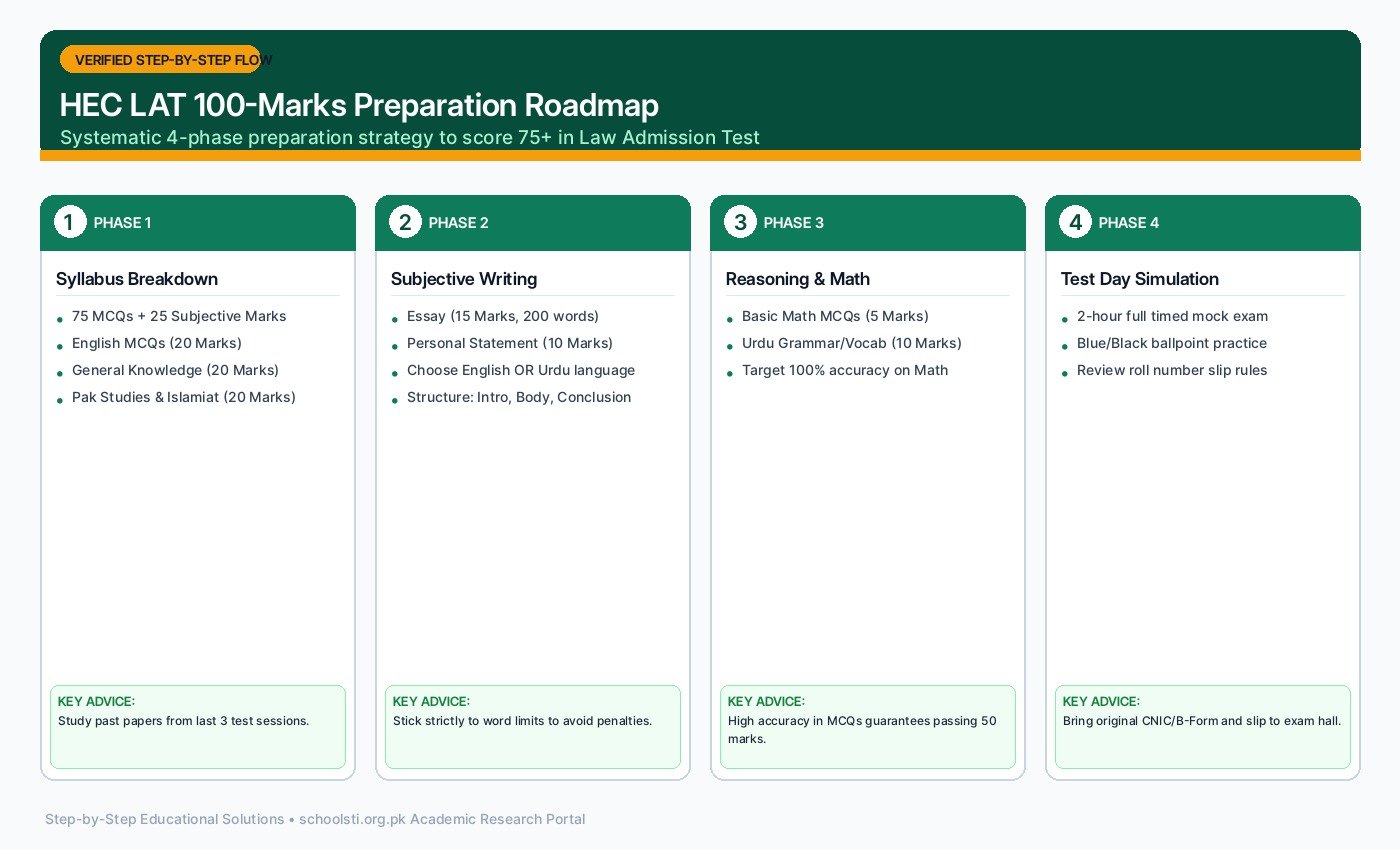
Once you know the pattern, break your preparation into one section at a time. For English, master the core grammar rules — tenses, subject-verb agreement, articles, prepositions — and build vocabulary through daily reading rather than memorising word lists. Practise one comprehension passage every day under time pressure.
For General Knowledge, follow the last six to twelve months of current affairs: national events, government changes, international organisations, capitals and currencies. For Islamic Studies, revise basic beliefs, the Seerah, important battles and events, and key Quranic concepts; non-Muslim candidates should prepare the Ethics syllabus with equal seriousness. Pakistan Studies rewards timeline thinking — the independence movement, the constitutions of Pakistan, and the country's geography and resources.
Urdu is a scoring section for most students: revise grammar, common idioms and proverbs, and practise short comprehension passages. Basic Mathematics needs no advanced formulas — percentages, ratios, averages, profit and loss, and simple algebra cover almost everything, and speed matters more than depth. Finally, treat the essay as a separate subject from day one, not as something you will figure out in the last week.
A 12-Week Preparation Timeline
Twelve weeks of steady, structured preparation beats twelve months of random studying. The plan below assumes two to three focused hours a day — scale it up or down to your own routine, but keep the order, because each phase builds on the one before it.
- Weeks 1-2: English foundations Cover core grammar rules, learn 20 new words a day, and attempt one comprehension passage daily. This is the highest-return investment in the whole plan.
- Weeks 3-4: Pakistan Studies and Islamic Studies or Ethics Build timeline notes for the independence movement and constitutions, and revise Islamic Studies or Ethics content. Re-read these notes every Sunday.
- Weeks 5-6: General Knowledge and Urdu Start a current-affairs diary covering the last year's major events, and revise Urdu grammar, idioms and comprehension passages.
- Weeks 7-8: Basic mathematics and English comprehension Drill percentages, ratios, averages and algebra with timed practice sets. Target speed and accuracy rather than difficult questions.
- Weeks 9-10: Past papers and mock tests Attempt two full timed papers per week under exam conditions, then spend a full day analysing every mistake. Maintain an error log from the first paper.
- Week 11: Essay writing practice Write three full essays on likely topics — the rule of law, the justice system, the constitution — and get each one reviewed by a teacher or a strong writer.
- Week 12: Revision and logistics Revise only your error log and short notes. Confirm your test centre, documents and travel plan. Sleep properly — cramming new material now will cost more than it gains.
Past Papers, Essay Writing and Test-Day Strategy
Past papers are the closest thing to seeing the actual test in advance, yet most students use them badly — solving them like homework instead of training with them. Collect the last three to five years of LAT papers and work through them in stages, from open-book familiarisation to strict timed attempts.
For the essay, examiners reward structure over fancy vocabulary: a clear introduction, three to four body paragraphs each making one point, and a firm conclusion. Practise writing 250 to 350 words in 30 minutes on topics like the rule of law, the justice system or the constitution — and always leave five minutes to proofread for grammar and spelling.
On test day, reach the centre at least an hour early with your original CNIC and roll number slip. Attempt your strongest sections first to build momentum, watch the clock strictly during the essay, and check the paper's instructions for any negative-marking rule before guessing.
- Attempt one paper open-book Do your first past paper slowly, with books and notes allowed. The goal is not a score — it is mapping exactly which topics HEC asks about.
- Move to timed attempts Attempt the next papers under real exam conditions: no phone, strict timing, one sitting. This builds the stamina the LAT demands.
- Maintain an error log After every paper, write down each wrong answer, why you got it wrong, and the correct concept. Revise this log — not the whole book — in your final week.
- Repeat your weak sections If the log shows the same section failing twice, stop taking full papers for two days and drill only that section with topic-wise practice.
- Simulate the essay under pressure Write at least three essays with a 30-minute timer. Ask a teacher or a strong writer to mark them for structure, grammar and relevance.
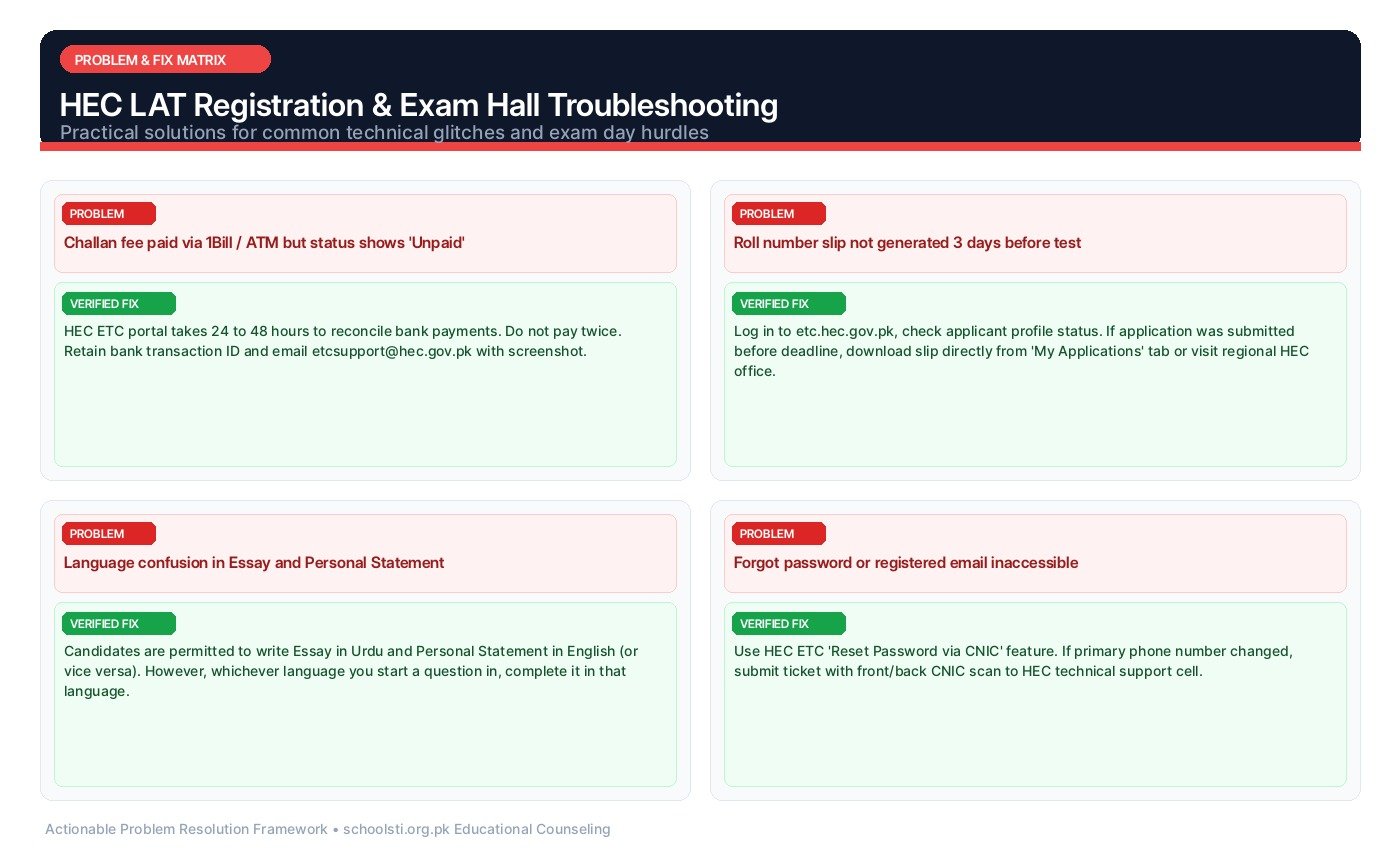
Troubleshooting: Common Student Problems & Verified Solutions
Real-world issues reported by Pakistani applicants and students, with actionable step-by-step solutions:
⚠️ Problem: I missed the LAT registration deadline.
✅ Verified Solution: HEC holds the LAT multiple times a year, so a missed deadline costs you months, not a career. Register for the next session on day one, and use the wait to finish the 12-week plan above — many students score higher because of the delay.
⚠️ Problem: My roll number slip has the wrong photo or test centre.
✅ Verified Solution: Contact the HEC helpline immediately with your application number and CNIC, and carry your original CNIC plus any correction receipt to the centre. Do not wait until test morning to report the error.
⚠️ Problem: I always run out of time in the essay section.
✅ Verified Solution: You are probably writing too much in the introduction. Cap it at four lines, move to the body paragraphs quickly, and practise with a visible timer until a complete essay in 30 minutes feels routine.
⚠️ Problem: My English mock scores are far below my other sections.
✅ Verified Solution: Stop attempting full papers for a week and drill grammar rules and comprehension passages separately. English is usually the highest-weightage MCQ section in the LAT, so every hour here pays more than an hour in General Knowledge.
⚠️ Problem: My Intermediate result is awaited and universities are closing admissions.
✅ Verified Solution: Apply to universities with your LAT score and result-awaiting status where the policy allows it, and submit your result the day it is declared. Keep checking each university's admission notice, because document deadlines differ and extensions are not guaranteed.
Frequently Asked Questions (FAQ)
Clear, direct answers to common questions about Complete Preparation Guide for HEC LAT (Law Admission Test): Syllabus, Marks Distribution & Past Papers: